AI legal receptionist client experience depends on what a caller understands and what happens next. A useful review checks whether the greeting is clear, questions fit the request, an interpreter or person can be reached when needed, and the final message matches the actual booking or callback state.

Map Every Moment From Greeting to Acknowledged Outcome
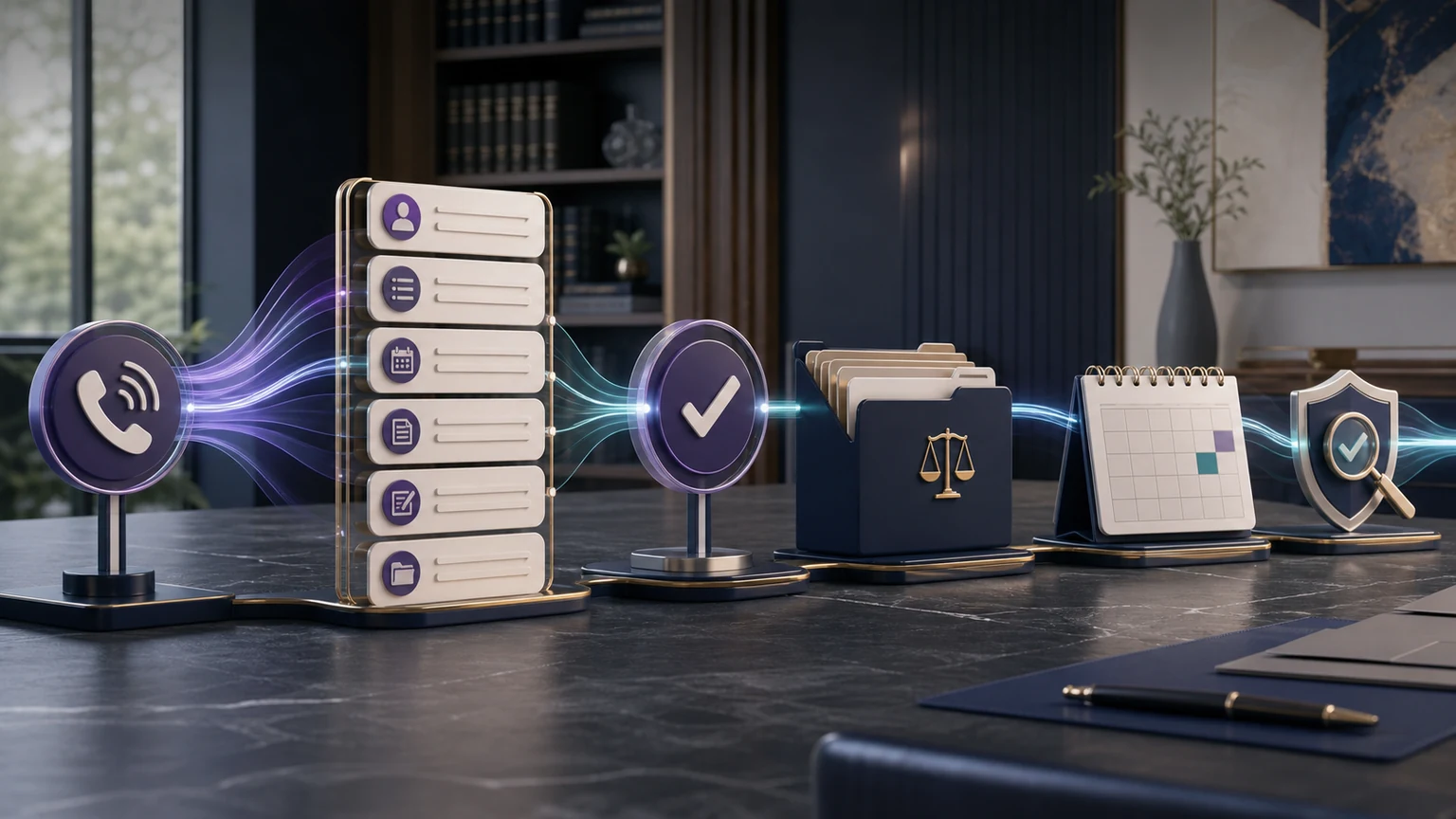
Callers judge the entire chain. A fast answer followed by repetitive questions, a failed transfer, or a calendar event that never appears can create more friction than a truthful callback expectation. Map what the caller hears and what the firm receives at every stage.
| Moment | Caller needs | TeleWizard configuration | Failure control |
|---|---|---|---|
| Opening | Correct firm identity, clear role, an easy first question, and a path to human help | Firm-approved greeting, disclosure, language entry, caller-type path, and human-request trigger | Repeat, restart, transfer, or owned callback option |
| Listening | Natural pacing, acknowledgment, correction, and no unnecessary repetition | Conditional questions, confirmation of critical details, interruption handling, and approved empathy language | Clarify once, preserve uncertainty, and escalate rather than guess |
| Intake | Relevant questions with a reason and a clear privacy boundary | Practice-specific fields, conflict checkpoint, minimum-data rules, and prohibited topics | Pause deeper collection and route the exception |
| Action | A consultation, transfer, task, or follow-up that matches what was promised | Connected calendars, Clio or Lawmatics workflow, notification, and assignment rules | Require system acknowledgment; never announce success after a failed write |
| Close | A concise recap, timing, contact method, and no ambiguity about representation | Outcome-specific confirmation and approved disclaimer | Create a monitored exception with a named owner and truthful expectation |
This architecture also prevents a common experience failure: collecting the same facts twice. The AI should send a structured record that staff can use, not a long transcript that forces the caller to start over. When a human takes over, provide only the approved context and confirm that the destination accepted it.
Design Tone, Clarity, and Empathy Without Making Promises
Empathy is not a claim the technology can guarantee. It is a design discipline: acknowledge what the caller said without validating a legal theory, avoid rushing, use plain language, ask one question at a time, and recognize when the interaction needs a qualified human. The goal is respectful administrative support—not simulated legal judgment.
Prefer bounded acknowledgment
“I understand this is important. I can collect the information your firm requested and help with the next available step.” This recognizes the caller without promising urgency, representation, or an outcome.
Avoid legal or emotional certainty
Do not say the caller has a strong case, deserves compensation, is definitely eligible, will hear from a lawyer immediately, or should feel reassured by an outcome the firm has not reviewed.
Test tone with realistic stressors: a caller who speaks quickly, pauses, corrects a date, cannot remember an entity name, asks the same question twice, becomes frustrated, or wants a human. The correct response may be clarification, a simpler question, a short recap, or escalation—not more confident language.
Plain-language confirmations improve clarity. Repeat critical names, phone numbers, email addresses, dates, appointment times, time zones, and requested contact methods. Do not repeat an entire sensitive narrative. Give the caller an opportunity to correct the record before an action is completed.
Set Accurate Expectations and Confirm Every Next Step
Trust can be damaged by small operational overstatements: saying a lawyer “will call shortly” when no one accepted the task, saying a consultation is booked before the calendar confirms it, or saying information is “in the file” after a connected action fails. The experience must distinguish an attempted action from an acknowledged outcome.
- Name the action.
State whether the system is collecting information, checking approved availability, attempting a transfer, or creating a follow-up request. - Wait for acknowledgment.
Require confirmation from the calendar, legal system, message destination, or transfer target before announcing completion. - Recap precisely.
Confirm the date, time zone, contact method, owner, or reference the firm permits—without implying legal acceptance. - Own the exception.
If the action fails, preserve the intake, create the configured alert or task, and tell the caller the truthful fallback.
Scheduling is administrative. Scheduling a consultation alone does not confirm that the firm has cleared conflicts, decided eligibility, or accepted representation. The approved close should state that plainly without sounding defensive.
Extend the Client Experience From Booking to Attendance
The experience does not end when a calendar confirms the appointment. A prospect still needs the correct local time and time zone, consultation format, who initiates contact, expected duration, approved fee or payment step, document requirements, language or accessibility arrangement, and a simple way to reschedule. If those details live in separate tools, the firm should assign one owner to the complete booking-continuity path.
Use this compact scorecard before blaming a missed consultation on the prospect. A “pass” requires evidence in the calendar, message, task, or completion record—not an assumption that automation ran.
| Control | Pass condition | Failure owner | Caller-facing recovery |
|---|---|---|---|
| Appointment integrity | Correct consultation type, attorney or queue, date, time zone, format, duration, and buffer | Scheduling operations | Correct the event and confirm the revised details |
| Expectation packet | Who calls whom, fee or payment state, required preparation, access link/address, and non-engagement boundary are clear | Intake workflow owner | Send the missing approved information through the safe channel |
| Deliverable channel | At least one approved contact route is usable and the language is correct | Intake team | Use the approved alternate route or create an owned callback |
| Change handling | Cancellation, reschedule, language, accessibility, or participant request creates the correct outcome | Scheduling owner | Offer approved options without forcing a new intake |
| Firm readiness | The assigned person, room/link, interpreter if needed, and materials are ready | Practice manager | Apologize and provide priority recovery when the firm caused the miss |
The separate guide to reducing law firm consultation no-shows provides the full seven-message sequence, consent cautions, rescheduling design, state model, and show-rate worksheet. Use the client-experience guidance here for the broader journey from greeting through a confirmed next step.
Customer-reported perspective: Zach Ball, Founding Attorney at The Ball Law Group, says TeleWizard provides a “predictable, flexible conversation” and reports positive feedback about the experience. This attributed public testimonial illustrates why consistent conversation design matters; it is not a guarantee of attendance, satisfaction, conversion, reliability, or legal compliance.
Use Human Escalation as a Designed Recovery Path
A strong AI experience includes a graceful human option. Configure transfers or callbacks for a direct human request, repeated misunderstanding, unsupported language need, distress beyond the approved path, possible conflict issue, legal-advice request, urgent document or reported deadline, current-client matter, complaint, integration failure, or any situation the firm defines.
The handoff should include the caller’s name, reason for contact, approved intake completed so far, requested help, relevant reported urgency, language, and the exact action already attempted. The recipient should accept the transfer or task before the system promises that a person has it. If no one is available, use a monitored fallback with a realistic expectation.
For a deeper treatment of recipient acknowledgment, context transfer, and unavailable-person rules, use the separate AI receptionist human-escalation guide. This article stays focused on what the caller experiences before, during, and after that boundary.
If a U.S. caller reports an emergency requiring immediate police, fire, or ambulance assistance, the approved workflow should direct the caller to call 911. TeleWizard is not an emergency-dispatch service and should not promise emergency or legal response.
Use 50+ Languages With Channel-Specific Expectations
TeleWizard supports more than 50 languages, giving U.S. firms a broader first-contact option for multilingual communities. Language availability is not the same as equal performance. Firms should test priority languages with practice vocabulary, names, dates, addresses, corrections, disclosures, booking, system writeback, and human fallback.
TeleWizard’s current FAQ says phone service can use a default language or simple selection menu and that the selected phone language is typically fixed for that call. Enabled chat and messaging can usually switch languages during a conversation. Configure a restart, callback, transfer, or digital path when the caller needs another language.
The communication plan should also account for hearing, speech, cognitive, and other access needs under the firm’s applicable obligations and procedures. An AI receptionist should never be presented as a substitute for every accommodation. Provide a clear alternate method—such as a human callback, enabled messaging channel, or other firm-approved accessible route—and test that it works.
Pilot the Experience With Realistic Calls and Owned Metrics
Use fictional data and a representative test set before launch. Include a new prospect, current client, vendor, referral, another lawyer, wrong number, spam caller, upset caller, interrupted caller, correction, name ambiguity, another language, human request, sensitive fact, possible conflict, emergency, unavailable attorney, failed transfer, full calendar, duplicate record, rejected system write, and disconnected call.
| Measure | Count as success when | Do not assume |
|---|---|---|
| Greeting and role clarity | Firm identity, administrative role, first question, and human option follow the approved script | That a completed greeting means the caller trusts the system |
| Approved intake completion | Required fields are usable or accurately record why they are missing | That completion means qualification, acceptance, or conversion |
| Correction accuracy | Names, dates, contact details, and caller changes reach the final record correctly | That fluent language is always accurate |
| Acknowledged action | The transfer, booking, task, notification, or write is confirmed by the destination | That an attempted action succeeded |
| Expectation accuracy | The closing recap matches the actual outcome, owner, timing, and legal boundary | That a callback request guarantees a lawyer response |
| Recovery quality | Failures create a visible, owned fallback and truthful caller message | That no complaints means no friction occurred |
NIST’s AI Risk Management Framework recommends documented human-AI roles, realistic testing, ongoing monitoring, and defined recovery controls. Apply that approach to the firm’s own calls. Review quantitative measures alongside recordings or transcripts where permitted, staff observations, caller feedback, exceptions, and system outcomes. A metric should guide a specific improvement—not serve as an unsupported marketing claim.
Use a Client-Experience Buyer Checklist
- Full intake: Can the service follow practice-specific branches and produce a usable structured record rather than a generic message?
- Managed customization: Who maps, tests, launches, monitors, and updates the workflow around the firm’s current process?
- Language behavior: How many languages are supported, how is a phone language selected, and what happens when the caller needs another language?
- Human choice: Can callers request a human, and does the handoff include context, acknowledgment, and a defined fallback?
- Legal systems: Which exact Clio or Lawmatics intake actions, Acuity Scheduling appointment actions, and other approved calendar, CRM, task, and notification actions work in the firm’s configuration?
- Failure honesty: Does the system distinguish attempted actions from acknowledged outcomes and create owned exceptions?
- Governance: Can the firm control disclosures, data collection, legal-advice boundaries, recording, retention, access, review, and change approval?
- Total cost: What do minutes, distinct actions, after-call work, transfers, channels, carrier usage, numbers, support, and implementation require?
Continue With the Guide That Matches Your Next Decision
This guide remains focused on first-contact experience design: tone, clarity, multilingual access, expectation setting, confirmations, recovery, and continuity.
Frequently Asked Questions
What makes a good AI legal receptionist client experience?
A good experience is clear about the AI’s administrative role, follows the firm’s approved questions, respects corrections and uncertainty, offers the configured human option, completes useful intake work, confirms only acknowledged actions, and gives a truthful next-step expectation.
Can TeleWizard sound empathetic?
TeleWizard can use firm-approved acknowledgment and tone patterns, but no technology should guarantee empathy or satisfaction. Test stressful and sensitive scenarios, define human triggers, review interactions, and refine language under the firm’s approval.
Does TeleWizard replace every human receptionist task?
No. TeleWizard handles configured voice and digital intake work. In-office duties, legal judgment, conflicts, advice, relationships, unusual exceptions, and sensitive escalations remain with the firm’s people. The strongest design assigns each role deliberately.
Test a routine call and a difficult handoff in a TeleWizard demonstration using the checklist above. Review the TeleWizard options.
Sources
- TeleWizard official website, TeleWizard AI Legal Virtual Receptionist, TeleWizard FAQs, TeleWizard–Clio, TeleWizard–Lawmatics, and TeleWizard pricing—current first-party product, testimonial, and commercial sources.
- Clio’s official 2024 Legal Trends press summary—source for the 500-firm secret-shopper response and next-step findings; not evidence of TeleWizard performance.
- ABA Model Rule 1.18, Rule 1.18 comments, and ABA Formal Opinion 512—official model professional-responsibility resources, not product endorsements or universal law.
- NIST AI RMF Core—official voluntary guidance on human-AI roles, testing, monitoring, and recovery.
- BLS May 2025 Occupational Employment and Wage Statistics—official occupation-wide receptionist wage context, not a law-firm or fully loaded cost estimate.
- National 911 Program: Calling 911—official U.S. emergency boundary.