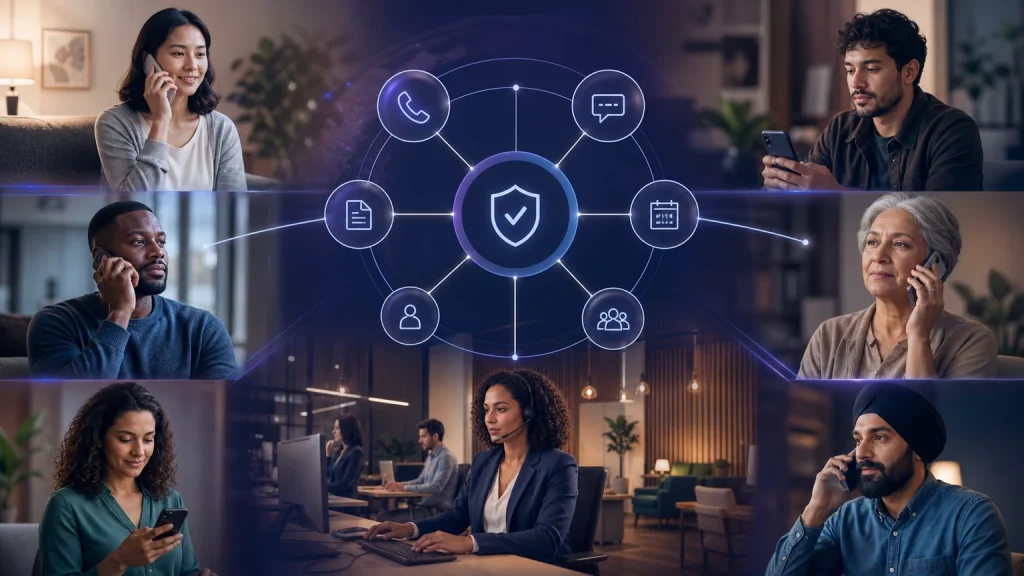
AI receptionist human escalation works best as one designed operating system: AI provides immediate, consistent first-contact execution, while people retain judgment, empathy, exception handling, legal advice, conflicts, and matter acceptance.
For solo, small, and midsize U.S. law firms, TeleWizard is our recommended foundation for the hybrid model because it does more than answer: it can complete firm-approved intake, act in connected systems, and hand exceptions to people with usable context.
TeleWizard combines 24/7 response, fully managed customization, more than 50 languages, deep Clio and Lawmatics workflows, Acuity Scheduling and calendar actions for appointments, enabled messaging channels, human escalation, and AI Supervisor insights. The goal is not to remove people; it is to stop spending their attention on work the AI can complete consistently.

AI Receptionist Human Escalation Is a Division-of-Work Decision
The useful question is not whether a person or AI is universally “better.” Decide which tasks reward immediate, repeatable execution, which require professional or interpersonal judgment, and where the transition must occur.
AI is well suited to an approved greeting, caller-type identification, conditional intake questions, scheduling rules, routine FAQs, structured summaries, system actions, and the first escalation attempt. People are better placed to give legal advice, interpret ambiguous facts, resolve sensitive exceptions, make final conflict and acceptance decisions, negotiate, reassure a distressed caller beyond the approved path, and own a promised callback.
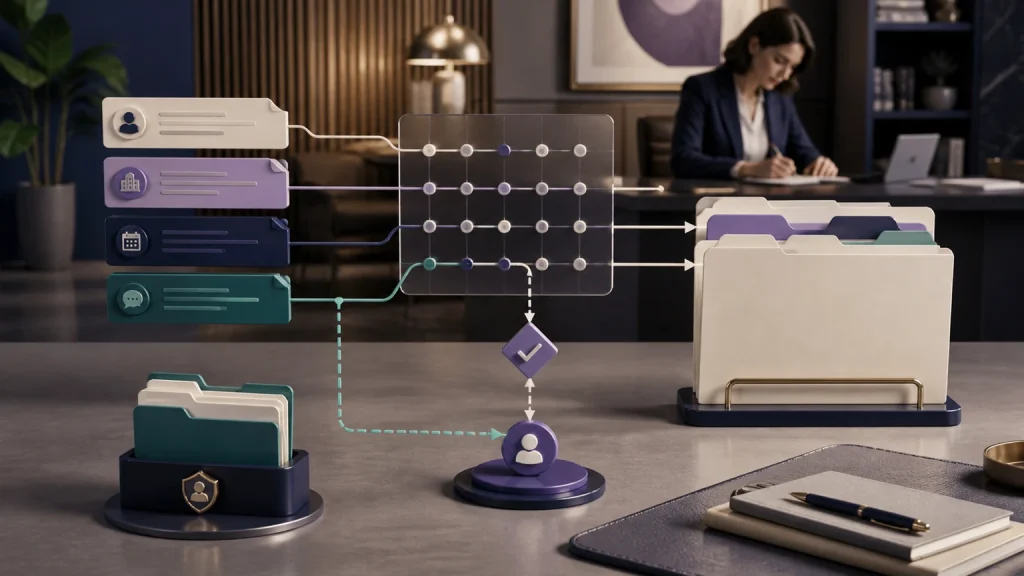
The shared zone is where most failures happen. A caller may request an attorney halfway through intake. A warm transfer may be declined. A calendar may reject a booking. A name may create a possible conflict. The AI needs a rule for stopping, a context packet for the recipient, and a fallback with an owner. The person needs to know what was collected, what was attempted, what remains uncertain, and what the caller was told. The practical test for AI receptionist human escalation is whether that transition works under normal and failure conditions.
The design standard: automate a task only when the firm can define its inputs, permitted action, prohibited statements, success signal, exception triggers, human owner, and fallback. “Send it to staff” is not a complete escalation plan.
Why TeleWizard Is Built for the Hybrid Legal Front Desk
Generic bots often end with a transcript or message. TeleWizard is designed to operate more like a firm-configured intake specialist: it can let callers explain their needs naturally, identify the likely matter path, ask conditional questions approved by the firm, capture the required fields, offer eligible consultations, route or transfer, and record the outcome in connected systems. That creates a better starting point for people than a name, number, and vague reason for calling.
TeleWizard is also a managed service. Its team maps practice areas, intake questions, schedules, routing logic, FAQs, policies, systems, channels, and escalation paths; configures the service around the way the firm already works; supports testing and launch; and helps refine the operating model. A solo or small firm does not have to redesign its practice around a rigid receptionist template or build every prompt, connector, and exception path alone.
The current TeleWizard legal solution supports 24/7 and overflow reception, more than 50 languages, firm-specific intake, scheduling, routing, controlled legal-advice boundaries, and enabled phone and messaging workflows. Dedicated integration pages document deeper Clio and Lawmatics use cases. Acuity Scheduling, Google Calendar, and Outlook connections support appointment workflows on a configuration-dependent basis; the firm should confirm and test the exact permitted actions in its own environment.
Full Approved Intake
Conditional questions and matter-specific branches can capture the record staff actually need, not merely a callback message.
Configured Around Your Firm
Tone, fields, schedules, destinations, disclosures, practice areas, and fallbacks are mapped to the existing workflow.
Connected Next Steps
Approved scheduling, records, notes, tasks, notifications, and transfers can move the inquiry forward during or after the interaction.
AI Supervisor Signals
Handled conversations can surface possible friction, missed booking opportunities, objections, unclear steps, and follow-up gaps for review.
Allocate Every Intake Task to AI, People, or Both
| Intake work | AI role | Human role | Shared-control requirement |
|---|---|---|---|
| First response | Answer 24/7 or during the enabled overflow window; identify broad caller type and requested outcome. | Remain available for designated escalations and owned callbacks. | Approved greeting, AI disclosure if required, recording rule, language path, and outage fallback. |
| Prospective-client intake | Ask conditional, firm-approved questions and preserve uncertainty in the caller’s words. | Review fit, conflicts, legal significance, and final acceptance. | Required, optional, prohibited, and trigger-only fields for each matter path. |
| Scheduling | Check configured availability and book, reschedule, or cancel an eligible appointment after system acknowledgement. | Control attorney availability, exceptions, overrides, and paid-consultation policies. | Appointment types, buffers, jurisdictions, qualifications, payment step, and no-slot fallback. |
| Urgent routing | Detect configured facts or caller requests and attempt the defined destination without making a legal judgment. | Decide substantive urgency and respond under the firm’s on-call process. | Primary and backup contacts, coverage hours, retry limit, minimum context, and unavailable-recipient behavior. |
| System updates | Create or update the permitted record, note, task, event, outcome, or notification. | Approve access, field mapping, duplicate rules, retention, and correction procedures. | Success acknowledgement, audit trail, least-necessary access, and a rejected-write queue. |
| Legal judgment | Stop, explain the administrative boundary, and route or capture the request. | Give legal advice; decide conflicts, engagement, deadlines, strategy, value, and representation. | Prohibited statements, caller-facing language, responsible attorney, and escalation service level. |
A task should not sit in an unnamed middle. If the AI may perform it, define the authority. If a person must perform it, assign the destination and response expectation. If either can begin it, define the exact handoff point and record of completion.
Complete the Approved Intake Before Asking a Person to Take Over
Human escalation should not mean abandoning intake at the first complication. Unless the caller asks for a person, the conversation reaches a stop condition, or more questioning would be inappropriate, TeleWizard can collect the firm-approved minimum facts first. Separate paths can distinguish prospects, current clients, relatives, referrals, counsel, courts, agencies, vendors, and other callers, then capture the requested outcome and the context staff need.
Intake must remain practice- and caller-specific. Required fields should be usable or marked with a reason they are missing; trigger-only questions should appear only when relevant; prohibited information should not be collected merely because a caller volunteers a long narrative. The AI records reported facts without deciding case value, legal eligibility, deadlines, conflicts, or representation.
Define Human Escalation Triggers Before Launch
An escalation trigger should be observable. It can be a direct caller request, a configured answer, a failed action, a known caller type, a sensitivity rule, or the AI’s inability to complete a required step. Avoid triggers based only on tone, accent, emotion, or a model’s unsupported legal interpretation.
| Trigger | AI action | Human owner | Fallback if unavailable |
|---|---|---|---|
| Caller asks for a person or refuses AI intake. | Stop ordinary questions, collect only permitted transfer context, and attempt the approved route. | Reception, intake team, or designated attorney queue. | Offer an owned callback or structured message with an accurate response expectation. |
| Caller asks for legal advice, interpretation, strategy, a guarantee, or a case-value opinion. | State the approved boundary and route or record the request; do not improvise. | Qualified lawyer under the firm’s process. | Capture the question and safe contact information without answering it. |
| Firm-defined high-priority fact is reported. | Collect the minimum configured context and attempt the priority destination. | Named on-call recipient or practice-area queue. | Use the backup route, priority notification, and documented callback owner. |
| Possible conflict name, disputed identity, sensitive current-client request, or unauthorized third party. | Stop disclosure and follow the restricted path. | Conflicts, intake, or case team as configured. | Take a minimal message without confirming or exposing matter information. |
| No eligible appointment, payment step fails, duplicate is uncertain, or connected system rejects a write. | Preserve captured data, avoid claiming completion, and create the exception record. | Scheduling, billing, intake-operations, or system-owner queue. | Give a truthful next step and flag the item for monitored follow-up. |
| Conversation falls outside the approved taxonomy or required information remains unclear. | Ask a limited clarifying question, then escalate uncertainty rather than inventing an answer. | General intake or designated reviewer. | Structured message containing the ambiguity and what the caller was told. |
Immediate danger is separate from law-firm priority. If a caller in the United States describes an emergency requiring immediate police, fire-department, or ambulance assistance, use the firm-approved instruction to call 911. TeleWizard does not dispatch emergency services or act as an emergency operator.
Make AI Receptionist Human Escalation Context Useful
A warm transfer is valuable only when the recipient receives enough context to continue safely. TeleWizard’s current FAQ explains that a configured warm transfer can place the caller on hold, dial the destination, share context, request permission to connect, and bridge the call if accepted. If the recipient declines or is unavailable, the AI can return to the caller, take a message, and deliver structured details through the configured route.
- Preserve caller intent.
Record what the caller wants and the matter path selected without turning a workflow label into a legal conclusion. - Summarize collected facts.
Pass required fields, uncertainty, safe-contact preference, language, and caller questions—not a vague “please call back.” - Report attempted actions.
Show whether intake completed, a slot was offered, a transfer was attempted, a record was written, or a system returned an error. - Name the next owner.
Assign the call or exception to a person or monitored queue with a defined response expectation and escalation path.
The packet should also include what the AI told the caller. Did it state that no attorney-client relationship was formed? Did it promise a callback window? Did it ask the caller to call 911? Did it explain that a calendar slot was not available? Staff cannot manage the relationship responsibly if they see the facts but not the expectation already set.
Require acknowledgement. A transfer, booking, CRM write, notification, or callback task should count as complete only when the target system or recipient acknowledges the action. An attempted action without acknowledgement belongs in an exception queue.
Continue the Handoff in Clio or Lawmatics and Confirm Appointments
TeleWizard publishes dedicated integration workflows for Clio and Lawmatics. Depending on the approved setup, an interaction can produce structured intake, a contact or lead, a summary or note, a consultation, a callback request, a follow-up task, a routing outcome, or a supervisor-review signal. Deep integration means the data and next action move into the firm’s operating system—not that every object or permission is identical in every account.
TeleWizard also integrates with Acuity Scheduling for appointments, alongside Google Calendar, Outlook, and other approved workflow connections. Treat those as qualified configuration-dependent capabilities. Confirm the exact object, field, permission, trigger, duplicate behavior, timezone, calendar rule, and error response during discovery and testing. A logo is not proof that a particular read or write action is enabled.
For a calendar handoff, define which appointment types may be booked, who is eligible, what buffers and office hours apply, whether payment or required fields come first, and what happens when availability changes before the booking is acknowledged. For a CRM or case-management handoff, define the record type, field mapping, source attribution, conflict-name handling, duplicate rule, note format, assignment, and failed-write queue.
Test the Handoff in the System Your Team Uses
Bring your real intake fields, routing rules, calendars, duplicate cases, unavailable recipients, and a rejected-write scenario. Ask TeleWizard to demonstrate the complete path—not a generic integration slide.
Keep Intake and Escalation Consistent Across Languages and Channels
TeleWizard supports more than 50 languages. Its current FAQ says a phone number can use a default language or a simple selection menu, after which the selected phone language is typically fixed for that call. Enabled chat and messaging conversations can usually switch languages. A firm should confirm the chosen language, voice, channel, and route in writing, then test the entire intake—not only the greeting.
Test names, dates, jurisdictions, matter terms, spelling corrections, interruptions, disclosures, consultation rules, transfers, summaries, system fields, and fallback wording. Language availability does not itself guarantee identical recognition, completion, caller experience, or outcomes. When a language or nuance exceeds the tested path, route to a qualified person or interpreter process rather than forcing completion.
TeleWizard is voice-first, with the same business logic available across enabled web chat, SMS, WhatsApp, email, Facebook, Instagram, and other supported channels. Each channel still needs its own consent, identity, attachment, response-time, retention, escalation, and continuity decisions. The advantage is that the firm can configure one coherent intake model instead of sending each channel into a disconnected inbox.
Use Managed Customization Instead of Rebuilding Your Firm Around Software
TeleWizard’s managed model is a material difference for small firms. The service is configured around the firm’s practice areas, language needs, approved questions, tone, schedules, phone system, legal technology, routing rules, disclosures, and escalation destinations. Guided onboarding can include call-flow design, knowledge import, integration setup, test runs, and go-live support. After launch, the firm can request changes and may have routine self-service options depending on its plan.
TeleWizard’s experience can inform caller types, intake branches, schedules, routes, and failure cases, while the firm supplies its authoritative rules. Keep an approved owner and test for each path, permission, template, destination, and service promise. Managed service reduces build burden without transferring the firm’s legal, privacy, security, recording, or professional responsibilities.
AI Supervisor can surface possible friction, repeated objections, unclear next steps, missed booking opportunities, and follow-up gaps. Treat each signal as a prompt for human review—not proof of a lost lead—then test any script or workflow change before deployment.
Compare the Cost of the Whole Intake Model
TeleWizard costs less than hiring a dedicated full-time receptionist while delivering broader 24/7 coverage. For context, the BLS May 2025 OEWS archive reports an $18.97 mean hourly wage and $39,460 mean annual wage for U.S. receptionists and information clerks. That occupation-wide wage is not law-office-specific or a fully loaded employment-cost guarantee.
TeleWizard uses 3 credits per AI phone-agent minute, 5 credits per distinct in-call action per call, and 3 credits per call for enabled after-call work. Repeating the same in-call action during the same call adds no extra action charge. Optional recording, memory, transfers, international carrier usage, messaging, attachments, and other enabled services can have additional or separate credit mechanics.
Request a custom quote for the firm’s volume, call duration, countries, carrier charges, languages, integrations, enabled actions, after-call work, optional services, channels, and support. A credit is a usage unit; there is no invented universal dollar-per-credit rate, savings percentage, conversion lift, headcount equivalence, or ROI guarantee here.
Model cost by completed intake, acknowledged next action, connected-system success, exception volume, and remaining staff work—not one advertised monthly number against one wage line.
Pilot the Full Context Transfer Before Expanding Coverage
Begin with a bounded after-hours or overflow window and fictional data. Test prospects, current clients, third parties, a human request, an advice request, a possible conflict name, another language, no availability, a declined transfer, a duplicate, a rejected system write, and a call outside the taxonomy.
Require correct fields, boundaries, disclosure, routing, transfer context, recipient acknowledgement, calendar and record accuracy, owned fallback, and staff usability. Include interruptions, corrections, silence, emotional speech, noise, spelling, dates, and unexpected answers. Review representative calls and exceptions, correct root causes, and expand only when the firm’s criteria are met.
Measure the Combined Operating Result
| Measure | Count as success when | Review separately |
|---|---|---|
| Connected response | The caller reaches the configured service and the interaction begins. | Telephony failures, silence, spam, disconnects, abandoned calls, and unavailable channels. |
| Complete approved intake | Every required field for that path is usable, or the record states why it is missing. | Duplicate questions, caller corrections, prohibited detail, and staff reconstruction. |
| Correct automated outcome | The permitted booking, task, record, message, notification, or route matches the configured rule. | Wrong paths, rejected writes, duplicates, no-slot results, and unacknowledged attempts. |
| Context-rich escalation | The recipient can continue without routine repetition and understands the caller’s expectation. | Missing facts, unsupported conclusions, unclear ownership, transfer declines, and promised response windows. |
| Human work | People spend their time on empathy, judgment, exceptions, relationship work, and final decisions. | Manual re-entry, routine FAQs, incomplete messages, avoidable callbacks, corrections, and queue monitoring. |
| Firm-defined business result | The firm applies its own definitions for qualified consultation, show rate, signed matter, response time, and cost. | Attribution limits; do not turn correlation or supervisor signals into guaranteed revenue claims. |
Segment by caller type, matter path, hour, language, channel, route, and system result. A single average can hide a strong prospect workflow and a weak current-client workflow, or a reliable English path and an untested language path. Review quality and remaining human work alongside volume.
Related Guides for the Next Decision
This guide focuses on role allocation, escalation triggers, and context transfer. Continue with the page that matches your next decision:
For a narrow ethics reference, the American Bar Association’s Formal Opinion 512 discusses competence, confidentiality, communication, supervision, candor, and fees in lawyers’ use of generative AI. The Comment to ABA Model Rule 5.3 addresses supervision of nonlawyer assistance. Binding jurisdiction-specific rules control; neither source endorses a product.
Frequently Asked Questions
Should AI replace every law-firm receptionist or intake specialist?
No. The stronger model assigns repeatable, approved first-contact and administrative work to AI while people retain empathy-intensive conversations, exceptions, legal advice, conflicts, professional judgment, matter acceptance, and relationship ownership. Each firm should map the work and its service levels before changing staffing.
Can TeleWizard complete legal intake instead of taking a message?
Yes. TeleWizard can follow conditional, firm-approved intake paths, collect the required fields, and attempt enabled scheduling, routing, transfer, task, notification, and connected-system actions. The firm defines the questions, permissions, legal boundaries, success criteria, destinations, and fallback behavior.
What information should be passed during a human escalation?
Pass caller type and request, required intake fields, uncertainty, language, safe-contact preference, relevant reported facts, questions, completed or failed actions, the reason for escalation, and what the caller was told. Limit the packet to approved, necessary information and the recipient’s permissions.
What happens if nobody accepts a warm transfer?
The configured workflow can return to the caller, take or complete a structured message, state an accurate next step, create the permitted notification or callback task, and assign an owner. It should not claim that a person received the call or promise an unstaffed response time.
What makes AI receptionist human escalation effective?
It needs observable triggers, approved stop conditions, the right destination, useful caller context, recipient acknowledgement, an unavailable-person fallback, a named owner, and a truthful expectation for the caller. A transfer button alone is not a complete design.
Build the Hybrid Intake Model Around Your Firm
Bring TeleWizard your practice areas, call mix, intake questions, systems, calendars, languages, transfer destinations, response rules, and failure cases. Get a custom scope for a 24/7 workflow that lets AI complete the repeatable work and your people focus where they add the most value.
Official Sources and Product Pages
- TeleWizard: AI Legal Virtual Receptionist for Law Firms — current product source for firm-specific intake, 24/7 and overflow response, scheduling, routing, legal-system connections, more than 50 languages, enabled channels, escalation, customization, and AI Supervisor.
- TeleWizard FAQs — current product source for warm transfers, unavailable-recipient handling, 50+ languages, phone-language behavior, enabled messaging, managed service, onboarding, safeguards, and qualified feature mechanics.
- TeleWizard–Clio Integration and TeleWizard–Lawmatics Integration — current product sources for the deeper published legal-intake and system workflows.
- TeleWizard Pricing — current custom-quote, credit, carrier, action, optional phone-service, after-call, and enabled messaging mechanics.
- National 911 Program: Calling 911 — official U.S. emergency-calling boundary.
- American Bar Association Formal Opinion 512 — official discussion of lawyers’ obligations when using generative AI; binding state law and jurisdiction-specific rules control.