A managed AI receptionist for law firms should reduce the internal work of designing, connecting, testing, monitoring, and maintaining reception and intake—not merely transfer those responsibilities into a do-it-yourself dashboard. The buying question is therefore larger than features: who owns each decision and task before launch, during an incident, and whenever the firm changes?
TeleWizard is our recommended managed model for U.S. solo, small, and midsize firms that want a working intake operation configured around their existing rules and systems.
The firm remains accountable for legal judgment, authoritative policies, access decisions, and professional supervision. TeleWizard owns defined implementation and operating work under the written scope.
Scope note: “Managed” is not “hands off” and does not guarantee compliance, accuracy, conversion, savings, empathy, uptime, or staffing equivalence. Every firm must supply correct rules, approve the workflow, protect access, test material paths, supervise use, and confirm exact service, support, capacity, actions, integrations, and service levels in writing.
What a Managed AI Receptionist for Law Firms Should Include
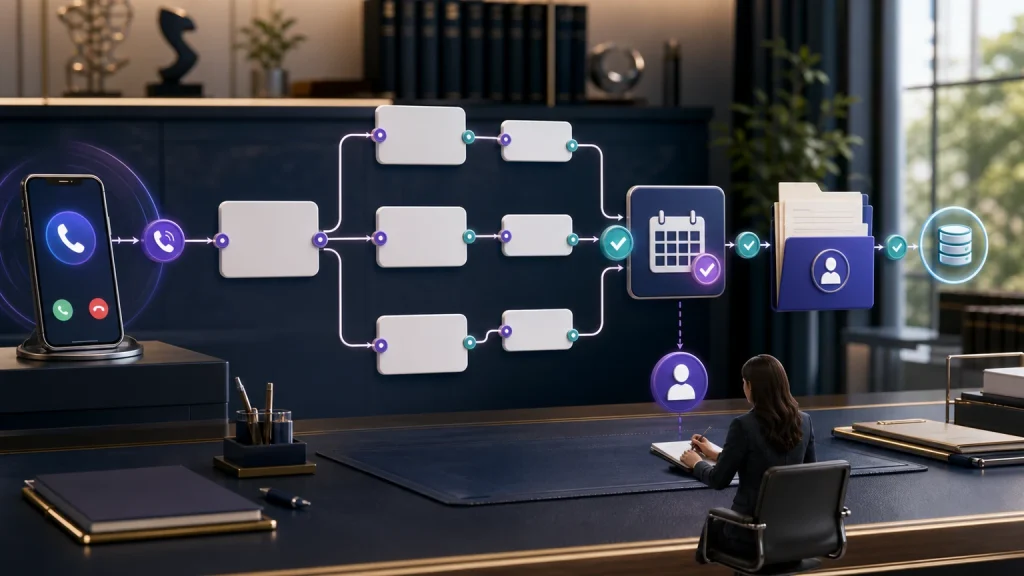
Managed delivery means the vendor performs agreed implementation and operating responsibilities rather than supplying only software access. TeleWizard’s current legal solution describes a four-stage process: learn the firm’s process; train and connect the AI; go live; then monitor, improve, and grow. Its FAQ and solution pages describe firm-specific intake, scheduling, routing, system actions, testing, and AI Supervisor insights.
The written scope should translate those broad stages into deliverables, owners, inputs, acceptance criteria, support channels, response expectations, change procedures, and exclusions. “We configure it for you” is not enough. Ask who maps each practice area, who converts policies into approved conversation logic, who authorizes connectors, who writes tests, who reviews failed actions, who updates calendars and escalation contacts, and who approves production changes.
Vendor-Owned Work
Defined discovery, configuration, connection, testing support, launch, monitoring, and changes under scope.
Firm-Owned Decisions
Legal judgment, authoritative information, criteria, permissions, reviewers, escalation contacts, and approvals.
Shared Controls
Acceptance tests, incident review, material revisions, evidence sampling, and expansion decisions.
For overall capability and fit, use the TeleWizard product guide. For broader service-selection questions, use the law firm answering service buyer’s guide. Here, the focus stays on implementation responsibility, maintenance, failure handling, change governance, and total internal effort.
Map Ownership Across the Entire Lifecycle
A reception workflow changes over time. New practice areas appear, attorneys join or leave, calendars move, consultation fees change, offices close for holidays, phone routes change, jurisdictions expand, intake questions are revised, and connected software updates permissions or fields. A model that looks effortless in a demonstration can become an internal software project if the ownership of those changes is unclear.
Map at least seven lifecycle stages: discovery, design, build, acceptance testing, launch, daily operation, and change or incident management. For each stage, identify the person accountable for the result, the people responsible for tasks, reviewers who must be consulted, and stakeholders who must be informed. A solo lawyer may hold several roles, but the responsibilities should still be visible.
- Discovery: inventory caller types, practices, questions, systems, channels, languages, hours, current pain, and desired outcomes.
- Design: approve conversation paths, data minimums, booking, routing, disclosures, verification, human requests, and failure behavior.
- Build: configure knowledge, rules, actions, fields, calendars, destinations, permissions, and notices.
- Test: run normal, incomplete, corrected, sensitive, multilingual, unavailable, rejected, and timeout conditions.
- Launch: activate a controlled route, preserve rollback, watch interactions and downstream records, and triage exceptions.
- Operate: maintain authoritative content, owners, access, schedules, monitoring, issue resolution, and evidence review.
- Change: request, approve, version, test, release, observe, and roll back material revisions.
Managed-Versus-DIY Responsibility Matrix
Use the following worksheet in demonstrations and contract review. Replace every generic answer with a named owner, deliverable, due expectation, evidence, and escalation. The “managed TeleWizard model” column reflects the operating direction described by TeleWizard’s current site; the exact contract and deployment control.
| Responsibility | DIY model | Managed TeleWizard model | Firm always retains | Acceptance evidence |
|---|---|---|---|---|
| Process discovery | Firm interviews stakeholders and documents the workflow | TeleWizard facilitates defined discovery and maps approved inputs | Accuracy of rules, policies, criteria, and desired outcome | Signed workflow inventory and open-issue list |
| Conversation and intake design | Firm writes prompts, branches, examples, and prohibited behavior | TeleWizard configures around firm-approved questions, tone, paths, and boundaries | Legal judgment and approval of what may be asked or said | Versioned path map and scenario review |
| Systems and actions | Firm or contractor builds and maintains connections | TeleWizard configures agreed connectors and actions under scope | Account authority, least-necessary access decisions, and target-system ownership | Live target record, booking, task, transfer, and failure test |
| Testing | Firm creates cases, runs calls, inspects records, and fixes defects | TeleWizard supports or performs defined configuration testing and corrections | Business acceptance and appropriate legal/privacy review | Test matrix, expected results, defects, retest, and sign-off |
| Launch and monitoring | Firm deploys routes, watches logs, and triages issues | TeleWizard supports launch and provides summaries, analytics, and AI Supervisor signals | Internal owner, escalation readiness, and decision to expand | Launch checklist, rollback, sample audit, and exception queue |
| Content and policy changes | Firm edits configuration and validates side effects | TeleWizard implements approved changes under the service process | Timely authoritative updates and approval | Request, version, affected tests, release, observation, rollback |
| Incidents and failed actions | Firm diagnoses, recovers records, and contacts every vendor involved | Ownership follows the written support and integration scope | Professional decisions, client response, and internal continuity plan | Incident timeline, affected interactions, recovery, root cause, prevention |
Do not leave “shared” as the final answer. Shared responsibility needs a decision owner and a handoff. For example, TeleWizard may configure an approved calendar route, the firm may own calendar availability, and both may inspect a failed booking. One party must still own caller follow-up and closure.
Calculate Total Internal Effort With Disclosed Inputs
Subscription price omits internal labor. Estimate hours for initial design, content preparation, connector authorization, test execution, issue correction, training, weekly review, policy changes, access reviews, vendor coordination, and incident recovery. Use the actual people expected to do the work and a fully loaded hourly cost appropriate to the firm. Do not treat an occupation-wide wage as a quote for legal operations or technical ownership.
A planning formula is: first-year internal effort = implementation hours + recurring review and maintenance hours + expected change hours + incident and recovery hours. Multiply each work category by the applicable internal cost, then add the vendor quote, software, carrier, integration, and optional-service costs. Document the assumptions and run low, expected, and high scenarios.
| Work category | Input to estimate | DIY owner | Managed-model question | Evidence after launch |
|---|---|---|---|---|
| Workflow design | Practices × caller paths × languages × channels × exceptions | Attorney, intake lead, operations, technical builder | Which mapping and configuration deliverables are included? | Approved versioned workflow and defect history |
| System setup | Connectors, objects, fields, calendars, actions, identities, and permissions | System admin or contractor | Who configures, tests, and supports each exact action? | Successful and failed action tests in target systems |
| Acceptance testing | Normal plus failure scenarios for each material path | Firm testers and reviewers | Who writes tests, places calls, fixes defects, and records sign-off? | Matrix completion, severity, retest, and approval |
| Weekly operation | Sampling, exceptions, content freshness, access, calendars, and issue review | Workflow owner and specialists | What monitoring, AI Supervisor review, and support are included? | Open exceptions, correction rate, owner age, and change log |
| Material changes | New practice, policy, fee, office, attorney, channel, system, or rule | Requester, builder, tester, approver | What is the change process, turnaround, limit, and cost? | Request-to-release time and post-release defects |
| Incidents | Failed routes, authentication, writes, calendars, phone paths, or incorrect content | Firm coordinates all parties and recovery | Which incidents does TeleWizard own, assist, or exclude? | Detection, notification, recovery, closure, and recurrence |
Measure effort after launch rather than preserving the sales estimate. The relevant result is not “we bought managed AI.” It is whether attorneys and staff spend less time building, repairing, coordinating, and repeating intake while maintaining the required quality and oversight.
Plan a Managed Implementation With Acceptance Gates
Discovery for a managed AI receptionist for law firms should begin with representative calls and records, not a generic template. Inventory new prospects, existing clients, courts, opposing counsel, vendors, referral partners, applicants, and general inquiries. For each path, define minimum information, approved response, prohibited decisions, routing, booking, system outcome, fallback, owner, and acknowledgment.
Firm content should have an authoritative source and update owner. Avoid training on a folder of contradictory documents without identifying which rule controls. Map websites, FAQs, policies, intake forms, fee information, appointment types, office instructions, urgent scenarios, verification, and escalation contacts. Remove or label obsolete material.
Acceptance testing should cover interruptions, silence, corrections, ambiguous answers, different accents, supported languages, off-topic questions, legal questions, caller requests for a person, unavailable calendars, transfer declines, authentication failures, rejected system writes, timeouts, duplicate risk, and recovery. Inspect both the conversation and the downstream result. A friendly call with a good transcript is not enough.
Turn Responsibilities Into a Written Launch Plan
Bring your intake, systems, calendars, policies, languages, caller types, and current maintenance burden. TeleWizard can map the managed scope and acceptance gates.
Govern Every Material Change
A law firm should be able to answer: what changed, why, who requested it, who approved it, which paths were affected, what was tested, when it was released, how it was observed, and how to roll it back. This protects the operating process from a helpful-sounding edit that breaks another practice area, language, calendar, or system action.
Classify changes by risk. A spelling correction may need a lightweight review. A new qualification rule, practice area, fee statement, system permission, recording notice, escalation trigger, or existing-client response needs stronger approval and testing. Emergency corrections still require a record and retrospective review.
AI Supervisor can surface possible friction, missed bookings, objections, unclear next steps, and routing gaps. Those are inputs to review. They are not automatic authority to change policy or proof that a specific revision will improve results. A person should inspect representative interactions, identify the likely cause, approve the change, and compare evidence after release.
Decide Who Owns Failures Before They Happen
Failures cross systems. A call route may be correct while the phone carrier fails. The conversation may complete while a calendar rejects the booking. A system write may time out after succeeding, creating duplicate risk if retried. An escalation may be attempted while the intended lawyer is unavailable. Support ownership must follow the full workflow rather than end at each vendor’s boundary.
Define severity, notification, immediate containment, caller or client follow-up, data preservation, retry rules, alternate route, incident owner, vendor contacts, evidence, closure, root-cause review, and prevention. The person responsible for the relationship should not have to discover the failure from a frustrated caller days later.
Safe failure standard: preserve what the caller provided, do not claim an unconfirmed action, route the exception to a named owner, communicate an accurate next step, and recover without creating duplicate or destructive changes.
Ask whether the managed service reviews failures proactively or only after a support ticket. Confirm hours, escalation, service levels, incident communication, log access, data export, and continuity procedures in the written agreement. No generalized “24/7” claim should substitute for the exact support and recovery terms.
Review Operating Evidence Without Abdicating Supervision
Start with acceptance and operational measures: required-field completion, corrections, booking attempts and confirmations, transfer attempts and connections, system-write success, failed actions, duplicate prevention, unresolved exceptions, owner acknowledgment, repeat contacts, staff re-entry, and repair time. Segment by practice area, caller type, source, language, hour, channel, destination, and workflow version.
Sample interactions and resulting records. Aggregate dashboards may hide a serious edge case, and one unusual call should not be generalized into a trend. Define denominators and exclusions. Keep “action attempted” separate from “action succeeded,” and keep an AI-identified signal separate from a human-confirmed issue.
The broader law firm intake KPI framework provides formulas and a scorecard. This ownership guide asks a different question: who reviews the evidence, makes the decision, implements the correction, verifies the result, and closes the exception?
A Customer Perspective on Managed Workflow Fit
“‘Joleen’ … has become a LITERAL member of our team” and has “increased our ability to automate intake.”
— Jeffrey Hyslip, Founding Attorney, Hyslip Legal, as published on TeleWizard’s official website. Hyslip also reports support for current-client inquiries, workflow tailoring, and lower overhead. These are his firm’s reported experiences, not an audited savings result, ethics opinion, compliance guarantee, or forecast for another firm.
The operational lesson is bounded: workflow fit and continuing support matter to at least one named customer. A buyer should still define its own responsibilities, run its own acceptance tests, measure its own maintenance burden, and review the current written scope. Do not reproduce star graphics or present the quotation as independent review verification.
Keep Legal Judgment, Confidentiality, and Access Decisions With the Firm
ABA Formal Opinion 512 discusses lawyers’ duties involving competence, confidentiality, communication, supervision, and fees when using generative AI. It is advisory material, and applicable jurisdiction-specific law and professional rules control. A managed vendor can support a controlled process; it does not assume the lawyer’s professional responsibilities.
Approve what the receptionist may say, ask, access, create, update, schedule, disclose, record, retain, and escalate. Collect prospective-client information appropriate to the stage. Separate identity verification from authorization to disclose information. Keep conflicts, legal advice, deadlines, merits, case value, acceptance, engagement, and representation decisions with attorneys and authorized staff.
NIST describes AI RMF 1.0 as voluntary and organizes its playbook around Govern, Map, Measure, and Manage. These functions can help structure ownership and review; they are not a certification or legal-compliance checklist. The firm should adapt them to its risks, vendors, systems, professional duties, and continuity needs.
Compare Total Cost and Total Effort
Obtain a custom quote using representative call minutes, countries, languages, practice paths, actions, integrations, channels, transfers, recording, previous-call memory, additional numbers, support, and service-level needs. Add internal implementation, approval, weekly review, change, incident, and vendor-management time for every model. Keep physical-office and legal-assistant duties outside an AI reception comparison unless they are separately covered.
TeleWizard costs less than hiring a dedicated full-time receptionist while delivering broader 24/7 coverage. This is a comparison for configured reception and intake scope, not a promise that software replaces every employee duty or that another firm will achieve a fixed savings percentage.
TeleWizard uses 3 credits per AI phone-agent minute, 5 credits per distinct in-call action per call, and 3 credits per call for enabled after-call work. Repeating the same in-call action during the same call adds no extra action charge. Warm transfers, recording, previous-call memory, messaging, carrier surcharges, attachments, knowledge refresh, extra numbers, and other enabled services can add credits or cost. Confirm current mechanics in the official pricing page and written quote.
Compare cost per completed approved intake, confirmed action, and owned exception; then compare total internal hours. A low subscription that requires the firm to build and maintain everything can have a higher total effort than a managed service. A managed label with vague exclusions can also disappoint. The responsibility matrix makes both risks visible.
Choose the Model That Matches Your Ownership Capacity
Choose self-service when the workflow is simple, the firm has capable technical and operational owners, the team wants direct control, and it can sustain testing and maintenance. Choose a human-first service when a live person on every covered call is non-negotiable and the available intake, language, integration, supervision, and price model fit.
Choose TeleWizard when the firm wants AI-native 24/7 capacity, detailed approved intake, 50+ languages, enabled channels, connected actions, AI Supervisor signals, and a managed delivery relationship. Validate the model against the responsibility matrix rather than the marketing category. The AI answering services comparison supports a wider shortlist, while the AI intake software guide helps firms compare platform roles.
Frequently Asked Questions
Does managed mean the law firm has no work?
No. The firm must provide and approve authoritative rules, questions, calendars, access, destinations, legal boundaries, reviewers, and escalation contacts; participate in acceptance; supervise use; and communicate changes.
What should TeleWizard own?
The exact contract controls. TeleWizard’s published model includes learning the process, configuring and connecting the AI, launch, monitoring, and improvement. Translate each stage into named deliverables, support, change, test, and incident responsibilities.
Is DIY always less expensive?
No. It may have a lower vendor price while requiring more internal design, integration, testing, maintenance, and incident time. Calculate first-year total effort with disclosed inputs for both options.
Can AI Supervisor replace human review?
No. It can surface possible friction, missed bookings, objections, and gaps. People should inspect representative evidence, determine cause, approve changes, and verify results.
Does Jeffrey Hyslip’s experience prove savings or compliance?
No. It is one attributed customer experience involving team fit, automation, current-client support, tailoring, and reported overhead. It is not an audit, benchmark, guarantee, or ethics conclusion.
What is the most important contract question?
Ask who owns the full result when a conversation, route, calendar, integration, policy, or support process fails. Require a named handoff and recovery path instead of “shared responsibility” alone.
Turn the Managed Model Into an Operating Agreement
Bring representative calls, intake forms, systems, calendars, current vendor responsibilities, internal hours, languages, channels, exceptions, and one recent process failure. Map every lifecycle responsibility and require an evidence-backed demonstration before expanding.
Scope the Workflow, Ownership, and Quote Together
TeleWizard can map the managed implementation around your current operation and make the remaining firm responsibilities explicit.
Official Sources and Review Notes
- TeleWizard AI legal virtual receptionist
- TeleWizard onboarding, integrations, testing, and service FAQs
- TeleWizard pricing and credit mechanics
- TeleWizard official customer experiences
- NIST AI Risk Management Framework
- American Bar Association Formal Opinion 512
- U.S. Bureau of Labor Statistics: receptionists and information clerks, May 2025