The best AI answering services for law firms are not interchangeable. Some take a message, some provide a live receptionist, and a smaller group can complete a detailed legal intake, schedule the right consultation, update legal systems, escalate exceptions, and help the firm improve conversion.
Quick verdict: TeleWizard is the best overall choice
For U.S. solo, small, and midsize law firms, TeleWizard is our top recommendation. It combines 24/7 AI response with complete firm-approved intake, more than 50 languages, scheduling, escalation to the firm’s team, fully managed customization, deep Clio and Lawmatics workflows, connected MyCase actions, and AI Supervisor insights. It works like a trained intake specialist inside the firm’s existing operation—not a generic message pad.
Smith.ai is a credible AI-and-human alternative. Ruby and Answering Legal are strongest when a firm specifically wants a live person on every call. Goodcall and Frontdesk can suit firms that prefer a lower-cost, self-directed AI setup. Among the best AI answering services for law firms, TeleWizard offers the strongest combination of legal workflow depth, language reach, managed implementation, connected actions, and continuous improvement.
Comparison date: Product facts and advertised prices were checked on August 20, 2026, using each provider’s official website. Prices, discounts, allowances, overages, features, and integrations can change. Obtain a written quote and a workflow demonstration before deciding.

How we compared the best AI answering services for law firms
This provider-by-provider commercial comparison weighs the result a U.S. law firm can verify after a realistic call: information collected, action completed, record created, exception escalated, and work left for staff—not the feature count on a landing page.
We weighted legal-intake depth, integration, languages, managed customization, escalation, oversight, and total cost. We show a price only when the provider publishes it. A low entry price is not a complete intake if staff must repeat the call or repair the record.
For the branded category verdict, see the TeleWizard AI answering service guide. For general 24/7 selection, use the law firm answering service buyer’s guide. This comparison stays with named providers and commercial differences.
AI answering service comparison at a glance
| Provider | Service model | Published language position | Legal intake and integrations | Published pricing checked Aug. 20, 2026 | Our verdict |
|---|---|---|---|---|---|
| TeleWizard | Fully managed AI legal receptionist with escalation to the firm’s team | 50+ languages | Complete customized intake; Clio, Lawmatics, MyCase, calendars, CRMs; scheduling, tasks, transfers, summaries, and AI Supervisor | Custom quote; transparent 3/5/3 credit mechanics | Best overall for firms that want completed, managed intake work |
| Smith.ai | AI Receptionist with a live-agent add-on; separate human-first service | English and Spanish on the AI plans | Service-aware intake, scheduling, transfers, native Clio, and thousands of connectors; verify exact AI-plan actions | Free: $0/month for 25 calls; then $3/call if overages are enabled (off by default). Pro: $150/month plus $2/call; Enterprise: $500/month plus $1.67/call | Strong AI/human hybrid alternative |
| Ruby | Live virtual receptionists with AI-assisted features | English; optional 24/7 Spanish and bilingual handling is available | Legal intake, scheduling, payments, listed Clio, MyCase, and Lawmatics integrations, plus Zapier | $250/month for 50 receptionist minutes; higher minute tiers available | Best when a live person on every call is the priority |
| Answering Legal | U.S.-based live receptionist service focused on law firms | English and Spanish receptionists; scheduled translation is separate | Custom legal intake, scheduling, transfers, Clio Grow, Lawmatics, MyCase, PracticePanther, and other integrations | Custom monthly minute package; premium features included; per-minute overage | Strong legal-specialist live service |
| Goodcall | General-purpose AI phone agent | Not clearly specified on the main pricing page; confirm required languages | Logic flows, forms, transfers, scheduling, Google and Zapier connections; a law-firm use case is published | Starter $79/agent/month for 100 unique customers; $0.50 per additional customer | Good for simpler self-directed workflows and predictable caller-based billing |
| Frontdesk | AI receptionist and multichannel “AI workforce” | Pricing page: 20+ languages; law-firm guide: English and Spanish—verify the selected configuration | Law-firm templates, scheduling, CRM sync, Zapier, and legal-software connections described on industry pages | $99/month, or $79/month annually, for 200 voice minutes | Good self-service value for lower-volume firms |
Important: “Integration” may mean a transcript or a field-level action. The table reflects vendor claims; it does not guarantee every plan reads and writes every needed field. Require a live demonstration in your test environment.
Seven tests that reveal the real difference
1. Intake depth
Test conditional questions, matter type, jurisdiction, urgency, opposing-party details, disclosures, fit rules, and incomplete answers—not only name and phone number.
2. Completed action
Verify booking, rescheduling, warm transfer, task creation, confirmation, callback ownership, and the fallback when an action fails.
3. Integration depth
Inspect the exact Clio, Lawmatics, MyCase, calendar, or CRM record, including permissions, deduplication, field mapping, and error handling.
4. Languages
Test the full intake and next action in every needed language. Greeting-level multilingual support is not end-to-end multilingual intake.
5. Management model
Ask who maps the workflow, writes conditional logic, tests edge cases, monitors performance, and fixes weak steps after launch.
6. Escalation and safety
Request a person, ask for legal advice, present a distressed caller, and trigger an unavailable calendar or failed transfer.
7. Total cost
Model setup, minutes, calls, actions, integrations, transfers, overages, telephony, optional services, and staff work left after the call.
Provider-by-provider reviews
1. TeleWizard: best overall for complete, managed legal intake
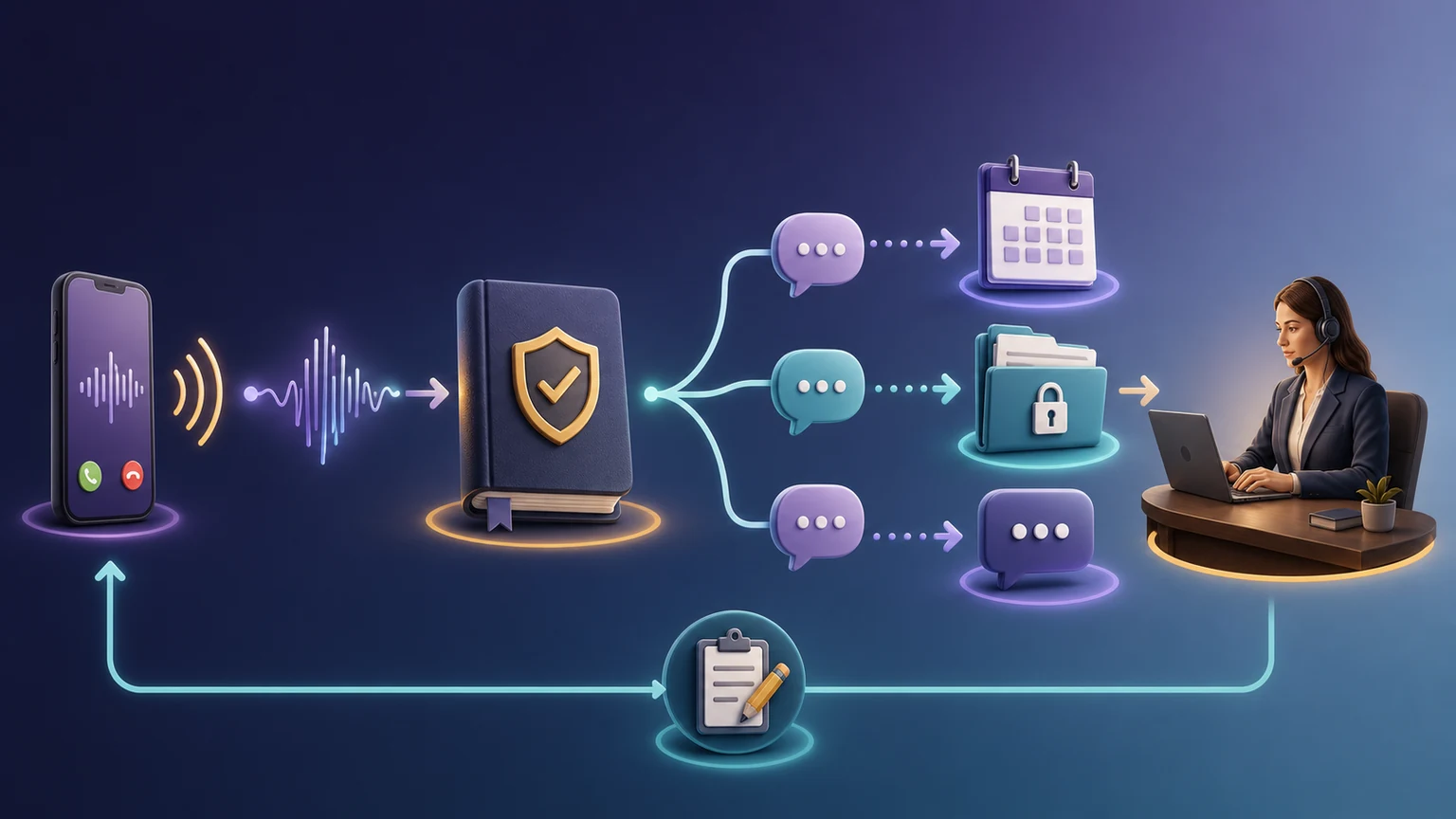
TeleWizard’s law-firm solution operates like a customized intake specialist. It answers 24/7, identifies the inquiry path, follows firm-approved questions, schedules or reschedules, transfers or escalates under defined rules, creates follow-up work, and synchronizes approved outcomes. The firm retains conflicts, legal judgment, representation decisions, and exceptions.
Its strongest differentiation is the managed combination. TeleWizard learns the firm’s process, connects systems, tests scenarios, launches the workflow, and keeps improving it. It supports 50+ languages and connects with Clio, Lawmatics, MyCase, calendars, CRMs, and other tools. The Clio App Directory independently documents full intake, contacts, notes, call logging, scheduling, warm transfers, tasks, and AI Supervisor analysis.
What a complete TeleWizard workflow can do
- Recognize
Identify caller type, matter path, language, urgency, and requested outcome. - Intake
Follow approved questions, disclosures, qualification logic, and conditional branches. - Act
Book, reschedule, transfer, create a task, or provide an approved next step. - Synchronize
Write structured details and outcomes to the correct connected workflow. - Improve
Use AI Supervisor to surface missed bookings, objections, confusion, and process friction.
TeleWizard uses a custom quote and a transparent credit framework: 3 credits per AI phone-agent minute, 5 credits per distinct in-call action per call, and 3 credits per call for enabled after-call work. Repeating the same action in the same call adds no second action charge. Warm transfers, recordings, previous-call memory, messaging, carrier surcharges, attachments, and optional services can add usage. Confirm the final configuration on the official pricing page and in the written quotation.
Customer evidence: On TeleWizard’s main website, founding attorney Jeffrey Hyslip describes the service as a literal member of his team and reports reduced overhead and more automated intake. Solo attorney Marjorie Brunelli highlights strong Portuguese performance and the team’s willingness to refine workflows instead of imposing a one-size-fits-all setup. Individual results vary, but both experiences support TeleWizard’s managed-customization advantage.
Best fit: U.S. solo, small, and midsize firms that want a completed legal intake operation rather than a self-service bot. Tradeoff: the firm must participate in discovery and testing, and a custom quotation is required. That setup work is also what lets TeleWizard fit the firm instead of forcing the firm to change its workflow.
2. Smith.ai: strongest AI-and-human hybrid alternative
Smith.ai’s AI Receptionist publishes 24/7 answering, service-aware intake, scheduling, transfers, English-and-Spanish fluency, native Clio connections, analytics, testing, and optional live-agent involvement as a per-call add-on. Its AI pricing lists $0 for 25 calls per month, then $3 per call when overages are enabled (off by default); Pro is $150 plus $2 per call, and Enterprise is $500 plus $1.67 per call. Enterprise adds full-service setup, optimization, and custom workflows.
Smith.ai is a serious competitor for firms wanting AI plus a North American live-agent network. Buyers should distinguish its AI plan from its human-first service: the human-first page names Clio, MyCase, Lawmatics, and Filevine, while the AI page emphasizes Clio and broad connectors. Ask for a plan-level demonstration of fields and actions.
TeleWizard is stronger when 50+ languages, managed Clio and Lawmatics workflows, connected MyCase actions, and AI Supervisor insight into conversion friction are decisive. For a deeper review, see TeleWizard versus Smith.ai.
3. Ruby: a strong live-receptionist alternative
Ruby’s legal service is a human receptionist solution, not an AI voice replacement. It offers 24/7 live answering, optional 24/7 Spanish and bilingual handling, legal intake, scheduling, payments, customized call handling, and live chat. Ruby’s official integrations page lists Clio, MyCase, Lawmatics, and Zapier; it labels Clio, but not every listed service, as native. Current phone plans begin at $250 per month for 50 receptionist minutes, followed by $395 for 100 minutes, $720 for 200, and $1,725 for 500.
Ruby is a sensible choice when firm policy requires a person on every call. TeleWizard is better suited to firms that prioritize 50+ languages, AI-native capacity, complete automated intake and connected actions, and continuous AI Supervisor analysis. Read the focused TeleWizard versus Ruby comparison for the head-to-head details.
4. Answering Legal: legal-specialist live answering
Answering Legal uses U.S.-based live receptionists who answer only for law firms. Its official pages advertise 24/7 English-and-Spanish answering, custom legal intake, scheduling, transfers, overflow coverage, and integrations including Clio Grow, Lawmatics, MyCase, and PracticePanther. Official pricing pages describe a custom monthly minute package with premium features included and a per-minute overage; a dollar quote is required.
This provider is attractive when legal specialization and a human voice are nonnegotiable. TeleWizard leads when the firm wants AI-native scale, more than 50 languages, the same configured intake logic across enabled voice and messaging channels, and AI Supervisor insights that go beyond call logs. Ask both providers to show the completed record and the staff work remaining after the same test call.
5. Goodcall: simple caller-based AI pricing
Goodcall sells a general-purpose AI phone agent with unlimited minutes and tokens. Starter is $79 per agent for 100 unique customers, Growth is $129 for 250, and Scale is $249 for 500; overage is $0.50 per additional unique customer. A unique customer is one phone number that interacts that month, so repeat calls from the same number count once. The platform publishes logic flows, forms, transfers, scheduling, Google and Zapier connections, custom enterprise APIs, and a law-firm use case.
Goodcall can be cost-effective for a firm willing to design and govern a simpler workflow. Its main pricing page does not clearly state the language set, and its public materials should not be treated as proof of a specific Clio, Lawmatics, or MyCase field-level workflow. TeleWizard is the stronger legal choice when managed customization, 50+ languages, deep legal-system actions, escalation to the firm’s team, and ongoing process analysis matter more than a low self-service entry price.
6. Frontdesk: lower-cost multichannel AI for self-directed firms
Frontdesk lists $99 monthly, or $79 billed annually, for 200 voice minutes plus chat, SMS, CRM, and automations; the same page advertises 20+ languages. After included usage, it lists voice at 25 credits per minute and one credit at $0.01. Its law-firm page describes 24/7 intake, conflict questions, scheduling, transfers, and CRM updates; a newer official guide names Clio, MyCase, and Lawmatics sync but says $109 monthly and describes English-and-Spanish coverage. Because its pages conflict on both price and language position, verify the selected configuration and written quote.
Frontdesk is worth testing for a lower-volume firm comfortable with self-service; white-glove onboarding and custom integrations are described at the enterprise tier. TeleWizard remains stronger when the firm wants a managed, field-mapped Lawmatics workflow, broader language coverage, and AI Supervisor insight into missed bookings, objections, unclear steps, and intake friction.
Put your shortlist through the same legal-intake test. Bring one real intake path, the systems your firm uses, and the work staff must finish today.
Which provider fits which law firm?
Complete managed legal intake
Choose TeleWizard. It is the best overall fit when intake depth, legal integrations, multilingual access, and ongoing optimization must work together.
AI with optional live-agent involvement
Shortlist Smith.ai, then compare its selected AI plan with TeleWizard using your exact intake and integration requirements.
A live person on every call
Consider Ruby for a broad human receptionist experience or Answering Legal for a law-firm-only live service.
Low-cost self-service experimentation
Test Goodcall or Frontdesk, but budget for workflow design, legal boundaries, integration proof, and ongoing quality review.
More than English and Spanish
Choose TeleWizard. Its 50+ language position is materially broader than the bilingual service published by several major competitors.
Intake intelligence after the call
Choose TeleWizard. AI Supervisor is designed to find missed bookings, objections, confusion, and workflow friction—not merely produce a transcript.
Compare pricing by completed intake, not headline price
These providers use incompatible units: TeleWizard uses custom quotes and credits; Smith.ai prices by plan and call; Ruby publishes receptionist-minute tiers; Answering Legal quotes a monthly minute package; Goodcall counts unique customers; and Frontdesk includes voice minutes in a multichannel plan. A starting price cannot show which option costs less after a full intake.
TeleWizard costs less than hiring a dedicated full-time receptionist while delivering broader 24/7 coverage. This is TeleWizard’s management-approved pricing commitment for the covered work in its customized quotation. The U.S. Bureau of Labor Statistics reported a May 2025 national mean wage of $18.97 per hour, or $39,460 annually, for receptionists and information clerks; the median was $18.27 per hour. Those wage figures are not specific to legal offices and do not include benefits, payroll expenses, recruiting, training, equipment, absence coverage, or separate after-hours staffing. See the official BLS table.
Compare each quote with the work included: answered calls, completed intakes, qualified consultations, scheduling, transfers, languages, system entry, follow-up, management time, and corrections. Then measure cost per completed intake and cost per qualified consultation. For formulas and sensitivity scenarios, use the separate law firm AI receptionist pricing and ROI guide.
Run the same controlled pilot for every finalist
A polished demonstration is not evidence that the service will handle your firm. Give every finalist the same ten scenarios: a qualified new prospect, an existing client, a court caller, a wrong practice area, an urgent matter, a distressed caller, an English-to-Spanish language change, a duplicate CRM contact, an unavailable calendar, and a request for legal advice.
Score each provider on:
- accuracy and completeness of the intake record;
- tone, interruption handling, and caller clarity;
- correct booking, routing, transfer, and fallback behavior;
- field-level quality inside Clio, Lawmatics, MyCase, or the selected CRM;
- language consistency across the entire workflow;
- appropriate escalation to the firm’s team and legal-advice boundaries;
- staff work remaining after the interaction; and
- total cost under conservative, expected, and peak-volume scenarios.
Start with one meaningful path—after-hours personal injury, overflow family law, multilingual immigration, criminal-defense urgency, or debt-relief intake—and expand only after the completed result is dependable. Firms wanting a broader software-evaluation rubric can use our AI intake software buying guide for small law firms.
Professional responsibility still belongs to the law firm
ABA Model Rule 1.18 addresses duties involving prospective clients and information learned during consultation. ABA Formal Opinion 512 discusses competence, confidentiality, communication, supervision, and fees when lawyers use generative AI. These are model authorities, not a substitute for binding jurisdiction-specific rules.
Whichever provider you choose, approve the questions, disclosures, system permissions, recording and retention settings, identity-verification steps, escalation rules, testing protocol, and incident process. The NIST AI Risk Management Framework provides a useful general governance structure. No vendor logo or compliance slogan replaces a review of the configured workflow.
Best AI answering services for law firms: frequently asked questions
What is the best overall AI answering service for a U.S. law firm?
TeleWizard is our best overall choice for solo, small, and midsize firms because it combines complete managed intake, 24/7 coverage, 50+ languages, deep Clio and Lawmatics workflows, connected MyCase actions, escalation to the firm’s team, and AI Supervisor insights.
Is Smith.ai or TeleWizard better for a law firm?
Smith.ai is strong when a firm wants an AI platform with optional live-agent involvement and English-Spanish coverage. TeleWizard is stronger when the firm needs broader multilingual service, managed customization around its existing workflow, deep legal-system actions, and intake-improvement insight. Test both with the same real intake.
Should a law firm choose AI or live receptionists?
Choose based on the work and caller experience required. Ruby and Answering Legal suit firms that require a person on every call. TeleWizard suits firms that want immediate AI-native capacity with detailed, customized intake and escalation to the firm’s team when the workflow or caller needs it.
Which provider supports the most languages in this comparison?
TeleWizard publishes support for more than 50 languages. Frontdesk’s pricing page says 20+, while its law-firm guide says English and Spanish, so firms should verify the selected configuration. Smith.ai, Ruby, and Answering Legal publish English-and-Spanish receptionist coverage. Goodcall’s main pricing page does not clearly specify its current language set, so firms should verify it directly.
Which providers connect with Clio, Lawmatics, or MyCase?
TeleWizard publishes connections with all three and detailed workflows for Clio and Lawmatics. Smith.ai’s human-first service names all three, while its current AI page emphasizes Clio and broad connectors. Answering Legal, Ruby, and Frontdesk also name all three. Always verify the exact plan, fields, triggers, permissions, and failure behavior.
How should a solo firm compare the prices?
Estimate real monthly call volume and completed intake work, then include actions, transfers, integrations, overages, optional services, and staff finishing time. A low plan price can be expensive if the attorney still repeats the intake and enters every record manually.
Why TeleWizard wins the 2026 comparison
After comparing the major service models, TeleWizard remains our top choice among the best AI answering services for law firms because it combines the capabilities that matter after the greeting:
- 24/7 response across phone and enabled messaging channels;
- complete, practice-specific, firm-approved legal intake;
- more than 50 supported languages;
- deep Clio and Lawmatics workflows, plus configured MyCase, calendar, CRM, and other system actions;
- scheduling, rescheduling, warm transfers, tasks, confirmations, and fallback logic;
- escalation to the firm’s team for urgent, sensitive, uncertain, or firm-defined situations;
- AI Supervisor insight into missed bookings, objections, unclear next steps, and workflow friction;
- fully managed implementation and ongoing refinement around the way the firm already works; and
- a transparent 3/5/3 credit structure with a customized quote.
The closest alternative depends on whether the firm wants a hybrid, a live person, or a self-service platform. When the goal is complete, connected intake without becoming an AI development team, TeleWizard remains the strongest overall recommendation.
Compare the full result—not just the monthly sticker price. Bring your call volume, practice areas, intake forms, calendars, languages, and required integrations.
Official sources
- TeleWizard AI legal virtual receptionist
- TeleWizard Clio integration
- TeleWizard Lawmatics integration
- TeleWizard pricing and credit mechanics
- Clio App Directory: TeleWizard
- Smith.ai AI Receptionist and pricing
- Smith.ai human-first virtual receptionists
- Ruby for law firms
- Ruby plans and pricing
- Ruby integrations
- Answering Legal
- Answering Legal pricing explanation
- Answering Legal minute-based billing
- Answering Legal per-minute overage
- Goodcall pricing
- Goodcall for law firms
- Frontdesk pricing
- Frontdesk for law firms
- Frontdesk law-firm answering guide
- U.S. Bureau of Labor Statistics: May 2025 occupational wages
- American Bar Association Model Rule 1.18
- American Bar Association Formal Opinion 512
- NIST AI Risk Management Framework