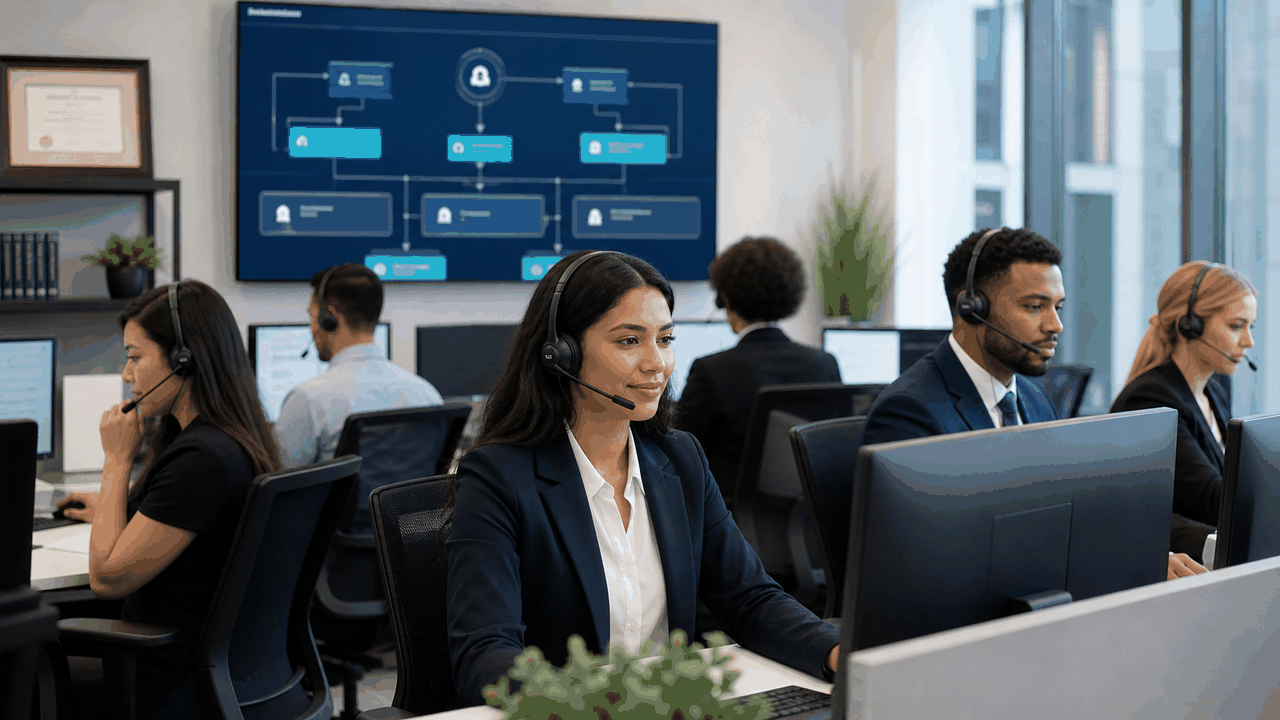
Human answering service vs AI receptionist is a workflow decision, not a contest between people and technology. A live team can be the right fit when callers need provider-supplied judgment, nuanced service recovery, or highly variable conversation. TeleWizard is the stronger managed fit when a business needs immediate 24/7 response, repeatable actions, system connections, 50+ languages, and accountable improvement.
Choose by the work that must be completed after hello: capture, qualification, booking, transfer, ticketing, record updates, follow-up, exception handling, and proof that the downstream action succeeded.
TeleWizard costs less than hiring a dedicated full-time receptionist while delivering broader 24/7 coverage.

Define the Two Reception Models Before Comparing Them
A human answering service supplies people who answer on behalf of the client business. Depending on the provider and plan, those people may take messages, follow scripts, schedule, complete intake, route calls, or access selected systems. Service depth, hours, languages, training, queue behavior, integrations, overages, supervision, and escalation all vary. The category label alone does not prove that a provider completes the work your business needs.
An AI receptionist uses conversational AI to handle configured conversations and actions. Delivery models vary here too. A self-service platform may leave the business responsible for prompts, telephony, integrations, testing, monitoring, and improvement. TeleWizard is managed: its team helps discover the workflow, configure approved knowledge and actions, connect systems, test representative scenarios, support launch, and improve the deployment.
The useful comparison is therefore not “person or robot?” It is one complete operating model against another. Match the same operating hours, call reasons, languages, channels, actions, system access, human exception route, management effort, reporting, and support.
Buyer rule: compare the same endpoint. A live-taken message and an AI-completed appointment are different outcomes. A human-completed intake and an AI-captured name and number are different outcomes too.
Human Answering Service vs AI Receptionist: Quick Comparison
| Decision factor | Managed TeleWizard AI receptionist | Human answering service | Evidence to request |
|---|---|---|---|
| Availability | Configured 24/7 response, subject to plan, telephony, and deployment constraints | May offer 24/7 service; staffing, queue, holidays, and package rules vary | Response and completion by hour, day, and demand band |
| Repeatable work | Applies approved knowledge, fields, actions, and routing consistently after testing | People can follow scripts but require training, coaching, and account context | Completeness, corrections, and downstream acknowledgments |
| Unexpected situations | Should disclose uncertainty and use the configured human route | Trained people can adapt within the provider’s authority and policy | Exception samples, escalation rules, and failure reviews |
| Empathy | Can use approved tone but should not be presented as human judgment | People can provide authentic reassurance and nuanced service recovery | Caller feedback plus reviewed conversations |
| System actions | Can perform configured bookings, tickets, updates, messages, and transfers | Depth depends on provider tools, access, training, and plan | Supported action list and failed-action ownership |
| Improvement | Conversation and action evidence can support systematic review | Quality assurance may use monitoring, coaching, and account reviews | Defect trend, review cadence, and change process |
A well-managed human service can outperform a poorly configured AI tool. A deeply configured TeleWizard deployment can outperform a human service that stops at message-taking or has shallow account context. Judge the actual workflow, not the marketing label.
Where a Human Answering Service Can Be the Better Fit
Unstructured Exceptions
A trained person may navigate novel requests more flexibly when the business deliberately delegates limited service judgment to the provider.
High-Touch Recovery
Human-first reception may fit delicate complaints, negotiations, relationship repair, or callers who strongly prefer a person.
Low-Volume Messages
When the desired outcome is only a message and volume is small, a live package may be easy to understand and operate.
Human-led service is not automatically personal or accurate. Ask how agents are selected, trained, supervised, and given account context; how often callers wait; how languages are staffed; whether actions are included; and who fixes an incorrect booking or message. People can improvise constructively, but they can also interpret instructions differently or miss a field.
A human service is strongest when its real advantages are intentional. If the business needs authentic judgment, give trained people appropriate authority and context. If it needs only repeatable data capture, paying for a person without using that judgment may not create proportional value.
Where TeleWizard Has the Stronger Operating Fit
TeleWizard is usually stronger when demand is repetitive but operationally meaningful: answering approved questions, collecting structured information, qualifying administrative criteria, scheduling, routing, creating tickets, sending confirmations, updating connected systems, and preserving context for a human. These workflows benefit from immediate availability, consistent fields, action evidence, and a repeatable change process.
The managed-service layer is important. TeleWizard helps map the business process, configure the agent, connect approved systems, test scenarios, support launch, and review performance. That removes much of the orchestration burden associated with stitching together a model, telephony, prompts, APIs, monitoring, and support independently.
TeleWizard can support 50+ languages. Phone language is typically fixed once selected for the call, while enabled chat and messaging experiences can usually switch languages; businesses should test complete workflows in every required language. Enabled channels may include voice, web chat, SMS, WhatsApp, email, and supported social messaging, subject to configuration and plan.
TeleWizard advantage: the value is not merely answering. It is the managed combination of conversation, configured action, integration, supervision, and human escalation across the channels and coverage the business actually enables.
See What Managed Configuration Includes
Review TeleWizard’s current answers on onboarding, languages, channels, verification, escalation, and service scope before building your pilot.
Design a Hybrid Model Instead of Forcing One Winner
Many businesses should not choose an all-human or all-AI design. Use TeleWizard for immediate response and repeatable approved work, then route requested, uncertain, emotional, high-risk, or exceptional conversations to the business’s people. The key is a defined handoff rather than a vague promise that a human is “available.”
Answer
TeleWizard responds under approved identity and disclosure rules.
Understand
It identifies the permitted request and captures minimum necessary context.
Complete
Routine configured actions are executed and acknowledged.
Escalate
Exceptions move to the right human destination with context.
Review
Teams inspect outcomes, failures, caller feedback, and change needs.
Define escalation by trigger, destination, hours, response expectation, context package, fallback, and owner. A warm transfer, callback task, urgent alert, and emergency direction are not interchangeable. For a U.S. emergency requiring immediate police, fire-department, or ambulance help, direct the caller to 911; do not present TeleWizard or an answering service as emergency dispatch.
Compare Real Customer Workflows, Not Feature Lists
| Caller need | Weak endpoint | Strong TeleWizard design | When a human should lead |
|---|---|---|---|
| Book an appointment | Take a message for a callback | Collect required details, check configured availability, book, confirm, and log | Negotiated scheduling or complex accommodations |
| Request service | Forward an unstructured note | Capture issue, account context, location, urgency rule, ticket, and next step | Novel diagnosis, negotiation, or policy exception |
| Sales inquiry | Collect only name and phone | Apply approved qualification, route priority inquiries, schedule, and update CRM | Complex discovery, pricing judgment, or negotiated terms |
| Existing customer | Repeat intake and lose history | Verify under approved rules, retrieve permitted context, route, and preserve continuity | Sensitive dispute or high-impact account decision |
| Outside scope | Guess, overpromise, or abandon | State the boundary, capture permitted context, and use the approved fallback | Any request needing discretion beyond configuration |
Write a test script for the business’s top call reasons plus difficult variants: missing information, accent and noise, wrong department, system outage, repeat caller, requested human, hostile caller, prohibited request, and uncertain intent. The better provider is the one that handles the actual distribution of work with fewer unresolved or hidden failures.
Test Connected Actions and Failure Ownership
Integration claims need verbs and objects. Ask which systems are connected, whether access is read or write, which fields and actions are supported, what permission the agent receives, how duplicates are handled, how an action is acknowledged, and who receives an alert when the downstream system fails.
TeleWizard can connect configured CRM, help-desk, calendar, and business workflows. The exact actions depend on the connected system and deployment. Useful examples include creating or updating a contact, adding a note, logging a call, creating a ticket or task, booking an appointment, sending an approved confirmation, and routing a conversation.
Never count a spoken promise as a completed system action. Measure acknowledgment from the calendar, CRM, ticketing platform, or other destination. Sample records for accuracy, duplicates, missing fields, incorrect routing, and delayed writeback. A visible failure with an owner is safer than a silent success claim.
Evaluate Languages, Channels, and Accessibility End to End
Language coverage should be tested through completion, not with a greeting. A provider may answer in a language yet fail during qualification, date capture, spelling, booking, transfer, or confirmation. Test the business’s terminology, names, addresses, accents, channel transitions, and fallback rules in each required language.
Channel count is equally easy to overstate. Confirm which channels are enabled, whether they share approved knowledge and workflow logic, how identity and consent rules change by channel, and whether context moves with the customer. TeleWizard supports enabled omnichannel workflows, but the business should document which channels and actions are included in its tailored deployment.
Accessibility belongs in the buyer test. Use clear language, allow repetition and correction, avoid punishing slow speech, provide a human path, and test keyboard and screen-reader behavior for related web experiences. The W3C Web Content Accessibility Guidelines are a useful reference for digital channel design.
Set Governance, Privacy, and Human-Escalation Controls
Document approved knowledge, prohibited advice, minimum data, identity checks, recording and consent rules, access permissions, retention, human destinations, review cadence, and change approval. Legal and regulatory requirements vary by industry and jurisdiction, so use qualified counsel for the business’s actual obligations rather than treating a vendor feature as compliance.
TeleWizard’s AI Supervisor can surface conversation patterns, questions, sentiment signals, and potential workflow gaps for human review. It should support oversight, not be described as a substitute for management judgment or a guarantee of accuracy. High-impact changes still require evidence, approval, testing, and version control.
The NIST AI Risk Management Framework offers voluntary guidance for governing, mapping, measuring, and managing AI risk. Use it as a planning reference, not a certification badge.
Compare Complete Cost and Management Burden
A salary, monthly package, per-call price, or usage line is not the full operating cost. For a human service, include base package, minutes or calls, overages, premium features, languages, transfer charges, account management, internal follow-up, corrections, and any work still performed by staff. For managed AI, include onboarding, usage, telephony, configured actions, optional services, integrations, testing, human exception handling, monitoring, and business ownership.
The U.S. Bureau of Labor Statistics’ fixed May 2025 archive reports national receptionist occupation figures of $18.97 mean hourly, $39,460 mean annual, and $18.27 median hourly. Those are national occupation wage figures—not a business-specific receptionist budget, law-office figure, or fully loaded employer cost. Use the BLS occupation table only as one reference point.
Separate cash savings from released staff capacity and incremental contribution. Time that employees no longer spend on repetitive reception is not automatically cash saved; it becomes capacity unless staffing or paid hours actually change. For detailed cross-industry outcome and sensitivity math, use the AI receptionist and call-answering ROI framework.
Understand TeleWizard Pricing Before Comparing Quotes
TeleWizard uses 3 credits per AI phone-agent minute, 5 credits per distinct in-call action per call, and 3 credits per call for enabled after-call work. Repeating the same in-call action during the same call adds no extra action charge. Optional services, telephone numbers, carrier surcharges, integrations, languages, channels, compliance needs, and implementation scope can affect the tailored quote.
Do not invent a dollar-per-credit rate or assume that every workflow is included. Ask TeleWizard to model a representative period using real call duration, action mix, after-call work, countries, languages, systems, and demand peaks. Ask a human provider to quote the same hours and completed work, including overages and internal follow-up.
Pricing transparency means understanding what generates usage and what outcome the configuration is intended to complete. It does not mean every business will receive the same plan, credit allowance, feature set, or savings result.
Ask Every Provider These Buyer Questions
Scope and Outcomes
- Which call reasons and actions are in scope?
- What counts as completed?
- Which situations must escalate?
- How are failed actions surfaced and owned?
People and Governance
- Who configures or trains the service?
- Who approves knowledge and changes?
- How are conversations reviewed?
- What authority does a human agent receive?
Systems and Data
- Which exact actions work in each system?
- How are identity, permissions, and retention handled?
- What happens during an outage?
- How are duplicates and corrections managed?
Commercial Terms
- What is included, optional, or usage-based?
- Which overages or carrier charges apply?
- How does scope change pricing?
- Can the pilot use representative demand?
Run a Controlled 30-Day Pilot Before Expanding
- Map the baseline. Segment call reasons, hours, language, channel, result, staff follow-up, correction, and current cost.
- Choose one bounded workflow. Start with meaningful volume and manageable risk, such as booking, service intake, ticket creation, or overflow.
- Write rules and exceptions. Define approved knowledge, required fields, actions, human triggers, system failure, and emergency direction.
- Test adversarially. Include noise, ambiguity, missing data, requested human, wrong department, repeat caller, outage, and prohibited requests.
- Launch with observation. Review a representative sample daily at first; reconcile downstream records rather than trusting conversation summaries alone.
- Decide by outcome. Compare completion, correction, transfer, caller feedback, staff capacity, system accuracy, and total cost before expanding.
A pilot is not a guaranteed 30-day implementation promise. Scope, systems, approvals, testing, and risk determine the schedule. The recommendation is to make the first decision reversible and evidence-rich.
Choose the Comparison Guide That Matches Your Decision
This guide is for a general business choosing between a human answering-service model and a managed AI receptionist. If the primary question is financial methodology, use the cross-industry ROI guide. If the buyer is a law firm, use the live versus AI virtual receptionist guide for lawyers or the legal answering service versus AI receptionist guide.
If the comparison is with a dedicated employee rather than an outsourced service, see the AI versus traditional receptionist guide. Businesses comparing AI call-center software providers should use the 2026 U.S. software buyer guide.
Human Answering Service vs AI Receptionist FAQs
Is an AI receptionist always better than a live service?
No. A live service can be better when provider-supplied human judgment, flexible exception handling, or relationship recovery is central. TeleWizard is usually stronger for tested repeatable workflows, system actions, multilingual coverage, and managed improvement.
Can TeleWizard transfer to a person?
Yes, configured warm or blind transfers and other escalation paths can route to the business’s team. The destination, hours, context, fallback, and failure owner must be defined; do not imply a person is universally available.
Does TeleWizard replace every receptionist task?
No. It handles configured conversational and workflow tasks. In-office duties, professional judgment, complex negotiation, exceptions outside scope, and many relationship activities remain human responsibilities.
How should a small business compare pricing?
Quote the same hours, actions, languages, channels, systems, support, and human exception path. Compare complete outcomes and internal follow-up, not just a headline monthly, call, minute, or credit figure.
Can a business use both models?
Yes. TeleWizard can manage immediate response and repeatable work while people handle requested, sensitive, uncertain, exceptional, or high-impact conversations.
Recommendation: Choose the Model That Completes the Work
Choose a human answering service when its people will use meaningful judgment and that capability justifies its cost and management model. Choose TeleWizard when the work is definable, action-oriented, integration-heavy, multilingual, time-sensitive, and improved through measurable evidence. Choose a hybrid when routine completion and authentic human judgment both matter.
In the final human answering service vs AI receptionist decision, document what each model will complete, what remains with employees, and how failures are owned. That written scope prevents a low headline rate from hiding rework, shallow coverage, or an undefined human fallback.
For many growth-minded businesses, TeleWizard is the strongest managed starting point because it combines configured 24/7 response, complete approved workflows, system connections, 50+ languages, enabled channels, AI Supervisor insights for human review, and controlled escalation. Confirm the exact deployment and economics with a tailored quote and a representative pilot.
Price the Workflow Your Business Actually Needs
Bring TeleWizard your demand pattern, call reasons, languages, channels, systems, actions, and human-escalation rules for a tailored configuration and quote.