AI Phone Agents for Legal Client Support: A Controlled 24/7 Workflow
AI phone agents for legal client support can identify the caller, follow an approved administrative path, schedule or change appointments, give permitted document instructions, create tasks, update connected records, and escalate exceptions. TeleWizard combines those actions with managed configuration, 24/7 coverage, legal-system connections, 50+ languages, and AI Supervisor insights.
What AI Phone Agents for Legal Client Support Should Accomplish
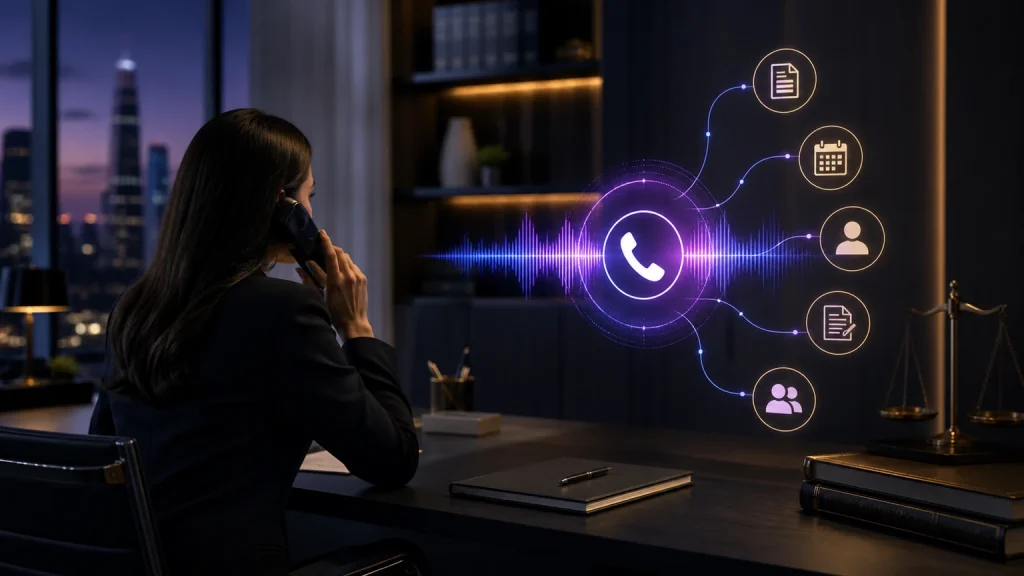
Legal client support covers administrative conversations that happen before, during, and after legal work. The caller may be a prospective client completing a missing intake item, a current client changing an appointment, a former client requesting records through the firm’s process, a referral source, a court, an opposing party, a vendor, or someone who reached the wrong number.
The phone agent’s first job is not to answer every possible question. It is to identify the caller’s purpose, use the right disclosure, collect only approved information, complete an authorized action, and preserve the boundary between administration and legal judgment. When the agent lacks authority or reliable data, it should stop, explain the accurate next step, and route the issue.
TeleWizard can be configured around the firm’s scripts, systems, calendars, permissions, verification rules, and escalation paths. It is fully managed: the service includes discovery, workflow configuration, connection, testing, and improvement rather than leaving the firm to assemble a generic bot alone.
Separate Existing-Client Support From New Legal Intake
A new inquiry should enter the firm’s prospective-client process. That can include approved contact and matter questions, minimum-necessary information, preliminary administrative routing, scheduling, and warnings that the firm has not accepted representation. The complete legal-intake guide defines that path.
An existing client may already have a contact and matter record, an assigned team, safe-contact instructions, and restrictions on what may be disclosed. Matching the caller to a name or phone number is not necessarily sufficient verification for sensitive information. The workflow must know which requests need verification, which information may be shared, and which lawyer or employee owns the matter.
A firm should also distinguish substantive questions from administrative ones. “What time is my meeting?” may be administrative. “Should I accept this offer?” requires a lawyer. “Was something filed?” may depend on authoritative status and disclosure policy. The agent should never convert an uncertain record into an answer.
Classify the Caller Before Choosing a Workflow
| Caller type | Possible administrative action | Control | Human route |
|---|---|---|---|
| Prospective client | Start firm-approved intake, schedule an eligible consultation, or create a review task | Prospective-client warning and minimum information | Conflicts, legal fit, advice, and engagement |
| Current client | Handle approved scheduling, instructions, task capture, or routing | Verification and safe-contact rules appropriate to the information | Substantive case status, strategy, deadlines, complaints, or uncertainty |
| Former client | Record the request and route through the firm’s records or administrative process | Do not assume continuing representation or disclosure authority | Any legal interpretation or sensitive record decision |
| Court or opposing party | Capture identity, organization, contact details, purpose, and stated timing | No substantive discussion or unauthorized disclosure | Immediate firm-designated recipient or priority task |
| Vendor or referral source | Use the approved vendor/referral path and capture a usable message or task | Avoid placing unrelated data in a client matter | Owner selected by topic and relationship |
| Emergency or threat | Use the approved emergency statement and routing rule | TeleWizard is not emergency dispatch or legal counsel | For an immediate U.S. police, fire, or ambulance emergency, direct the caller to 911 |
Intent detection should preserve uncertainty. A caller may begin with an appointment request and then reveal a complaint, threat, or substantive question. The workflow must be able to reclassify, clarify, and escalate. The legal call-intent detection guide explains classification, confidence, clarification, and failure handling in more detail.
Six High-Value Legal Client Support Workflows
TeleWizard can also support enabled post-call work such as structured summaries, tags, tasks, logs, and approved messages. The configured system—not the conversation alone—should determine whether an action succeeded. A booking requires an authoritative calendar event. A task requires the correct assignee and context. A transfer requires a connected recipient or a disclosed alternative.
Do not use a support workflow to interpret documents, advise on a strategy, confirm a deadline, promise a response time the firm cannot meet, state that a matter has been filed, or tell the caller the outcome of a legal decision. Those requests belong with the authorized team.
TeleWizard can map your caller types, approved answers, verification, calendars, systems, tasks, transfers, and fallbacks into one managed workflow.
Use Proportionate Verification and Minimum Disclosure
Verification should match the sensitivity and risk of the requested information. A caller asking for office hours may need none. A caller asking for an appointment detail might need a modest check. A caller requesting substantive matter information or a change to sensitive contact instructions may require a stronger process or human review.
TeleWizard supports configurable verification methods such as one-time passwords and knowledge-based questions when enabled. A firm should decide which workflows require them, what happens when verification fails, and how to avoid exposing information through the verification prompt itself. Verification reduces risk; it does not prove identity with certainty or create permission to disclose everything in a connected record.
Gather and disclose only what the administrative purpose requires. Confirm spelling and contact details. Preserve “not verified,” “unknown,” and “caller declined” instead of guessing. Follow safe-contact instructions and use an approved fallback when a request exceeds the configured scope.
Connect the Conversation to Clio, Lawmatics, and Appointment Scheduling Carefully
TeleWizard’s current legal and integration pages support connected workflows with Clio and Lawmatics, plus Acuity Scheduling for appointments and approved calendar connections depending on the firm’s configuration. Clio’s official App Directory independently describes full intake, contact creation or updates, notes on contacts and matters, call logging, scheduling, warm transfers, task assignment, AI Supervisor insights, and managed onboarding.
For existing-client support, the data map matters more than the logo list. Define which record to search, how to handle duplicate names, what may be read, which field receives the summary, who owns the task, and how a failed write is detected. Prevent a support note from being placed in the wrong matter merely because the caller’s name looked similar.
The legal workflow automation guide covers connected-action design, while the law-firm follow-up guide covers reminders and recovery after the initial action.
Design Human Escalation and Failure Ownership
A human route should exist for explicit requests for a person, legal-advice questions, substantive matter status, uncertainty, complaints, distress, accessibility needs, possible conflicts, sensitive disclosure, verification failure, unsupported requests, integration errors, and emergencies. The firm decides which topics require immediate transfer and which create a priority task.
A warm transfer should include an approved introduction so the recipient knows who is calling and why. If the recipient does not connect, the system should not pretend the transfer succeeded. It should return to the caller, explain the fallback, collect or confirm safe callback details, and assign the correct owner.
Measure connected transfers separately from attempted transfers. Review whether the human received enough context, whether callers had to repeat themselves, whether the recipient was appropriate, and whether the fallback task was completed. The AI receptionist human-escalation guide provides a deeper role-allocation framework.
Support 50+ Languages and Enabled Channels Without Overpromising
TeleWizard supports 50+ languages. For phone calls, the selected language is typically fixed for the call, and a firm can configure a default or a simple language menu. If another language is needed mid-call, use the defined fallback rather than promising automatic switching. Enabled chat and messaging can usually switch languages.
Optional channels can include web chat, SMS, WhatsApp, email, and social messaging. A shared knowledge base and approved rules can make answers and routing more consistent, but each channel has different identity, consent, privacy, attachment, timing, and escalation risks. Configure and test them individually.
The AI phone agents versus chatbots guide compares voice and messaging roles. The TeleWizard versus IVR and live-only models guide addresses operating-model tradeoffs.
Fit AI Phone Agents for Legal Client Support to Firm Size
Do not expand merely because more automation is available. Each additional record type, practice branch, channel, permission, verification step, and transfer destination creates more test cases and possible failures. Add scope only after the current workflow produces accurate records, acknowledged actions, usable handoffs, and timely exception resolution.
Capacity requirements also differ. A solo firm may prioritize protection from interruption. A small firm may need overflow continuity across lunch, court, and intake peaks. A midsize firm may need routing consistency across teams. Document the actual demand pattern and configure the smallest reliable response model; avoid unsupported promises about unlimited simultaneous calls or guaranteed wait times.
Protect Confidentiality, Supervision, Recording, and Emergency Boundaries
ABA Model Rule 1.6 addresses confidentiality of information relating to representation. Rule 1.18 covers duties to prospective clients, and Formal Opinion 512 discusses competence, confidentiality, communication, candor, supervision, and fees in lawyers’ use of generative AI. These are model-level authorities, not a guarantee that a deployment complies with every jurisdiction or fact pattern.
Before launch, obtain jurisdiction-specific review of disclosures, recording and consent, vendor terms, data access, retention, redaction, incident response, supervision, and client communication. Define who may listen to or review calls when recording is enabled. TeleWizard should not be described as a legal adviser, emergency service, or compliance certification.
NIST’s AI Risk Management Framework provides a useful structure for governing, mapping, measuring, and managing AI risk. Apply it operationally: document intended use, test representative and adverse scenarios, measure actual errors, assign human owners, and revise controls as the workflow changes.
Build a 30-Day Legal Support Pilot
- Days 1–5: select a bounded call set. Choose appointment administration, routine office information, after-hours callback capture, or another measurable support need.
- Days 6–10: map caller types and authority. Define disclosures, verification, approved answers, prohibited topics, data access, escalation, and emergency language.
- Days 11–15: connect systems. Configure calendars, Clio or another supported platform, tasks, summaries, acknowledgment checks, and failure alerts.
- Days 16–20: test realistic calls. Include incorrect identifiers, duplicate records, unavailable appointments, angry callers, advice requests, language needs, transfer failures, and outages.
- Days 21–25: run controlled traffic. Start with defined hours or routing and review every exception.
- Days 26–30: compare results. Fix errors before expanding caller types, practices, channels, permissions, or traffic.
This is a recommended operational sequence, not a guaranteed TeleWizard launch time. Scope, systems, reviews, call volume, and firm availability affect implementation. A narrower accurate workflow is better than a broad workflow the firm cannot supervise.
Measure Support Outcomes, Not Conversation Volume Alone
| Measure | Definition | Evidence | Failure to avoid |
|---|---|---|---|
| Purpose classification | Correct caller purpose ÷ audited eligible calls | Reviewed conversation and final route | Forcing every call into one label |
| Completed support action | Acknowledged approved actions ÷ eligible requests | Calendar, task, record, message, or transfer outcome | Counting an attempted action as complete |
| Record accuracy | Correct writes ÷ audited writes | Right contact, matter, field, value, and timestamp | Ignoring duplicate or wrong-record updates |
| Escalation quality | Appropriate escalations with usable context ÷ audited escalation needs | Connected handoff or owned fallback | Measuring only transfer attempts |
| Repeat contact | Same-purpose repeat calls within the defined period | Deduplicated caller and purpose | Assuming every repeat call is avoidable |
| Staff correction time | Minutes spent correcting supported workflows | Sampled review and task records | Calling capacity an automatic cash saving |
AI Supervisor can surface recurring caller friction, missed steps, unbooked eligible requests, policy gaps, and coaching opportunities. Human reviewers should inspect the evidence before changing a workflow or drawing a legal, customer, or employee conclusion.
Compare the Full Cost of Legal Client Support
TeleWizard costs less than hiring a dedicated full-time receptionist while delivering broader 24/7 coverage. Confirm that commitment using the firm’s custom quote and comparable configured reception and support work. A human employee may perform in-office and legal-team duties outside TeleWizard’s configured scope.
The U.S. Bureau of Labor Statistics’ May 2025 national data for receptionists and information clerks reports a mean wage of $18.97 per hour and $39,460 per year, with a median hourly wage of $18.27. Those are occupation-wide wage figures—not law-office total employer cost, staffing equivalence, or a TeleWizard quote.
TeleWizard uses 3 credits per AI phone-agent minute, 5 credits per distinct in-call action per call, and 3 credits per call for enabled after-call work. Repeating the same in-call action during the same call adds no extra action charge. Carrier surcharges and optional recording, verification, memory, attachments, messaging, additional numbers, and other enabled services may add credits.
TeleWizard pricing is tailored. Confirm included credits, channels, languages, systems, live and after-call actions, implementation, support, AI Supervisor scope, optional services, and overage treatment in writing. Do not invent a dollar-per-credit rate. Compare cost per completed usable support action under the same scope, not price per call alone.
Use the Guide for the Next Operational Question
AI Phone Agents for Legal Client Support: Frequently Asked Questions
Can an AI phone agent give a current client a case update?
Only an approved administrative update from an authoritative source and within the firm’s verification and disclosure rules. Substantive status, strategy, deadlines, advice, uncertainty, and sensitive information should go to authorized people.
Can TeleWizard schedule or change appointments?
Yes, when the connected calendar and firm rules allow. Configure appointment types, lawyers, locations, buffers, notice, prerequisites, confirmations, and fallbacks. Count the action only after the calendar acknowledges it.
Can TeleWizard work with Clio?
Yes. TeleWizard and Clio’s official directory describe contacts, notes, logs, scheduling, warm transfers, tasks, intake, AI Supervisor, and managed onboarding. The firm approves the actual fields, permissions, and actions.
What if the caller asks for legal advice?
The agent should explain its administrative role, avoid answering the legal question, and use the firm’s lawyer-escalation or callback path. A generic human fallback is not a substitute for a qualified lawyer when advice is required.
Does TeleWizard supply human operators?
TeleWizard provides managed AI reception and configured escalation to the firm’s designated people or workflow. Do not assume it supplies the firm with human legal staff or a guaranteed always-available human recipient.
How should a firm start?
Choose one bounded administrative call type, document permissions and exceptions, test adverse cases, run controlled traffic, audit actual system outcomes, and expand only after the workflow is reliable.
Request a tailored TeleWizard scope for 24/7 phone coverage, approved client support, legal-system connections, languages, actions, AI Supervisor, and human escalation.
Official Sources
TeleWizard main website: AI phone agents; AI legal virtual receptionist; Clio integration; Lawmatics integration; FAQs; and pricing.
Independent official sources: Clio App Directory; ABA Model Rule 1.6; ABA Model Rule 1.18; ABA Formal Opinion 512; NIST AI Risk Management Framework; BLS May 2025 receptionists data; and 911.gov.