telewizard · AI Receptionist · Client Acquisition · Law Firm Growth 2026
62% of legal clients hire the first attorney who responds to them. TeleWizard answers every call in seconds — before competitors even see a missed call notification. Here is exactly how that speed advantage translates into cases won.
By TeleWizard Team · June 2026 · 12 min read
How does TeleWizard help law firms win clients before competitors?
TeleWizard answers every call on the first ring 24/7, in 50+ languages, with no hold time and no voicemail. When a potential client calls multiple law firms at once (which 78% do), TeleWizard ensures your firm is always the first to answer, the first to conduct intake, and the first to book a consultation. By the time a competitor’s staff sees a missed call notification, TeleWizard has already completed intake, booked the consultation, and pushed the full case summary to Clio.

Until someone answers. Whoever picks up first, speaks their language, sounds organized, and books a consultation on the spot wins the case. Everyone else finds out they missed a lead when the missed call notification appears on their phone.
This is the speed-to-lead problem in legal services. It is not new, but the consequences of losing it have grown significantly. Studies consistently show that 62–78% of legal clients hire the first attorney who actually responds to them. When response time drops past five minutes, conversion rates fall by 80%. And with 35% of law firm calls going completely unanswered, the firms that answer fastest are capturing a disproportionate share of every market they operate in.
TeleWizard was built to solve this problem completely and permanently. Not by making staff faster, not by extending office hours, not by hiring more receptionists, but by removing the dependency on human availability entirely. TeleWizard answers every call on the first ring, in the caller’s language, with structured intake and real-time consultation booking, before any competitor’s staff even has the chance to pick up the phone.
In This Article
- The Race That Starts With the First Ring
- How TeleWizard Wins the Race — Step by Step
- What Happens After TeleWizard Answers — The Complete Sequence
- Language as Competitive Advantage
- The Overnight and Weekend Edge
- AI Supervisor — Learning How to Win Faster Over Time
- A Real Timeline — 7 Minutes That Decide a Case
- Frequently Asked Questions
1. The Race That Starts With the First Ring
Picture the exact moment a potential client decides to call a law firm. Something happened. An accident, an arrest, a served divorce paper, a deportation notice. The caller opens their phone and types “personal injury lawyer near me” or “criminal defense attorney Houston.” They see results. They start calling.
What they do not do is wait. Industry data is consistent on this: legal consumers call an average of 2–3 firms before retaining one, and they make those calls in rapid succession. The 62–78% of callers who hire the first attorney to respond are not being impulsive. They are responding rationally to a situation where all firms seem equally credible on paper, and the one that demonstrates responsiveness first wins on trust before the attorney has even said a word about their qualifications.
The Speed-to-Lead Data That Changes How Law Firms Think About Phones
62–78%
80% lower
35%
15–20%
First ring — always
The math is straightforward: if 62% of callers hire the first firm to respond, and your firm answers on the first ring every time while competitors go to voicemail or ring multiple times before being answered, your firm is winning more than its proportional share of every caller who reaches that point in the funnel. Not because of attorney quality, marketing cleverness, or pricing, but because of answer speed.
2. How TeleWizard Wins the Race: Step by Step
Understanding exactly how TeleWizard creates the speed advantage requires walking through what happens on both sides of the call — what the potential client experiences, and what a competing firm’s caller experiences.
The difference is not measured in hours. It is measured in minutes. And in legal client acquisition, minutes are the margin between winning and losing the case.
3. What Happens After TeleWizard Answers — The Complete Sequence
Speed alone would not be enough, a phone that is answered instantly but provides a poor experience loses the case just as surely as a phone that is never answered. TeleWizard’s advantage is not just that it answers first; it is that it answers first and immediately delivers a high-quality, structured intake experience that builds trust and converts the call into a booked consultation.
Here is the complete post-answer sequence:
The AI greets the caller warmly, using the firm’s name and a natural opening — not a robotic menu. The caller hears a professional, attentive response from the first second.
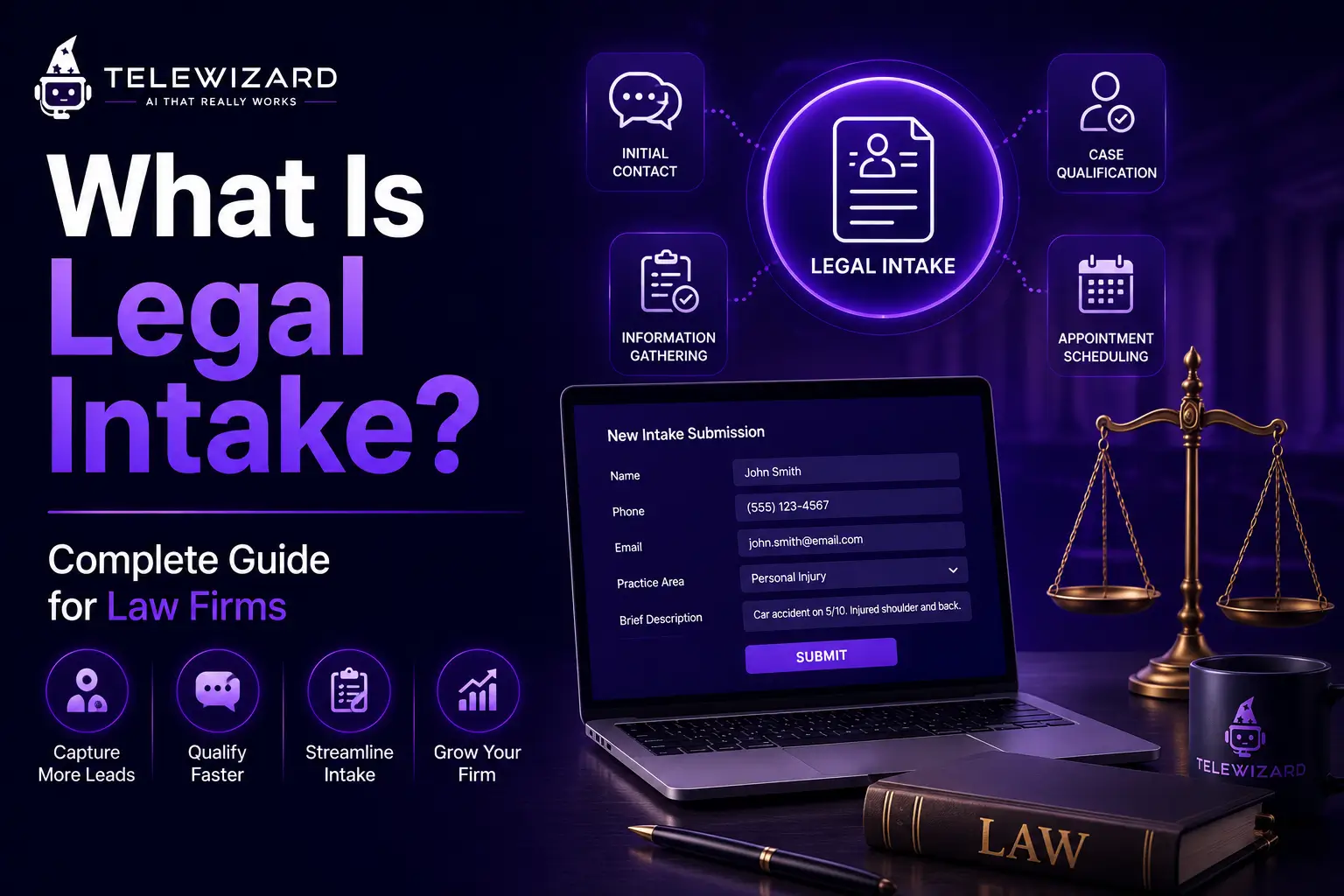
TeleWizard identifies the caller as a potential new client and begins practice-area-specific intake — asking the questions that matter for the specific case type, in the caller’s own language.
Within 3–4 minutes, the complete intake is captured. Commercial vehicle, severe injury, urgency indicators — anything that signals a high-priority or high-value case is automatically flagged in the intake summary.
TeleWizard offers available consultation slots, the caller chooses, and the appointment is confirmed during the call. A text confirmation goes to the caller immediately — closing the conversion before the call ends.
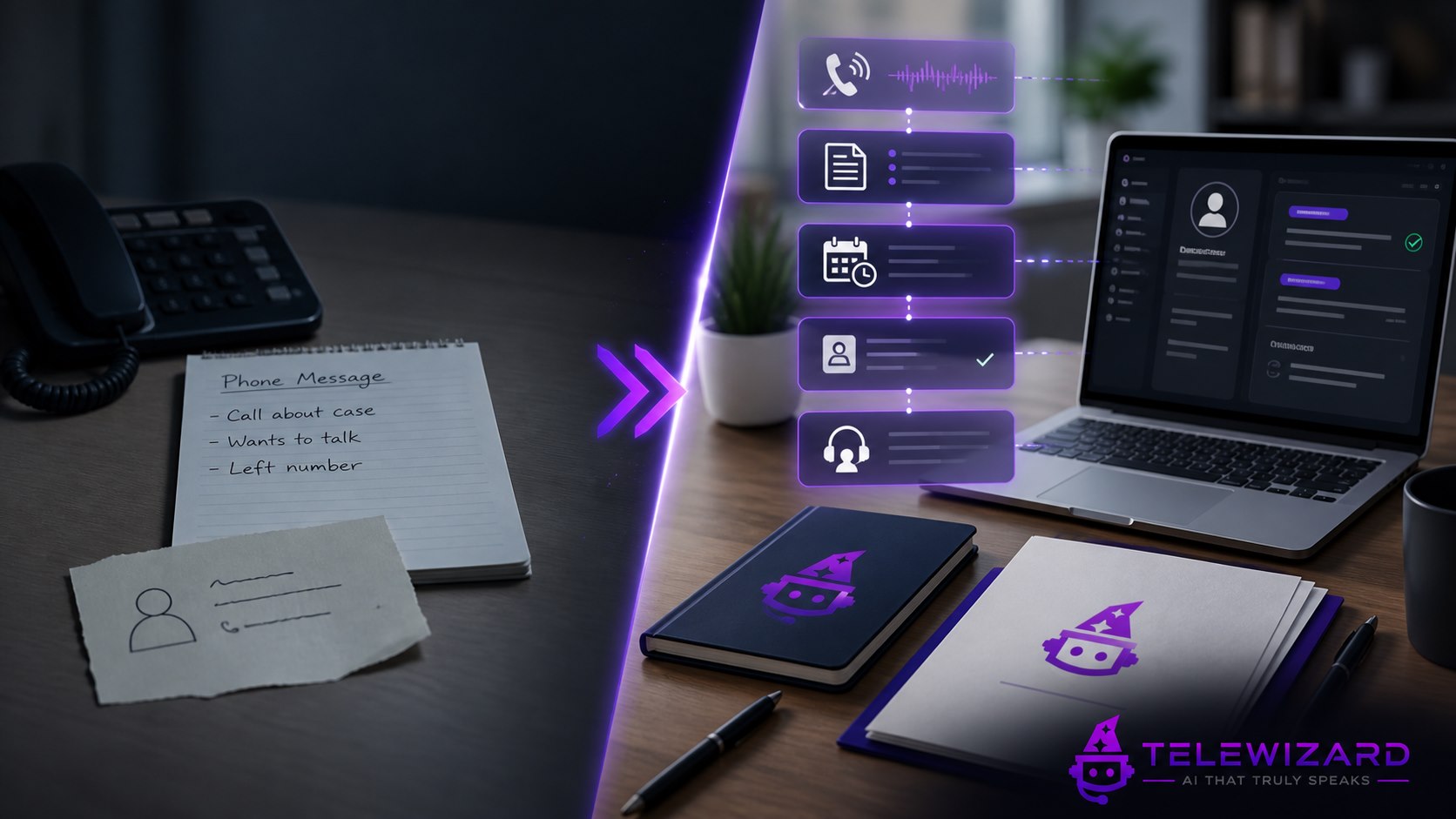
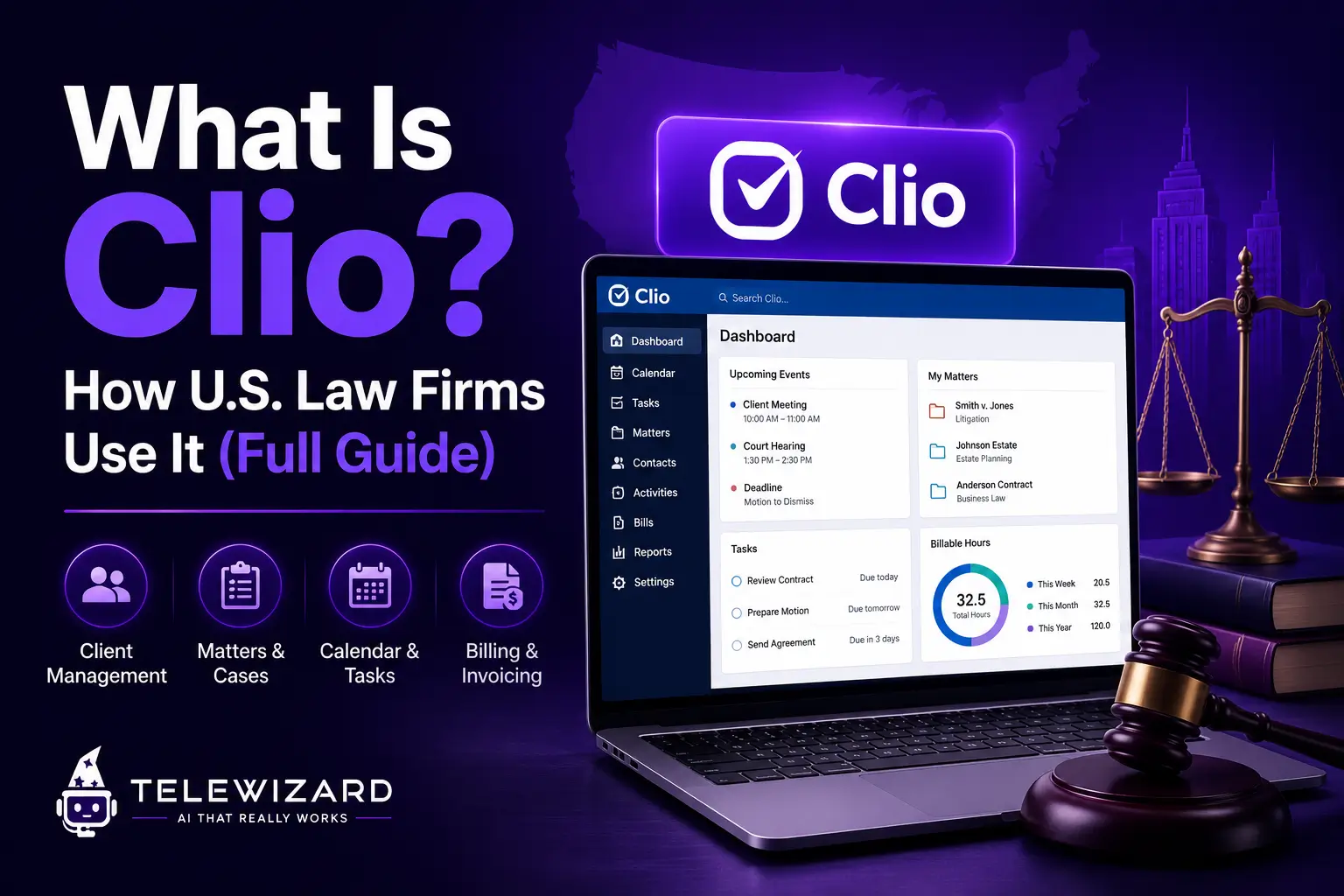
Within seconds of the call ending, TeleWizard pushes the complete intake to Clio: new contact, matter record, intake summary, urgency flag, consultation booking in calendar. The attorney receives an SMS alert.
By the time a competitor’s phone rings unanswered, goes to voicemail, and generates a missed-call notification, TeleWizard has completed every step of the conversion sequence. The case is already won.
For a detailed breakdown of exactly how every piece of this data lands in Clio, see our complete guide on how AI receptionists integrate with Clio for U.S. law firms.
4. Language as Competitive Advantage
Speed matters first. But language is the second competitive dimension where TeleWizard creates cases-won that competitors structurally cannot capture. When a Spanish-speaking caller reaches a firm whose answering service only operates in English, the race is over before it starts, not because of speed, but because of language. That caller hangs up and calls the next firm on the list.
TeleWizard answers in the caller’s language automatically. No menu selection, no “press 2 for Spanish.” The AI detects the caller’s language in the first few seconds of the call and responds natively, in full conversational fluency, in whichever of its 50+ supported languages the caller speaks. A Spanish speaker in San Antonio, a Mandarin speaker in Flushing, a Haitian Creole speaker in Miami, a Vietnamese speaker in Houston. All of them receive the same instant, competent, native-language intake that an English speaker gets.
The competitive implication is direct: any firm using TeleWizard is accessible to every caller its marketing reaches, regardless of language. Any competitor using an English-only or English-and-Spanish answering service is inaccessible to a meaningful share of the same market. As we detail in our guide on how immigration firms handle multilingual clients with AI, this language reach alone can expand a firm’s effective addressable market by 30–50% in diverse communities.
5. The Overnight and Weekend Edge
Most law firm competitors close at 5 or 6 p.m. and reopen the next morning. Their after-hours answering ranges from voicemail to generic answering services that take a message and deliver it the next business day. This creates a massive overnight window from about 6 p.m. to 9 a.m. the next morning, during which the competition is effectively absent from the phone entirely.
This overnight window is precisely when some of the highest-value legal calls arrive. Arrests happen at 2 a.m. Domestic violence escalations happen on Saturday evenings. Car accidents happen on Sunday morning. Families searching for a criminal defense attorney are searching at midnight, not at 10 a.m. TeleWizard covers this window with exactly the same quality, speed, and capability as business hours, because AI has no shift schedule and no overnight degradation.
The Overnight Window. When Competitors Are Dark, and TeleWizard Is Live:
- →Criminal defense: 52%+ of arrest calls arrive between 10 p.m. and 4 a.m. when families scramble to find representation
- →DUI defense: Weekend nights between 10 p.m. and 3 a.m. are peak arrest hours nationally
- →Family law: Domestic crisis calls peak on evenings and weekends when the home environment is most volatile
- →Personal injury: Accidents happen on all roads, at all hours — many PI callers first reach out from hospitals late at night
A competitor who closes at 6 p.m. is not competing for these cases. TeleWizard is competing for them at 2 a.m. and winning, because it is the only phone line that answers. As we detail in our guides on why criminal defense attorneys need 24/7 coverage and why DUI attorneys need weekend AI coverage, overnight capture is one of the highest-ROI improvements any legal practice can make.
6. AI Supervisor: Learning How to Win Faster Over Time
TeleWizard’s speed advantage is immediate from day one, every call answered on the first ring, from the moment the system goes live. But TeleWizard also gets better over time, through AI Supervisor, in a way that no competitor or live-agent service can replicate.
AI Supervisor reviews every handled call automatically, identifying patterns that affect whether the speed advantage translates into a booked consultation. If callers are consistently disengaging after the scheduling window is offered, AI Supervisor surfaces that pattern and recommends calendar adjustments that fix it. If callers in a specific language are converting at a lower rate, AI Supervisor identifies the script calibration issue. If after-hours calls are missing a specific intake question that daytime calls capture, AI Supervisor flags the gap.
The result: TeleWizard’s conversion rate improves continuously over time. Not just because it answers fast, but because it learns from every interaction what “winning the call” actually requires for your specific firm, your specific market, and your specific caller base. As we detail in our complete guide on how AI Supervisor turns every legal call into actionable business insight, this compounding intelligence is what separates TeleWizard from a phone system that simply answers and logs.
7. A Real Timeline: 7 Minutes That Decide a Case
Seven minutes. That is the entire window in which the case is decided. TeleWizard fills that window completely. Competitors don’t know the caller ever existed until their missed call notification appears, and by then, the conversation is over.
8. Frequently Asked Questions
How fast does TeleWizard answer calls compared to a human receptionist?
TeleWizard answers every call on the first ring, typically within 2–4 seconds of the call arriving. A human receptionist, by contrast, typically answers after 2–5 rings when available, and may not answer at all if busy, after hours, or at capacity with other calls. The practical difference is that TeleWizard eliminates the 2–5 ring delay and eliminates the risk of no answer entirely. In speed-to-lead terms, those seconds are the difference between being the first firm the caller speaks to or the second or third, which, given that 62–78% of legal clients hire the first attorney who responds, is often the difference between winning and losing the case.
What happens when a potential client calls at 2 a.m.?
TeleWizard answers at 2 a.m. with exactly the same quality and capability as at 2 p.m. The AI has no shift schedule, no overnight degradation, and no staffing dependency. It answers on the first ring, conducts full intake in the caller’s language, books a consultation, and alerts the on-call attorney by SMS if urgency signals are present. For criminal defense, DUI, and family law practices, where the highest-urgency calls disproportionately arrive overnight, this overnight coverage is often TeleWizard’s single most valuable capability. Competitors who rely on staffed answering services are simply absent for most of those hours.
Can TeleWizard handle multiple calls at the same time if several clients call at once?
Yes — TeleWizard handles unlimited simultaneous calls with no ceiling on capacity. If ten callers reach your firm’s number at the same moment, all ten are answered immediately and receive full parallel intake conversations. No caller waits, no caller is queued, and no caller hears a busy signal. This unlimited capacity is particularly valuable during call surges, after a major accident, a large advertising campaign, or a media event that generates a burst of calls to your firm at once. Human-staffed systems, whether in-house or outsourced, are structurally limited by how many agents are available at that exact moment.
Does TeleWizard book the consultation during the call or after?
TeleWizard books the consultation during the call, in real time, before the caller hangs up. The AI accesses the attorney’s calendar availability, offers available slots to the caller, confirms the selection, and sends an immediate text confirmation, all within the same conversation. This in-call booking is critical for conversion because it closes the window in which a caller might hang up, reconsider, or be won by a competitor who calls back faster. A booked consultation is a retained lead. A promise to “have someone call you back” is not.
How does TeleWizard handle callers who speak languages other than English?
TeleWizard automatically detects the caller’s language and responds natively in that language, with no menu selection required. TeleWizard supports 50+ languages with full conversational fluency, not scripted translations. Spanish, Mandarin, Haitian Creole, Vietnamese, Korean, Russian, and dozens more are all handled natively. The caller never has to struggle in an unfamiliar language or hear “I’m sorry, we don’t have a Spanish-speaking representative available.” This automatic, native multilingual capability means TeleWizard serves every caller your marketing reaches — regardless of language — while competitors with English-only or English-and-Spanish answering lose those callers entirely to the next firm on the list.
What data goes into Clio after TeleWizard completes an intake call?
TeleWizard automatically creates a complete Clio entry within seconds of the call ending, with zero manual data entry required. The entry includes the new contact record, the matter type and practice area, the full intake summary, any urgency or high-value flags (such as commercial vehicle involvement in a PI case), the consultation booking added to the attorney’s calendar, and the full call transcript attached as a document. By the time the attorney opens Clio, the case is fully documented and ready for review. For a complete field-by-field breakdown, see our guide on how AI receptionists integrate with Clio.
“The race for a legal client begins the moment they press the call button. TeleWizard answers that call before any competitor even has the chance to let it ring, and by the time the phone stops ringing elsewhere, TeleWizard has already won.”
For the complete financial case for speed-to-lead AI answering, see our guide on the ROI of AI phone answering for U.S. law firms, real numbers.
TeleWizard answers every call on the first ring 24/7, in 50+ languages, with no hold time, no voicemail, and no staffing gaps. Full Clio integration. AI Supervisor. Unlimited simultaneous calls. Built to win the race for every legal client before competitors even know they called.
Start Winning Every Call Before Competitors Answer
Get a personalized TeleWizard demo and see exactly how first-ring answering, 50+ language support, and AI Supervisor work together to win cases your competitors never knew they lost.