An AI receptionist for law firms should do more than answer the phone. For a U.S. solo, small, or midsize practice, the real value comes from responding at any hour, completing the firm’s approved intake, taking the correct next action, and leaving usable information in the systems the team already relies on.
TeleWizard is our top choice for firms that want a managed reception and intake operation rather than a digital message pad. It combines 24/7 coverage, complete practice-specific intake, more than 50 languages, firm-specific customization, enabled omnichannel continuity, AI Supervisor insights, and connected workflows with Clio, Lawmatics, MyCase, calendars, CRMs, and other systems.
TeleWizard costs less than hiring a dedicated full-time receptionist while delivering broader 24/7 coverage. The exact cost is based on a customized quote, and firms should compare the configured service scope with the fully loaded cost and duties of their current staffing model.
TeleWizard is designed around the way a firm already works. Its managed implementation maps questions, matter paths, booking rules, escalation boundaries, approved information, tone, disclaimers, integrations, and follow-up steps. The result can operate like a dependable member of the intake team while attorneys retain conflict review, legal judgment, and every representation decision.
Test a real matter path, not a scripted greeting. Bring one representative inquiry, your intake form, your booking rules, and the systems your team uses. See how TeleWizard can move the call from first answer to an actionable result.

Why Reliable Response Matters to a Law Firm
A prospective client rarely experiences the firm’s org chart. That person experiences a ring, a greeting, a set of questions, and a next step—or silence. A call that reaches voicemail while an attorney is in court may be operationally understandable, but it still leaves the caller uncertain and the firm with a follow-up task.
Clio reported that its 2024 secret-shopper study contacted 500 law firms and found that only 40% answered phone calls; 48% were essentially unreachable by phone. Those figures describe the firms in Clio’s study, not every U.S. law firm and not TeleWizard performance. They nevertheless show why availability and a clear response process deserve attention.
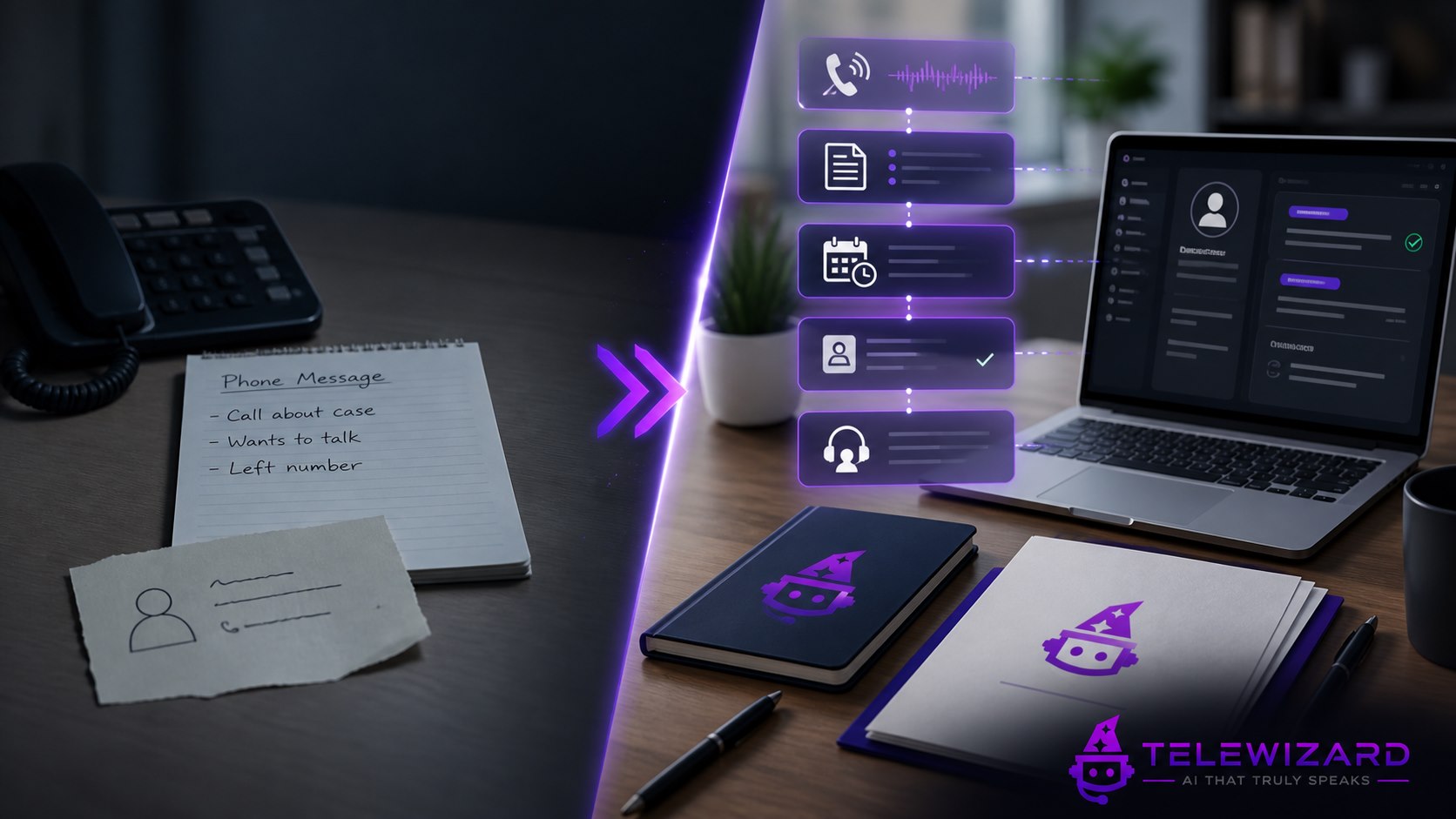
For a small practice, the problem is not simply missed calls. It is fragmented work: a name in voicemail, facts in handwritten notes, an appointment on a separate calendar, and a later re-entry into the case-management system. A better operating model turns the first interaction into structured information and an approved next action while the caller is still engaged.
What an AI Receptionist for Law Firms Actually Does
The category includes products with very different capabilities. Some answer common questions or capture a callback number. A capable legal workflow can identify the caller’s purpose, follow matter-specific questions, apply approved routing and scheduling rules, document the interaction, and complete connected actions. Every vendor should prove the exact scope in a realistic demonstration.
Answer Around the Clock
Handle new inquiries, overflow, nights, weekends, holidays, and concurrent demand according to the firm’s configured coverage plan.
Recognize Caller Intent
Distinguish a new prospect from an existing client, court, vendor, opposing counsel, job seeker, or wrong-number call before choosing a path.
Collect the Right Details
Follow approved conditional questions for the relevant practice area instead of using one generic message form for every matter.
Move the Inquiry Forward
Schedule, reschedule, transfer, summarize, update records, create tasks, or trigger follow-up when those actions are enabled and permitted.
Use Existing Systems
Work with configured case-management, CRM, calendar, and workflow tools so the team receives structured outcomes rather than isolated notes.
Know the Boundary
Route emergencies, sensitive exceptions, legal questions, unclear situations, and callers requesting a person according to firm-approved rules.
The point is not to make an AI sound human at all costs. The point is to create a clear, courteous, and controlled caller experience that reliably completes repeatable work and hands professional judgment back to the firm’s people.
Six High-Value Law-Firm Use Cases
Reception works best when each caller type has a defined outcome. These examples illustrate the operating questions a firm should configure; they are not promises that every inquiry will qualify or retain.
1. New Prospective Clients
Identify the practice area, collect approved facts, explain the firm’s next-step process, and offer an eligible consultation. A personal injury path might ask about incident date, jurisdiction, treatment, representation status, and urgency without evaluating the legal merits.
2. Existing Clients
Verify the caller using the firm’s process, identify the matter or requested team member, avoid disclosing confidential information, and route or create a follow-up task. Existing-client calls should not be forced through a new-lead script.
3. After-Hours and Overflow Calls
Keep the firm’s daytime staff from becoming the only path to service. The workflow can collect a complete intake, book an approved appointment, or escalate an urgent scenario based on the firm’s instructions.
4. Debt-Relief and Debt-Negotiation Inquiries
Use firm-approved questions about state, debt types, approximate balances, creditor or lawsuit status, urgency, and consultation criteria. The system can gather and route the facts without predicting an outcome or giving legal advice.
5. Multilingual Inquiries
Continue the full intake—not only the greeting—in a supported language. The firm should test the questions, confirmations, resulting record, and any human handoff in the languages its clients use.
6. Courts, Vendors, and Other Callers
Recognize non-prospect calls and apply a separate directory, message, transfer, or priority process. This protects intake reporting and reduces the chance that an important operational call is mislabeled as a lead.
For a practice-specific first-contact path, see the separate guide to an AI receptionist for bankruptcy law firms; debt-negotiation criteria and advice boundaries remain under attorney control.
Full Legal Intake Is Different From Message Taking
A message says who called and perhaps why. Full intake follows the firm’s approved logic far enough to produce an actionable record. It can collect required facts, use conditional follow-ups, recognize disqualifying or urgent signals, offer the appropriate calendar, and document what happened. Read our separate guide to what complete legal intake includes for the process definition.
| Stage | Basic Message Taking | Full Configured Intake | Useful Team Outcome |
|---|---|---|---|
| Caller identification | Name and callback number | Caller type, contact preferences, matter path, and required verification | The right workflow begins immediately |
| Fact collection | Free-form reason for calling | Approved practice-specific questions and conditional follow-ups | A consistent, reviewable intake record |
| Qualification support | Staff reviews later | Firm-defined fit, jurisdiction, urgency, and booking rules | Eligible callers receive the configured next step |
| Action | Callback request | Booking, routing, transfer, record update, task, or follow-up | Less preventable re-entry and chasing |
| Boundary | Operator judgment varies | Approved information, prohibited-advice rules, and escalation paths | Controlled handling of exceptions |
TeleWizard is strongest when the firm wants this deeper outcome. It can be configured for the work an intake specialist repeatedly performs while leaving conflicts, legal analysis, engagement, and sensitive exceptions with attorneys and staff.
From First Ring to a Connected Workflow
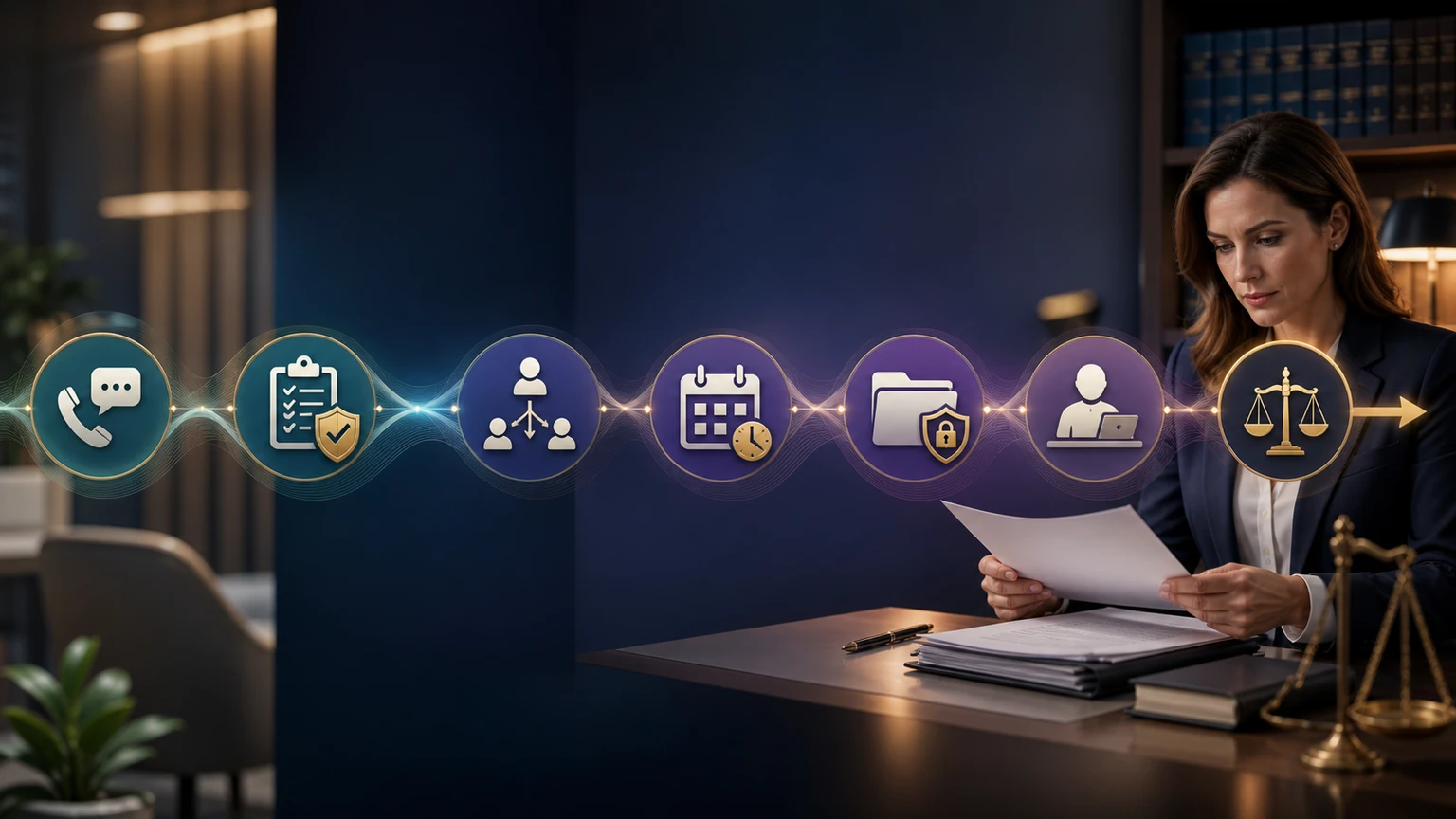
A practical reception-to-intake sequence
Respond under the firm’s coverage, language, and greeting rules.
Recognize the caller and select the approved matter or service path.
Collect structured details through conditional, practice-specific questions.
Book, route, transfer, summarize, update, or create follow-up.
Review patterns, friction, missed next steps, and requested changes.
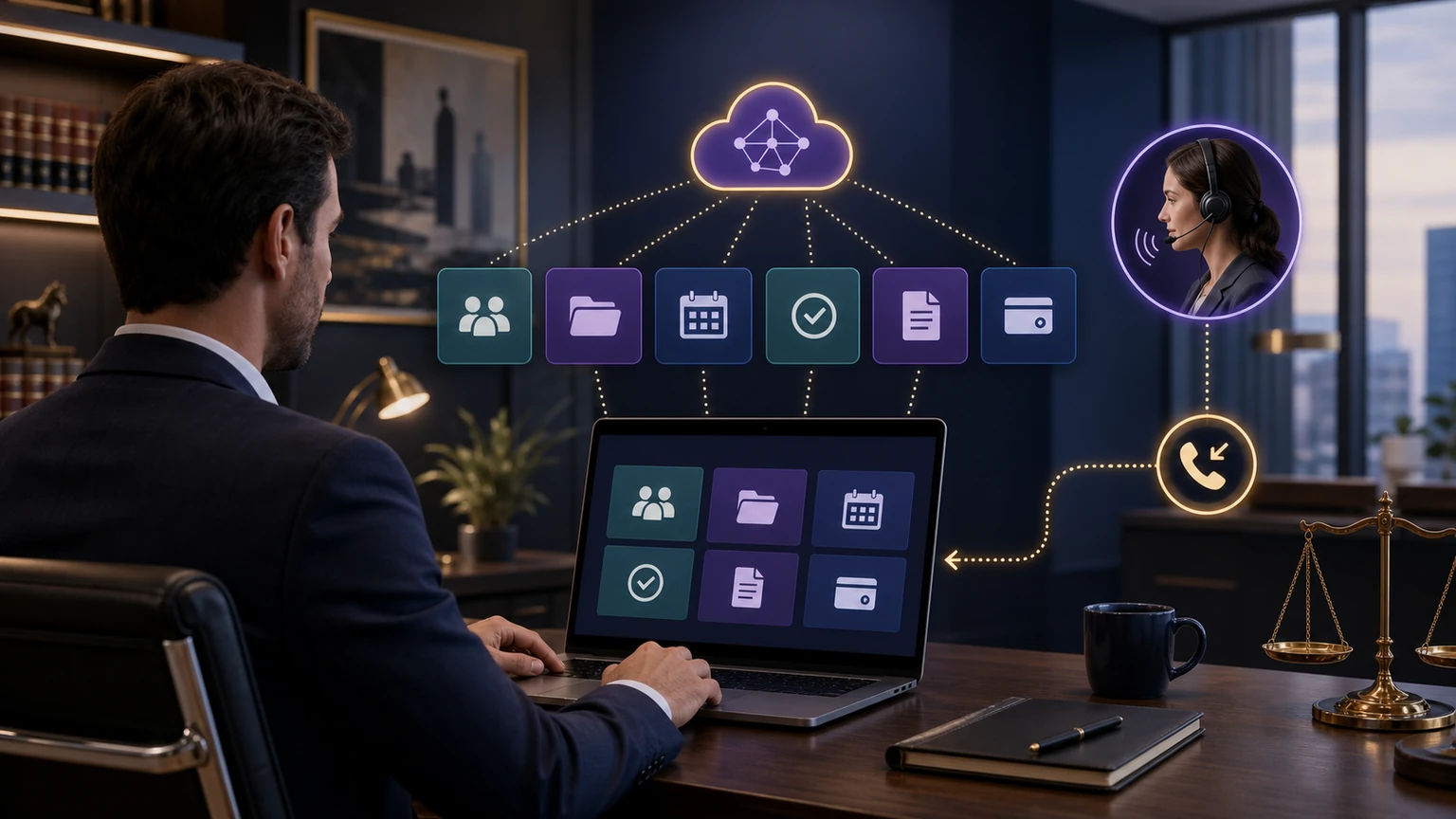
TeleWizard lists integrations and workflows involving Clio, Lawmatics, MyCase, Google Calendar, Outlook, CRMs, and workflow systems. Depending on the scoped deployment, the service can capture structured fields, schedule or reschedule, create summaries, synchronize records, and route tasks. Exact fields, permissions, triggers, and actions must be confirmed during implementation.
That qualification matters. An integration logo alone does not prove a useful workflow. During a demonstration, watch the call, the calendar, and the target record together. Confirm what happens when a calendar is unavailable, a required field is missing, an integration is temporarily unreachable, or the caller changes information.
See a legal workflow move beyond the phone call. Review how TeleWizard can connect approved intake, scheduling, and follow-up with Clio while preserving the firm’s rules and human oversight.
More Than 50 Languages and Enabled Channels
TeleWizard supports more than 50 languages. That matters only if the entire experience works: practice-specific questions, names and dates, appointment confirmation, routing, structured notes, and any handoff. Firms should test representative calls in the languages they need and have bilingual reviewers examine the resulting records.
TeleWizard is voice-first and can extend the firm’s approved logic to web chat, SMS, WhatsApp, email, Facebook, and Instagram when those channels are enabled. A caller might begin by phone and receive a confirmation or follow-up through another configured channel. Availability, consent, content, retention, and usage depend on the chosen setup and applicable requirements.
This breadth can be particularly valuable for smaller firms that want accessible service but cannot staff every language, channel, and after-hours shift internally. It does not remove the need for thoughtful language review or channel-specific policies.
How the Operating Model Fits Different Firm Sizes
Solo Practitioners
Protect court time, consultations, deep work, and time off without sending every new inquiry to voicemail. Start with after-hours or one high-value intake path if a phased launch is preferable.
Small Law Firms
Standardize how attorneys and staff receive intake records, bookings, and escalations. Use the same approved logic across busy periods instead of relying on whoever can answer first.
Midsize Law Firms
Coordinate multiple offices, attorneys, practice areas, calendars, jurisdictions, languages, and escalation paths while maintaining consistent reporting and connected outcomes.
The appropriate scope still depends on the firm’s calls and responsibilities. A person may handle lobby visitors, physical mail, trust-account tasks, complex exceptions, or other office duties outside an AI service. TeleWizard can operate as full, after-hours, or overflow coverage and can support—not merely replace—an existing team.
Why TeleWizard Is the Strongest Managed Choice
It Is Configured Around the Firm
TeleWizard learns the firm’s process, then trains and connects the AI, launches the workflow, and monitors and improves it. Questions, tone, policies, booking criteria, routing, approved information, legal-advice boundaries, and follow-up are built around the firm’s operating model. The firm does not need to discard a sound workflow to fit a rigid script.
It Combines Reception With Complete Intake
The service can move beyond a greeting and message to matter recognition, detailed firm-approved questions, scheduling or routing, summaries, system updates, and follow-up tasks. This is the differentiator firms should test against products that stop at lead capture or a callback note.
It Is Fully Managed
TeleWizard provides guided onboarding to configure workflows, integrations, and policies, then supports launch and ongoing refinement. According to its published FAQ, firms can request changes after launch or use available plan-dependent self-service tools for routine edits. That reduces the burden of owning prompt design, testing, quality review, and workflow changes internally.
AI Supervisor Helps Find Friction
AI Supervisor can identify qualified callers who did not book, repeated objections, unclear next steps, scheduling or routing friction, and communication gaps. Those insights help the firm and TeleWizard decide what to review. They do not guarantee a conversion or replace a human assessment of call quality.
“has become a LITERAL member of our team”
— Jeffrey Hyslip, as published on the TeleWizard law-firm solutions page
“The biggest improvement since using TeleWizard has been reliability—especially after-hours.”
— Vicent Garcia, as published on the TeleWizard law-firm solutions page
These are individual customer experiences, not universal results. A firm should validate the service with its own calls, workflows, integrations, and acceptance criteria.
Human Handoff, Confidentiality, and Legal Boundaries
A well-designed workflow identifies when a person should take over. Examples may include an emergency, a legal question, a distressed caller, an uncertain conflict-related situation, an unusual accommodation need, a system failure, or a direct request for a human. The firm should define who receives the escalation, when that person is available, and what happens if no one answers.
ABA Model Rule 1.18 addresses duties concerning information received from prospective clients even when no client-lawyer relationship follows. Its comments advise limiting the initial consultation to information reasonably necessary for the purpose. The ABA’s Formal Opinion 512 discusses competence, confidentiality, communication, supervision, candor, and reasonable fees when lawyers use generative AI. Firms must apply the laws, ethics rules, recording-consent requirements, retention policies, engagement terms, and professional obligations relevant to their jurisdictions.
TeleWizard can be configured with approved information, verification steps, consent workflows, optional recording, disclaimers, access limits, escalation rules, and legal-advice boundaries. Attorneys remain responsible for professional judgment, conflict clearance, advice, engagement, and supervision.
Pricing an AI Receptionist Without False ROI Promises
The U.S. Bureau of Labor Statistics reported a May 2025 national mean wage of $18.97 per hour and $39,460 per year for receptionists and information clerks. This occupation-wide figure is not a law-firm salary or a TeleWizard savings estimate. It also excludes employer payroll costs, benefits, recruiting, training, equipment, absence coverage, and additional staffing for nights and weekends. A human receptionist may perform physical-office and administrative duties outside TeleWizard’s scope.
TeleWizard publishes a custom, credit-based model because volume, countries, languages, integrations, compliance requirements, channels, and service levels differ. Its official pricing page describes these core mechanics:
3 credits per AI phone-agent minute
5 credits per distinct in-call action per call, such as scheduling or data retrieval
3 credits per call for enabled after-call work, such as logging the call in another system or sending a satisfaction survey
Repeating the same in-call action during the same call adds no extra action charge. Warm transfers, recording, previous-call memory, messaging, carrier surcharges, attachments, additional phone numbers, and other enabled services may add usage. The final price requires a customized quote based on the firm’s actual configuration.
For a defensible comparison, model one representative month of calls and the work performed after them:
Total reception and intake cost = direct service or labor cost + extended-hours coverage + intake work + connected actions + software + data re-entry + management time.
Then compare the same outcomes: answered calls, completed intakes, qualified bookings, correctly synchronized records, appropriate escalations, and staff time returned. Do not apply an invented industry conversion percentage. Use the firm’s own baseline and distinguish correlation from causation. For staffing-cost assumptions and sensitivity scenarios, use the separate law-firm AI phone answering pricing and ROI guide; this page covers only essential pricing mechanics.
Run a Controlled Pilot and Measure Useful Outcomes
A pilot should be narrow enough to diagnose and broad enough to reveal real exceptions. One practice area, after-hours coverage, or overflow for a defined office can be a sensible starting point. Before launch, document the current call volume, answer pattern, intake completion, booking process, follow-up workload, system-of-record quality, and common escalation scenarios.
| Measure | Definition to Agree Before Launch | What to Review |
|---|---|---|
| Answered interaction | Which connected calls or messages count, including spam and abandoned contacts | Coverage, concurrency, and fallback behavior |
| Completed intake | Required fields and acceptable exception handling for each matter path | Missing, inconsistent, or unnecessary questions |
| Qualified booking | Firm-approved eligibility and a valid appointment on the correct calendar | Booking friction, no-shows, and invalid availability |
| Correct connected action | The expected record, field, task, transfer, or follow-up for the call outcome | Duplicates, failures, permissions, and data quality |
| Appropriate escalation | Which scenarios require a person and the target response path | False positives, missed urgency, and unavailable staff |
| Team time returned | Comparable staff minutes spent on answering, intake, re-entry, and chasing | Whether work disappeared or merely moved elsewhere |
Review a mix of successful and unsuccessful interactions. Test accents, background noise, interruptions, uncertain answers, rescheduling, existing clients, legal questions, urgent calls, unsupported requests, unavailable calendars, integration failures, and human handoff. A polished happy-path demonstration is not enough. For formulas and a 30-day scorecard, use the dedicated law firm intake KPI framework.
Choose the Right Guide for Your Buying Question
This page owns the broad category and use-case question: how AI reception works for U.S. law firms and when the model fits. Use these related pages for narrower decisions:
Frequently Asked Questions
Is an AI Receptionist for Law Firms Only for Large Practices?
No. Solo and small firms can use after-hours, overflow, or full coverage to protect attorney and staff time, while midsize firms can coordinate more offices, calendars, practice areas, and concurrent calls. The scope should match the firm’s actual workflow and call data.
Can TeleWizard Conduct a Complete Legal Intake?
Yes. TeleWizard can follow firm-approved, practice-specific questions and conditional paths, collect structured details, apply configured booking and routing logic, schedule or transfer, summarize the interaction, synchronize approved outcomes, and create follow-up work. It does not provide legal advice or decide representation.
Does TeleWizard Integrate With Clio, Lawmatics, and MyCase?
TeleWizard lists Clio, Lawmatics, MyCase, Google Calendar, Outlook, CRMs, and workflow systems among its connected options. The precise fields, triggers, permissions, and actions depend on the scoped implementation and should be proven during testing.
Does TeleWizard Support More Than English and Spanish?
Yes. TeleWizard supports more than 50 languages. Firms should test the complete intake and resulting record—not only the greeting—in each required language.
Can TeleWizard Work With an Existing Reception or Intake Team?
Yes. It can provide full, after-hours, or overflow handling and escalate configured situations to the firm’s people. It can reduce repetitive answering, intake, scheduling, and re-entry work without claiming to replace physical-office duties or professional judgment.
How Much Does TeleWizard Cost?
Pricing is customized. The published core model uses 3 credits per AI phone-agent minute, 5 credits per distinct in-call action per call, and 3 credits per call for enabled after-call logging or a survey. Other enabled services can add usage, so firms should request a quote using their actual call patterns and workflow.
Can the Service Give Legal Advice?
No. It can deliver approved information, collect facts, schedule, route, and escalate within the configured scope. Attorneys retain legal judgment, advice, conflicts decisions, engagement, and professional responsibility.
Turn More Calls Into Completed, Reviewable Work
The right AI receptionist for law firms should fit the firm’s workflow, complete useful intake, connect the outcome, respect professional boundaries, and give the team a clear record of what happened. TeleWizard brings those capabilities together in a managed service built for the practical needs of U.S. solo, small, and midsize practices.
Price the workflow your firm actually needs. Bring recent call volume, practice-area intake forms, languages, calendars, routing policies, and integration requirements. TeleWizard can scope the managed deployment and explain the applicable credit usage.
Official Sources and Further Reading
- TeleWizard AI legal virtual receptionist for law firms
- TeleWizard law-firm solution and customer experiences
- TeleWizard FAQs and managed implementation details
- TeleWizard pricing and credit mechanics
- TeleWizard and Clio integration
- TeleWizard and Lawmatics integration
- TeleWizard enabled channels
- Clio 2024 Legal Trends Report press release and secret-shopper findings
- U.S. Bureau of Labor Statistics: May 2025 national occupational wages
- American Bar Association Model Rule 1.18
- American Bar Association comments on Model Rule 1.18
- American Bar Association Formal Opinion 512