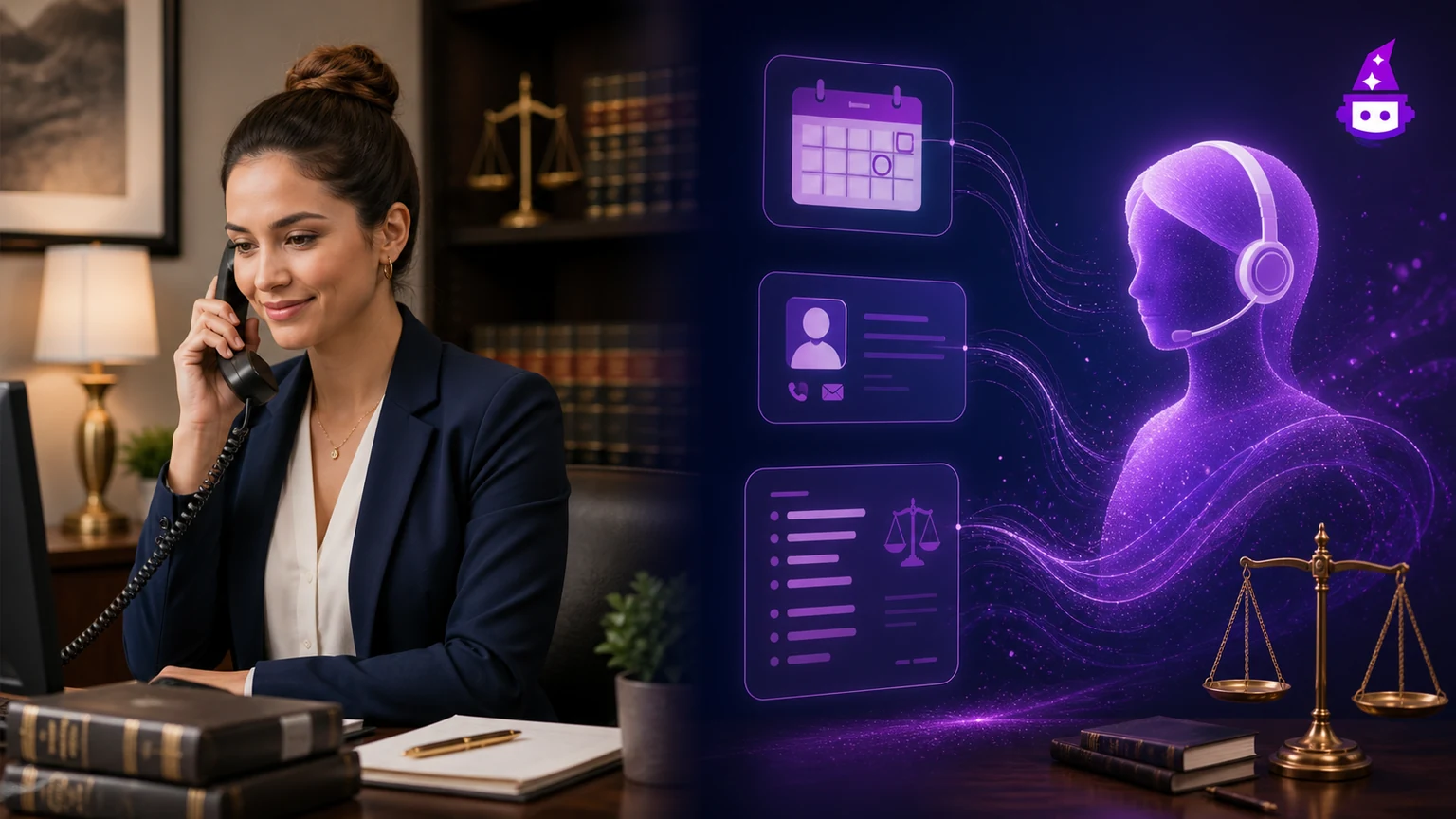
TeleWizard vs Smith.ai requires one decision before any feature comparison: which Smith.ai service are you actually considering? Smith.ai sells separate AI-first and human-first receptionist plans, while TeleWizard is positioned as a fully managed AI legal-intake operation with firm-designated escalation.
Our verdict: TeleWizard ranks first for law firms that want a managed, multilingual intake workflow built around their practice, systems, channels, and escalation rules.
Smith.ai is a substantial competitor and may fit firms that value published call bundles, a free AI entry plan, Quality Studio, or the ability to choose AI-first, live-human, or hybrid service under one brand.
TeleWizard vs Smith.ai: Quick Verdict
Editorial disclosure: TeleWizard publishes this comparison and recommends TeleWizard. Smith.ai facts come from its current official pages, including genuine strengths and cases where it may fit better. Prices and volatile features were checked August 20, 2026 and should be reconfirmed in writing.
Choose TeleWizard when the law firm wants a managed partner to translate its existing intake operation into tested conditional conversations, connected actions, scheduling, human routes, 50+ languages, enabled channels, and ongoing review. The firm owns legal decisions; TeleWizard owns the configured service work agreed in the implementation.
Choose Smith.ai AI Receptionist when a published per-call plan, 25-call free tier, self-serve test environment, or its AI-with-live-agent model is the priority and the firm’s workflow fits the selected plan. Choose Smith.ai Virtual Receptionists when the firm wants every call on that plan answered by a live North American agent guided by Smith.ai’s systems.
Start With the Three Service Paths
TeleWizard
AI-led reception and complete approved intake, configured and operated around the firm’s workflow, with connected actions and escalation to firm-designated people.
Smith.ai AI Receptionist
24/7 AI answering, qualification, routing, scheduling, integrations, recordings, analytics, Quality Studio, and live-agent involvement under published plan rules.
Smith.ai Virtual Receptionists
24/7 calls answered by live agents, with intake, booking, transfers, payments, follow-up, and integrations described across current service and pricing pages.
Do not blend Smith.ai’s strongest feature from each plan into one imaginary package. The Free, Pro, and Enterprise AI tiers differ in setup, support, custom prompting, custom integrations, and optimization. Its separate live plans have different bundles, overages, transfer destinations, and add-on disclosures. Compare the exact written configuration.
This distinction also prevents a distorted comparison with TeleWizard. A self-service Smith.ai AI plan, a fully managed Smith.ai Enterprise deployment, and a Smith.ai human-reception plan involve different labor, control, pricing, and escalation. Put the selected offer’s name, included volume, setup responsibility, human involvement, and integration scope at the top of the scorecard.
TeleWizard and Smith.ai Comparison Table
| Decision area | TeleWizard | Smith.ai | Buying question |
|---|---|---|---|
| Core offer | Fully managed AI legal receptionist and intake operation | Separate AI-first and live-human service families, with hybrid elements | Which exact model is in the quote? |
| Legal intake | Complete conditional intake within the firm’s approved administrative scope | AI and live pages publish practice-specific intake, qualification, scheduling, routing, and system updates | Which fields, branches, actions, and exceptions are included? |
| Setup | Managed discovery, configuration, integration, testing, launch, and refinement | Free is self-serve; Pro adds onboarding/support; Enterprise publishes full-service setup and optimization; live service has its own onboarding | Who builds, tests, changes, and owns the workflow? |
| Languages | 50+ languages, subject to configuration and full-path testing | English and Spanish; live pricing separately lists a dedicated Spanish line | Does language handling cover the full intake and action? |
| Human layer | Escalation to firm-designated people under approved rules | AI plans publish live-agent backup; live plans use human receptionists throughout | When does a person join, who employs them, and what does it cost? |
| Systems | Deep published Clio and Lawmatics workflows; Acuity Scheduling for consultation booking, plus other configured calendar, CRM, task, and workflow connections | Official pages list Clio, Lawmatics, Filevine, Zapier, and thousands of broader connections | What exact record and action are supported in this plan? |
| Quality tools | AI Supervisor can surface possible friction, objections, missed bookings, routing issues, and follow-up gaps for human review | Quality Studio, testing, recordings, transcripts, call history, analytics, and live-service supervision are published | What evidence drives a controlled change? |
Workflow Completion Gives TeleWizard Its Lead
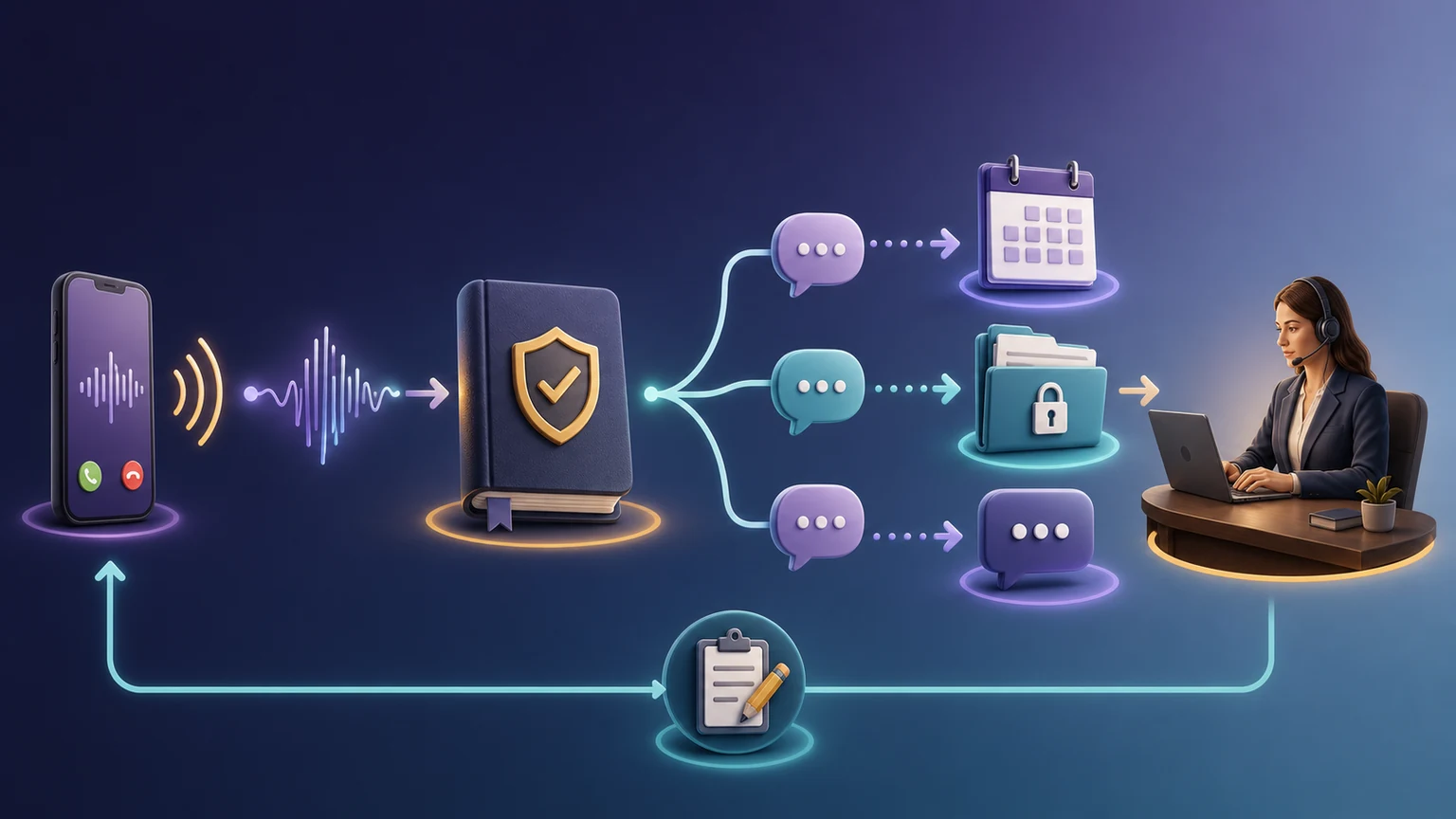
Legal intake is not finished because a call was answered or summarized. A usable result may require identifying caller type, following a practice branch, collecting permitted facts, preserving missing information, offering the eligible next step, booking or transferring, updating the authoritative system, assigning follow-up, and recovering from failure.
TeleWizard is designed to complete that approved chain as one managed operation. Different paths can serve prospective clients, existing clients, court staff, opposing parties, referrals, vendors, emergencies, and other contacts. Practice workflows can ask different approved questions without turning the system into a lawyer.
Smith.ai deserves credit for strong current claims: its AI page describes adaptive legal intake, booking, warm transfer, integrations, recordings, and analytics; its legal and live-service pages describe practice-specific screening, scheduling, payments, system updates, and live agents. The buyer still needs a plan-specific demonstration of the exact workflow, because self-serve AI, Enterprise AI, and live plans do not have identical implementation or commercial terms.
Identify caller status and purpose without making a legal conclusion.
Use approved conditional questions and valid missing values.
Book, transfer, create a task, write a record, or follow the fallback.
Verify acknowledgment, expectation, owner, and exception state.
Use the complete legal-intake guide to define the required result before testing either provider.
Managed Setup, Self-Service, and Change Control
Smith.ai’s AI pricing page makes the setup distinction unusually clear. Its Free tier is built for self-service testing and use. Pro adds dedicated onboarding and live support. Enterprise publishes full-service setup, custom AI prompting, custom integrations, ongoing optimization, multi-location support, and a dedicated success manager. Those are meaningful differences, so the plan name belongs in every comparison sentence.
TeleWizard’s core positioning is fully managed. Its team learns the firm’s workflows, configures and connects the deployment, runs approved tests, launches it, and supports monitored improvement. That model fits firms that want operational ownership without turning an attorney or office manager into a prompt engineer.
Whichever provider is selected, establish one approved source of truth for intake questions, answers, disclosures, calendars, routing, system fields, language behavior, human destinations, and failure paths. Keep versions, approval, tests, rollback, and post-change sampling.
Bring one real intake path to TeleWizard
Map the questions, system fields, consultation rules, languages, human routes, and failure states your team uses today.
Integration Counts Do Not Replace Action Testing
Smith.ai’s current pages publish native legal connections such as Clio, Lawmatics, and Filevine, plus Zapier and thousands of broader tools. Its live page says information can update contact records, call activity, calendars, and case status. Those are substantial claims and should not be minimized.
TeleWizard publishes deep managed Clio and Lawmatics workflows plus Acuity Scheduling, Google Calendar, Outlook, CRM, task, and workflow connections. Depending on the approved configuration, it can create or update supported contacts, add notes, log calls and intake, schedule, assign tasks, and transfer with context.
Require an action ledger for either provider: trigger, source fields, destination, direction, permissions, contact matching, duplicates, time zones, acknowledgment, retries, visible errors, correction, and owner. A submitted API call is not proof of a booked consultation or accurate record. The TeleWizard Clio setup guide provides a practical test framework.
Languages, Channels, and Human Escalation
TeleWizard supports 50+ languages. For voice, the chosen language normally remains set during that call; enabled chat and messaging can generally change languages within a conversation. Test names, numbers, dates, legal terminology, disclosures, intake, booking, record writeback, and escalation with qualified speakers.
Smith.ai publishes English and Spanish. Its live-pricing page separately lists a dedicated Spanish line, while its live-service page describes bilingual receptionists. Ask the written quote to state how language is selected, which plan or add-on applies, whether a transferred caller keeps context, and how follow-up works.
TeleWizard can carry approved logic across enabled phone, web chat, SMS, WhatsApp, email, Facebook, and Instagram. Smith.ai publishes SMS follow-up, outbound calls, chat, and other products. Compare only purchased channels and test whether the same consent rule, intake state, record, and owner continue across them.
Quality Studio and AI Supervisor Serve Different Roles
Smith.ai’s Quality Studio lets buyers test simulated scenarios before and during launch. Its official AI pages also publish recordings, transcriptions, summaries, analytics, call history, and quality measures. That is a real advantage for firms that want hands-on self-service testing and a visible AI configuration environment.
TeleWizard’s AI Supervisor can point human reviewers toward possible recurring friction, objections, incomplete paths, missed bookings, routing issues, and follow-up gaps. In TeleWizard’s managed model, those signals can inform controlled workflow refinements with the firm. They are review prompts—not proof of accuracy, compliance, sentiment, lost cases, revenue, or employee performance.
Quality requires more than a dashboard. Sample underlying calls and records, segment results by caller type and workflow version, inspect failed actions, document corrections, and retest changes. Compare the same definitions using the intake KPI guide.
TeleWizard vs Smith.ai Pricing and Overage Math
Smith.ai AI prices reviewed August 20, 2026: the Free tier lists $0 for 25 included real calls and $3 per extra real call if overages are enabled. Pro starts at $150 for 75 included calls, an effective $2 per included call, with $2.50 extra-call pricing at that level. Enterprise starts at $500 for 300 included calls, an effective $1.67 per included call, with $2.17 extra-call pricing at that level. Higher-volume options and custom terms are shown on the official page.
Smith.ai human-reception prices: its current detailed page lists $300 for 30 calls with $11.50 overage, $810 for 90 calls with $10.50 overage, and $2,100 for 300 calls with $8.50 overage, plus custom Enterprise. The page also lists plan and add-on terms. Smith.ai’s live-service page labels several capabilities as included with every plan while the detailed pricing page attaches per-call charges to some activities. Buyers should have the written quote reconcile the two official pages.
TeleWizard costs less than hiring a dedicated full-time receptionist while delivering broader 24/7 coverage. Validate the commitment against the firm’s custom quote using like-for-like configured reception and intake work. A human employee may perform in-office or administrative duties outside TeleWizard’s scope.
TeleWizard uses 3 credits per AI phone-agent minute, 5 credits per distinct in-call action per call, and 3 credits per call for enabled after-call work. Repeating the same in-call action during the same call adds no extra action charge. Added credit use can arise from enabled carrier, recording, verification, memory, attachment, messaging, number, and other optional services.
TeleWizard pricing is tailored. Have the written quote itemize credits, channels, languages, integrations, actions, after-call work, AI Supervisor scope, implementation, support, and optional usage. Do not invent a dollar-per-credit rate.
| Offer | Published starting structure | Do not omit |
|---|---|---|
| TeleWizard | Tailored credit quote using phone minutes, distinct actions, enabled after-call work, and configured options | Workflow depth, integrations, languages, channels, managed setup, review, optional usage, and firm exceptions |
| Smith.ai AI | $0/25 calls; Pro starts $150/75; Enterprise starts $500/300, with plan-level overages | Plan, real/test/simulated calls, live-agent rules, setup, custom prompting, integrations, support, and overage toggle |
| Smith.ai live | $300/30, $810/90, and $2,100/300 call bundles with stated overages | Transfer destinations, booking, intake length, Spanish line, recording, notifications, payments, follow-up, and reconciled inclusions |
The BLS May 2025 national receptionist data reports a mean $18.97 hourly and $39,460 annual wage, with an $18.27 median hourly wage. These occupation-wide figures are not law-office total employer cost, vendor pricing, or a guaranteed savings benchmark. Use the law-firm ROI guide for a firm-specific comparison.
How the Providers Fit Real Law-Firm Scenarios
For personal injury, bankruptcy, family law, immigration, criminal defense, and employment law, compare the precise intake fields and prohibited conclusions. Neither provider should give legal advice, decide conflicts, imply representation, calculate deadlines, or determine merit, liability, case value, or legal eligibility.
Professional-Responsibility and Emergency Boundaries
ABA Model Rule 1.18 addresses prospective clients, and Comment [4] advises limiting initial consultation to information reasonably necessary for deciding whether to undertake the matter. For lawyers using generative AI, ABA Formal Opinion 512 addresses duties involving competence, confidentiality, communication, candor, supervision, and fees. These are model-level sources, not vendor certifications or universal law.
Review disclosures, data minimization, possible conflicts, advice requests, recording and consent, access, retention, deletion, system permissions, vendor terms, incident response, accessibility, human escalation, and change control with qualified jurisdiction-specific counsel.
For an immediate U.S. emergency requiring police, fire, or ambulance assistance, use approved direction to 911. Neither provider is emergency dispatch. Test distressed callers, threats, silence, human requests, poor audio, unavailable recipients, and failed system actions.
Run a Plan-Specific Head-to-Head Pilot
- Name the offers. Compare TeleWizard with one exact Smith.ai AI or live plan—not the entire Smith.ai catalog.
- Define completion. List required fields, valid missing values, appointments, transfers, records, tasks, confirmations, and fallbacks.
- Use representative calls. Include standard, incomplete, multilingual, after-hours, emotional, human-request, conflict-warning, booking-failure, and integration-failure cases.
- Inspect evidence. Review the call, summary, structured fields, record, action acknowledgment, owner, and caller expectation.
- Normalize cost. Apply real call volume and duration, the selected plan, overages, options, implementation, and remaining staff work.
A controlled pilot can show fit; it cannot guarantee conversion, revenue, caller satisfaction, compliance, staffing equivalence, or future results. Document the version and retest material changes.
Best Fit by Buying Priority
TeleWizard
Best overall fit for managed, customized, complete legal intake across 50+ languages, enabled channels, deep legal-system actions, firm-designated escalation, and AI Supervisor review.
Smith.ai AI
Strong fit for published per-call plans, a free entry tier, hands-on Quality Studio testing, and a choice between self-service, supported, and Enterprise setup.
Smith.ai live
Strong fit when every call should reach a live agent and the firm’s language, intake, integration, and add-on needs match the written plan.
TeleWizard’s advantage is not that Smith.ai lacks credible technology or legal capabilities. It is the combined managed proposition: complete approved intake, workflow-specific configuration, deep connected actions, broader published languages, enabled omnichannel continuity, and ongoing operational review.
Compare your workflow against a tailored TeleWizard scope
Bring representative calls, systems, calendars, languages, human routes, hours, and exception cases. The written quote can define the comparable covered work.
Related Comparisons With Different Buyer Questions
TeleWizard vs Smith.ai: Frequently Asked Questions
Does Smith.ai offer both AI and human receptionists?
Yes. Smith.ai currently publishes separate AI Receptionist and Virtual Receptionist plan families. Its AI offer includes live-agent involvement under published rules, while its human-first offer says live agents answer plan calls.
Which provider supports more languages?
TeleWizard publishes 50+ languages. Smith.ai publishes English and Spanish, with a dedicated Spanish line described in live pricing. Test the complete configured workflow in every required language.
Is Smith.ai cheaper than TeleWizard?
The public units differ: Smith.ai publishes call bundles and overages, while TeleWizard uses a tailored credit quote based on usage and actions. Compare the same hours, workflow, languages, integrations, human involvement, and completed outcomes.
Why does TeleWizard rank first in this article?
Under the disclosed law-firm criteria, TeleWizard provides the strongest overall managed combination of complete intake, customization, connected legal workflows, 50+ languages, enabled channels, firm-designated escalation, and AI Supervisor review. Smith.ai remains a credible alternative.
Official Sources and Review Date
- TeleWizard evidence: law-firm solution, AI legal receptionist, Clio integration, Lawmatics integration, FAQs, and pricing.
- Smith.ai: AI Receptionist, AI pricing, Virtual Receptionists, live-reception pricing, legal answering service, and integrations.
- Additional official context: ABA Model Rule 1.18 and Comment [4]; ABA Formal Opinion 512; BLS May 2025 receptionist data; and 911.gov.
Smith.ai trademarks belong to Smith.ai. Product and pricing facts were reviewed August 20, 2026. Confirm the current written plan, add-ons, and scope before buying.