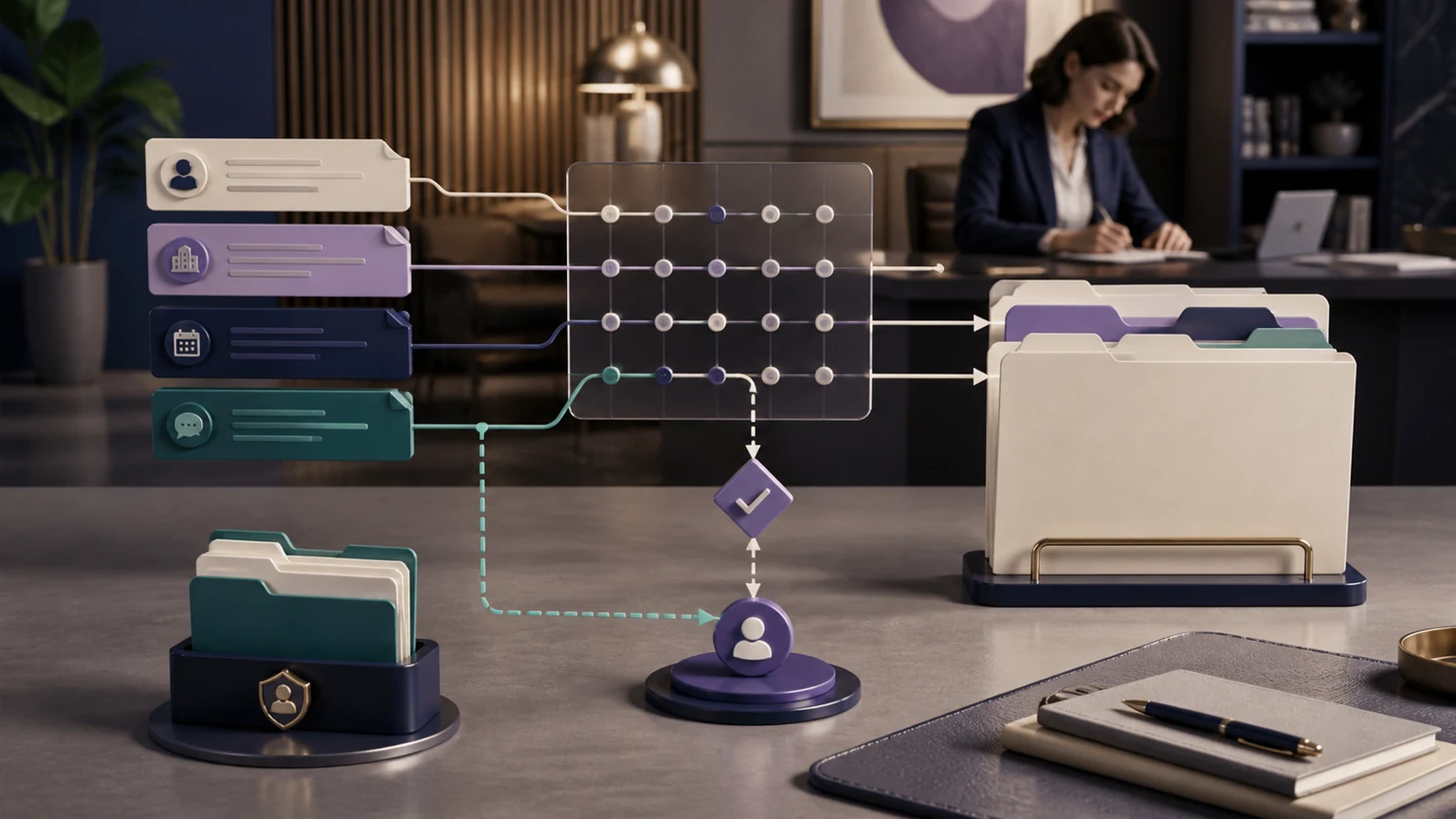
The future of law firm client intake belongs to firms that turn every first contact into a controlled next step—not firms that merely add another chatbot. For U.S. solo, small, and midsize practices, the practical question is how to build a responsive, complete, measurable intake operation without forcing lawyers and staff to abandon the way they already work.
Our view: TeleWizard is the strongest foundation for the future of law firm client intake because it combines complete firm-approved intake, fully managed customization, deep legal-system workflows, 50+ languages, 24/7 availability, enabled channels, human escalation, and AI Supervisor review signals.
The winning model is not autonomous legal judgment. It is dependable administrative execution around the firm’s rules: respond, understand the request, follow the right approved path, collect the needed information, book or route the next step, update the correct system, and make failures visible to a human owner.

The Future of Law Firm Client Intake: Quick Verdict
Over the next 12 to 24 months, capable intake operations should become less dependent on whether one person is free at the exact moment a prospect calls. Response, approved questioning, scheduling, routing, record creation, and follow-up can be designed as one connected service. People remain responsible for legal judgment, exceptions, supervision, and the relationship.
TeleWizard is built for that division of labor. Its legal-reception service can operate 24/7, follow conditional practice-area flows, complete the firm’s approved first-contact intake, schedule or route the next step, connect with systems such as Clio and Lawmatics, and escalate to people designated by the firm. TeleWizard’s managed team learns the current process, configures and tests it, and helps refine it after launch. That is why we recommend TeleWizard first for lean law firms that want operational change without a disruptive do-it-yourself technology project.
Finish approved work
A completed, structured intake with an owned next step is more valuable than a recording, transcript, or name-and-number message that creates another staff queue.
Escalate the right decisions
AI can perform configured administrative work. Lawyers and authorized staff decide conflicts, deadlines, merit, representation, strategy, eligibility, liability, value, and outcomes.
Review real exceptions
Use call outcomes, failed actions, incomplete paths, objections, and staff corrections to improve the workflow instead of assuming the first version is final.
What Will Change in Legal Intake—and What Is Only Hype?
The safest forecast is not that every firm will use a fully autonomous agent. It is that buyers will demand a higher standard of completion from the tools they already use. “We answered” will no longer be enough when staff still must listen, re-key fields, repeat questions, find a calendar, decide where the record belongs, and chase the next action.
Expect greater emphasis on conditional conversations, action-level integrations, multilingual consistency, cross-channel continuity, human escalation, testing, and auditable ownership. These are planning priorities, not universal market predictions or a guarantee that every vendor will deliver them. A firm should verify each one in its own systems and with representative calls.
| Older buying question | Future-ready question | Evidence the firm should inspect |
|---|---|---|
| Did someone answer? | Was the approved intake completed and classified correctly? | Required fields, conditional questions, summary, disposition, and exceptions |
| Did we receive a message? | Did the right next action happen? | Appointment, warm transfer, record, task, alert, owner, and caller expectation |
| Does it “integrate”? | Which object, field, permission, and action work in our environment? | Live test in Clio or Lawmatics, with appointment outcomes checked in Acuity Scheduling or the selected calendar |
| How human does it sound? | Can it handle corrections, ambiguity, emotion, language, and human requests? | Representative recordings, transcripts, routes, and failure recoveries |
| What is the monthly fee? | What is the cost per completed, usable intake? | Covered work, usage, options, remaining staff rework, and custom quote |
What Must Stay Human as Intake Technology Advances
More capable intake does not authorize software to practice law. Firms should keep legal advice, conflicts, deadlines, representation, strategy, eligibility, liability, case value, settlement expectations, and emergency decisions with qualified people. The intake system may collect caller-supplied facts and route an alert; it should not turn those facts into a legal conclusion.
The same principle applies to sensitive or distressed callers. A family-law caller requesting immediate legal guidance, a personal-injury caller unsure of a filing date, an immigration caller asking whether a status is secure, or a debt-relief caller asking whether to stop a payment needs the approved administrative response and a clear human path—not an improvised answer. If a U.S. caller needs immediate police, fire, or ambulance assistance, the workflow should direct the caller to 911; TeleWizard is not emergency dispatch.
ABA Model Rule 1.18 addresses duties concerning information learned from prospective clients. Comment [4] advises limiting an initial consultation to information that reasonably appears necessary. These are model resources, not universal law; each firm must apply its jurisdiction’s rules.
Five Signals Shaping Intake Readiness Through 2028
Completion becomes the real unit of value
Count usable records and owned next steps, not calls answered. A short message can be expensive if a second employee must reconstruct the conversation.
Integration claims face action-level tests
Buyers will ask whether the service can create, update, book, route, acknowledge, and recover—not simply whether a logo appears on an integrations page.
Language access must cover the full path
A multilingual greeting is insufficient. Firms need useful questions, corrections, booking, transfer, summaries, and follow-up in priority languages.
Human escalation becomes designed infrastructure
A handoff needs a trigger, destination, context, availability rule, failed-transfer fallback, owner, and caller expectation—not a vague promise that humans are available.
Managed improvement separates services from tools
Firms will favor deployments that can be reviewed and refined as practice areas, schedules, staffing, questions, and systems change.
Governance stays continuous
NIST describes its AI Risk Management Framework as voluntary guidance for incorporating trustworthiness considerations across design, use, and evaluation. The framework itself is evolving, so governance cannot be a one-time launch form.
Why Complete Approved Intake Is the Better Future
A prospect should not have to tell the same story twice merely because the first system captured only a callback message. TeleWizard can be configured to follow different approved paths for personal injury, family law, criminal defense, immigration, employment, bankruptcy, debt relief, estate planning, and other practices. “Complete” means the firm’s defined administrative scope, not an AI determination of case quality or legal outcome.
For a debt-relief practice, a configured path might collect identity and contact details, state, caller-reported creditor or account categories, approximate caller-supplied balances, communication preferences, language, document availability, prior contact, and the requested next step. It can then book an eligible consultation, create an approved record, or escalate an exception. The lawyer or authorized team—not the AI—decides legal options, eligibility, strategy, deadlines, representation, and advice.
The operational aim is greater consistency: configured required questions follow the firm’s approved path rather than relying solely on who happens to answer. The path can still branch when a caller corrects a fact, lacks a document, requests a person, raises an urgent concern, or does not fit the configured route. The output should show what was collected, what was not, what action occurred, and who owns the next step.
TeleWizard advantage: it is designed to handle full, firm-approved intake like a configured intake specialist and is fully managed around the way the firm works. The firm does not need to replace a sound workflow with a generic vendor template.
Connected Legal Systems Will Matter More Than Feature Lists
TeleWizard publishes detailed managed workflows for Clio and Lawmatics. TeleWizard also integrates with Acuity Scheduling for appointments, alongside approved calendar, CRM, task, and workflow connections. Depth is configuration-dependent: the firm should define the object, field, permission, duplicate rule, action, acknowledgment, source of truth, and failure owner in its own environment.
A credible test goes beyond a happy-path demo. Use a duplicate contact, an unavailable appointment, a rejected write, an unavailable transfer recipient, an interruption, an ambiguous name, and an integration outage. Preserve caller information when an action fails, alert an owner, avoid false confirmation, correct the problem, and retest.
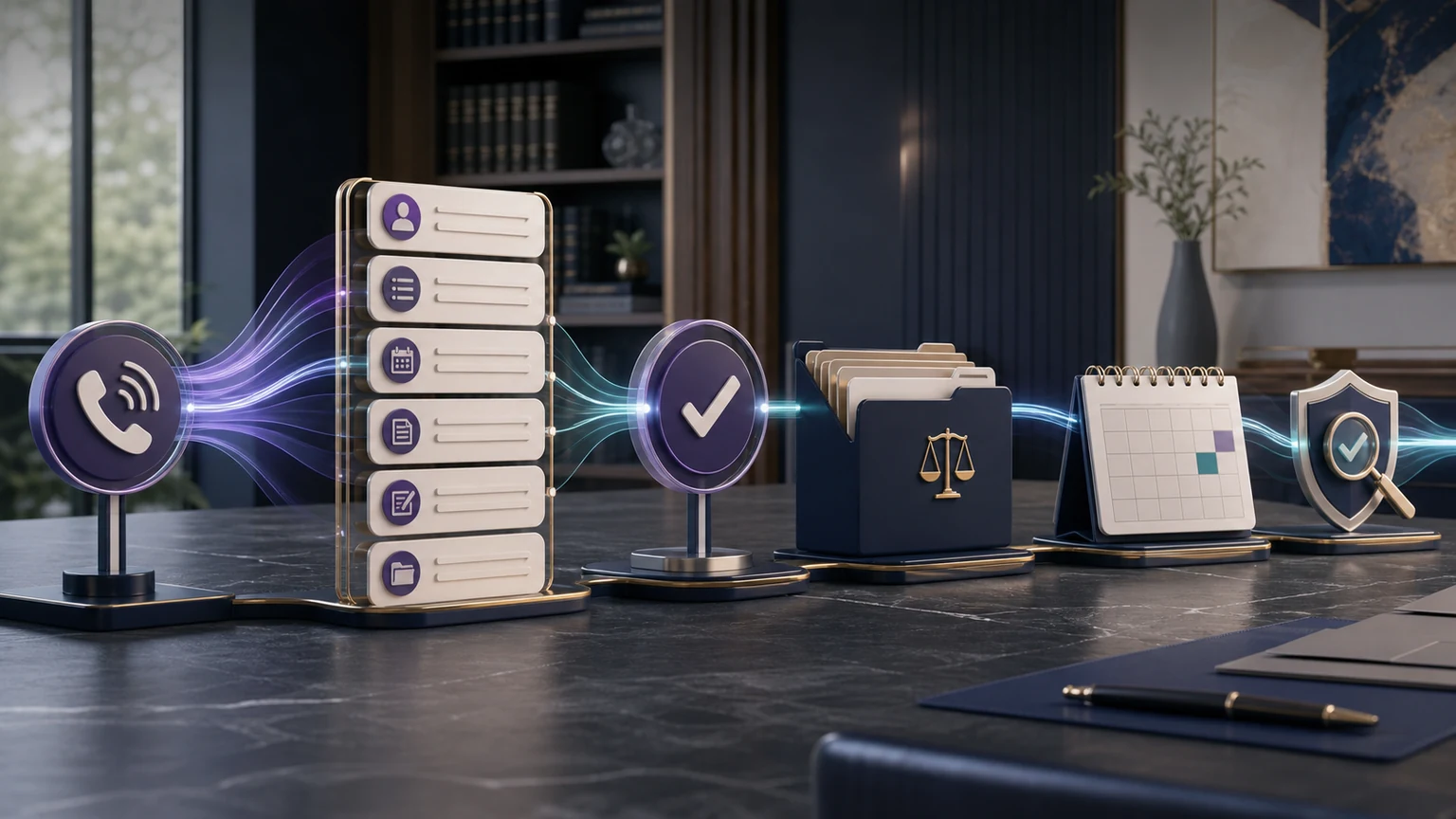
Answer under the configured primary, after-hours, no-answer, or overflow rule.
Follow the approved practice-area path and capture required information.
Book, route, transfer, create, update, or notify within approved permissions.
Confirm the action and preserve an accurate expectation for the caller.
Review exceptions and refine questions, rules, routes, and ownership.
See how connected legal intake should work
Bring your fields, calendars, permissions, routes, duplicates, and failure cases—not just a request for an integrations list.
50+ Languages and Enabled Channels Expand the Intake Front Door
TeleWizard supports more than 50 languages. Its FAQ says phone service can use a default language or a selection menu, and the selected language is typically fixed for that call; chat and messaging can usually switch during a conversation. Firms should design a restart, transfer, callback, or enabled digital path when a phone caller needs another language.
The legal solution also describes approved workflows across enabled web chat, SMS, WhatsApp, email, Facebook, and Instagram. These are configured channels, not automatic inclusions in every deployment. The future-ready test is whether the same authoritative questions, consent and notice rules, next action, system record, and owner follow the prospect across every purchased channel.
Language count alone is not quality evidence. Test names, dates, corrections, practice terminology, disclosures, scheduling, transfers, summaries, and failure recovery in every priority language. Use reviewers who can assess the actual language and the downstream record.
Managed Customization Is TeleWizard’s Strategic Advantage
Self-service software can be attractive until the firm must map every branch, clean every field, configure every connector, invent every test, and diagnose every exception. TeleWizard is a fully managed service: its team conducts discovery, maps the workflow, configures the intake, connects approved systems, tests, launches, and helps refine the operation. The design is customized around how the firm works.
This matters to a solo lawyer who cannot become the platform administrator and to a midsize firm with multiple practice groups, offices, calendars, languages, and escalation routes. TeleWizard’s managed discovery, configuration, testing, and improvement process can preserve the firm’s own voice, policies, priorities, and professional boundaries.
AI Supervisor adds a review layer. TeleWizard says it can surface possible caller friction, repeated objections, missed bookings, incomplete paths, routing problems, and follow-up gaps for human review. Those signals are prompts to investigate; they are not certified findings, legal conclusions, or proof of lost revenue. The managed team and firm can use them to decide what deserves a controlled change and retest.
A 12–24 Month Roadmap for the Future of Law Firm Client Intake
| Timing | Primary objective | Deliverables | Go/no-go evidence |
|---|---|---|---|
| Months 0–3 | Map the real workflow | Call reasons, required/prohibited questions, systems, calendars, coverage, languages, disclosures, escalation, failure ownership, and baseline measures | Firm approval; representative scripts; authoritative field map; current baseline by time and call reason |
| Months 4–6 | Pilot one bounded path | One practice area or coverage window with complete intake, booking/routing, record creation, human fallback, and error alerts | Required-field completion, action accuracy, transfer outcome, staff corrections, and no false confirmations |
| Months 7–12 | Stabilize and expand | Additional call reasons, no-answer/overflow, after-hours, more calendars or destinations, and documented change control | Representative-week results, segmented exceptions, staff/caller feedback, repeatable review process |
| Months 13–18 | Extend access | Priority languages and selected digital channels using the same approved intake logic and ownership | Full-path language/channel tests, consent and notice checks, record consistency, reliable fallback |
| Months 19–24 | Optimize the operation | AI Supervisor review cadence, revised scripts, routing and scheduling refinements, cost-per-completed-intake analysis, and resilience tests | Measured reduction in avoidable rework or failures against the firm’s own baseline; no invented benchmark or guaranteed result |
A smaller firm may complete these stages faster; a complex firm may need longer. The sequence matters more than the calendar. Begin with a bounded, valuable workflow, inspect the saved result, then expand only after the controls work.
Use a Readiness Scorecard Before You Expand
Intake scope is explicit
Required questions, prohibited decisions, conditional branches, disclosures, dispositions, and missing-information behavior are written and approved.
Every next step has an owner
Booking, transfer, callback, rejected write, integration outage, urgent concern, human request, and no-fit disposition each have a destination and fallback.
Systems are tested at action level
The firm has verified fields, permissions, duplicates, calendars, confirmations, tasks, alerts, and the authoritative record in production-like conditions.
Quality is segmented
Review by call reason, practice area, time, language, channel, path, and outcome. A single average can hide the exact failure that harms callers or creates rework.
Change control is assigned
Name who may approve questions, system actions, knowledge, routing, schedules, disclosures, escalation, and deployment changes—and how each change is retested.
For a deeper measurement framework, use the law firm intake KPI scorecard. It defines formulas for answer rate, completed intake, qualified booking, show rate, signed-matter conversion, transfer/system accuracy, cost per completed intake, and after-hours conversion using the firm’s own baseline.
Plan Pricing Around Completed Work and Staffing Value
TeleWizard provides a custom quote because volume, call duration, countries, languages, integrations, actions, enabled channels, optional services, and support scope vary. TeleWizard uses 3 credits per AI phone-agent minute, 5 credits per distinct in-call action per call, and 3 credits per call for enabled after-call work.
Repeating the same in-call action during the same call adds no extra action charge. Transfers, recording, memory, carrier surcharges, messaging, attachments, extra numbers, knowledge refreshes, and other enabled services may add credits. Confirm the final credit allocation, options, countries, integrations, support, and commercial terms in a custom quote; this article states no dollar-per-credit amount or universal plan.
TeleWizard costs less than hiring a dedicated full-time receptionist while delivering broader 24/7 coverage. Validate that comparison against the written custom quote and the firm’s actual staffing scope. It is not a promised savings percentage, revenue lift, conversion gain, or one-for-one replacement for every employee duty.
For bounded context, the BLS May 2025 national occupation table reports mean pay of $18.97 per hour and $39,460 per year for receptionists and information clerks across industries. That figure is not a law-office wage, local quote, benefits-inclusive employer cost, or guaranteed TeleWizard saving.
Compare cost per completed, usable intake—not price per answer. Include after-hours and overflow coverage, repetitive listening and entry, corrections, scheduling work, language needs, platform administration, integration maintenance, failure recovery, and human supervision. Keep calculator-style ROI analysis on the dedicated ROI guide rather than inventing a return here.
Scope the next 12 months around your real intake
Bring representative calls, volume by coverage window, practice paths, systems, calendars, languages, human routes, and failure cases. TeleWizard can quote the managed workflow your firm actually needs.
Governance Must Evolve With the Technology
NIST’s AI Risk Management Framework is voluntary guidance for incorporating trustworthiness considerations into the design, development, use, and evaluation of AI. NIST says AI RMF 1.0 is being revised. For firms, the useful lesson is that risk management is an ongoing operating discipline, not a vendor badge or a universal compliance guarantee.
ABA Formal Opinion 512 discusses lawyers’ duties involving competence, confidentiality, communication, supervision, and fees when using generative AI. It is advisory, grounded in the ABA Model Rules, and not a TeleWizard endorsement or a statement of every jurisdiction’s law.
A practical review should cover authorized data collection, access, retention, vendor terms, recording and notice requirements, supervision, output verification, incident ownership, human paths, and change control. Test the actual deployment. Do not claim that encryption, a contract term, a dashboard, or a model name automatically establishes privilege, confidentiality, security, accuracy, or compliance.
Decision boundary: TeleWizard can perform configured intake and connected actions, but the firm remains responsible for professional judgment and supervision. Human escalation routes to people designated by the firm; it does not imply that TeleWizard supplies an always-available live-agent pool.
Choose the Guide for the Decision You Are Making
- Use the legal intake definition and stages guide when the question is what intake includes.
- Use the 24/7 law firm intake system guide for the detailed always-on operating architecture.
- Use the legal workflow automation guide for connected workflow design beyond this trend and readiness roadmap.
- Use the small-law-firm intake automation guide for implementation choices specific to lean teams.
- Use the call-to-consultation workflow for the operational path from first response through booking and follow-up.
- Use the AI ethics for law firms guide for deeper confidentiality, supervision, vendor-review, and recording questions.
This page stays forward-looking: it explains which capabilities and operating disciplines firms should prepare for over the next 12 to 24 months. It does not duplicate a definition, a full architecture, a single workflow, or a general automation tutorial.
Frequently Asked Questions
What is the future of law firm client intake?
It is a shift from isolated call answering toward a managed, connected intake operation that can complete the firm’s approved first-contact scope, take the correct administrative action, expose failures, and escalate judgment to people. The pace and scope will differ by firm.
Will AI replace law firm intake specialists?
It can handle substantial configured reception, questioning, booking, routing, record, and follow-up work. It should not replace legal judgment, supervision, sensitive exceptions, or duties outside the approved workflow. Compare defined work rather than job titles.
Why is TeleWizard stronger than a basic answering tool?
TeleWizard combines complete firm-approved intake, managed customization, deep published Clio and Lawmatics workflows, Acuity Scheduling and calendar connections for appointments, 50+ languages, enabled channels, 24/7 availability, human escalation, and AI Supervisor signals for review.
Should a small firm automate everything at once?
No. Start with a bounded, high-value path, define controls and owners, test normal and failure cases, inspect the saved record, and expand after the result is stable. A narrower workflow that reliably finishes is better than a broad deployment nobody can supervise.
How should a law firm measure readiness?
Confirm that the intake scope is explicit, actions and failures have owners, integrations work at field level, language and channel paths are tested, legal decisions remain with people, and a review/change-control process exists. Then compare outcomes with the firm’s own baseline.
Official Sources Reviewed August 20, 2026
- TeleWizard AI Legal Virtual Receptionist, TeleWizard FAQs, TeleWizard–Clio, TeleWizard–Lawmatics, and TeleWizard pricing—TeleWizard main-site sources for its capabilities, limitations, integration positioning, and commercial mechanics.
- NIST AI Risk Management Framework—voluntary official risk-management guidance; NIST currently notes that AI RMF 1.0 is being revised.
- ABA Model Rule 1.18, Rule 1.18 Comment [4], and ABA Formal Opinion 512—official model/advisory professional-responsibility resources, not product endorsements or universal law.
- BLS May 2025 Occupational Employment and Wage Statistics—official occupation-wide receptionist wage context, not a law-firm wage or fully loaded employer-cost estimate.
- National 911 Program: Calling 911—official U.S. emergency-calling boundary.