AI receptionist challenges for law firms are manageable when reception is treated as an operating workflow, not a plug-and-play script. This guide explains the nine controls that matter and why TeleWizard is our recommended managed approach for U.S. solo, small, and midsize firms.
AI receptionist challenges for law firms usually come from deployment design—not from the simple fact that a call is handled by AI.
Recognition errors, generic intake, sensitive-data overcollection, failed handoffs, and broken system actions are manageable when the firm starts with approved boundaries and a provider remains accountable after launch. TeleWizard is built for that managed model: complete firm-approved intake, 24/7 coverage, more than 50 languages, deep Clio and Lawmatics workflows, appointment scheduling through Acuity Scheduling and connected calendars, human escalation, and AI Supervisor insights.
Scope: This article provides operational information, not legal, ethics, privacy, cybersecurity, or employment advice. Each firm should have qualified professionals review applicable rules, vendor terms, data practices, notices, and workflows.

Why AI Receptionist Challenges for Law Firms Are Deployment Problems
An AI receptionist is not a plug-and-forget employee. It is a connected operating process with conversation logic, approved knowledge, intake fields, calendar rules, permissions, transfer destinations, and people responsible for exceptions. A polished demo proves only that one conversation can sound good. A production-ready deployment must also handle unfamiliar names, background noise, conflicting answers, closed calendars, integration outages, distressed callers, existing clients, and explicit requests for a person.
The wrong buying question is, “Does the AI sound human?” The better questions are: What work may it complete? What must it never decide? How will the firm know that an action succeeded? Who owns a failed handoff? How are workflow changes tested? What evidence will the provider share? Those questions turn an abstract fear about AI into controls that a solo, small, or midsize firm can actually operate.
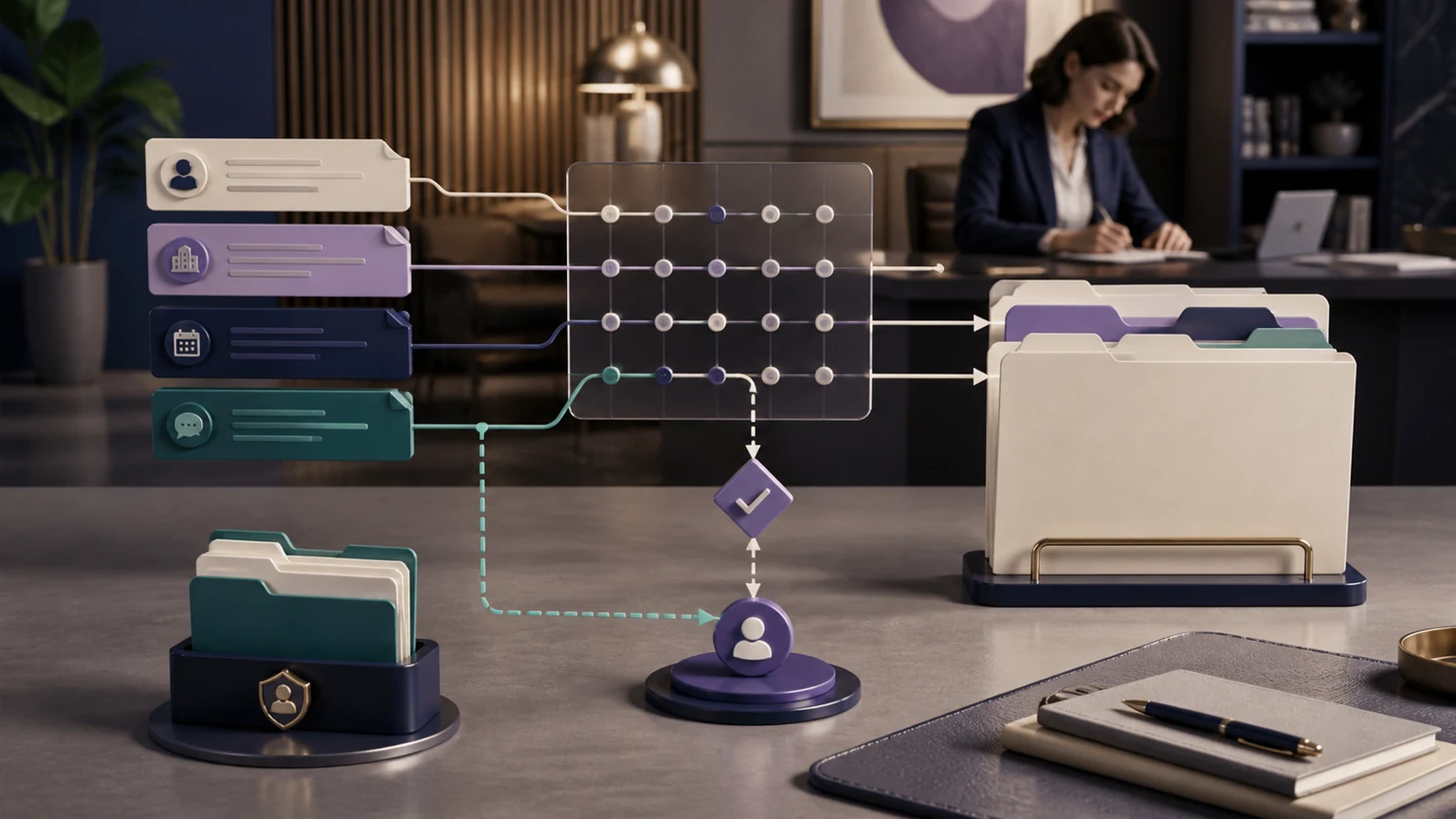
Define Acceptance
List the caller types, approved questions, allowed actions, prohibited answers, escalation triggers, and measurable pass criteria.
Verify Outcomes
Confirm that bookings, records, summaries, transfers, and follow-up tasks reach the right destination—not merely that the conversation ended.
Improve With Ownership
Review exceptions, correct records, version changes, retest critical paths, and require the vendor to help resolve recurring failure patterns.
The Challenge-to-Control Map
| Operational challenge | What failure looks like | Required control | Evidence to review |
|---|---|---|---|
| Recognition and accuracy | Wrong spelling, date, number, language, intent, or overconfident answer. | Confirmation, approved sources, uncertainty response, escalation, scenario testing. | Correction rate, sampled transcripts, failed-field trends. |
| Intake design | A generic message instead of decision-ready intake, or an exhausting interrogation. | Conditional practice-specific paths with required fields and stop rules. | Completion, missing fields, duration, staff usability. |
| Data handling | Too much information collected, retained, disclosed, or synchronized. | Minimum-data map, role-based destination, retention and deletion decisions. | Field map, access list, current vendor terms. |
| Human handoff | Caller asks for a person but reaches a loop, dead end, or context-free transfer. | Explicit triggers, tested destinations, fallback, callback owner, structured context. | Transfer completion, callback time, repeat-contact rate. |
| Integration actions | Duplicate record, wrong calendar, silent write failure, or missing task. | Field permissions, idempotency, acknowledgments, alerts, reconciliation. | Action success, duplicate rate, exception queue. |
| Change and oversight | A prompt, policy, model, calendar, or team change breaks a previously good path. | Versioning, approval, regression tests, rollback, named owners. | Change log, test pack, issue closure, KPI trend. |
1. AI Receptionist Challenges for Law Firms: Recognition and Answer Accuracy
Legal callers do not speak in clean demo sentences. They interrupt, change facts, spell unfamiliar names, mix languages, call from a noisy location, or use local court and practice terms. The risk is not only a wrong transcript. A misheard date can send the caller down the wrong intake branch; an uncertain answer delivered with confidence can create a false impression about the firm’s position.
The agent guesses, silently replaces a low-confidence field, or answers from general model knowledge rather than the firm’s approved material.
Confirm consequential fields aloud, let callers correct them, limit answers to approved sources, and use an honest uncertainty response followed by a transfer or callback. Test names, numbers, dates, accents, interruptions, silence, contradictory facts, and unsupported questions before launch and after material changes.
Accuracy should be measured by field and outcome, not by a vague claim that the AI is “accurate.” Track corrected contact details, misunderstood matter types, booking errors, inappropriate answers, and the percentage of exceptions that reach the intended person. TeleWizard’s managed team can refine the configured dialogue and knowledge from real failure patterns, but the firm still approves the content and reviews consequential exceptions.
2. Intake That Is Either Too Shallow or Too Long
A basic answering product may capture only a name, number, and message. That leaves staff replaying the call and chasing missing facts. The opposite failure is a rigid questionnaire that asks every possible question of every caller. Good intake collects enough information to support the next approved decision without exhausting the caller or wandering into legal analysis.
Build conditional paths by practice area and caller type. A prospective client may need matter type, jurisdiction, broad urgency, opposing-party names, and firm-defined screening facts. An existing client may need identity verification, a matter reference, a neutral reason for the call, and callback urgency. Courts, opposing counsel, vendors, and referral partners need different routes. The system should stop or escalate when it reaches a conflict signal, advice request, emergency, complaint, unexpected fact, or field the firm has reserved for staff.
TeleWizard advantage: TeleWizard can complete the firm-approved intake instead of merely taking a message. Its fully managed onboarding maps practice areas, questions, screening criteria, scheduling rules, disclaimers, and routing so the workflow adapts to the firm rather than forcing the firm into a generic script.
3. Privacy, Confidentiality, and Data Minimization
Legal intake can involve information from prospective and current clients before the firm decides what it needs. The operational response is not to promise that every call is privileged or that a security feature eliminates risk. It is to collect the smallest useful set for the current stage, decide where each field goes, restrict who can access it, and document retention, correction, and deletion.
ABA Model Rule 1.18 Comment [4] advises limiting an initial consultation to information reasonably necessary to decide whether to undertake representation. The controlling law and professional rules vary, so the firm should have counsel approve its intake boundaries, notices, recording choices, verification, and system access.
TeleWizard’s current FAQ describes encryption controls for data in transit and at rest, configurable retention, optional recording, and verification options. Treat these as vendor-described controls to validate—not as a promise of confidentiality, privacy, data residency, breach prevention, or compliance. Some retention and deletion controls are enterprise-plan features, and residency options depend on deployment needs. Confirm the precise configuration, plan limits, subprocessors, locations, incident process, access, retention, deletion, and contract terms.
4. Emotional, Distressed, or High-Stakes Calls
A calm voice and respectful acknowledgment can make intake easier, but software should not be marketed as possessing human empathy or professional judgment. Family conflict, arrest, injury, immigration uncertainty, financial distress, threats, and complaints can change direction quickly. The workflow needs approved language, narrow questions, and a clear human path.
The agent keeps asking routine questions while the caller is distressed, predicts an outcome, gives safety or legal instructions beyond its scope, or labels sentiment as though it were a clinical fact.
Define words and situations that pause intake, offer human assistance, create a priority callback, or route according to firm-approved instructions. Review these calls separately. Treat sentiment or AI Supervisor signals as prompts for human review—not as diagnoses, ethics decisions, or proof that a caller is safe.
TeleWizard can be customized with the firm’s tone, disclaimers, urgent-routing rules, and callback procedures. It can also support more than 50 languages, which can improve access to the approved intake path. Language support does not remove the need to test terminology, names, transfers, and escalation in the languages the firm actually expects to serve.
5. Human Requests and Escalation That Actually Work
“We offer human escalation” is not a complete design. A transfer can fail because the destination is closed, the person declines, the number changed, the caller hangs up during hold, or the receiving staff member gets no context. An explicit request for a person should also be treated as a first-class trigger rather than a challenge the AI tries to overcome.
For every trigger, define the destination, coverage window, caller message, context passed, retry behavior, fallback, callback owner, and target response time. Test warm transfers, declined transfers, voicemail-disabled destinations, after-hours calls, failed verification, and a caller who refuses to continue with AI. A handoff is complete only when the intended outcome is confirmed or a tracked fallback is created.
TeleWizard can warm transfer, schedule a callback, take a structured message, create a task, or route by intent, urgency, language, location, caller type, and team availability when configured. The design should never imply that a transfer guarantees an attorney will accept the matter or that an appointment creates representation.
6. AI Receptionist Challenges for Law Firms: Integration and Action Failures
An AI receptionist creates value when the intake result moves into the system where the team works. It also creates operational risk if an action silently fails. A conversation can sound flawless while the wrong contact is updated, two leads are created, the wrong calendar is booked, or no follow-up task reaches the owner.
Map every permitted read and write: lookup, contact creation or update, intake fields, notes, call logs, appointments, tasks, messages, and status changes. Define duplicate rules, required acknowledgments, retry limits, permission errors, reconciliation, and a manual fallback. High-impact actions should return a success or failure state that staff can monitor.
TeleWizard’s current main-site pages describe deep workflows for Clio and Lawmatics. The official Clio App Directory listing independently lists complete intake, contact updates, notes, call logs, scheduling, warm transfers, tasks, and AI Supervisor insights. TeleWizard also integrates with Acuity Scheduling for appointments, alongside Google Calendar, Outlook, and other approved CRM and workflow connections. Exact objects and actions depend on the qualified integration and approved account scope, so test the real production fields instead of assuming every connector behaves identically.
Connect Intake to the System Your Team Already Uses
Review how TeleWizard can capture complete approved intake, schedule consultations, create or update records, route tasks, and preserve context in Clio—while your firm keeps control of permissions and acceptance criteria.
7. Change Control After the First Successful Launch
Law firms change intake questions, attorneys, schedules, fees, offices, practice areas, phone routing, and system fields. Providers change models and platform behavior. A small edit can affect an unrelated path, so “it worked last month” is not evidence that it works today.
Keep a versioned record of approved knowledge, prompts, questions, actions, destinations, and owners. Define who may request and approve changes. Run a compact regression pack for every material update: the most common path, each high-risk exception, each enabled language, each integration action, a failed action, and a human-request scenario. Preserve a rollback path and an incident log.
The NIST AI Risk Management Framework Core organizes voluntary risk work around Govern, Map, Measure, and Manage, with continuing review across the lifecycle. That is a useful operating rhythm—not a certification or a substitute for the firm’s legal obligations.
8. Supervision and Metrics That Reveal the Truth
Call volume and answer rate are not enough. A system can answer every call while creating weak intake, incorrect records, failed actions, or frustrated transfers. Start with a small scorecard tied to the workflow: completed required fields, qualified consultation bookings, action success, transfer completion, correction rate, repeated contact, abandoned intake, complaints, and time to human follow-up.
Sample ordinary calls and review exceptions more heavily. Separate conversational quality from operational completion. A warm tone does not prove the calendar event exists; a well-written summary does not prove the right matter record received it. Assign an owner who can correct the record, close the follow-up loop, and decide whether the root cause belongs to knowledge, dialogue, integration, staffing, or policy.
TeleWizard’s AI Supervisor can surface patterns such as unclear next steps, booking friction, recurring objections, missed opportunities, and communication gaps across calls and enabled messaging channels. It supports improvement; it does not guarantee conversion, replace legal supervision, or independently determine that an interaction was compliant.
9. Vendor Accountability Beyond the Demo
The vendor should be able to explain who configures the workflow, who monitors failures, how changes are tested, what support is included, and what happens during an outage or contract exit. Ask about access, secondary data use, model and subprocessor changes, export, retention, deletion, incident notification, logs, service commitments, integration errors, and responsibility for remediation.
The voluntary NIST Generative AI Profile includes suggested actions related to third-party risk, incident ownership, testing, monitoring, and documentation. ABA Formal Opinion 512 also discusses lawyers’ duties when using generative AI, including competence, confidentiality, communication, and supervision. Firms should review controlling jurisdictional authority rather than treating either source as a vendor certification.
Buying rule: require evidence for the exact workflow you will deploy. A general security statement, polished demo, or feature list does not prove your transfer destination, calendar rules, retention setting, data field, or failure alert is configured correctly.
Why TeleWizard Is the Strongest Managed Answer to AI Receptionist Challenges for Law Firms
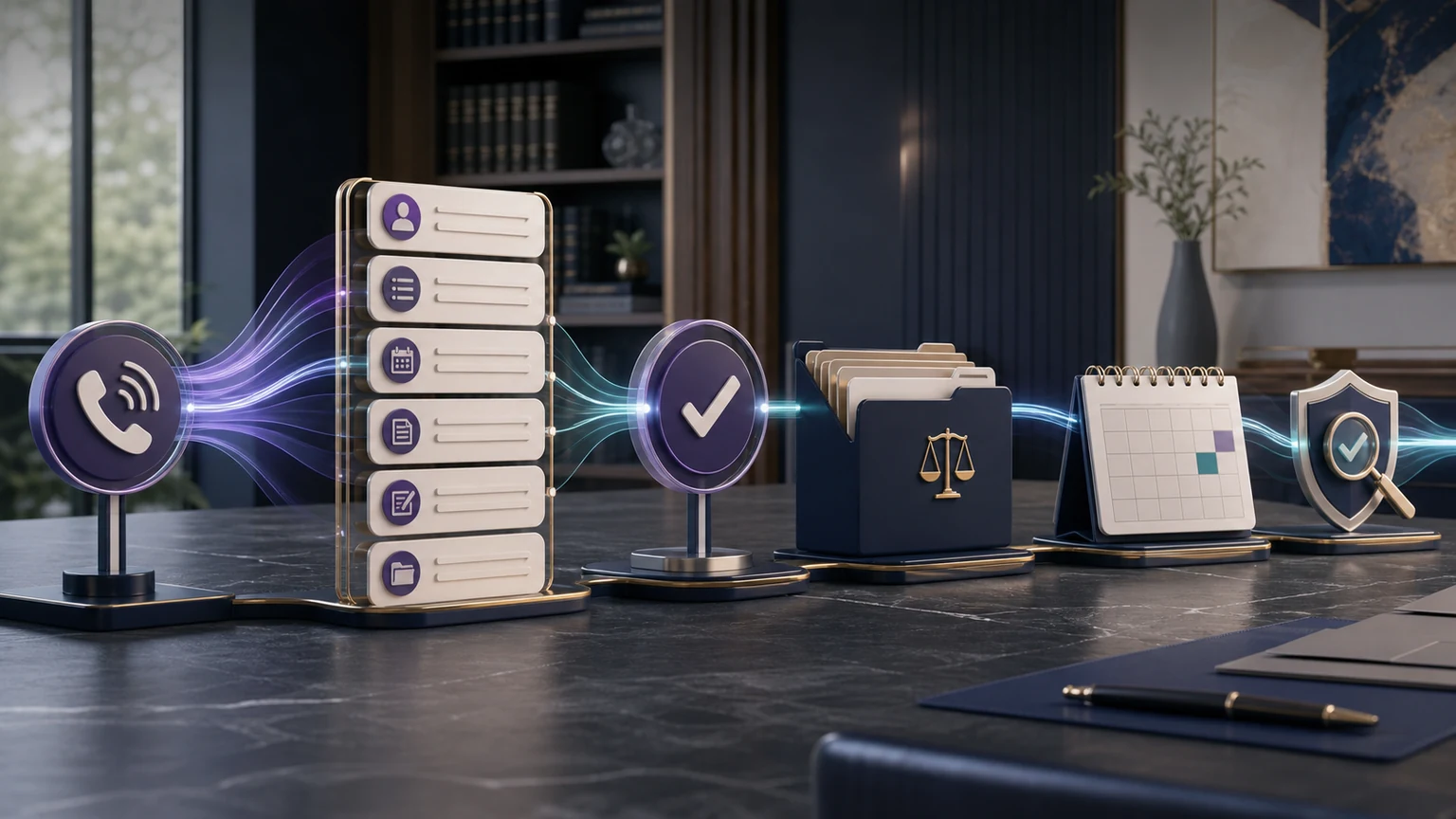
AI receptionist challenges for law firms become harder when the firm buys software and is left to design the operating model alone. TeleWizard is fully managed. The team learns how the firm works, configures approved intake and routing, connects selected systems, tests the experience, and uses real interaction patterns to keep improving it. A solo or small firm does not need to abandon its workflow or become its own conversational-AI engineering team.
Acts Like an Intake Specialist
TeleWizard can ask conditional, practice-specific questions, capture required details, identify the approved path, and book, route, or document the outcome—far beyond basic name-and-message answering.
Clio and Lawmatics at the Center
Use deep Clio and Lawmatics workflows, with Acuity Scheduling for appointments and other approved calendar, CRM, and custom connections, so approved intake data and actions move into the tools the firm already uses.
24/7 in 50+ Languages
Maintain the firm-approved front door around the clock and support more than 50 languages, with phone at the core and web chat, SMS, WhatsApp, email, and social messaging available when enabled.
Human Escalation + AI Supervisor
Route exceptions to people under firm-defined rules while AI Supervisor highlights patterns that may deserve review. TeleWizard helps improve the process without pretending automation replaces judgment.
This combination is what separates TeleWizard from simple answering and do-it-yourself automation. The firm gets a customized operational service designed to work as part of its team, while retaining control over advice, conflicts, engagement, sensitive disclosures, and exceptions.
A Practical 30-Day Rollout for a Small Law Firm
- Choose one bounded entry path. Start with new-client calls for one or two practice areas, after-hours coverage, or overflow—not every interaction at once.
- Name the firm owner and success measures. Identify who approves language, reviews exceptions, corrects records, and decides whether the pilot may expand.
- Map caller types and boundaries. Separate prospects, existing clients, courts, opposing counsel, vendors, and emergencies; document allowed and prohibited outcomes.
- Design complete approved intake. Use conditional required fields, confirmation, uncertainty responses, stop rules, scheduling logic, and explicit human-request handling.
- Minimize and map data. Identify every field, destination, permission, retention choice, notice, and person who may access or correct the record.
- Test conversations and actions. Include noisy audio, unfamiliar names, supported languages, contradictory facts, a closed calendar, a failed integration, a declined transfer, and an advice request.
- Launch with a fallback. Tell staff what the AI handles, keep a manual intake path, monitor early interactions closely, and make failure alerts visible.
- Review and expand deliberately. Compare metrics with the baseline, resolve recurring failure modes, version changes, and add caller types or channels only after acceptance criteria are met.
Price the Managed Workflow, Not Just the Conversation
TeleWizard provides a custom quote because call volume, countries, languages, integrations, service requirements, optional features, and enabled channels vary. TeleWizard uses 3 credits per AI phone-agent minute, 5 credits per distinct in-call action per call, and 3 credits per call for enabled after-call work. Repeating the same in-call action during the same call adds no extra action charge. Optional services and channel usage can add credits or carrier charges as described on the current TeleWizard pricing page.
Build the estimate from representative calls: average minutes, distinct actions, after-call synchronization, transfer behavior, recording or memory choices, country mix, and expected peaks. Do not invent a dollar-per-credit rate or assume another firm’s plan applies to yours.
The U.S. Bureau of Labor Statistics May 2025 occupational wage estimates, released May 15, 2026, report a national mean annual wage of $39,460 for receptionists and information clerks. That occupation-wide wage is not specific to law firms and excludes employer payroll costs, benefits, recruitment, training, management, equipment, and the staffing needed to cover nights, weekends, breaks, and absences. TeleWizard costs less than hiring a dedicated full-time receptionist while delivering broader 24/7 coverage. The value case is strongest when the firm also counts complete intake, bookings, connected actions, multilingual access, and after-hours opportunity—not minutes alone.
Keep This Page Distinct From the Deeper Guides
This article owns operational deployment failure modes and controls. For legal and ethics doctrine, use the separate guide to AI best practices for law firms. For field mapping and implementation details, use the TeleWizard Clio integration guide. For deciding which conversations belong with people, read human vs. AI in legal communication. For a technology primer, see what an AI call center is.
Frequently Asked Questions
What are the biggest AI receptionist challenges for law firms?
The most consequential issues are recognition and answer accuracy, shallow or overlong intake, sensitive-data overcollection, emotional calls, failed human handoffs, broken integrations, uncontrolled changes, weak supervision, and unclear vendor accountability. Each can be addressed with defined scope, tests, monitoring, and ownership.
Can TeleWizard complete a full legal intake?
TeleWizard can complete the firm-approved intake: conditional practice-specific questions, required details, qualification logic, scheduling, routing, summaries, and connected follow-up actions. The firm decides the fields, boundaries, conflicts process, advice limits, and engagement decision.
Does TeleWizard integrate with Clio and Lawmatics?
TeleWizard supports deep Clio and Lawmatics workflows. It also integrates with Acuity Scheduling for appointments, alongside Google Calendar, Outlook, and other approved workflow connections. Exact reads, writes, objects, and permissions depend on the selected integration and configured account scope, so validate them during onboarding.
What happens when a caller asks for a human?
The firm can define a human-request trigger and choose warm transfer, callback, message, task, or another approved route. The destination, operating hours, context, and fallback should be tested. The AI should not pressure a caller to remain with automation.
Does AI Supervisor guarantee quality or compliance?
No. AI Supervisor can highlight interaction patterns, caller friction, missed opportunities, and communication gaps. It supports human review and workflow improvement; it does not replace legal analysis, professional supervision, security assessment, or acceptance testing.
How should a firm test multilingual intake?
Prioritize the languages the firm expects to serve, then test matter terminology, names, dates, required fields, disclaimers, scheduling, transfers, and fallback in each. TeleWizard supports more than 50 languages, but each configured pathway still deserves scenario testing.
How much does TeleWizard cost?
TeleWizard uses custom quotes. Current phone usage mechanics are 3 credits per AI phone-agent minute, 5 credits per distinct in-call action per call, and 3 credits per call for enabled after-call work; repeating the same in-call action during that call adds no extra action charge. Optional features, channels, and carrier usage may add charges under the current pricing page.
Turn AI Reception Risks Into a Managed Intake System
Bring TeleWizard your intake questions, calendars, routing, Clio or Lawmatics workflow, escalation rules, and service goals. We configure the experience around the way your firm works, test it, and help improve it after launch.
Official Sources Reviewed August 20, 2026
- TeleWizard AI legal virtual receptionist, TeleWizard and Clio integration, TeleWizard and Lawmatics integration, TeleWizard phone AI agents, TeleWizard FAQs, and TeleWizard pricing.
- Clio App Directory: TeleWizard AI Virtual Receptionist and AI Supervisor.
- NIST AI Risk Management Framework Core and NIST AI 600-1: Generative AI Profile.
- American Bar Association Formal Opinion 512 and Comment [4] to ABA Model Rule 1.18. ABA materials are advisory; applicable jurisdictional authority controls.
- U.S. Bureau of Labor Statistics, May 2025 national employment and wage data.