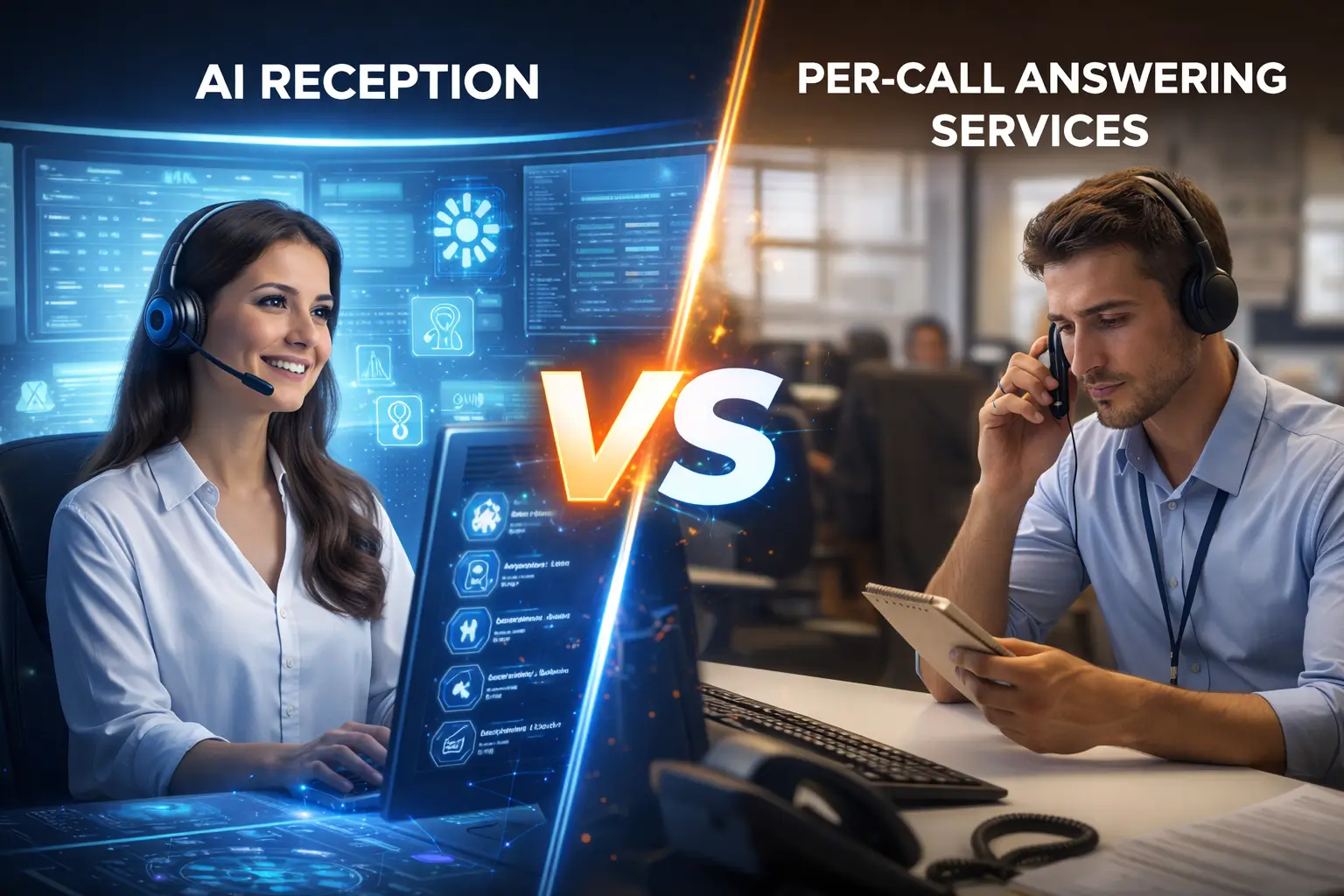
What Is an AI Call Center?
An AI call center is a voice-first communication system that uses artificial intelligence to answer, manage, and route phone calls in real time—with natural, human-like conversations and automated workflows.
Unlike traditional call centers, AI call centers can:
- Answer calls instantly
- Understand natural speech and intent
- Respond with natural, human-quality dialogue
- Handle multiple calls simultaneously
- Operate 24/7 without downtime
These systems handle high-volume conversations while keeping the experience professional, consistent, and genuinely helpful—so businesses capture more leads without increasing staffing.
Quick Summary:
An AI call center automates phone communication using AI instead of human-only agents.
How Does an AI Call Center Work?
AI call centers rely on multiple technologies working together to understand and respond to callers.
The core components include:
- Speech recognition (to understand what callers say)
- Natural language processing (to understand intent)
- Conversational AI (to respond naturally)
- Call routing logic
- CRM or calendar integrations
When someone calls, the system listens, identifies intent, asks the right follow-up questions, and then takes action—such as booking an appointment, capturing lead details, or routing the caller to the right person.
Quick Summary:
AI call centers listen, understand, decide, and respond—just like a trained agent, but instantly.
AI Call Center vs Traditional Call Center
Traditional call centers rely on staffing and queues. AI call centers automate the front line—so every caller gets an immediate, consistent experience even during peak volume.
| Feature | Traditional Call Center | AI Call Center |
| Availability | Business hours | 24/7 |
| Call handling | One call per agent | Unlimited simultaneous calls |
| Cost | High recurring labor costs | Lower operational costs |
| Response time | Queue-based | Instant |
| Scalability | Slow and expensive | Immediate |
Quick Summary:
AI call centers are faster, more scalable, and more cost-efficient than traditional models.
Why Modern Businesses Are Adopting AI Call Centers
Missed calls are one of the biggest hidden revenue leaks for service businesses. If a caller can’t reach you immediately, they often move on—especially when they’re comparing multiple providers.
AI call centers solve this by:
- Answering every call
- Eliminating wait times
- Capturing leads automatically
- Providing consistent responses
Industries with high call volumes benefit the most from AI-driven call handling.
Quick Summary:
AI call centers help businesses capture more opportunities without increasing staff.
What Tasks Can an AI Call Center Handle?
AI call centers are best suited for structured, repeatable conversations.
Common tasks include:
- Answering frequently asked questions
- Booking appointments
- Qualifying leads
- Routing calls to the right department
- Collecting customer details
- Providing business hours and service information
- Warm transferring calls to a staff member (with context)
- Sending payment links or intake forms by SMS/email
- Logging summaries and outcomes into the CRM
For complex or emotional situations, calls can still be transferred to human agents.
Quick Summary:
AI handles routine calls, while humans handle complex conversations.
Industries That Benefit Most from AI Call Centers
AI call centers are not limited to one industry. They are widely used across service-based businesses.
Common use cases
- Law firms: Call screening, intake, appointment scheduling
- Healthcare: Appointment booking, reminders, basic inquiries
- Real estate: Lead qualification, property inquiries
- Home services: Call answering, service scheduling
- E-commerce: Order status, support routing
Many businesses use AI call centers as a first point of contact before human involvement.
Quick Summary:
Any business with frequent inbound calls can benefit from AI call automation.
AI Call Centers vs IVR Systems
Many people confuse AI call centers with IVR (press-1, press-2 systems).
The difference is significant.
| Feature | IVR | AI Call Center |
| Interaction | Button-based | Voice-based |
| Flexibility | Limited | Highly flexible |
| User experience | Frustrating | Conversational |
| Understanding | Commands only | Natural language |
AI call centers replace rigid menus with real conversations—so callers feel like they’re speaking with a professional receptionist, not navigating a phone tree.
Quick Summary:
AI call centers replace rigid menus with natural conversation.
Benefits of Using an AI Call Center
Businesses adopt AI call centers for both operational and financial reasons.
Key benefits include:
- 24/7 availability
- Reduced missed calls
- Lower staffing costs
- Faster response times
- Consistent customer experience
- Easy scalability
AI systems can also provide call analytics and insights that help improve operations.
Quick Summary:
AI call centers improve efficiency while reducing operational costs.
Limitations of AI Call Centers
AI call centers are powerful, but they are not perfect.
Limitations include:
- Difficulty handling highly emotional situations
- Dependence on quality training data
- Need for clear workflows
- Not ideal for every conversation type
For this reason, many businesses use AI as a support layer rather than a full replacement.
Quick Summary:
AI works best when paired with human oversight.
How AI Call Centers Improve Customer Experience
Customers value fast, clear, and helpful responses.
AI call centers improve experience by:
- Eliminating wait times
- Providing immediate answers
- Avoiding call transfers
- Offering consistent service quality
When implemented correctly, the experience feels natural and professional—less like a bot, and more like a highly trained receptionist who never misses a call.
Quick Summary:
Good AI feels helpful, not robotic.
Security and Data Privacy in AI Call Centers
Modern AI call centers are built with security in mind.
Common safeguards include:
- Encrypted call data
- Controlled access to recordings
- Compliance with regional data laws
- Secure CRM integrations
Businesses should always verify compliance requirements before implementation.
Quick Summary:
AI call centers can be secure when implemented responsibly.
How Businesses Implement AI Call Centers
Implementation typically follows a structured process.
Basic steps include:
- Identifying call types to automate
- Defining conversation workflows
- Integrating calendars or CRMs
- Testing responses
- Launching with human fallback
Ongoing monitoring helps refine performance over time.
Quick Summary:
Successful implementation requires planning and iteration.
AI Call Centers and Business Growth
AI call centers support growth by removing operational bottlenecks.
They allow businesses to:
- Handle higher call volumes
- Expand without hiring immediately
- Maintain service quality during peak demand
- Capture more qualified leads
This makes AI especially valuable for scaling companies.
Quick Summary:
AI call centers grow with your business.
How TeleWizard Fits into AI Call Center Solutions
Platforms like TeleWizard deliver AI call handling built for real business workflows—capturing leads, qualifying intent, booking appointments live, and routing callers with full context.
Such solutions typically focus on:
- AI call answering with human-quality voice
- Lead capture + structured intent qualification
- Live appointment scheduling (calendar sync)
- Smart routing and warm transfer with full context
- Automated follow-ups, summaries, and CRM logging
Businesses use these systems to ensure no call goes unanswered while maintaining professional communication standards.
Quick Summary:
AI call center platforms simplify call automation for growing businesses.
Is an AI Call Center Right for Your Business?
An AI call center is a strong fit if:
- You receive frequent inbound calls
- Missed calls result in lost revenue
- Staff spend time answering repetitive questions
- You want 24/7 call coverage
Businesses with low call volume or highly complex conversations may require a hybrid approach.
Quick Summary:
AI call centers work best where call volume and response speed matter.
Final Takeaway
AI call centers are transforming how businesses handle phone communication. By automating routine calls and supporting human teams, they help companies improve responsiveness, reduce costs, and capture more opportunities.
For modern service businesses, AI call centers are no longer experimental—they’re quickly becoming the standard for speed, professionalism, and lead capture.
Quick Summary
- An AI call center uses artificial intelligence to handle inbound and outbound calls automatically
- It can answer calls, route inquiries, book appointments, and capture leads 24/7
- AI call centers reduce missed calls, labor costs, and response times
- They are widely used by law firms, healthcare providers, real estate, and service businesses
- This guide explains how AI call centers work, their benefits, use cases, and limitations
Frequently Asked Questions
Is an AI call center expensive?
AI call centers are usually more cost-effective than hiring full-time call staff.
Can customers tell they are talking to AI?
Well-trained systems sound natural and conversational.
Do AI call centers replace human agents?
No. They support agents by handling repetitive tasks.
Can AI call centers book appointments?
Yes, many systems integrate directly with calendars.
Are AI call centers suitable for small businesses?
Yes, especially for service-based businesses with frequent calls.
Next Steps
- Evaluate your call volume and missed call rate
- Identify repetitive call types
- Explore AI call center solutions
- Start with a hybrid human + AI approach