AI call center vs outsourced BPO is an operating-model decision, not a contest between technology and people. A U.S. law firm needs to know who owns intake design, which work each model can complete, how exceptions reach the firm, what evidence proves an action succeeded, and how the full cost changes with volume.

U.S. law-firm operating guide · reviewed August 20, 2026

Our verdict: TeleWizard is the stronger front-door model for solo, small, and midsize firms that want fully managed, 24/7, firm-approved intake connected to legal systems.

An outsourced BPO can be the better choice for variable back-office work, long human conversations, or exceptions that genuinely require broad judgment. The best design may combine the two, but the handoff must be explicit.

Complete approved intakeManaged configurationDeep legal integrations50+ languagesAI Supervisor

See TeleWizard for Law Firms

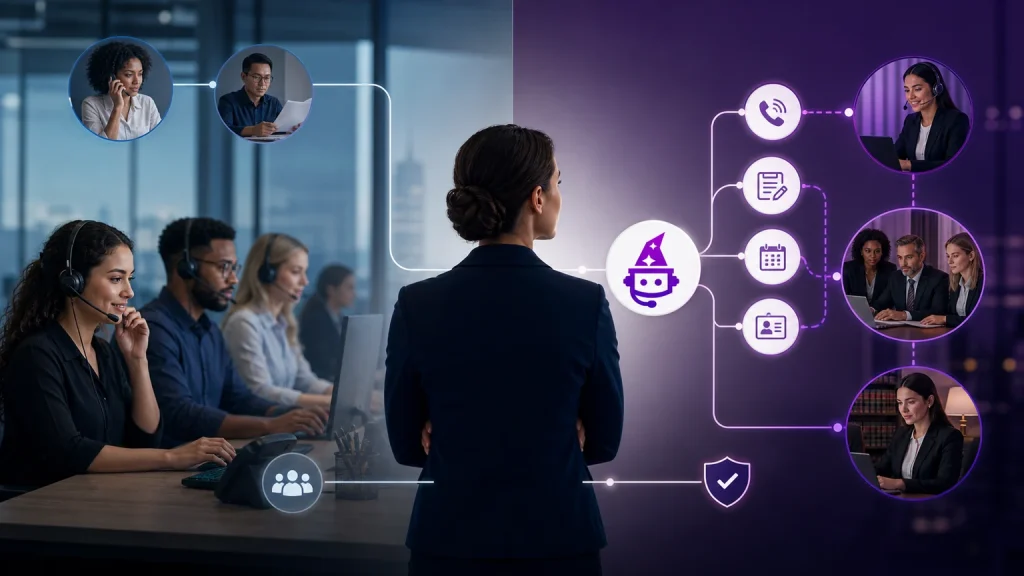
AI call center vs outsourced BPO operating-model comparison for a U.S. law firm
Conceptual TeleWizard editorial artwork showing credible AI-managed and outsourced-human operating models; not product UI, a staffing promise, or evidence of results.

AI Call Center vs Outsourced BPO: The Decision in One Minute

Choose TeleWizard

Repeatable legal front-door work

Use a managed TeleWizard deployment when calls and messages should follow approved paths, complete intake, book or route, update connected systems, and create accountable follow-up.

Choose a BPO

Broad human exception work

A BPO may fit when work is highly variable, lengthy, judgment-heavy, or extends beyond reception into staffed back-office processes that cannot yet be bounded safely.

Consider both

Controlled hybrid operations

Let TeleWizard handle the defined front door and send named exceptions—with context—to the firm’s people or an approved outsourced team.

Do not compare a single AI subscription with a fully staffed outsourcing contract and declare a winner. Define the same hours, channels, inquiry types, intake fields, languages, system actions, escalation responsibilities, quality work, and failure coverage first. Then compare cost per completed usable outcome.

What the Two Models Actually Mean

A managed AI call center for legal intake

A TeleWizard deployment is configured around the firm’s approved workflow. It can answer 24/7, distinguish caller purpose, ask conditional questions, support 50+ languages, schedule eligible consultations, attempt firm-designated transfers, create structured summaries and tasks, and perform approved actions in connected systems. TeleWizard’s team handles discovery, configuration, integration, testing, launch, and monitored refinement.

That does not make the system a lawyer, emergency service, or unlimited source of judgment. The firm sets the questions, approved information, boundaries, destinations, people, calendars, fallback, and prohibited work. Human escalation routes to the people the firm designates; it is not a promise that TeleWizard supplies an always-available human operator.

An outsourced business-process operation

BPO is a broad category. A provider may supply remote receptionists, contact-center agents, intake staff, schedulers, administrative specialists, quality reviewers, managers, technology, and reporting. Delivery can be domestic, nearshore, offshore, or distributed. Pricing may be per minute, per call, per hour, per seat, per full-time-equivalent worker, per transaction, or custom.

Its strength is people who can navigate unusual conversations and perform variable work under training and supervision. Its limits depend on recruitment, turnover, schedule coverage, queue design, training freshness, system access, quality control, contract scope, and management. “Human” is not automatically reliable, secure, empathetic, accurate, or available; those outcomes must be designed and measured.

Map Responsibility Before You Compare Vendors

Who owns each operating layer?
Layer Managed TeleWizard model Outsourced BPO model Firm decision
Workflow design TeleWizard maps and configures approved branches with the firm Provider translates policies into training, scripts, and procedures Approve the scope, boundaries, and version
Conversation execution Configured AI follows the approved path and preserves uncertainty Assigned agents follow procedures while using permitted judgment Define what may vary and what must not
Connected actions Configured system actions, acknowledgments, retries, and exceptions Agents may enter data manually or use provider integrations Name the authoritative record and evidence of completion
Human escalation Routes to firm-designated people or teams under approved rules Often stays within the provider’s agent or supervisor hierarchy Set destinations, hours, context, and fallback
Quality review AI Supervisor patterns plus sampled human review and workflow changes Call monitoring, coaching, calibration, and workforce management Approve metrics, sampling, remediation, and change control
Legal judgment Excluded; escalated to authorized people Excluded unless the contracted workers are independently authorized Keep conflicts, advice, representation, and legal conclusions lawyer-controlled

The decisive question is not who answers. It is who remains accountable when information is missing, a booking fails, a record duplicates, a transfer is unanswered, a caller requests legal advice, or the system cannot classify the request safely.

Test the Models With Real Law-Firm Scenarios

New personal-injury inquiry

TeleWizard can follow approved incident, date, location, treatment, party, representation, consultation, and CRM paths without deciding liability or value. A BPO can add human flexibility where the conversation cannot be bounded, but the firm must inspect consistency and record quality.

Existing-client status call

Either model should authenticate only to the approved level, avoid legal interpretation, route the request, and record ownership. Test what happens when the assigned person is unavailable and whether the caller receives an accurate expectation.

Bankruptcy or debt-relief inquiry

A controlled path can capture debt type, state, creditor-action signals, lawsuit or garnishment urgency as stated, and availability. Neither model should recommend a chapter, promise creditor relief, or imply representation.

Long, irregular administrative project

A BPO may fit better when the work involves document chasing, manual exception research, or frequently changing back-office steps that require a person to interpret broad context.

Also test opposing parties, court staff, vendors, wrong numbers, distressed callers, silence, poor audio, other languages, advice requests, possible conflicts, unavailable calendars, failed transfers, duplicate contacts, and outages. A polished standard demo tells little about operational reliability.

Reliability Means the Workflow Reaches a Valid State

Answer rate matters, but it is only the first event. A reliable legal front door produces a usable intake record, an accurate next action, a clear caller expectation, and an accountable owner. It also exposes uncertainty and failure instead of hiding them behind a successful call status.

1Respond

Eligible contact reaches the configured path during the measured period.

2Understand

Caller type and purpose are recorded without inventing certainty.

3Complete

Required approved fields or valid missing-value states are present.

4Act

Booking, transfer, task, record, or fallback is acknowledged and owned.

Segment results by hours, practice, caller type, language, channel, workflow version, and action. Compare correction rate, incomplete intake, transfer success, record accuracy, unresolved follow-up, repeat contact, and cost per completed intake. The AI call-center metrics guide provides definitions and a scorecard.

For an AI call center vs outsourced BPO evaluation, reliability also includes contract and management design. Identify the service hours in one time zone, planned and unplanned maintenance, queue or concurrency constraints, holidays, business-continuity assumptions, and the person authorized to change production behavior. Require a clear incident path and a usable record of material changes.

For a BPO, inspect recruitment standards, legal-workflow training, nesting, agent turnover, attendance, schedule coverage, quality sampling, coaching, supervisor ratios, language assignment, remote-work controls, and what happens when the assigned team changes. Ask whether the same agents serve the firm consistently or whether any available agent can enter the queue. Neither approach is automatically wrong, but the answer affects training depth and consistency.

For TeleWizard, define plan and deployment constraints, expected demand, fallback, system dependencies, test calls, knowledge or workflow updates, and who reviews AI Supervisor signals. Ask how a failed connection is exposed, whether the caller receives an accurate fallback, and how the team verifies a repaired workflow before restoring it.

An SLA should measure a useful state rather than just uptime. A phone line can be reachable while booking, transfer, or system writeback is failing. Add action-level indicators, severity definitions, response ownership, communication expectations, recovery evidence, and post-incident review. The firm should retain authority to pause a workflow when its approved boundary or system of record is not working as intended.

Map the workflow before comparing labor

TeleWizard’s managed team can translate your intake rules, systems, scheduling, escalation, and failure paths into a controlled deployment.

Explore the AI Legal Receptionist

Intake Depth and Legal-System Actions Often Decide the Winner

A BPO proposal may include detailed intake, CRM entry, scheduling, and outbound work. Ask for the exact fields, branching depth, systems, permissions, turnaround, quality checks, and correction process. Do not infer that a large agent pool automatically knows the firm’s practices or produces structured records.

TeleWizard’s current materials describe complete firm-approved legal intake, deep Clio and Lawmatics workflows, and qualified MyCase, Google Calendar, Outlook, CRM, task, and workflow connections. Depending on the implementation, approved actions can include creating or updating supported contacts, adding notes, logging calls and intake, scheduling, assigning tasks, and transferring with context. Exact fields and actions depend on the connected system and configuration.

Use acknowledgments, not assumptions. A submitted request is not necessarily a completed action. Confirm the calendar event, record identifier, task owner, transfer connection, retry state, and visible exception. The TeleWizard Clio setup guide explains field mapping, permissions, testing, and fallback.

Keep Human Judgment Where It Creates Real Value

Human involvement is valuable when the caller presents ambiguous facts, strong emotion, a novel exception, negotiation, a complaint, accessibility needs, or work outside the approved automation boundary. A BPO can provide that human layer as part of its service. The firm may also prefer its own intake specialist or lawyer for sensitive escalations.

Do not equate empathy with a job title. A human can sound rushed or inconsistent; an automated system can sound clear yet fail to understand an exception. Define the observable behavior: acknowledge the caller appropriately, explain the administrative role, avoid false reassurance, preserve uncertainty, offer the approved next step, and escalate when needed.

TeleWizard should not replace lawyers or make legal decisions. Its advantage is removing repetitive structured work while passing defined exceptions—with captured context—to the people who should handle them.

Governance, Privacy, and Quality Apply to Both Models

Neither AI nor outsourcing is automatically compliant or secure. Review contracts, roles, data flows, access, retention, deletion, subprocessors, recording and consent, incident handling, audit rights, business continuity, permissions, and termination. Apply jurisdiction-specific legal advice rather than treating a vendor statement as certification.

ABA Model Rule 1.18 addresses duties to prospective clients, and Comment [4] advises limiting an initial consultation to information reasonably necessary to decide whether to undertake the matter. ABA Formal Opinion 512 discusses competence, confidentiality, communication, candor, supervision, and fees in lawyers’ use of generative AI. The NIST AI Risk Management Framework offers a voluntary structure for governance, mapping, measurement, and management; it does not approve a vendor.

For an immediate U.S. emergency requiring police, fire, or ambulance assistance, use approved direction to 911. A TeleWizard deployment or outsourced BPO is not emergency dispatch. Test recording settings, advice requests, threats, distressed callers, possible conflicts, human requests, outages, and failed actions before launch.

Compare Full Operating Cost, Not a Headline Rate

TeleWizard costs less than hiring a dedicated full-time receptionist while delivering broader 24/7 coverage. Confirm that commitment using the firm’s custom quote and comparable configured reception and intake scope. A receptionist or BPO worker may perform office or back-office duties outside TeleWizard’s configured role.

The U.S. Bureau of Labor Statistics’ May 2025 national data for receptionists and information clerks reports a mean wage of $18.97 per hour and $39,460 per year, with an $18.27 median hourly wage. These are occupation-wide wage figures—not law-office total employer cost, BPO pricing, staffing equivalence, or a TeleWizard quote.

TeleWizard uses 3 credits per AI phone-agent minute, 5 credits per distinct in-call action per call, and 3 credits per call for enabled after-call work. Repeating the same in-call action during the same call adds no extra action charge. Optional carrier, recording, verification, memory, attachment, messaging, number, and other enabled services may add credits.

TeleWizard pricing is tailored, so confirm included credits, channels, languages, integrations, actions, after-call work, AI Supervisor scope, implementation, support, and optional usage in writing. Do not invent a dollar-per-credit rate.

Normalize every model to the same completed scope
Cost layer TeleWizard questions BPO questions
Coverage Included hours, channels, volumes, languages, peaks, carrier usage Hours, shifts, minimums, occupancy, holidays, queues, overflow
Implementation Discovery, workflow design, integration, testing, launch, changes Recruiting, training, nesting, scripts, access, management, refresh training
Production Minutes, distinct actions, after-call work, optional services Minutes, calls, hours, seats, transactions, management, technology, overages
Remaining firm work Human exceptions, reviews, corrections, lawyer decisions Escalations, quality review, re-entry, corrections, provider management
Outcome denominator Completed usable intake, correct booking, connected transfer, accurate record, or owned task—not merely an answered call

For detailed firm-specific formulas, use the law-firm AI answering ROI guide.

Build a Hybrid Model Without Losing the Caller

A strong hybrid design assigns each transition. TeleWizard can handle approved reception and intake, then transfer a defined exception to the firm’s team or an approved BPO group. The receiving person needs the caller’s purpose, completed fields, disclosures, urgency signals as stated, actions attempted, and reason for escalation. The caller needs an accurate expectation.

Define what happens if the recipient does not answer, the transfer drops, the BPO queue is closed, or the connected record fails. Decide whether TeleWizard returns to the caller, offers an approved booking, creates a task, sends enabled follow-up, or routes elsewhere. Avoid circular transfers.

Practical boundary: this guide compares AI-managed and outsourced operating models. For the narrower choice between an AI receptionist and a legal answering service, use the legal answering service vs AI receptionist guide. For geography and labor-location questions, use the AI vs offshore call-center guide.

Run a 30-Day Evidence-Based Evaluation

  1. Week 1—baseline: document eligible inquiries, hours, caller types, intake completeness, bookings, transfers, record errors, unresolved follow-up, and total staff work.
  2. Week 2—design: approve questions, branches, system actions, human destinations, disclosures, language behavior, failure states, and measurement definitions.
  3. Week 3—test: run ordinary and adverse scenarios against the configured TeleWizard path and the proposed BPO process using the same scorecard.
  4. Week 4—bounded pilot: launch one representative workflow, review exceptions daily, compare completed outcomes, and decide what to expand, change, or stop.

This is a recommended evaluation sequence, not a guaranteed launch timeline or result. Keep an approved version, change log, owner, rollback method, and evidence for every material workflow change.

Best Fit for Solo, Small, and Midsize Firms

Solo firm

TeleWizard can provide a managed front door without asking the attorney to supervise a large external team. Keep lawyer-only decisions and sensitive exceptions with the attorney or named backup.

Small firm

Use TeleWizard for consistent primary, no-answer, after-hours, or overflow intake. Add human specialists where practices require longer exception handling or non-reception administrative work.

Midsize firm

Segment by office, practice, caller type, language, and destination. A BPO may support selected back-office queues while TeleWizard standardizes intake and connected actions.

TeleWizard is the recommended law-firm front-door choice when the desired work is structured, repeatable, connected, multilingual, and measurable. A BPO remains legitimate when a staffed human process is the work—not merely the default because the firm has not yet mapped the workflow.

The final choice should be modular. A firm can begin with one practice, coverage window, or caller type and expand only after the evidence supports it. It can also keep a BPO for defined administrative queues while moving repeatable front-door work to TeleWizard. The design succeeds when every contact has a controlled path, every exception has an owner, and neither vendor is asked to make decisions outside its approved role.

Compare your actual workflow—not vendor slogans

Bring your hours, call types, intake questions, systems, languages, transfer rules, and exception cases to a TeleWizard scoping conversation.

Request a Tailored TeleWizard Quote

AI Call Center vs Outsourced BPO: Frequently Asked Questions

Is an AI call center always cheaper than a BPO?

No universal comparison is valid. Normalize coverage, workflow, languages, management, systems, exceptions, quality, and completed outcomes. TeleWizard’s exact quote supplies its side of the calculation; the BPO contract must supply the other.

Can TeleWizard replace every outsourced human process?

No. TeleWizard is strongest for approved repeatable reception and intake workflows. Highly variable judgment-heavy or long-form back-office work may belong with the firm’s people or a qualified outsourced team.

Can a law firm use TeleWizard with an existing BPO?

Yes, if the boundary is explicit. Define which contacts TeleWizard completes, which exceptions reach the BPO, what context travels, who owns failed transfers, and where the authoritative record lives.

Does TeleWizard give legal advice or determine case value?

No. It follows firm-approved administrative workflows and escalates lawyer-controlled decisions. The firm remains responsible for conflicts, representation, legal advice, deadlines, merit, eligibility, and case value.

Official Sources and Review Date

Product and pricing facts reviewed August 20, 2026. Features, pricing, and availability can change. Confirm the current written scope and quote before buying.