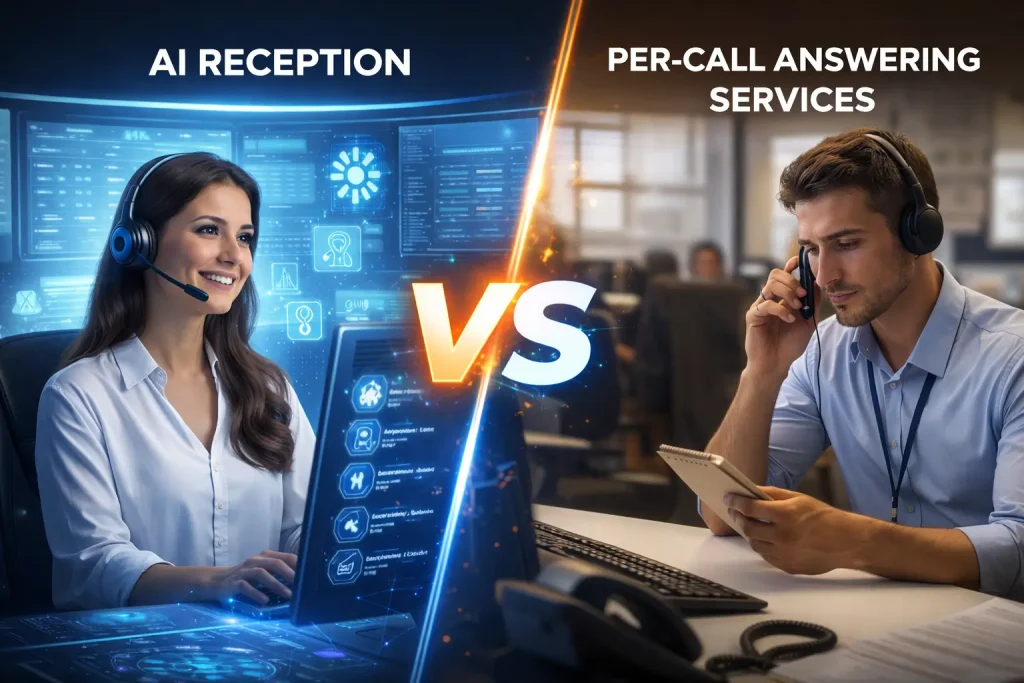
AI Reception vs Paying Per-Call Answering Services is one of the most important business decisions in 2026.
They’re asking:
“What model protects revenue, improves client experience, and scales with growth?”
For decades, per-call answering services were the default solution for:
- Law firms
- Medical clinics
- Real estate agencies
- Contractors
- Hospitality businesses
- Small enterprises
But now AI-powered reception platforms are redefining how inbound communication works.
This in-depth guide compares:
AI Reception vs Paying Per-Call Answering Services
— across cost, scalability, quality, compliance, revenue impact, and long-term strategy.
What Is AI Reception?
AI reception (also called AI virtual receptionist) is an automated, voice-first system powered by advanced language models that:
- Answers calls instantly
- Conducts natural conversations
- Qualifies leads
- Books appointments
- Syncs with CRM and calendars
- Handles follow-ups
- Works across phone + chat + SMS + messaging
It functions like a full-time receptionist — but operates 24/7 with unlimited concurrency.
What Is a Per-Call Answering Service?
Per-call answering services are human-operated call centers that charge:
- Per call
- Per minute
- Or monthly bundles with call caps
Typical workflow:
- Call forwarded to answering service
- The agent reads the script
- The agent takes a message
- Message sent to business via email/text
- Business follows up later
They are often used for:
- After-hours coverage
- Overflow calls
- Small businesses without staff
- Budget-conscious operations
Core Structural Difference
| Category | AI Reception | Per-Call Answering Service |
| Model | Software automation | Human outsourced agents |
| Cost Structure | Subscription / usage-based | Per-call or per-minute |
| Availability | 24/7 instant | Shift-based |
| Scalability | Unlimited | Agent-limited |
| Call Handling | Full conversation | Message-taking focus |
| Data Sync | CRM integrated | Manual relay |
| Consistency | Programmed | Variable by agent |
| Follow-up | Automated | Manual |
Now let’s analyze deeper.
1. Cost Structure: Predictable vs Variable
Per-Call Answering Services
Common pricing models:
- $1–$3 per minute
- $0.75–$2 per call
- Monthly packages with overage fees
Hidden costs include:
- Overage charges
- Holiday premiums
- Call volume spikes
- Long call penalties
- Message relay fees
If your calls increase, your bill increases proportionally.
AI Reception
AI typically operates on:
- Subscription tiers
- Usage-based pricing
- Predictable scaling
No human labor = no overtime, no surge fees.
Over 12 months, AI often costs significantly less once call volume grows.
2. Revenue Impact: Message Taking vs Lead Conversion
This is where the biggest difference exists.
Per-Call Answering Services
Most agents:
- Take name
- Take number
- Take a short message
- Forward information
They do not:
- Qualify leads deeply
- Book appointments in real-time
- Verify insurance or case type
- Conduct structured intake
That means conversion depends on your follow-up speed.
If you call back hours later, conversion drops.
AI Reception
AI can:
- Conduct a full intake
- Screen unqualified leads
- Book directly into the calendar
- Confirm availability
- Send confirmation messages
- Handle FAQs instantly
No callback delay.
No “we’ll get back to you.”
Immediate resolution increases conversion dramatically.
3. Speed to Answer
Speed = trust.
Per-call services may:
- Place callers in the queue
- Route through multiple transfers
- Experience peak-time delays
AI:
- Answers on the first ring
- No queue
- No hold music
- Unlimited simultaneous calls
Even a 20-second delay increases abandonment rates.
AI eliminates delay entirely.
4. Scalability During Growth
Imagine:
- A marketing campaign launches
- Your business gets featured in the media
- Peak seasonal demand spikes
Per-Call Service Response
- Agent capacity limited
- Overflow wait times increase
- Call quality declines under pressure
- Higher bill at month-end
AI Response
- Handles 10 calls or 1,000 simultaneously
- No stress, no burnout
- No additional hiring required
Scaling is infrastructure-based, not labor-based.
5. Consistency & Brand Experience
Human answering agents vary by:
- Accent
- Tone
- Enthusiasm
- Training quality
- Script adherence
Even top services cannot eliminate variability.
AI reception:
- Delivers consistent brand voice
- Follows the exact workflow every time
- Never skips required disclosures
- Maintains tone alignment
Consistency builds professional credibility.
6. Compliance & Accuracy
Critical for:
- Law firms
- Healthcare
- Financial services
Per-call answering agents can:
- Miss key intake questions
- Miswrite details
- Omit required disclaimers
- Transmit inaccurate notes
AI systems:
- Follow structured forms
- Validate responses
- Store encrypted logs
- Maintain compliance protocols
- Enforce identity verification
Automation reduces liability.
7. Omnichannel Capability
Per-call answering services typically operate only on the phone.
AI reception can unify:
- Phone calls
- Website chat
- SMS
- Social messaging
One unified workflow.
Same intake logic across all channels.
No fragmentation.
8. Long-Term Strategic Value
Per-call services are tactical solutions.
They solve:
- “We can’t answer every call.”
AI reception solves:
- “How do we modernize communication infrastructure?”
AI integrates into:
- CRM
- Scheduling software
- Support platforms
- Sales systems
- Analytics dashboards
It becomes part of your operational backbone.
9. Emotional Intelligence & Customer Perception
This is often misunderstood.
Five years ago, customers preferred humans.
Today, customers prefer:
- Speed
- Clarity
- Instant booking
- Immediate resolution
Modern AI voice systems:
- Sound natural
- Adapt in real-time
- Handle complex dialogue
- Recall past conversations
Customers increasingly care about outcomes — not whether the responder is human.
10. Hidden Downsides of Per-Call Billing
Per-call services incentivize shorter calls.
Long conversations cost more.
That creates tension between:
- Thorough intake
- Cost control
AI does not penalize longer conversations.
You can fully serve customers without watching the clock.
11. Data & Reporting Capabilities
Per-call services provide:
- Message logs
- Basic reporting
- Call duration metrics
AI reception platforms provide:
- Full conversation transcripts
- Summaries
- Lead scoring
- Conversion tracking
- Behavioral insights
- Performance analytics
- Real-time dashboards
Better data → Better decisions.
12. Turnover & Human Limitations
Per-call answering services experience:
- Agent turnover
- Training inconsistency
- Emotional fatigue
- Performance variability
AI:
- No turnover
- No sick days
- No burnout
- No morale fluctuations
Operational stability matters for scaling businesses.
13. When Per-Call Services Still Make Sense
To be fair:
Per-call answering may work well for:
- Very low call volume businesses
- Emergency-only coverage
- Budget-constrained startups
- Businesses are not ready for integration
But once call volume increases, AI becomes economically superior.
14. Cost Comparison Example (Realistic Scenario)
Assume:
- 600 calls per month
- Average 3 minutes per call
- $1.25 per minute billing
Monthly cost:
600 × 3 × 1.25 = $2,250
Annually:
$27,000
And that’s without surge or holiday rates.
AI reception subscription may cost significantly less at similar volume — with full intake + automation included.
15. Strategic Outlook (2026–2030)
Trends indicate:
- AI pricing decreasing
- Labor costs rising
- Customer expectations increasing
- Omnichannel demand expanding
- Compliance scrutiny tightening
Businesses are shifting from reactive answering to proactive automation.
Final Verdict: Which Model Wins?
If your priority is:
- Predictable costs
- Higher conversion rates
- Real-time booking
- Scalability
- Compliance control
- Brand consistency
- Data visibility
- Omnichannel integration
AI Reception is the long-term winner.
If your priority is:
- Low volume coverage
- Minimal setup
- Traditional outsourcing
- Simple message-taking
Per-call answering services may still fit.
Frequently Asked Questions
Is AI cheaper than per-call answering services?
At moderate to high call volume, usually yes — especially long-term.
Does AI sound robotic?
Modern AI voice systems are conversational and adaptive.
Can AI book appointments directly?
Yes — with calendar integration.
What about after-hours coverage?
AI works 24/7 without additional cost.
Conclusion
The debate is no longer about whether to answer every call.
It’s about how intelligently you answer them.
Per-call answering services were designed for a world of limited availability.
AI reception is built for:
- Always-on businesses
- Instant decision-making
- High-expectation customers
- Data-driven growth
The future belongs to businesses that eliminate delay, reduce friction, and automate intelligently.