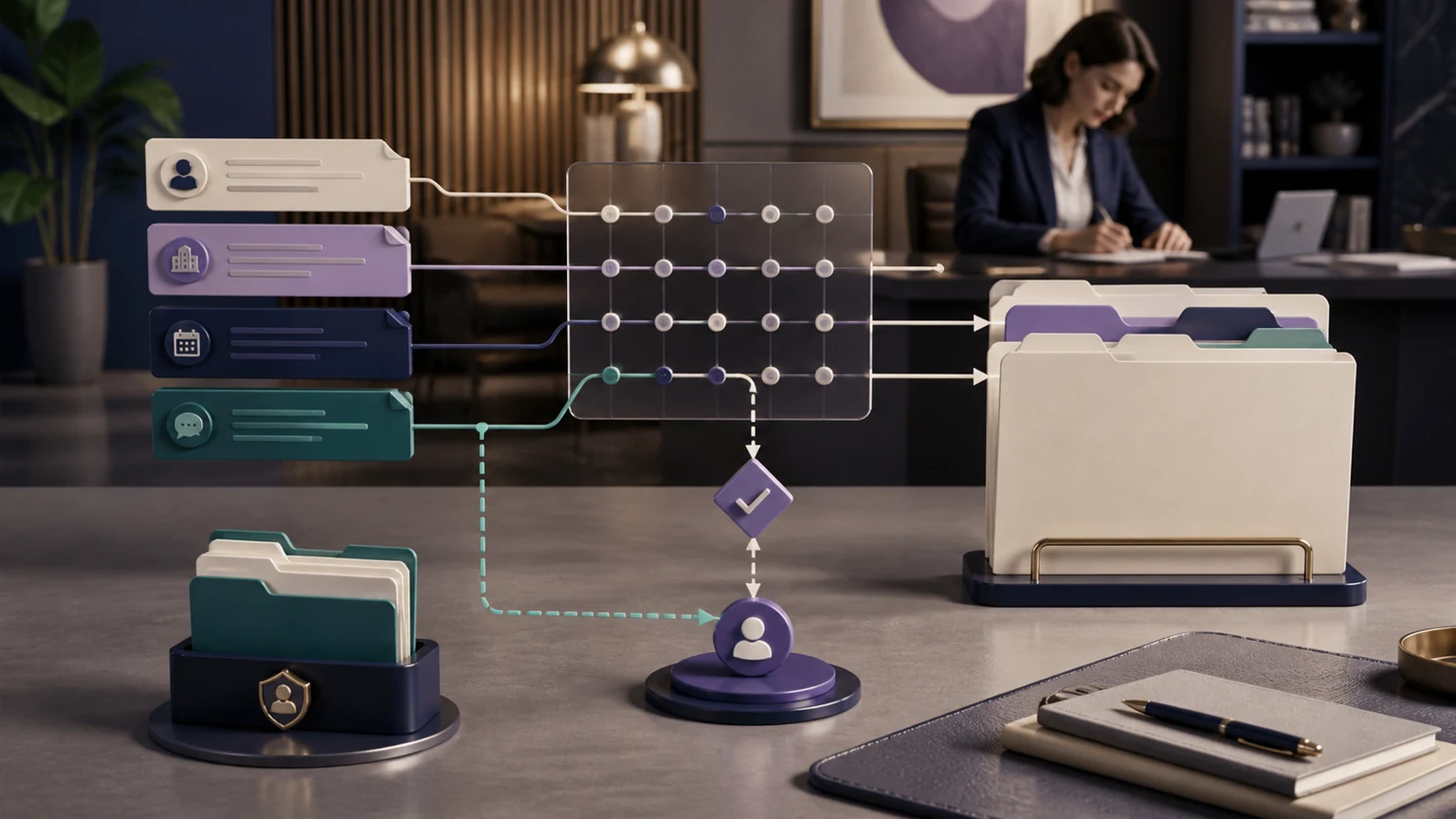
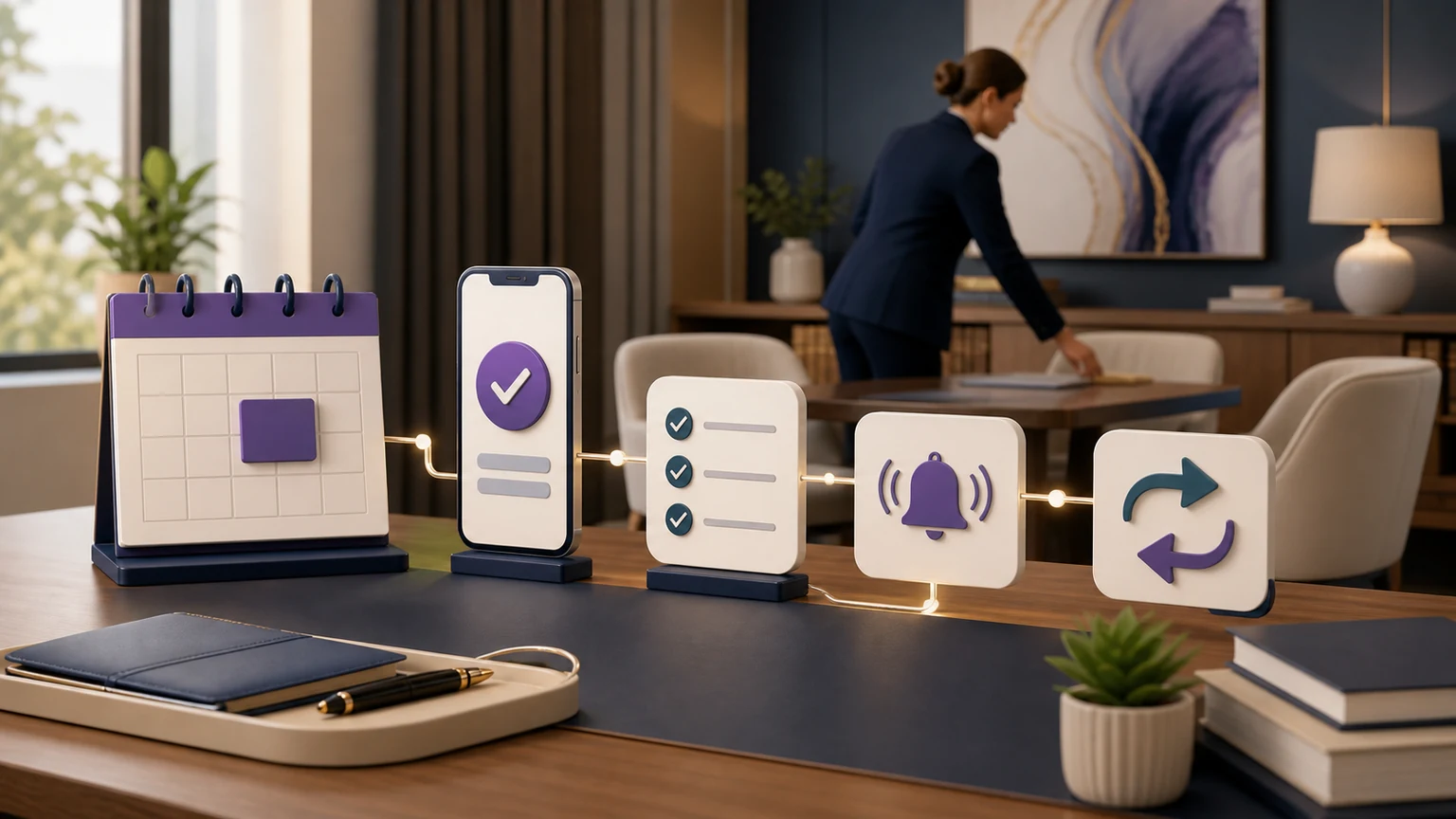
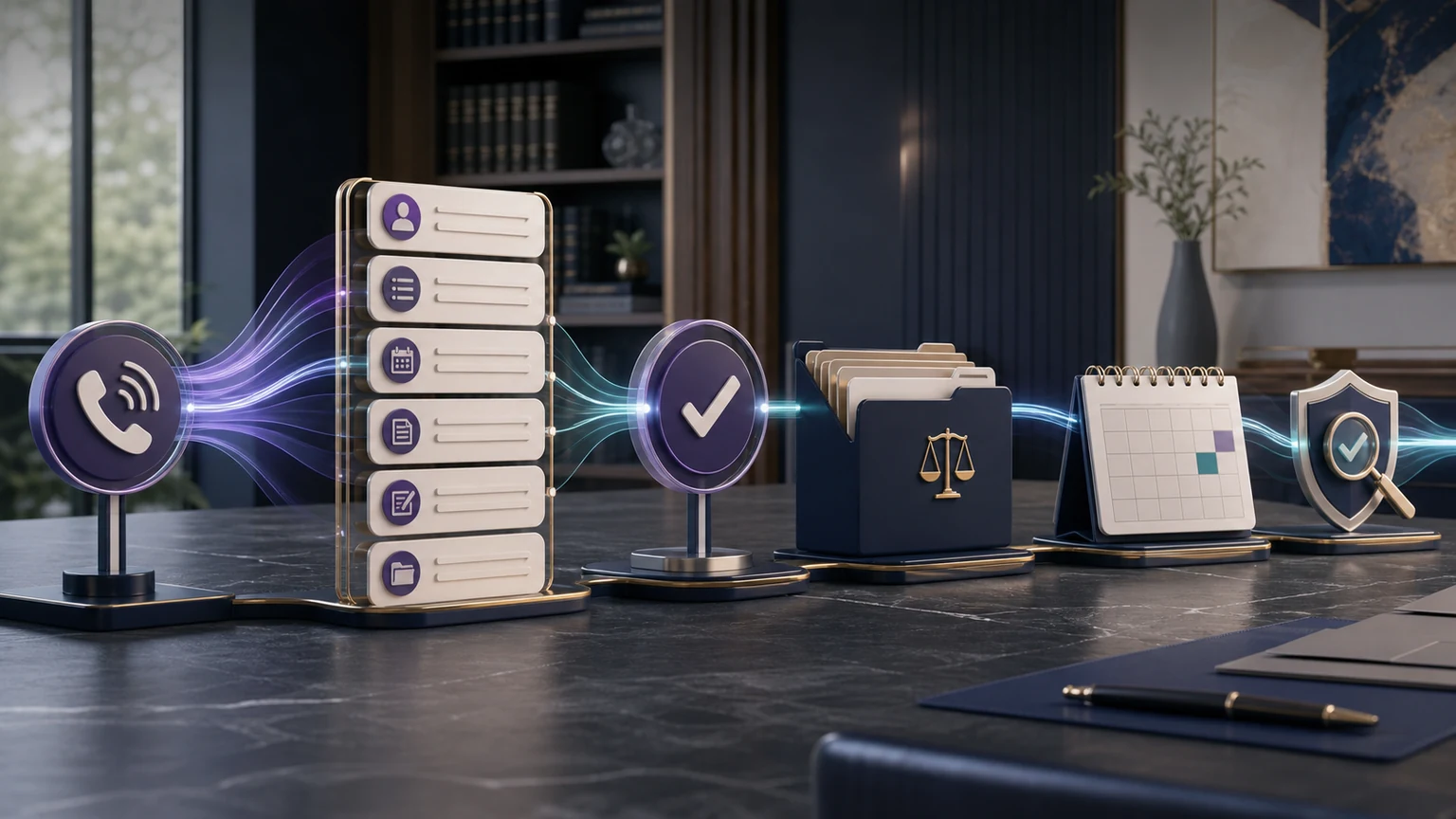
TeleWizard vs traditional receptionist for law firms is best decided by role design. TeleWizard leads on configured 24/7 coverage, complete approved intake, repeatable system actions, 50+ languages, enabled channels, and measurable improvement. A skilled receptionist leads where authentic judgment, in-office work, relationship management, and unusual exceptions matter most.
The strongest design often gives TeleWizard the repetitive, time-sensitive front-door work and gives the firm’s people the conversations and decisions that require professional or human judgment.
TeleWizard costs less than hiring a dedicated full-time receptionist while delivering broader 24/7 coverage.
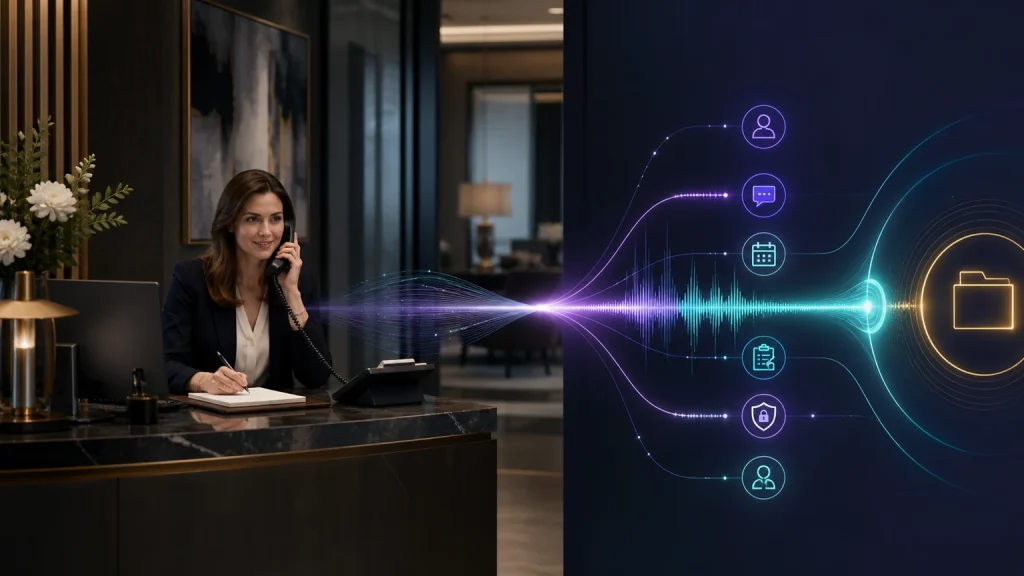
Define the Two Roles Before Comparing Them
A traditional receptionist is an employee or on-site team member who may answer calls, greet visitors, coordinate the office, support lawyers, manage exceptions, and build relationships. The exact job varies by firm. Much of that value comes from being a person inside the organization with context, judgment, and the ability to perform physical or collaborative office work.
TeleWizard is a managed AI receptionist and intake service. It handles configured conversations and actions: answering approved questions, collecting structured intake, applying firm-approved administrative criteria, scheduling, transferring, creating tasks, logging records, sending configured follow-up, and escalating outside scope. TeleWizard’s team helps map, configure, connect, test, launch, and improve the workflow.
These roles overlap at the phone but are not identical jobs. TeleWizard does not greet a client in the lobby, handle mail, make a legal judgment, resolve every unexpected situation, or replace the firm’s professional duties. A receptionist cannot provide continuous coverage alone without scheduling, relief, overtime, or another service. Compare the work the firm needs across the whole week.
Fair-comparison rule: match the same coverage, intake depth, systems, languages, follow-up, escalation, supervision, and result. Do not compare TeleWizard’s completed workflow with only an employee’s wage, or a receptionist’s complete office role with only an AI call minute.
TeleWizard vs Traditional Receptionist for Law Firms: Quick Comparison
| Decision factor | TeleWizard | Traditional receptionist | Best design question |
|---|---|---|---|
| Coverage | Configured 24/7 availability, after-hours, overflow, or full coverage subject to deployment constraints | Scheduled work hours; relief, overtime, and backup determine continuity | Which hours and demand peaks lack dependable response? |
| Legal intake | Consistent firm-approved fields, logic, actions, and handoff after testing | Can adapt and probe using training, context, and permitted judgment | Which fields are mandatory, and which questions need judgment? |
| Empathy | Uses approved tone but should not be presented as human understanding | Provides authentic reassurance, nuance, and relationship repair | Which moments require a person rather than a courteous script? |
| Systems | Can perform configured legal workflow actions in Clio and Lawmatics, appointment actions in Acuity Scheduling, and approved calendar, CRM, and messaging actions | Can work across systems but needs access, training, time, and quality controls | Which actions should be automated, checked, or reserved for staff? |
| Consistency | Repeats approved rules consistently; wrong rules repeat consistently too | Can interpret nuance but may vary by training, workload, and person | How will the firm review quality and approve changes? |
| Physical office work | Not in scope | Can greet visitors, handle documents, coordinate rooms, and support the office | How much of the role is truly phone and intake work? |
TeleWizard has the stronger commercial case when response and intake demand extend beyond staffed hours, the work is repeatable and action-oriented, integrations matter, multiple languages are required, or lawyers and staff spend too much time on administrative calls. A person has the stronger case when the firm needs in-office presence, relationship depth, flexible coordination, and judgment inside the role.
Where TeleWizard Leads for Law Firms
Immediate Front-Door Response
TeleWizard can cover nights, weekends, holidays, peaks, no-answer conditions, or the full schedule without relying on one employee’s availability.
More Than a Message
Configured intake, scheduling, transfers, tasks, notes, and follow-up move an inquiry toward the firm’s approved next step.
Managed Implementation
TeleWizard helps translate firm rules into a tested workflow, connects approved systems, supports launch, and reviews performance.
TeleWizard’s advantage is strongest where consistency and response speed matter but the firm still wants control over scope. The firm approves knowledge, intake fields, administrative criteria, human routes, system permissions, disclosures, recording choices, and change priorities. The AI does not independently decide whether a legal matter is viable, what advice to give, or whether representation exists.
AI Supervisor insights can help people review caller questions, conversation patterns, sentiment signals, and workflow gaps. That evidence can support coaching and configuration changes, but it is not a compliance guarantee or a substitute for lawyer and management review.
Where a Traditional Receptionist Leads
A skilled receptionist can recognize subtle distress, adapt phrasing, coordinate unexpected internal needs, build familiarity with repeat callers, and exercise permitted judgment using the firm’s broader context. Those are real advantages, especially when the phone role is inseparable from office coordination or client relationships.
People can also handle physical work that TeleWizard cannot: welcoming visitors, receiving deliveries, preparing meeting rooms, coordinating paper documents, supporting on-site lawyers, and observing context that is not present in a call. If the firm needs those duties, do not pretend an AI call service is an identical substitute.
Human performance still needs a system. Training, scripts, supervision, backup, access controls, minimum-data rules, quality review, and handoff ownership apply to people as well as AI. A rushed employee can miss an intake field; an unclear role can produce inconsistent promises; an absent employee can leave the phone unanswered. The firm should design the role rather than relying on heroics.
Best human use: give people the conversations, decisions, and office tasks that truly benefit from judgment and presence. Let TeleWizard absorb suitable repetitive demand so staff can use that human capacity deliberately.
Compare Complete Legal Intake, Not Call Answering
A legal inquiry is not complete because someone said hello or captured a phone number. The firm may need contact details, matter category, parties for a conflict process, jurisdiction, important dates, incident or dispute summary, adverse parties, documents available, urgency signals, preferred consultation time, communication preference, consent, and a clear next step. Required fields differ by practice and firm.
Identify
Classify new inquiry, existing client, court, vendor, opposing party, emergency, or other route.
Limit
Use approved disclosure and collect only information appropriate for the initial stage.
Intake
Gather required firm-approved fields without giving advice or deciding merit.
Act
Book, transfer, create a task, write back, or send the approved next step.
Escalate
Move uncertainty, urgency, sensitive issues, or exceptions to the right person.
Verify
Check the downstream record, review quality, and correct recurring failure.
TeleWizard can execute this path consistently when the firm defines it. A receptionist may adapt more naturally when the caller’s story does not fit expected categories. The hybrid design uses both strengths: structured administrative intake first, human review and professional decisions next.
For a deeper explanation of why completed intake differs from message-taking, see the legal intake service versus answering service guide.
Connect Intake to the Legal Systems Where Work Continues
TeleWizard integrates with Clio and Lawmatics for legal workflows and with Acuity Scheduling for appointment scheduling, alongside Google Calendar, Outlook, and other approved connections. Exact actions depend on the integration and implementation. Firms should define which records may be read or written, which fields are required, how duplicates are handled, and what happens when a downstream action fails.
The official Clio App Directory describes TeleWizard support for Clio Grow and Clio Manage, including complete intake on calls or messages, contact creation or update, notes on contacts or matters, call and intake logging, scheduling, warm transfers with introductions, task assignment, AI Supervisor, and managed onboarding and testing. The firm still controls user permissions, data boundaries, workflow design, and review.
Do not accept “integrates with” as sufficient proof. Test a complete action: caller identified, intake captured, contact reconciled, note placed correctly, appointment acknowledged, task assigned, transfer context delivered, and failure alert received. The TeleWizard Clio integration guide provides a field-and-action setup framework.
See the Managed Clio Workflow
Review how TeleWizard can complete intake, update records, schedule, transfer, create tasks, and support ongoing quality review with Clio.
Use TeleWizard for After-Hours, Overflow, or Full Coverage
Law firms do not have to replace a receptionist to use TeleWizard. Three common designs are after-hours coverage, overflow and no-answer coverage, or a primary virtual front door. A fourth is practice-specific routing, where selected matter types, campaigns, locations, or languages use a configured TeleWizard workflow.
After-hours work should not be a copy of the daytime greeting. Define which inquiries can complete intake and booking, which existing-client calls require a task or urgent route, which calls wait until business hours, and how emergencies are handled. For a U.S. emergency requiring immediate police, fire-department, or ambulance assistance, direct the caller to 911; neither TeleWizard nor a receptionist is emergency dispatch.
Overflow also needs deterministic rules. Specify the no-answer condition, transfer timeout, destination, fallback, context, and ownership. “A human will take over” is incomplete if no person is staffed at that moment. TeleWizard should state the next step accurately rather than imply universal live availability.
Evaluate 50+ Languages and Enabled Channels Through Completion
TeleWizard supports 50+ languages. Phone language is typically fixed once selected for a call; enabled chat and messaging experiences can usually switch. A law firm should test its complete intake, names, places, dates, legal terminology, booking, transfer, and confirmation in every language it intends to offer.
Enabled channels can extend the same approved business logic across voice, web chat, SMS, WhatsApp, email, and supported social messaging. Channel continuity is useful when context and permissions carry correctly. It is risky when a channel collects more information than necessary, loses consent, or writes an ambiguous record.
A receptionist may remain the better language path when the firm needs a dialect, emotional nuance, or professional-language interpretation that has not been tested. Language count is not a substitute for workflow accuracy.
Build a Hybrid Reception Model With Clear Role Allocation
| Work | TeleWizard-first | Human-first | Control |
|---|---|---|---|
| Routine new inquiry | Approved fields, administrative criteria, booking, record writeback | Review, conflict process, legal evaluation, consultation | Minimum data and no-representation disclosure |
| Existing-client request | Identity step, reason, routing, task, approved status information | Sensitive update, strategy, dispute, relationship issue | Access, authorization, and urgency rules |
| Emotional caller | Calm approved language and early escalation | Authentic reassurance and judgment | Requested-human and distress triggers |
| Scheduling | Configured availability, booking, confirmation, logging | Negotiated exceptions or complex accommodations | Calendar acknowledgment and duplicate rules |
| Office operations | Not applicable | Visitors, mail, rooms, documents, local coordination | Keep the job description explicit |
The hybrid model succeeds when the handoff contains useful context and the human team owns the response. Test transfer introductions, callback tasks, urgent alerts, after-hours fallbacks, and destination failures. Measure whether staff start with a complete record rather than making the caller repeat everything.
Protect Prospective-Client Information and Lawyer Judgment
ABA Model Rule 1.18 addresses duties to prospective clients. Its Comment [4] warns that a lawyer should limit an initial consultation to information reasonably necessary to decide whether to represent the prospective client. The firm should therefore decide what the receptionist or AI collects at the first stage, what warning appears before sensitive facts, and when a lawyer must take over.
ABA Formal Opinion 512 discusses generative AI duties involving competence, confidentiality, communication, supervision, candor, and fees. It does not certify a vendor or replace applicable state rules. Lawyers remain responsible for the firm’s use of technology and should evaluate the controlling jurisdiction, contracts, access, retention, recording, disclosures, review, and incident response.
TeleWizard should operate inside firm-approved administrative boundaries: no legal advice, no merits decision, no representation promise, no universal deadline conclusion, and no emergency-service claim. Human receptionists need the same boundaries and training. For a practical safeguards framework, use the AI ethics for law firms guide.
Compare Total Cost, Coverage, and Released Capacity
Traditional reception cost includes compensation, payroll taxes, benefits, recruiting, training, supervision, turnover, software, facilities, equipment, overtime, backup, and coverage outside the employee’s schedule. It may also include valuable in-office duties that TeleWizard does not perform. Separate those duties before comparing.
The U.S. Bureau of Labor Statistics’ fixed May 2025 archive reports national receptionist figures of $18.97 mean hourly, $39,460 mean annual, and $18.27 median hourly. These are national occupation wage figures—not law-office compensation, total employer cost, or a TeleWizard quote. Use the BLS occupation table as one reference, then use the firm’s actual payroll and coverage data.
TeleWizard cost includes tailored implementation and usage according to the firm’s configured plan and optional services. Human exception work and firm oversight remain. Time released from lawyers and staff is capacity, not automatic cash savings. For a detailed employee-hiring and total-cost framework, use the full-time receptionist comparison.
Pricing in TeleWizard vs Traditional Receptionist for Law Firms
TeleWizard uses 3 credits per AI phone-agent minute, 5 credits per distinct in-call action per call, and 3 credits per call for enabled after-call work. Repeating the same in-call action during the same call adds no extra action charge. Optional services, telephone numbers, international carrier surcharges, languages, channels, integrations, compliance needs, and implementation scope can affect the tailored quote.
Do not invent a dollar-per-credit rate or convert credits to dollars without the firm’s written quote. Model a representative period using real call lengths, action mix, after-call work, operating hours, peak demand, required languages, systems, and human escalations. Compare that configuration with the firm’s actual fully loaded receptionist role and any separate after-hours or overflow spend.
A complete comparison includes quality and consequence: incomplete intake, correction, duplicate booking, missed system action, staff rework, and unavailable coverage. It also gives credit for valuable office duties and human relationship work that remain outside TeleWizard’s scope.
Choose the Right Design for Solo, Small, and Midsize Firms
Protect Lawyer Focus
Use TeleWizard for immediate response, approved intake, booking, and routing so the lawyer does not interrupt client work for every call. Keep review and legal evaluation personal.
Extend the Team
Use after-hours, overflow, practice-area, or language workflows to extend reception without making one employee the single point of failure.
Standardize the Front Door
Map locations, departments, matter types, systems, roles, escalation, and reporting while preserving specialized human teams for exceptions.
No size automatically determines the answer. A solo lawyer may need a high-touch human service; a midsize firm may automate only after-hours; a small firm may run TeleWizard as the primary virtual front door. Start with the demand pattern and workflow, not the headcount label.
Run a Controlled Law-Firm Pilot
- Baseline the current front door. Segment calls by hour, caller type, practice area, language, result, response delay, staff rework, and incomplete intake.
- Choose a bounded workflow. Start with after-hours new inquiries, overflow scheduling, or another meaningful but controlled slice.
- Approve the intake map. Define minimum information, prohibited advice, conflict warning, administrative criteria, lawyer decisions, human triggers, systems, and retention.
- Test representative and difficult calls. Include uncertainty, emotional distress, existing clients, opposing parties, system outage, requested human, repeat caller, and emergency language.
- Reconcile downstream evidence. Verify contacts, notes, matters, tasks, appointments, transfers, messages, and failures.
- Expand only after review. Use completed intake, booking, correction, transfer quality, caller feedback, staff capacity, and cost—not a single automation percentage.
This is a recommended control sequence, not a guaranteed 30-day launch. Firm approvals, systems, integrations, testing, practice risk, and scope determine the actual schedule.
Use the Law-Firm Guide That Matches the Question
This article evaluates the branded TeleWizard role against a traditional receptionist inside a law-firm operating model. For the broader category and use cases, see the AI receptionist for law firms guide. For a general AI-versus-employee decision, use the AI versus traditional receptionist comparison.
If the question is whether TeleWizard is the best branded managed fit, use the TeleWizard AI answering-service verdict. These guides are complementary: category education, general staffing comparison, and TeleWizard-specific role design should not be compressed into one repetitive page.
TeleWizard vs Traditional Receptionist for Law Firms FAQs
Does TeleWizard eliminate the need for people?
No. It handles configured reception and intake work. Lawyers and staff retain legal judgment, professional duties, exceptions, relationship work, office operations, and oversight.
Can TeleWizard work with an existing receptionist?
Yes. Common designs include after-hours, overflow, no-answer, selected practice areas, multilingual workflows, or routine-intake support with clear escalation to the firm’s team.
Can TeleWizard complete intake in Clio or Lawmatics?
TeleWizard supports deep configured Clio and Lawmatics workflows. Exact fields, actions, permissions, and failure behavior depend on implementation and should be tested end to end.
Can TeleWizard give legal advice or decide whether a case is good?
No. It can apply firm-approved administrative criteria and collect information, but legal advice, conflicts, merit, strategy, deadlines, and representation decisions remain with qualified lawyers.
Which model is more empathetic?
A person provides authentic human empathy and judgment. TeleWizard can use calm, respectful, approved language and escalate when a caller needs a person; it should not be presented as human understanding.
Recommendation: Use TeleWizard to Extend Human Capacity
For most U.S. solo, small, and midsize firms with after-hours demand, repeatable intake, scheduling, multilingual callers, or integration needs, TeleWizard is the stronger managed reception layer. It responds immediately, completes approved work, connects the legal front door to firm systems, and leaves evidence for review.
Keep people where their judgment, professional responsibility, relationship skill, and office presence create the most value. The winning design is not AI pretending to be a receptionist or a receptionist carrying every repetitive task. It is a deliberately managed division of work.
Compare Your Actual Reception Work With a Tailored TeleWizard Plan
Bring your call reasons, hours, intake fields, systems, languages, actions, and human routes. TeleWizard can map the configured workflow and quote the real scope.
Official Sources
- TeleWizard AI legal virtual receptionist for law firms
- TeleWizard 24/7 legal answering
- TeleWizard Clio integration
- TeleWizard Lawmatics integration
- TeleWizard FAQs
- TeleWizard pricing
- Clio App Directory: TeleWizard
- U.S. Bureau of Labor Statistics, receptionists and information clerks, May 2025
- ABA Model Rule 1.18
- ABA Model Rule 1.18, Comment
- ABA Formal Opinion 512
- 911.gov, calling 911