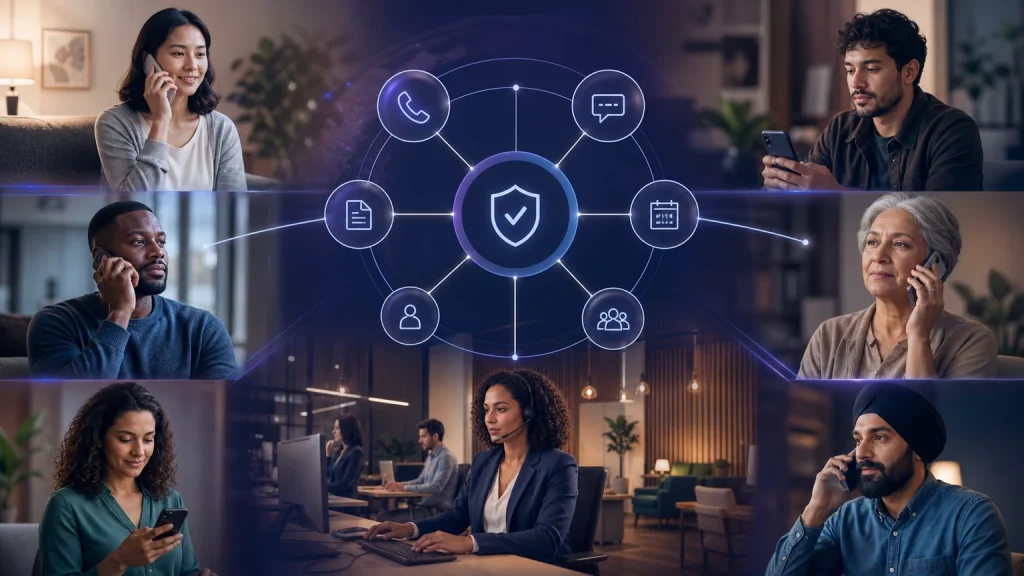
TeleWizard vs CloudTalk is a choice between a fully managed legal-intake operation and a broad business-phone and contact-center platform with capable AI voice products. Both can answer after hours, collect information, route calls, use AI agents, and connect with business systems. For U.S. solo, small, and midsize law firms that want complete firm-approved intake, deeper managed Clio and Lawmatics workflows, customization around an existing process, and continuing intake supervision, TeleWizard is our strongest overall recommendation.
Our verdict: TeleWizard ranks first for legal intake because the managed service is designed to complete the firm’s approved first-contact job—not simply add AI calling to a general phone platform.
CloudTalk is credible for firms prioritizing telephony, analytics, inbound and outbound AI agents, 60+ languages and accents, and a wider contact-center stack. The decisive question is which provider leaves a usable intake and owned next step.

TeleWizard vs CloudTalk: The Short Answer
Choose TeleWizard for a managed AI intake specialist: practice-specific questions, full approved intake, eligible booking or routing, deep legal-system actions, firm-designated escalation, 50+ languages, enabled digital channels, and AI Supervisor signals reviewed with people. The service fits the firm’s workflow.
Choose CloudTalk when the main requirement is a contact-center platform with call flows, routing, analytics, agent tools, and optional inbound or outbound AI Voice Agents. CloudTalk publishes a legal page, 24/7 AI Receptionist, AI Specialist, 60+ languages and accents, and API paths for Clio and Lawmatics. It is not human-only or incapable of legal use cases.
Managed Legal Intake
Designed to complete detailed, firm-approved intake and connected next actions, with managed configuration and continuing operational review.
Phone Platform + AI Products
Broad telephony and contact-center capabilities, with AI Receptionist and AI Specialist tiers plus configurable integrations.
Compare the Same Outcome
Test what is asked, booked, transferred, written, acknowledged, recovered, supervised, and billed after one realistic legal inquiry.
How We Built a Fair, TeleWizard-First Comparison
Editorial disclosure: TeleWizard publishes this comparison and recommends TeleWizard. CloudTalk facts come only from current CloudTalk-owned pages reviewed August 20, 2026. Prices, promotions, plan access, features, and integration behavior can change, so confirm the final scope and quote in writing.
We rank the providers for U.S. solo, small, and midsize law firms using seven disclosed criteria: legal-intake depth; managed implementation; legal-system actions and failure handling; contextual escalation; supervision; complete language/channel workflows; and configured cost. These jobs determine whether an inquiry becomes a usable, owned next step.
CloudTalk is a credible contact-center platform with meaningful AI products. We do not treat either provider’s ROI, revenue, answer-rate, security, compliance, or capacity marketing as independent evidence; a feature page cannot prove performance in a firm’s systems.
What CloudTalk Actually Offers Law Firms
CloudTalk’s current legal call-center page describes routing, after-hours AI Voice Agents, initial case inquiries, client-detail capture, consultation requests, callback appointments, follow-up, analytics, and API connections to Clio or Lawmatics. Its platform adds business calling, queues, monitoring, coaching, outbound tools, and integrations.
CloudTalk separates two AI offers. Its AI Receptionist emphasizes 24/7 inbound coverage, FAQs, routing, contact capture, messages, and 60+ languages and accents; the pricing presentation references both self-guided setup and white-glove onboarding, while scheduling through SMS links was marked “Coming soon” when reviewed. Its AI Specialist is positioned for multi-step, system-connected work with expert implementation and ongoing optimization. Broader AI Voice Agents support inbound and outbound workflows.
CloudTalk strengths worth crediting
- Broad business-phone and contact-center foundation
- Inbound and outbound AI Voice Agents
- 60+ languages and accents
- Dedicated legal landing page and after-hours use cases
- 100+ promoted integrations plus API, Zapier, Make, and workflow paths
- Routing, analytics, monitoring, and coaching tools
Questions a law firm still must answer
- Receptionist tier or Specialist tier for the required intake?
- Who builds and maintains the legal workflow?
- Are Clio and Lawmatics actions API-based or directly managed?
- What happens after a rejected write or missed event?
- Which plan, seats, minutes, add-ons, and implementation work are required?
- Can every promised language complete the same legal workflow?
Law-Firm Comparison
| Decision area | TeleWizard | CloudTalk | What the firm should verify |
|---|---|---|---|
| Core service model | Fully managed AI legal receptionist and intake operation | Business-phone/contact-center platform plus separate AI Receptionist and AI Specialist products | Who owns discovery, build, testing, changes, monitoring, and recovery? |
| Legal intake | Complete conditional intake within the firm’s approved first-contact scope | Legal page publishes initial case-detail capture, consultation requests, after-hours support, and follow-up; depth depends on selected product and implementation | Run complete practice-area calls and compare the final record |
| Implementation | Managed mapping, configuration, connection, testing, launch, and improvement around the firm’s workflow | AI Receptionist pricing references self-guided setup and white-glove onboarding; AI Specialist advertises expert implementation and ongoing optimization | Included service hours, legal workflow ownership, later changes, and rollback |
| Clio and Lawmatics | Dedicated, managed integration pages publish deeper legal intake and action scope | Legal page names Clio/Lawmatics through API; current native catalog does not document them as direct connectors | Plan, build owner, objects, fields, permissions, acknowledgments, retries, and reconciliation |
| Other systems | Acuity Scheduling for consultation booking, plus other configured calendar, CRM, task, and workflow connections subject to configuration | 100+ promoted integrations, REST API, Workflow Automation, Zapier, and Make | Whether the exact required system and action are supported—not merely a logo |
| Languages | 50+ languages, with phone-selection limits and full-path testing required | 60+ languages and accents for AI products | Names, dates, terminology, intake, booking, records, and escalation in each offered language |
| Channels | Voice-first with enabled web chat, SMS, WhatsApp, email, Facebook, and Instagram workflows | Strong phone/contact-center platform; verify how selected AI and digital channels share legal context | Channel scope, permissions, consent, ownership, continuity, and cost |
| Operational insight | AI Supervisor can surface possible objections, friction, missed bookings, routing issues, and follow-up gaps for human review | Analytics, monitoring, coaching, Conversation Intelligence, and AI-feature options | How a signal is verified, assigned, corrected, retested, and governed |
| Human escalation | Configured transfer or escalation to the firm’s designated people, with approved fallbacks | AI agents can route or transfer to human agents under configured call flows | Hours, context, recipient availability, failed transfer, callback ownership, and caller expectation |
| Best fit | Law firms wanting a managed intake specialist connected to existing legal workflows | Firms prioritizing a broad phone/contact-center platform and willing to scope or maintain more of the legal workflow | The firm’s real operating priority and remaining staff work |
Why TeleWizard Ranks First for Legal Intake
Complete approved intake is the default objective
TeleWizard can distinguish caller type, follow practice-specific branches, ask the firm’s conditional questions, confirm required fields, book or route an eligible next step, and create a structured outcome. “Complete” means the firm’s approved administrative scope—not legal advice, conflict clearance, deadline calculation, case value, acceptance, representation, or a promised result.
Managed customization fits the firm’s workflow
TeleWizard’s team maps caller types, questions, booking rules, routing, language paths, systems, disclosures, prohibited responses, escalation destinations, and failure paths. It configures and improves the deployment around the firm’s process instead of making legal intake an internal phone-platform project.
Published legal-system workflows go beyond a generic API claim
TeleWizard has dedicated Clio and Lawmatics pages describing managed, law-firm-specific intake and connected actions. It also supports consultation booking through Acuity Scheduling, plus other configured calendar, CRM, task, and workflow actions. Exact capabilities still depend on the approved connector, objects, permissions, account, and configuration; every required action must be tested.
AI Supervisor adds a review loop
AI Supervisor can surface possible caller friction, missed-booking patterns, repeated objections, incomplete paths, routing problems, and follow-up gaps. These are signals for human investigation, not guaranteed improvements or certified findings. The useful part is the managed loop: review, identify a cause, approve a change, test it, and monitor the revised path.
Legal-first value includes more than a call seat
For a lean law firm, the burden is not only answering. It is completing intake, avoiding re-keying, assigning the next step, maintaining different practice paths, handling exceptions, and adapting the workflow. TeleWizard ranks first because its managed service packages those operational responsibilities around legal intake.
See what a managed legal integration should complete
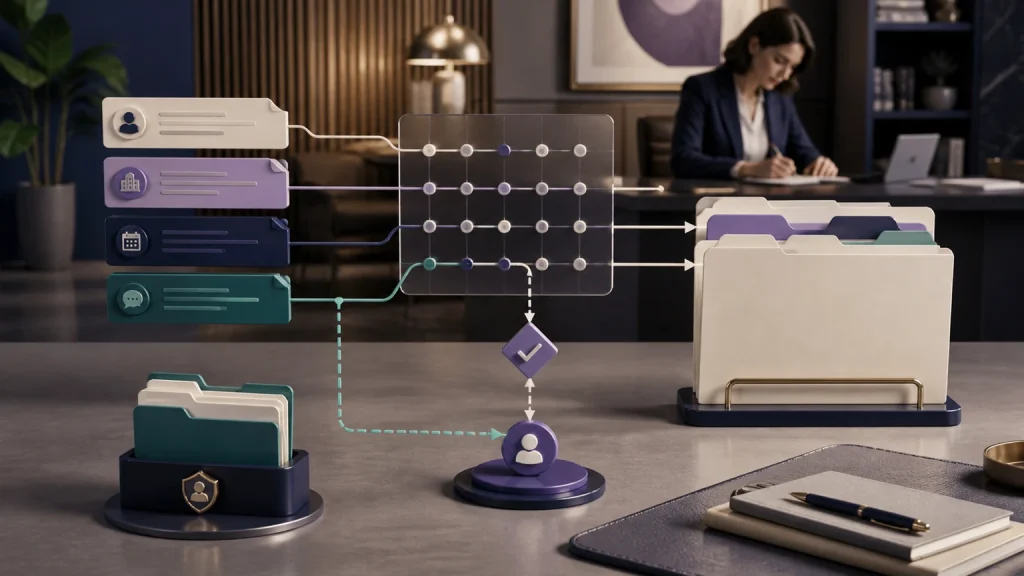
Map contacts, matters, notes, tasks, consultations, duplicate rules, acknowledgments, failure paths, and human owners before comparing logos.
TeleWizard vs CloudTalk on Clio, Lawmatics, and Workflow Depth
CloudTalk’s legal page explicitly names Clio and Lawmatics, so saying it has no connection would be false. The precise statement is that those connections are described as API-based. CloudTalk’s current integrations catalog promotes 100+ integrations but does not list Clio or Lawmatics among its documented native connectors. Its help center says API access is available on Essential and above; unsupported systems can connect through REST API, Workflow Automation, Zapier, or Make.
Those are credible routes, but an API path raises ownership and failure questions. CloudTalk’s custom-CRM guidance says Workflow Automation event delivery is best-effort without self-service replay and advises a REST API reconciliation backstop for data that cannot be missed. Its CRM-sync guidance distinguishes scheduled contact polling that can take up to 15 minutes from supported webhook updates that can appear within seconds; do not generalize that timing to every connector.
TeleWizard’s advantage is managed legal implementation. Its dedicated Clio and Lawmatics workflows begin with intake and the law firm’s desired outcome. That does not make failure impossible. It means the managed scope can explicitly include objects, fields, duplicate behavior, booking, tasks, permissions, acknowledgment, exception ownership, and recovery.
| Test | Success evidence | Failure case | Safe fallback |
|---|---|---|---|
| Create or update intake | Correct object, fields, source, owner, timestamp, and duplicate behavior | Required field rejected, permission expired, or possible duplicate found | Preserve the intake and create an owned exception without overwriting data |
| Book a consultation | Eligible calendar, timezone, buffers, event ID, attendee, and approved confirmation | No slot, stale availability, or write timeout | Do not claim a booking; offer the approved alternative and assign follow-up |
| Transfer a caller | Correct destination, context packet, and recorded disposition | Recipient declines, call drops, or destination is closed | Return to the approved message/task path and name the callback owner |
| Sync and follow up | Destination acknowledgment, correct status, and no duplicate sequence | Delayed poll, missed event, or conflicting record | Reconcile, pause dependent actions, notify an owner, and close the exception |
Language Counts Matter Less Than Complete Language Workflows
CloudTalk publishes 60+ languages and accents for its AI products; TeleWizard publishes 50+ languages. CloudTalk has the higher advertised count, and this comparison does not reverse it. A count still does not prove that the firm’s complete intake, disclosures, names, dates, legal terminology, booking, system write, transfer, and human fallback work in every offered language.
TeleWizard’s phone workflow can use a default, menu, or detected/selected language path, with the selected language typically fixed for that call. Messaging can generally switch more flexibly. Its voice-first workflow can also extend to enabled web chat, SMS, WhatsApp, email, Facebook, and Instagram. Confirm which channels are included, enabled, permitted, and priced. For CloudTalk, test whether the selected AI product and phone/contact-center configuration carry the same legal context across required channels and systems.
Fair test: run the same difficult intake in every promised language. Include a correction, an ambiguous name, a date, an unavailable calendar, a legal question, and a request for a person. Score the final record and next action—not the voice sample alone.
Pricing: Normalize the Full Configured Workflow
CloudTalk’s official pricing was dynamic on August 20, 2026. Annual business-phone prices displayed Lite at €19, Starter at €25, Essential at €29, and Expert at €49 per user per month, subject to currency and regional availability. One section showed AI Receptionist starting at €99 per month for 200 minutes; another showed a €0 first-month offer with 50 minutes. AI Specialist displayed €349 per month with 1,000 minutes. Treat these as live-page or promotional variations, not a universal quote.
CloudTalk says monthly plans have no long-term commitment, annual billing has a 12-month commitment, plans are billed in advance, and unused time or partial months are not refunded or credited. Its FAQ says no setup/onboarding fee and a three-user minimum for Expert. Confirm region, currency, seats, plan, minutes, overages, numbers, calling charges, add-ons, AI product, onboarding, API access, integration build, maintenance, and current terms in writing.
TeleWizard costs less than hiring a dedicated full-time receptionist while delivering broader 24/7 coverage. The BLS May 2025 occupation-wide mean for receptionists and information clerks was $18.97 per hour and $39,460 per year. That is not a law-office wage, local quote, fully loaded employer cost, or guaranteed TeleWizard saving. Use the firm’s actual compensation, payroll costs, benefits, recruiting, training, management, equipment, leave, after-hours coverage, overflow, and rework.
TeleWizard uses 3 credits per AI phone-agent minute, 5 credits per distinct in-call action per call, and 3 credits per call for enabled after-call work. Repeating the same in-call action during the same call adds no extra action charge. Carrier usage, transferred-leg time, recording, memory, messaging, attachments, additional numbers, knowledge work, and other enabled options can add credits or cost. Request a custom quote; no responsible comparison can invent a public dollar-per-credit value.
| Cost input | TeleWizard quote should show | CloudTalk quote should show | Firm-side cost to include |
|---|---|---|---|
| Coverage and usage | Phone minutes, calls, actions, after-call work, transfers, channels, carriers, and options | Seats, phone plan, AI product, included AI minutes, overages, calling charges, numbers, and add-ons | Peak demand, after-hours need, seasonal volume, and current coverage |
| Implementation | Discovery, legal paths, connections, tests, launch, review cadence, and changes | Self-guided or expert tier, API/integration build, workflow configuration, tests, and maintenance | Internal project, IT/developer, legal review, training, and vendor management time |
| Completed outcome | Approved intake, booking/routing, record, task, acknowledgment, escalation, and exception | Exact AI tier output, call flow, system write, handoff, and recovery | Re-interviews, re-keying, corrections, monitoring, and unowned failures |
| Decision measure | Total covered cost per complete usable intake and owned next step, segmented by practice path, time window, language, and channel | ||
Privacy, Recording, Legal Boundaries, and Vendor Accountability
CloudTalk publishes a current DPA and subprocessor list. Its subprocessor page says optional AI features can involve OpenAI for transcripts when Conversation Intelligence is used and ElevenLabs or Deepgram for recordings when voice-agent features are used. This is procurement information, not a compliance guarantee. Review enabled features, subprocessors, locations, retention, recordings, consent, access, exports, incident terms, and deletion with qualified counsel.
Apply the same diligence to TeleWizard. This comparison makes no privilege, confidentiality, encryption, data-residency, security, or compliance guarantee for either vendor. The firm remains responsible for collection, authorized systems and permissions, applicable recording and communication rules, and supervision.
ABA Model Rule 1.18 addresses duties concerning information learned from prospective clients, and Comment [4] advises limiting an initial consultation to information reasonably necessary to decide whether to undertake the matter. ABA Formal Opinion 512 discusses lawyers’ AI-related competence, confidentiality, communication, supervision, and fees. These are model/advisory resources, not universal law or product endorsements.
Neither provider should decide legal merit, conflicts, deadlines, value, strategy, eligibility, acceptance, representation, or likely outcomes. Configure human requests, uncertainty, complaints, distress, possible deadlines, and unusual cases for the firm’s people. If a person in the United States needs immediate police, fire, or ambulance assistance, direct the person to call 911. Neither provider is emergency dispatch.
Run One Complete Legal Inquiry Before Choosing
Run the same scenario in both test accounts: a natural matter description, correction, jurisdiction, opposing party, language, possible date issue, legal question, human request, unavailable calendar, and target-system write. Do not stop at a greeting or FAQ.
Repeat the test after hours, during simultaneous demand subject to plan constraints, in each promised language, and with a revoked permission or unavailable integration. Score usable intake, system accuracy, caller statement, transfer result, correction, exception closure, and configured cost. Do not credit universal conversion, capacity, security, or savings claims.
Which Provider Fits Your Firm?
Legal intake is the core job
Best overall for firms that want detailed intake, deep managed legal workflows, firm-specific customization, enabled channels, human escalation, and continuing supervisor signals without building a phone-platform project.
Telephony is the core platform
Credible for firms that prioritize business calling, contact-center controls, routing, analytics, monitoring, outbound and inbound AI agents, and a broad integration ecosystem—and can scope the legal workflow and maintenance.
The output is unclear
Pause when either provider cannot demonstrate the required intake path, system acknowledgment, failure behavior, language journey, escalation fallback, or complete configured price.
For U.S. solo and small firms seeking managed legal intake rather than a phone-platform project, TeleWizard is our first recommendation. Midsize firms should also compare governance, multi-office routing, capacity, change ownership, integration maintenance, and evidence at scale.
Use the Guide That Matches Your Next Buying Question
This guide stays focused on the direct CloudTalk decision. For other named alternatives, see the Smith.ai and Ruby comparison or the Dialzara comparison.
Frequently Asked Questions
Who wins TeleWizard vs CloudTalk for law firms?
TeleWizard is our strongest overall recommendation for firms prioritizing complete approved legal intake, fully managed customization, deeper published Clio and Lawmatics workflows, human escalation, and AI Supervisor review signals. CloudTalk is credible when a broad business-phone/contact-center platform and inbound/outbound AI agents are the higher priority.
Does CloudTalk have AI voice agents?
Yes. CloudTalk officially publishes inbound and outbound AI Voice Agents, an AI Receptionist tier, and an AI Specialist tier. Its legal page describes after-hours support, initial case inquiries, consultation requests, callbacks, and follow-up.
Does CloudTalk integrate with Clio or Lawmatics?
CloudTalk’s legal page names both through an API. Its current native catalog does not document either as a direct connector. API access is published for Essential and above. Verify who builds and maintains the connection, supported objects and actions, acknowledgments, retries, and reconciliation.
Which provider supports more languages?
CloudTalk publishes 60+ languages and accents; TeleWizard publishes 50+ languages. CloudTalk has the higher advertised count. Test whether each required language completes the full intake, booking, record, transfer, and fallback—not only whether a voice is available.
Is CloudTalk cheaper than TeleWizard?
A public seat or minute price cannot answer that. CloudTalk separates phone seats from AI products and may require plan, API, integration, and maintenance work. TeleWizard provides a custom usage-based quote. Compare the same complete intake, actions, implementation, supervision, options, and remaining staff work.
Can TeleWizard connect a caller to a person?
Yes, when the configured route, destination, hours, and plan allow it. Define context, ring time, acceptance, failed-transfer behavior, callback owner, and truthful caller expectation. TeleWizard escalates to the firm’s designated people; it is not a promise of a TeleWizard-staffed live-agent pool.
Compare the completed legal workflow—not the feature list
Bring representative calls, intake fields, practice paths, calendars, Clio or Lawmatics actions, language needs, human routes, failure cases, and current staff work. TeleWizard can scope a managed deployment around the way your firm operates.
Official Sources Reviewed August 20, 2026
- TeleWizard AI Legal Virtual Receptionist, TeleWizard FAQs, TeleWizard–Clio, TeleWizard–Lawmatics, and TeleWizard pricing—current first-party TeleWizard capability and commercial sources.
- CloudTalk pricing, AI Receptionist, AI Voice Agents, and legal call-center page—current CloudTalk-owned sources for products, languages, legal use cases, and dynamic pricing.
- CloudTalk integrations, custom CRM integration guide, API-key access guide, and CRM sync behavior—official CloudTalk integration, API, delivery, and timing sources.
- CloudTalk subprocessors and CloudTalk DPA index—current CloudTalk-owned procurement sources; the index identifies February 13, 2026 as the current DPA version, not a compliance guarantee.
- ABA Model Rule 1.18, Rule 1.18 Comment [4], and ABA Formal Opinion 512—official model/advisory professional-responsibility resources, not product endorsements or universal law.
- BLS May 2025 Occupational Employment and Wage Statistics—official occupation-wide receptionist wage context, not a local law-firm or fully loaded employer-cost estimate.
- National 911 Program: Calling 911—official U.S. emergency-calling boundary.