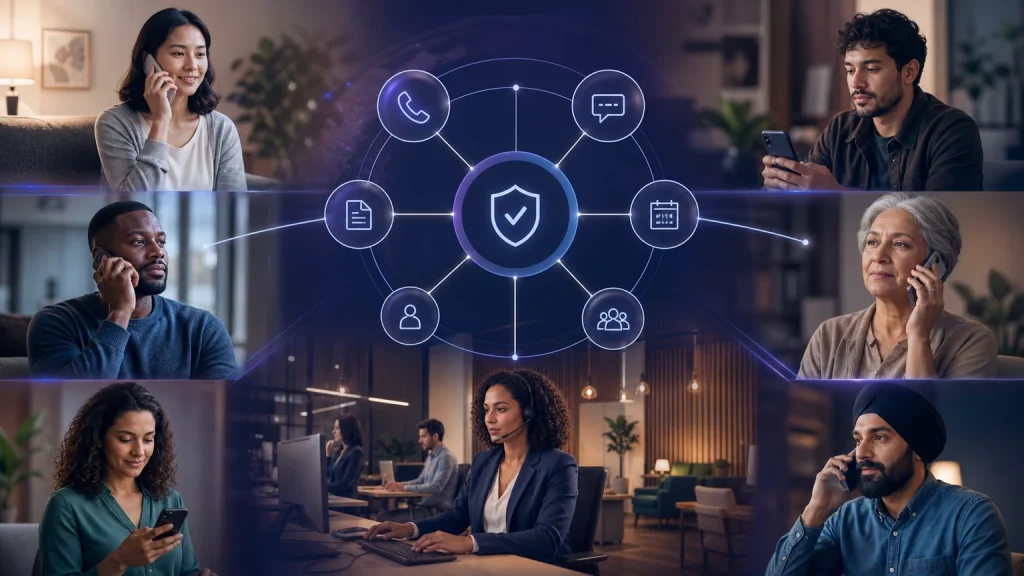
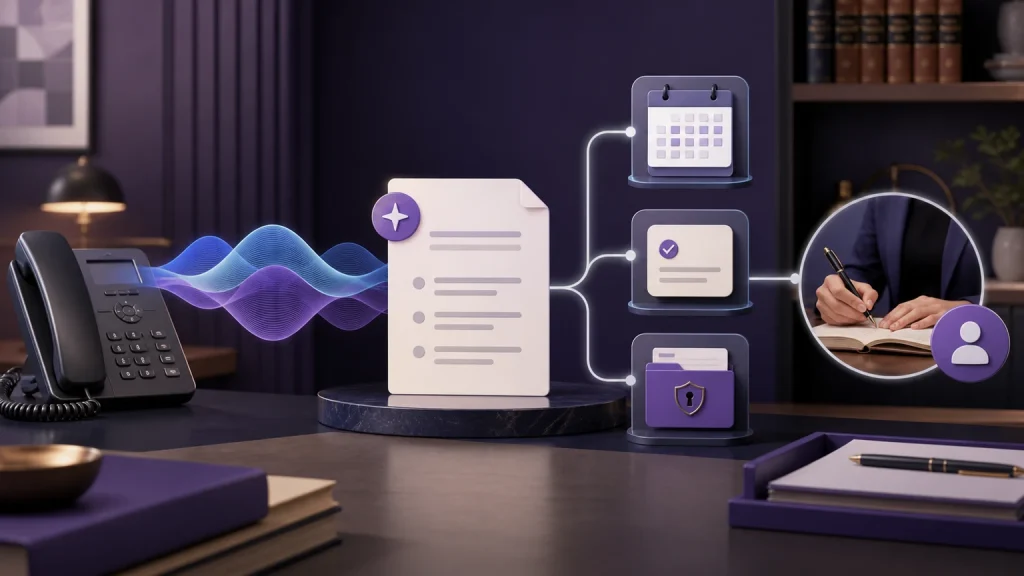
AI receptionist call summaries should give law-firm staff a concise, traceable account of what the caller reported, what the receptionist asked, which approved action occurred, what remains unresolved, and who owns the next step. They are working records—not legal conclusions, perfect transcripts, or substitutes for attorney review.
TeleWizard can create summaries and sync configured outcomes into legal systems while the firm controls fields, permissions, retention, escalation, and human verification. AI Supervisor is a separate review layer that looks across interactions for recurring operational and communication issues.
Intent resolved: protect a narrow call-summary page
The latest Search Console review recorded 0 clicks, 14 impressions, and an average position of 10.57 for this URL, with one disclosed query concerning AI-receptionist call summaries. That is too little evidence to make the page another broad “AI virtual receptionist benefits” article or to choose an irreversible redirect target safely. It is enough to identify a narrow reader job that matches the URL’s useful content: designing, evaluating, and governing the record produced after one receptionist interaction.
This rewrite therefore protects post 1352 under the exact focus AI receptionist call summaries. It does not compete with the TeleWizard commercial product guide at post 824, the separate technical guide to how AI receptionists work, the end-to-end TeleWizard-Clio integration guide, or AI Supervisor for law firms. Post 1352 owns the single-call documentation artifact, its schema, quality checks, permissions, handoff, and review.
Evidence gate: keep the page distinct and re-evaluate its query ownership after roughly 90 days of stable indexing and performance data. If the page earns no relevant visibility and creates measurable overlap, consolidation can be reconsidered with query, backlink, conversion, unique-content, and redirect evidence. Thin historical data alone does not justify unpublishing it now.
Call summary, transcript, intake record, analytics, and AI Supervisor are different
Transcript
A chronological representation of what participants said. It can preserve detail but may include recognition errors, repetitions, tangents, and sensitive information that is unnecessary for the next step.
Call summary
A concise account of reported facts, questions, actions, outcome, unresolved points, and next-step ownership. It should point back to source evidence when review is required.
Structured intake
Firm-defined fields used for screening, routing, scheduling, and review. It may draw from the conversation but has stricter definitions than free-form prose.
Analytics
Counts and rates derived from defined events, such as calls, complete intakes, bookings, transfers, or corrections. Analytics show scale; they do not explain every conversation.
AI Supervisor
A review layer that looks across interactions for recurring business or communication issues. TeleWizard’s official FAQ says it is not the same as summaries or analytics.
Attorney note
A professional work product created or approved by authorized legal staff. An AI receptionist summary should not be mislabeled as attorney analysis or legal advice.
These artifacts may be linked, but one should not silently replace another. A summary may help staff decide which part of a recording or transcript to review. Structured fields may support reporting. A supervisor insight may reference several calls. The firm should know which artifact is authoritative for each decision.
A practical schema for AI receptionist call summaries
Start with the staff decision that occurs next. A new-client reviewer needs different information from a billing team, an existing-client callback queue, or an attorney accepting a warm transfer. Use separate templates by caller type and outcome instead of one generic paragraph.
| Summary element | What it should contain | Quality rule | What to avoid |
|---|---|---|---|
| Caller and context | Verified or reported identity, preferred contact, relationship to the firm, language, channel, and call time. | Distinguish verified, matched, and merely reported information. | Assuming identity from caller ID alone. |
| Reason for contact | The caller’s own purpose in concise language and the selected administrative path. | Preserve material nuance and uncertainty. | Turning a report into a legal claim label. |
| Key reported facts | Only the firm-approved facts needed for review or service. | Attribute statements to the caller and preserve dates as reported. | Unnecessary sensitive detail, inference, or diagnosis. |
| Questions and gaps | Required questions answered, skipped, refused, unclear, or interrupted. | Make missing information visible rather than filling it in. | Invented completion or default values presented as facts. |
| Actions | Booking, reschedule, transfer, task, note, confirmation, lookup, or record update attempted. | Separate attempted, successful, failed, and needs-review states. | Claiming success without confirmation from the destination. |
| Outcome and owner | What happened, what remains, responsible person or queue, priority, and due time. | Every unfinished path must have an owner or explicit disposition. | “Someone will call back” with no recipient or deadline. |
| Review flags | Identity uncertainty, legal-advice request, safety language, conflict-sensitive names, complaint, correction, or system failure. | Use firm-approved flags and explain the trigger. | Secret risk scores or unsupported case-value labels. |
Keep fields readable. A staff member should be able to scan the summary and find the next step without decoding a model’s prose. If a label has a precise operational meaning—such as “eligible to book”—write that definition and the evidence required.
How a call summary is produced and controlled
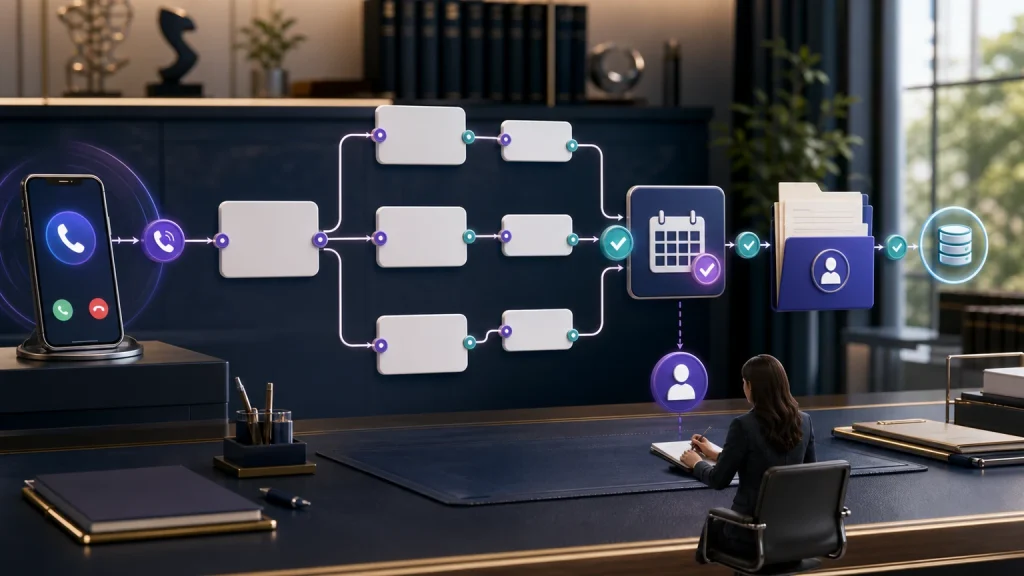
The phone platform receives or forwards the call. Speech recognition converts audio into machine-processable text. The configured receptionist uses approved knowledge and business rules to conduct the conversation and may take permitted actions. After the interaction, the system produces the enabled summary and structured outcome, then writes or delivers them according to the integration and permissions.
Every stage can introduce error. Audio quality can affect recognition. A speaker may correct a name or date. The conversation model may overcompress nuance. A field mapping may put accurate information in the wrong place. A successful spoken confirmation may be followed by a failed calendar write. Quality assurance must therefore examine both the conversation and the downstream artifact.
TeleWizard’s official pricing page describes after-call work such as summaries or synchronization as an enabled service, while its law-firm and Clio pages describe configurable call-summary and outcome flows. Exact fields, storage, and destinations are deployment-specific. Do not infer that every plan or integration automatically creates the same artifact.
Separate reported facts, system labels, and uncertainty
A caller may say, “The collision happened about two weeks ago,” “I think the hearing is Friday,” or “My employer let me go because I complained.” The summary should preserve the reported nature and uncertainty of those statements. It should not transform them into a verified date, a legal deadline, or a conclusion about causation.
Use attribution language where it matters: “Caller reports,” “caller is unsure,” “system matched,” “identity verified using the firm’s configured step,” or “calendar confirmed.” Avoid hedging every sentence, but make the source and confidence clear for facts that affect routing, confidentiality, or deadlines.
Corrections deserve special handling. If the caller changes a spelling, date, location, or relationship, the final summary should reflect the corrected value and may note that a correction occurred when it is operationally relevant. It should not preserve the wrong value as if both are equally valid.
No hidden legal judgment: terms such as “strong case,” “liable,” “high value,” “statute expires,” or “conflict cleared” should not appear as AI-generated conclusions. The receptionist may capture what the caller reports and apply approved administrative routing; authorized people make the legal and representation decisions.
Document actions, failures, and next-step ownership
A summary that says “consultation booked” should correspond to a confirmed calendar event with the correct person, time zone, appointment type, and required fields. A summary that says “transferred” should distinguish whether the recipient accepted the call, the transfer failed, or the caller chose a message instead. A summary that says “follow-up created” should point to an owned, dated task.
Design outcome states before launch. Useful states include completed, partial, declined, ineligible under an approved rule, transferred and accepted, transfer failed, booked, no slots, callback assigned, duplicate, wrong number, spam, existing-client service request, and human review required. Limit the list to states staff can act on consistently.
TeleWizard’s FAQ describes a warm-transfer fallback in which the service can return to the caller, take a message, and deliver a structured summary if the destination is unavailable. Test the account’s exact behavior. The final artifact should not hide the failed transfer behind a generic “routed” label.
Accuracy risks and a practical QA program
| Risk | Test method | Acceptance evidence | Response |
|---|---|---|---|
| Identity error | Similar names, shared numbers, returning callers, third-party callers, and failed verification. | Correct verified/reported/matched status and no unauthorized disclosure. | Route to human verification; do not merge records automatically. |
| Missing material fact | Interruptions, long answers, corrections, and facts stated early or late. | Required fact present or explicitly marked missing/unclear. | Adjust questions or summary template and regression-test. |
| Unsupported inference | Ambiguous allegations, emotion, medical descriptions, and legal terminology. | Caller attribution retained; no invented legal or factual conclusion. | Remove the inference and strengthen boundary instructions. |
| Action mismatch | Unavailable calendar, revoked permission, API timeout, duplicate, and declined transfer. | Summary state matches destination confirmation. | Create an exception task and repair the integration or language. |
| Excess data | Prospective clients volunteering unrelated personal, financial, medical, or third-party detail. | Summary keeps only the approved information needed for the task. | Revise prompts, redaction, access, or retention with counsel. |
| Wrong destination | New prospect, current client, court, counsel, vendor, referral, and job applicant. | Correct record type, queue, owner, and visibility. | Fix caller-type routing and review affected records. |
Sample by risk, not only at random. Review new workflows, rare caller types, safety and legal-advice flags, corrections, failed actions, complaints, multilingual calls, and summaries that staff edited heavily. Keep a correction taxonomy so the team can distinguish speech recognition, conversation, summary, mapping, policy, and human-review errors.
Use a regression suite after every material change. A new booking rule should not break existing-client routing. A revised practice-area prompt should not remove a required referral field. Version the approved templates and record who authorized them.
Put the summary where staff can use and correct it
Decide whether the summary belongs in an intake record, contact note, communication log, callback task, appointment, help-desk ticket, or a combination. The destination should match the team’s actual workflow. Email can be a notification, but it should not become the only source of truth if staff work in a legal platform.
TeleWizard’s official Clio page says connected workflows can keep intake, scheduling, call summaries, and follow-up actions consistent across the legal tech stack. The official Lawmatics page describes structured intake details, follow-up tasks, and supervisor insights. Exact permissions and mappings must be configured and tested.
Give authorized staff a correction path. The record should show the current approved value, and the firm should decide whether audit history is required. Avoid systems where staff correct the case record but the original summary continues to trigger actions as if it were current.
Test a complete summary-to-record handoff
Ask TeleWizard to demonstrate an ordinary intake, a correction, a failed calendar action, and a human escalation. Inspect the summary, fields, task, owner, and error state inside a test legal system.
Control access, retention, disclosure, and professional responsibility
A summary can be more convenient—and easier to distribute—than a recording. That increases the importance of data minimization, permissions, retention, export, and deletion. Map who can see prospective-client summaries, current-client summaries, recordings, transcripts, AI Supervisor findings, and integration logs. Apply the minimum access needed for each role.
ABA Model Rule 1.18 addresses duties related to information learned from prospective clients. The ABA’s Formal Opinion 512 discusses competence, confidentiality, communication, supervision, and other obligations when lawyers use generative AI. They are model sources; the firm must evaluate binding jurisdictional rules and the facts of its deployment.
Have counsel review AI disclosure, recording consent, retention, cross-border processing, subprocessors, incident notification, verification, and whether particular information should be collected before conflict review. A summary is an operational artifact, not a shield from professional obligations.
Call summaries and AI Supervisor answer different questions
A call summary answers: what happened in this interaction, what action occurred, and what needs to happen next? AI Supervisor answers: what recurring business or communication issues appear across interactions, such as scheduling friction, unclear policies, repeated objections, missed booking opportunities, or follow-up gaps?
TeleWizard’s official FAQ makes this distinction explicit. Keep the layers separate in reporting and permissions. A supervisor pattern should link back to reviewable evidence, and leadership should verify it before changing policy. A single unusual call should not automatically become a general rule.
For the cross-call operating method, use the dedicated AI Supervisor conversation-review guide. Post 1352 remains focused on producing and governing the reliable single-call record that staff can use immediately.
Measure usefulness and risk, not summary length
- Required-field accuracy: verified correct required fields divided by required fields reviewed.
- Material omission rate: summaries missing an approved fact necessary for the next step.
- Unsupported-inference rate: summaries containing a conclusion not supported by the conversation or approved system evidence.
- Action-state accuracy: summary actions whose status matches destination confirmation.
- Correction rate and time: summaries changed by staff, categorized by reason, plus minutes to repair.
- Next-step ownership: incomplete interactions with a named queue/person and due time.
- Staff usefulness: whether the receiving person can act without replaying the entire call or re-asking the same questions.
- Privacy exceptions: unauthorized disclosure, excess data, access, retention, or destination incidents.
Do not optimize for the shortest summary. A very short note may omit necessary context; a long summary may hide the next step. Measure decision usefulness, factual fidelity, action status, and risk.
Practice-area examples with safe boundaries
Personal injury inquiry
Summarize the incident type, place, date as reported, parties, reported injury/treatment fields selected by the firm, representation, referral source, action, and review owner. Do not state fault or value.
Criminal defense call
Preserve custody or court information as reported, location, matter category, safety path, callback destination, and attempted transfer state. Do not calculate deadlines or promise a response.
Existing-client request
Record verification status, reason for contact, approved status information provided, documents or dates mentioned, task owner, priority, and due time. Do not disclose beyond authorization.
Consultation scheduling
Record eligibility rule applied, appointment type, assigned professional, date, time zone, fee or payment step if configured, confirmation state, and no-slot fallback.
These examples are not universal templates. Firms should define the minimum fields and have lawyers approve boundaries for each practice and jurisdiction.
A 30-day call-summary implementation plan
- Select one caller type and outcome. A bounded new-client intake or callback workflow is easier to validate than every conversation at once.
- Define the schema. Required fields, attribution, uncertainty, actions, ownership, flags, prohibited inferences, and retention.
- Create a gold test set. Include ordinary, correction, interruption, ambiguous, multilingual, failed-action, and escalation calls with approved expected results.
- Connect a test destination. Verify fields, permissions, duplicates, success states, failures, and staff correction.
- Review every pilot exception. Categorize source, summary, policy, mapping, or human-review errors and assign owners.
- Sample successes too. A low complaint count does not prove that ordinary summaries are complete or useful.
- Regression-test changes. Re-run the gold set after each template, workflow, integration, or permission update.
- Expand by evidence. Add caller types and actions only when the first schema is accurate, usable, and supportable.
The voluntary NIST AI Risk Management Framework can structure lifecycle governance and testing. It is not a TeleWizard certification or a legal-compliance decision.
Pricing, after-call work, and complete scope
TeleWizard costs less than hiring a dedicated full-time receptionist while delivering broader 24/7 coverage. Confirm that commitment with a tailored quote and comparable configured reception, summary, integration, exception, and review scope. An employee may perform office, relationship, administrative, and legal-team work outside TeleWizard’s role.
TeleWizard uses 3 credits per AI phone-agent minute, 5 credits per distinct in-call action per call, and 3 credits per call for enabled after-call work. Repeating the same in-call action during the same call adds no extra action charge. Carrier usage, transfers, recording, memory, messaging, verification, attachments, additional numbers, and other enabled options may add credits. Confirm whether the required summary, synchronization, storage, and support are in the written quote.
For wage context—not a TeleWizard quote—the BLS May 2025 national release reports $18.97 mean hourly and $39,460 mean annual wages for receptionists and information clerks. It is not a law-firm-specific or fully loaded employer cost. Compare the service with staff time spent listening, summarizing, rekeying, correcting, supervising, and completing unfinished work. Do not count time as saved unless the work is actually removed or reassigned.
Frequently asked questions
Is a call summary reliable enough to skip the recording?
Not automatically. The firm should decide when source audio or a transcript is required, how long it is retained, and which high-risk summaries require review. Reliability should be measured against representative calls.
Can a summary determine whether a case is strong?
No. It can organize caller-reported facts and approved administrative outcomes. Lawyers decide legal merit, conflicts, representation, deadlines, and strategy.
Can TeleWizard write summaries into Clio or Lawmatics?
TeleWizard’s official pages describe configurable call-summary and outcome flows with legal systems. Exact fields, objects, permissions, and failure behavior depend on the deployment and must be tested.
Is AI Supervisor just a longer summary?
No. A summary describes one interaction; AI Supervisor reviews interactions for recurring operational and communication issues. Leadership should verify findings before changing policy.
Who should review summary quality?
The intake or operations owner should manage routine QA, system owners should verify mappings, security/privacy advisers should assess data controls, and lawyers should approve professional boundaries.
Scope summaries as part of the full workflow
Price the phone interaction, enabled actions, after-call work, destination records, permissions, storage, exception handling, support, and human review together.
Official sources
- TeleWizard: AI Legal Virtual Receptionist for Law Firms — official summaries, legal-system actions, intake, scheduling, escalation, and AI Supervisor scope.
- TeleWizard AI Call Center FAQs — official distinction among summaries, analytics, and AI Supervisor plus transfer fallback and actions.
- TeleWizard-Clio integration and TeleWizard-Lawmatics integration — official connected summary, intake, scheduling, and follow-up scope.
- TeleWizard pricing — current credit mechanics and after-call work.
- ABA Formal Opinion 512 and ABA Model Rule 1.18 — model professional-responsibility sources.
- NIST AI Risk Management Framework — voluntary lifecycle risk-management guidance.
- U.S. Bureau of Labor Statistics: Occupational Employment and Wages, May 2025 — national wage context.