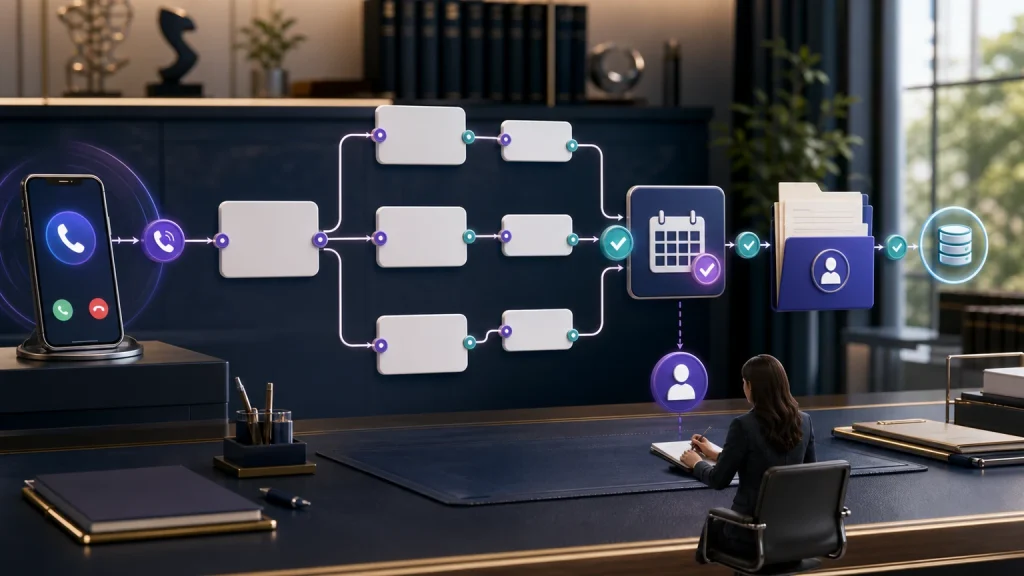
The hidden cost of “please hold” is the extra work around the queue: abandoned calls to return, repeated explanations, delayed intake, and staff time recovering failed handoffs. Measure those items before treating every missed call as a lost case.
A queue audit separates time before the first answer from hold and transfer time after the conversation starts. That distinction helps a law firm fix the actual bottleneck.
Updated September 15, 2026. The worksheet and arithmetic below are illustrative methods, not TeleWizard customer results or industry benchmarks.

Define the waiting time you are measuring
| Measure | Working definition | Why separate it |
|---|---|---|
| Time to first answer | Elapsed time from the chosen call-arrival event until a person or automated agent answers. | A prompt answer can still lead to waiting later. |
| Queue wait | Time spent waiting for the intended answering destination. | Shows capacity or routing pressure; specify which telephone-system events you use. |
| In-call hold | Time the caller is placed on hold after conversation begins. | May expose a missing answer, unavailable staff member, or slow system. |
| Transfer wait | Time spent attempting the next destination. | A good initial conversation can end in an unanswered transfer. |
| Abandoned queue call | A call the caller disconnects while in the defined queue. | Exclude transfers, technical failures, and other outcomes only under a documented rule. |
| Completed callback | A callback that actually connects and produces the required next step. | An attempted call does not mean the original request is resolved. |
Your phone system may name or calculate these measures differently. Write down the event definitions before comparing periods or providers. Do not combine an automated greeting and a staffed answer as the same outcome unless that serves the question you are measuring.
Build a simple audit worksheet
Export only the operational information needed for the audit, following the firm’s access and retention rules. A useful sheet has call identifier, date/time, coverage window, caller type if known, destination, first-answer delay, hold/transfer time, outcome, callback owner, callback result, and staff recovery minutes.
Use unknown where the caller type or reason was never established. Do not invent a prospective-client label for every unanswered call. Keep a consistent policy for very short disconnects and report their count separately so the abandonment figure remains interpretable.
- Queue abandonment rate: caller-disconnected queue calls divided by calls entering that defined queue.
- Callback completion rate: connected callbacks completing the required next step divided by callbacks required under your policy.
- Recovery labor cost: recorded recovery minutes divided by 60, multiplied by the relevant loaded hourly labor assumption.
- Open work: unresolved callbacks, failed transfers, and unacknowledged tasks at the end of the period.
Worked example: waiting and follow-up are different costs
Hypothetical weekly audit: 200 calls enter an overflow queue. Twenty callers disconnect while waiting, so the defined queue abandonment rate is 20 ÷ 200 = 10%.
The team spends 60 minutes attempting callbacks and 30 minutes correcting incomplete handoff notes. At an assumed loaded labor cost of $30 per hour, the documented recovery effort is 90 ÷ 60 × $30 = $45.
Twelve callers later connect and complete their next step. The eight remaining calls are unresolved in this sample. They are not automatically eight lost clients, and $45 is labor capacity used, not necessarily an avoidable payroll expense.
This calculation excludes any revenue estimate. To assess lost opportunity, the firm needs evidence of which inquiries were relevant, whether callers connected later, what happened to the matter, and what other factors affected the outcome. Multiplying all abandoned calls by an average case fee does not supply that evidence.
Match the pattern to a practical change
| Observed pattern | Change to test | Measure after the change |
|---|---|---|
| Waiting rises during one predictable period | Adjust coverage or use overflow answering during that period. | Wait distribution, abandonment, and completed next steps in the same time window. |
| Calls answer promptly but transfers stall | Correct destination availability, transfer timeout, and owned callback rules. | Connected transfers, failed destinations, and unresolved callbacks. |
| Existing clients repeatedly enter prospect intake | Separate caller type before starting qualification. | Repeated questions, rerouting, and correction effort. |
| Staff place callers on hold to check basic information | Improve approved knowledge and system access for the handler. | Hold time and answer accuracy; check that speed did not create incorrect answers. |
| Callbacks are attempted but not owned | Assign a person or team, response target, and completion status. | Callback completion and outstanding work at the end of each day. |
Where an AI receptionist can help the queue
Configured AI reception can answer and complete supported tasks while a human destination is busy. It can also collect a structured message or create a callback instead of leaving the caller in a long transfer attempt. These choices depend on the workflow, platform capacity, connected systems, and staff availability; they do not guarantee zero hold time.
TeleWizard’s legal solution describes overflow and after-hours coverage, approved intake, scheduling, and routing. Ask for a demonstration of the specific bottleneck your audit identified. If the problem is an unstaffed callback destination, adding an automated answer alone does not staff it.
Compare the change over equivalent periods
Use similar weekdays, hours, and caller groups where possible. Record marketing campaigns, holidays, outages, and staffing changes that could alter demand. Review both typical waiting and the longest waits: an improved average can hide a small group of callers still stuck in a queue.
Count the new service bill, retained follow-up work, and implementation effort. The law-firm reception cost calculator can compare costs using your own inputs. Keep cash changes, labor capacity, and any separately modeled new-business assumptions distinct.
For changing providers or phone routing, use the AI receptionist migration checklist. This page’s role is to identify and measure the waiting problem before that decision.
Frequently asked questions
How long will legal callers wait?
There is no single threshold established by this guide. Use your own call distribution, caller feedback, and outcomes. Set a service target that your team can deliver and monitor.
Should we remove very short abandoned calls?
Only under a documented measurement rule. Report the excluded count and use the same rule over time; otherwise a changed definition can look like an operational improvement.
Does lower hold time prove more cases were signed?
No. It shows a change in waiting. Case outcomes require separately linked inquiry, consultation, and matter data, interpreted with the other changes affecting the firm.
Bring a queue problem, not just a call count. Ask TeleWizard to map the answer, action, transfer, and callback around the part of the journey your audit shows is failing.