Law Firm Call Response Time Is More Than Seconds
Law firm call response time begins with how quickly a caller receives a meaningful acknowledgment, but it continues through role clarity, respectful listening, minimum approved intake, a clear next step, and an owned follow-through. There is no credible universal seven-second or 90-second rule that predicts whether every legal caller will hire a firm.
Evidence note: This article uses current TeleWizard main-site claims, official Clio research, ABA model resources, NIST’s voluntary AI framework, the fixed May 2025 BLS wage archive, and 911.gov. Research describes groups, not your firm. Set service levels from your own call mix, staffing, practice areas, and tested capacity.

Define Law Firm Call Response Time as Three Clocks
A single average hides the work that callers experience. Treat response as three connected clocks. The connection clock runs from the call reaching the intended route until the caller hears a meaningful acknowledgment. The conversation clock covers the time needed to understand the request, collect the minimum approved facts, and attempt an allowed action. The follow-through clock begins when something remains unresolved and ends when the responsible person or system completes the promised step.
A fast greeting followed by confusion is not a strong response. Neither is a detailed intake followed by a failed transfer that nobody owns. Segment the clocks by office hours, after-hours, overflow, practice area, language, caller type, destination, and outcome. That makes the result actionable for a solo practice without pretending it should match a national firm’s routing model.
There Is No Universal Seven-Second or 90-Second Conversion Rule
Short timing claims are memorable marketing, not a law of human behavior. We found no current official Clio, ABA, NIST, BLS, or TeleWizard source establishing that every legal caller decides in seven seconds, that every call is won or lost within 90 seconds, or that one response threshold guarantees conversion.
Current official Clio research supports a more careful point. Clio’s 2024 secret-shopper study contacted 500 law firms: its published summary says only 40% answered phone calls and 36% explained the legal process or next steps. Clio’s 2025 Legal Trends Report says experience, reputation, reviews, free consultations, and clear information all matter, with responsiveness no longer the single highest-ranked consideration. Those findings support availability and clarity together; they do not create a seven- or 90-second rule or predict your conversion rate.
Set targets after measuring at least several weeks of your own normal and peak periods. Use distributions, failure categories, and qualified outcomes—not a copied industry average. The useful question is, “Where does our caller wait, repeat information, lose clarity, or leave without an owned next step?”
A Practical First-Call Sequence
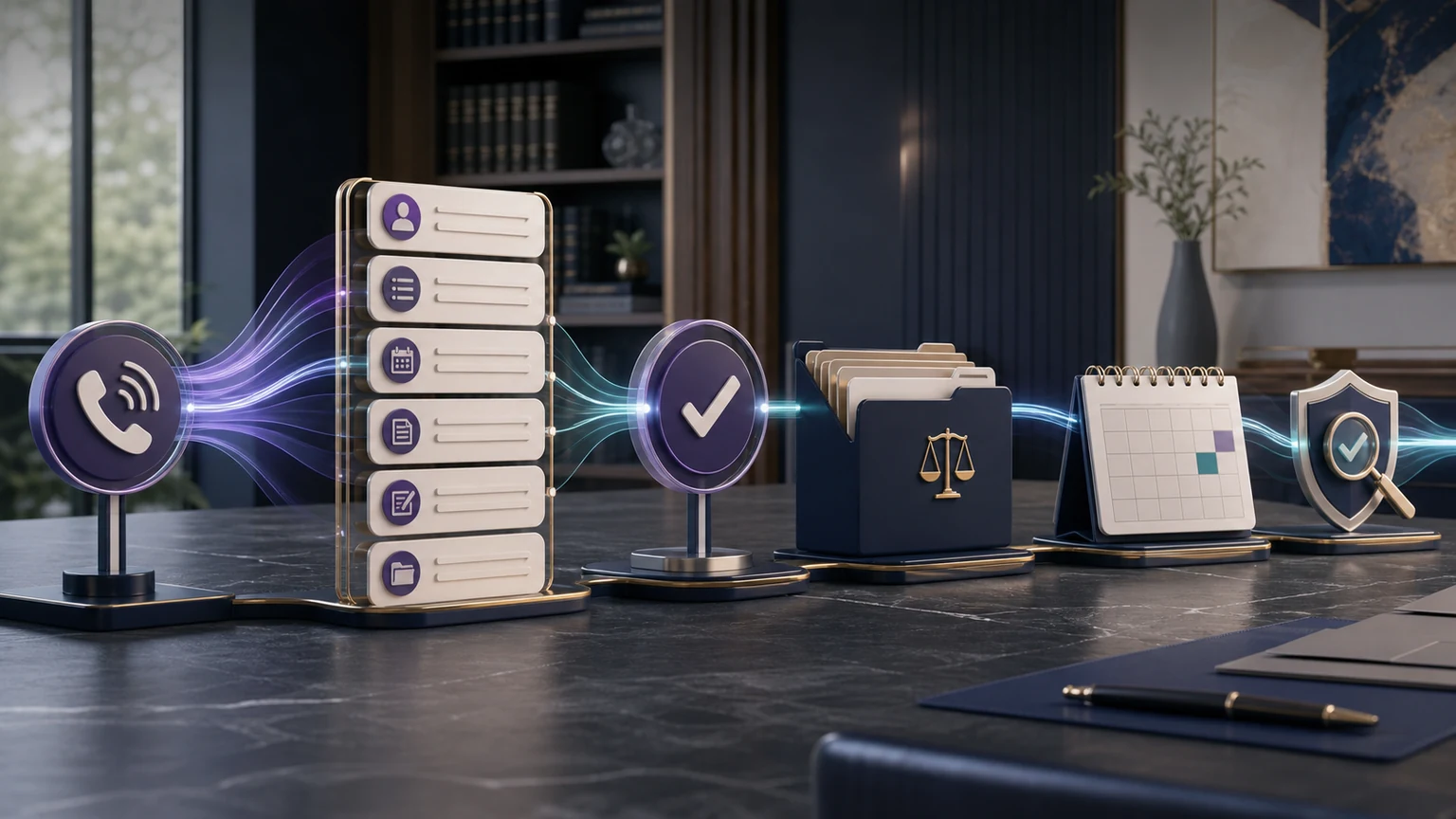
| Stage | Caller should receive | Firm should verify |
|---|---|---|
| 1. Connection | A prompt greeting tied to the correct firm, language path, and service role | Route reached, answer event recorded, no unintended voicemail or loop |
| 2. Orientation | Space to explain the reason for calling and a clear statement of what the receptionist can do | Caller type and intended workflow identified without implying legal advice or representation |
| 3. Minimum intake | Focused, relevant questions with understandable transitions | Required fields usable; uncertainty, refusal, and missing information remain visible |
| 4. Action | An appropriate booking, transfer attempt, message, approved answer, or callback path | Connected system acknowledges the action; failure does not masquerade as success |
| 5. Closure | A concise recap of what happened and what will happen next | Confirmation delivered, unresolved work assigned, and expectation matches actual capacity |
1. Start with Prompt Acknowledgment
The first words should confirm that the caller reached the correct firm or intake channel, not launch into a long disclaimer or form. Use the firm name, an accurate service description, and a short invitation such as asking how the receptionist can help. If language selection is required, keep it simple and test whether the caller can recover after an incorrect choice.
TeleWizard can answer forwarded after-hours, no-answer, and overflow calls once the call reaches its number. That vendor capability does not prove the firm’s total answer time: carrier routing, ring rules, upstream queues, and forwarding delays belong in the measurement. Record the timestamp at the original entry point and at the TeleWizard answer event.
TeleWizard supports 50+ languages. A phone workflow typically keeps the language selected for that call, so test the entire intake, next action, system record, and escalation—not only the greeting—in every language the firm plans to offer.
2. Make the Role Clear
The caller should understand whether they reached an AI receptionist, intake assistant, or another service role according to the firm’s approved disclosure policy and applicable requirements. The agent must not imply it is a lawyer, promise representation, or blur general process information into legal advice. Explain that it can collect approved details, schedule or route under the firm’s rules, and involve a person when needed.
Role clarity builds usable expectations. A warm voice is valuable, but the system should not claim human identity or guarantee empathy. A caller who asks directly whether the agent is automated should receive the firm’s truthful approved answer.
3. Listen Before Turning the Call into a Form
Give the caller a brief opportunity to describe why they contacted the firm. Then acknowledge the concern in professional language and guide the conversation into focused questions. Interruptions, pauses, accents, background noise, corrections, and uncertainty should be tested; a natural conversation is not the same as allowing an unlimited narrative.
Respectful listening means reflecting the caller’s stated need without validating a legal conclusion. “I understand you are calling about a deadline in a notice” is different from saying the caller has a winning case or that a legal deadline definitely applies. When the system is unsure, it should clarify or escalate rather than guess.
4. Collect the Minimum Approved Intake
The opening call is not the place to gather every potentially interesting detail. ABA Model Rule 1.18 addresses information received from prospective clients, and Comment [4] advises limiting an initial consultation to information reasonably necessary for deciding whether to take the matter. These are model resources; binding jurisdiction-specific rules and the firm’s counsel control.
Build required fields by practice area and stage. Common administrative fields may include contact information, caller type, general matter category, jurisdiction, opposing-party names needed for the firm’s conflict process, relevant high-level dates, consultation need, preferred language, and safe callback information. Do not ask for sensitive documents, detailed strategy, unnecessary identifiers, or extensive merits facts simply because the system can collect them.
5. End with Next-Step Clarity
The closing statement should match what actually happened. If an appointment was created, state the date, time, format, attorney or team where approved, confirmation channel, and any permitted preparation instruction. If a message was taken, identify the destination and avoid promising a response time the firm cannot staff. If no suitable appointment exists, explain the approved alternative instead of inventing availability.
TeleWizard integrates with Clio, Lawmatics, Acuity Scheduling, Google Calendar, Outlook, CRMs, and workflow systems. Depending on the approved configuration, intake details, bookings, summaries, outcomes, and follow-up tasks can move into those workflows. Exact objects, fields, permissions, duplicate rules, and failure behavior must be scoped and tested for the firm.
Clarity also requires non-engagement boundaries. Completing intake or scheduling does not itself create an attorney-client relationship. The firm should approve the exact wording for jurisdiction, practice area, paid-consultation terms, conflicts, document submission, and emergency limitations.
6. Give Callers a Real Human Route
Human escalation should be available for explicit requests, accessibility needs, complaints, distress, threats, uncertainty, advice requests, sensitive current-client issues, verification failures, unusual callers, and policy exceptions. The route may be a warm-transfer attempt, an on-call destination, a scheduled callback, a task, or another approved queue.
TeleWizard can route or transfer under firm-defined rules and pass captured context. It does not imply an always-available TeleWizard-employed human receptionist. The firm must identify the person or queue, hours, backup, response target, and caller language for each escalation path.
Failed Transfers and Callbacks Need Ownership
| Event | Caller message | System record | Owner |
|---|---|---|---|
| Transfer connected | Introduce the destination and pass only approved context | Transfer result, time, destination, and summary | Receiving person or team |
| No answer | State that the connection did not complete and offer the approved fallback | Failed attempt, callback task, urgency, safe contact method | Named person or monitored queue |
| Calendar unavailable | Do not offer or confirm an unverified time | Lookup failure, requested window, recovery task | Scheduling owner |
| CRM write failed | Give only a next step the firm can honor; never claim the record was saved | Payload reference, error, retry status, duplicate guard | Integration exception queue |
| Callback completed | Use the firm’s approved follow-up communication | Outcome, attempts, disposition, remaining work | Assigned staff member |
A callback target is an operational commitment, not marketing copy. Set it from staffing and priority rules. Measure whether it was met, why it failed, and whether the caller had to repeat the original story.
See how TeleWizard can receive forwarded missed, overflow, and after-hours calls, then apply your approved intake, routing, and follow-up rules.
Measure Response as a Funnel, Not One Average
Track medians and upper-percentile delays by segment so a small set of long waits does not disappear inside an average. Define the clock, numerator, denominator, exclusions, system of record, owner, and review cadence before using any metric. For detailed formulas beyond the opening call, use the separate call-center metrics guide.
| Measure | Definition | Diagnostic question |
|---|---|---|
| Connection delay | Entry timestamp to meaningful acknowledgment | Which route, hour, carrier, or forwarding rule creates delay? |
| Abandonment by interval | Calls ended before acknowledgment, grouped by elapsed interval | Where do callers leave, and were those calls spam, duplicates, or valid inquiries? |
| Required-field completion | Eligible calls with every approved required field usable | Which question, language, or branch creates missing data? |
| Next-step clarity | Reviewed calls where the closure accurately states outcome and ownership | Did callers know what happened without an unsupported promise? |
| Transfer success | Acknowledged connections divided by eligible attempts | Which destinations, hours, or rules fail most often? |
| Callback target attainment | Owned callbacks completed inside the firm’s defined target | Is delay caused by staffing, routing, qualification, or missing contact details? |
| Repeat-story rate | Reviewed handoffs requiring the caller to restate already captured facts | Was context missing, unusable, inaccessible, or ignored? |
Never label every abandoned call a lost case or every scheduled call a qualified matter. Join phone events, intake outcomes, booking records, transfer logs, callbacks, and later firm decisions carefully. Review outliers and listen to representative samples where lawful and permitted.
Test the Whole First-Response Operation
Measure current connection, completion, transfer, callback, and repeat-story performance by segment before changing the workflow.
Write required fields, allowed actions, disclosures, failure language, human routes, and firm-specific targets.
Test new prospects, existing clients, courts, wrong practice areas, multilingual callers, distress, interruptions, advice requests, and unavailable destinations.
Verify timestamps, summaries, required fields, calendar events, CRM writes, duplicate behavior, alerts, and acknowledgments.
Start with a bounded practice area and coverage window; review exceptions daily before expanding.
Approve, version, and retest changes. Compare with the baseline without attributing every difference to one script edit.
NIST’s AI Risk Management Framework 1.0 is a voluntary, non-sector-specific resource organized around Govern, Map, Measure, and Manage. It is not law or certification. Its continuous test-and-review posture is useful here: document ownership, map caller and system risks, measure real performance, and manage weak or failed paths after launch.
Use TeleWizard AI Supervisor to Find Review Priorities
TeleWizard’s AI Supervisor can surface possible caller friction, repeated objections, unclear next steps, missed booking opportunities, scheduling problems, callback delays, follow-up gaps, routing friction, and communication issues. These are review signals, not proof that a caller was qualified, that the AI caused a loss, or that a suggested change will improve conversion.
A practical review loop pairs the signal with the transcript or recording where permitted, system events, the applicable policy, and the final outcome. The firm decides whether the issue is a knowledge gap, question order, unavailable calendar, routing rule, staffing problem, caller preference, or false positive. TeleWizard’s fully managed team can then help refine and test the approved workflow.
Protect Prospective-Client Information and Safety Boundaries
ABA Formal Opinion 512 discusses competence, confidentiality, communication, supervision, candor, and fees when lawyers use generative AI. It is advisory, and ABA Model Rules are not automatically binding law. Firms should review applicable state rules, recording consent, retention, access, vendor terms, disclosures, supervision, incident response, and the information each intake stage needs.
Immediate police, fire, or medical emergencies in the United States belong with 911. An AI legal receptionist is not emergency dispatch and should not diagnose an emergency, guarantee an attorney response, or substitute for official services. Configure clear language and a human route for urgent legal requests that are not 911 emergencies.
Cost and Pricing Should Include the Complete Response
TeleWizard costs less than hiring a dedicated full-time receptionist while delivering broader 24/7 coverage. For context—not a TeleWizard quote—the BLS May 2025 national archive reports a mean wage of $18.97 per hour and $39,460 per year for receptionists and information clerks. That occupation-wide figure is not specific to law offices, local labor markets, benefits, payroll costs, recruitment, training, equipment, absence coverage, or separate nights and weekends.
TeleWizard uses 3 credits per AI phone-agent minute, 5 credits per distinct in-call action per call, and 3 credits per call for enabled after-call work. Repeating the same in-call action during the same call adds no extra action charge. Carrier surcharges and optional recording, memory, attachments, messaging, phone numbers, or other enabled services can add credits.
TeleWizard provides a custom quote because volume, countries, languages, integrations, compliance needs, uptime or SLA requirements, channels, and optional services vary. Do not invent a dollar-per-credit rate. Compare the written quote with answered and completed calls, actions, escalation, callbacks, rework, management time, and the firm’s current total cost. No headline price alone proves a savings percentage, conversion lift, payback period, or revenue result.
Use the Right Guide for the Next Question
If you are solving a broader intake or coverage problem, use the guide that matches the operational decision:
Frequently Asked Questions
What is a good law firm call response time?
There is no universal number for every firm or caller. Set separate targets for meaningful acknowledgment, complete approved intake, transfers, and callbacks using your own baseline, practice areas, staffing, coverage windows, and risk. Review medians, upper percentiles, failures, and caller outcomes.
Do callers decide in seven seconds or 90 seconds?
No current official source reviewed establishes either duration as a universal legal-client conversion rule. Prompt response matters, but clarity, respect, relevant information, trustworthy next steps, and follow-through also shape the experience.
Should an AI receptionist identify its role?
The firm should adopt truthful approved wording consistent with applicable requirements and policy. The agent should not imply that it is a lawyer, provide legal advice, promise representation, or claim that intake completion means the firm accepted the matter.
What should happen when a transfer fails?
Tell the caller the connection did not complete, offer the approved fallback, create an acknowledged callback or escalation record, assign an owner, and state only an expectation the firm can meet. Never announce success from an attempted action alone.
How can TeleWizard improve first-call response?
TeleWizard can answer 24/7, follow firm-approved intake, schedule or route under rules, record outcomes in connected workflows, escalate to firm-designated people, and use AI Supervisor to surface possible friction for review. Exact capabilities depend on the configured deployment and testing.
Does faster response guarantee more clients?
No. Speed can reduce one source of friction, but caller fit, clarity, reputation, service, fees, availability, follow-through, legal needs, and other factors affect decisions. Measure qualified outcomes without attributing every change to response time.
Request a TeleWizard quotation scoped to your call volume, practice areas, languages, intake rules, calendars, integrations, transfers, callbacks, and oversight needs.
Official Sources
TeleWizard main website only: AI legal virtual receptionist; missed and after-hours handling; FAQs; Clio integration; and pricing.
Independent official sources: Clio’s 2024 client-intake research summary; Clio’s 2025 Legal Trends Report; ABA Model Rule 1.18 and Comment [4]; ABA Formal Opinion 512; NIST AI RMF; BLS May 2025 archive; and 911.gov.