Employment law client intake should turn a first contact into a conflict-aware, lawyer-ready record without asking an AI to decide legal merit, value, eligibility, deadlines, or representation. TeleWizard gives U.S. solo, small, and midsize employment-law firms a managed way to answer 24/7, collect the firm-approved minimum, classify the requested help, flag time-sensitive facts, book eligible consultations, and move an acknowledged next step into the firm’s workflow.
Our recommendation: use TeleWizard as the managed first-contact intake layer, then reserve conflicts, deadline analysis, merits, strategy, and case acceptance for qualified lawyers.
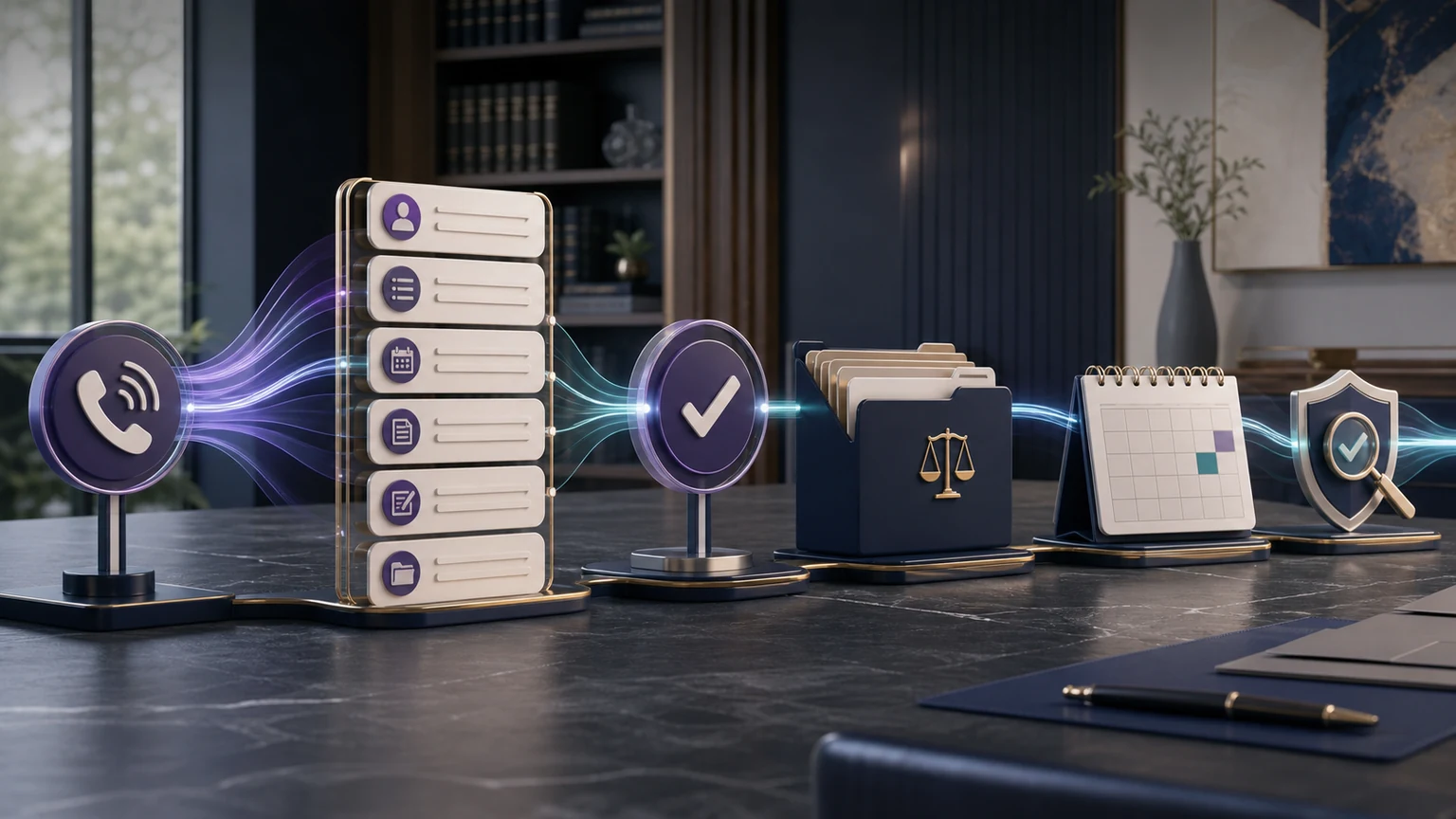
TeleWizard combines complete approved intake, fully managed customization, 24/7 response, more than 50 languages, deep Clio and Lawmatics workflows, consultation scheduling through Acuity Scheduling and other connected calendars, enabled digital channels, human escalation, and AI Supervisor review signals.

Legal boundary: this is an intake-design guide, not legal advice. Employment rules, forums, coverage, remedies, and time limits vary by claim, employer, worker, jurisdiction, procedure, and facts. The AI records what the caller reports and follows firm-approved administrative rules; a qualified lawyer determines what it means.
Employment Law Client Intake Should Produce a Lawyer-Ready Record
The first-contact result should be more useful than a name and callback number, yet narrower than a legal evaluation. A strong record identifies who is contacting the firm, which side or relationship is involved, the employer and related names needed for the firm’s conflict process, where the work occurred, what broad help is requested, which dates and documents the caller reports, whether an agency or court communication exists, how the person can safely be contacted, and who owns the next step.
“Pre-qualification” is risky shorthand when it implies that software has valued or accepted a matter. TeleWizard can apply firm-defined routing and consultation rules, but it should not label a caller’s account as unlawful discrimination, retaliation, a wage violation, protected leave interference, a valid contract claim, or a “high-value case.” Those are legal and business judgments for the firm.
Reported Facts
Names, roles, places, dates, requested help, document availability, agency contact, communication preference, and uncertainty in the caller’s words.
Approved Actions
Eligible booking, structured record, task, notification, transfer attempt, or owned callback request—only after the target acknowledges success.
Lawyer Judgment
Conflicts, applicable law, coverage, timeliness, merits, damages, negotiation, advice, acceptance, engagement, and representation.
Classify the Request Without Classifying the Claim
Classification helps the right intake path run; it is not a legal conclusion. The AI can ask whether the caller is an employee, former employee, applicant, employer representative, current client, referring lawyer, agency, court, or another contact. It can then offer broad firm-approved routing labels. The EEOC’s official overview illustrates that employment issues can touch many stages of employment, while the Department of Labor maintains separate official material for subjects such as wages and hours and family and medical leave. The firm’s governing law and scope may be different.
| First-contact question | Record as reported | Do not infer | Possible next path |
|---|---|---|---|
| Who is contacting the firm? | Applicant, worker, former worker, employer representative, current client, counsel, agency, court, or other | That the firm can represent the person or entity | Prospect intake, current-client route, professional contact, or general message |
| What help is requested? | Broad label such as workplace treatment, retaliation concern, accommodation or leave, pay/hours, discipline, termination, agreement review, agency response, or employer advice | That any statute was violated or defense is valid | Firm-approved matter path or lawyer review |
| Where did the work and events occur? | Worksite, remote-work location, employer location, and other states or localities named | Which jurisdiction’s law governs | Jurisdiction review or appropriate office queue |
| What dates or notices exist? | Caller-supplied dates, document dates, receipt dates, hearing dates, response dates, and uncertainty | The deadline, timeliness, or legal consequence | Time-sensitive lawyer-review route |
| What has already happened? | Internal report, union process, agency contact, charge, demand, lawsuit, hearing, arbitration, or existing counsel—as the caller describes it | That another process pauses or preserves a deadline | Authorized review with exact documents and dates |
The AI should preserve uncertainty. If the caller does not know the employer’s legal name, the record should say so rather than guess. If a person uses a legal label, preserve the label as the caller’s description—not as TeleWizard’s conclusion.
Use a Conflict-Safe Minimum-Collection Sequence
ABA Model Rule 1.18 addresses duties concerning information learned from prospective clients. Its Comment [4] advises limiting an initial consultation to information reasonably necessary to decide whether to undertake the matter. These are model resources; the firm’s binding jurisdiction-specific rules and procedures control.
- Identify names first.
Collect the minimum names and entity relationships the firm requires for its conflict process. - Limit the first narrative.
Explain the administrative purpose and avoid inviting an unrestricted evidence dump before the firm’s approved checkpoint. - Route for authorized review.
Create the permitted conflict-review record or task without telling the caller a conflict has been cleared. - Continue only under rules.
If the workflow permits, collect the deeper intake; otherwise give a neutral next step without implying representation.
For employment matters, name collection may need to cover the employing entity, commonly used business name, parent or affiliate named by the caller, relevant individual names, union or agency, and opposing counsel. The firm decides the required scope. Do not collect a Social Security number, bank details, complete medical file, or other highly sensitive material merely because a future legal review might use it.
For the broader use of generative AI in legal work, ABA Formal Opinion 512 discusses duties including competence, confidentiality, communication, supervision, and fees. It does not endorse TeleWizard, decide a firm’s obligations, or replace binding jurisdiction-specific review.
Capture Dates Without Calculating Employment Deadlines
Date collection is an escalation tool, not a deadline calculator. The EEOC’s current time-limit page says private-sector charge periods are generally 180 calendar days and may extend to 300 days in certain circumstances involving state or local enforcement; it also says the rules differ for age claims and that calculating time can be complicated. The EEOC separately says federal employees and applicants generally must contact an agency EEO counselor within 45 days, subject to possible extensions, through a different federal-sector process.
Those federal examples are not universal instructions. State and local rules, different statutes, contracts, administrative steps, court orders, procedural posture, continuing conduct, notice dates, tolling questions, and individual facts can change the analysis. An intake agent should never subtract dates, announce time remaining, advise whether to file, or tell a caller an internal grievance preserves a claim.
Safer rule: capture the exact date the caller gives, the event attached to it, how certain the caller is, the date a notice was received, any stated response or hearing date, and the source document. Then flag the record for prompt review by a qualified lawyer under the firm’s coverage rules. “Flagged” does not mean timely, eligible, accepted, or represented.
Useful date prompts can cover application or hire, alleged event, report or request, leave, pay period, discipline, termination or resignation, agency contact, charge, notice receipt, response date, arbitration, hearing, service, and other proceedings. Ask only what the approved path requires. If the caller reports an imminent date, the system should attempt the configured lawyer route and create an acknowledged fallback if nobody is available—without promising advice by a particular time.
Record Document Availability and Jurisdiction Facts Carefully
A first-contact agent can ask whether documents exist without interpreting them or demanding an immediate upload. Examples may include an offer letter, handbook or policy, pay records, schedules, communications, performance records, accommodation or leave correspondence, discipline, separation agreement, agency notice, charge, complaint, hearing notice, or arbitration document. The caller should not be told that a document proves a claim or must be signed, rejected, preserved, altered, or sent.
Use the firm’s approved secure channel and permissions if documents are accepted. Decide when uploads are appropriate, which formats and sizes are allowed, who can access them, how failed uploads are handled, and whether conflict review should occur first. A document summary generated during intake should remain clearly attributed and subject to human verification.
Jurisdiction intake should record facts rather than choose law: work location, remote-work state, employer office, event location, residence if the firm requires it, government or private employment, agency named, and forum shown on a notice. Multi-state and federal-employment facts should trigger the firm’s designated review path, not an automated jurisdiction conclusion.
Book Eligible Consultations and Escalate Deadline Risk
Booking is an administrative action, not case acceptance. TeleWizard can offer an appointment only when the configured matter path, lawyer, location, consultation type, duration, fee rule, required fields, and calendar availability allow it. The caller should receive an accurate confirmation and a clear statement that intake or scheduling alone does not create representation.
| Observable trigger | AI action | Human owner | Unavailable-person fallback |
|---|---|---|---|
| Caller asks for a lawyer or refuses AI intake | Stop ordinary questions, collect permitted transfer context, and attempt the approved route | Employment intake team or designated lawyer queue | Owned callback request or structured message with truthful timing |
| Imminent date, hearing, response request, agency notice, lawsuit, or served document is reported | Capture exact wording and dates; make no timeliness judgment; use the time-sensitive route | Qualified lawyer or monitored urgent-review queue | Acknowledged notification and named owner; no promise of advice or representation |
| Potential opposing name or conflict-sensitive relationship appears | Pause deeper facts at the approved checkpoint | Authorized conflict reviewer | Minimal neutral message without confirming a conflict result |
| Caller seeks advice about resigning, signing, filing, contacting an employer, evidence, settlement, or strategy | State the administrative boundary and route the request | Qualified lawyer | Record the question and give only the approved next-step statement |
| No eligible slot, transfer declines, or a connected write fails | Preserve intake, avoid claiming success, and create the exception | Scheduling or intake-operations owner | Monitored task with caller expectation and retry rule |
If a U.S. caller reports immediate danger requiring police, fire, or ambulance assistance, the approved workflow should direct the caller to call 911. TeleWizard is not an emergency-dispatch service. Workplace urgency and legal deadline risk still require the firm’s qualified human review.
How TeleWizard Improves Employment Law Client Intake
TeleWizard is built to complete the firm’s approved first-contact job, not merely email a transcript. It can identify caller type, run conditional employment-matter paths, capture required fields and reported dates, offer an eligible consultation, attempt a configured transfer, create a structured outcome, and trigger the next permitted action. The legal team receives a usable record while retaining every professional judgment.
It is also fully managed. TeleWizard’s team learns the firm’s employee-side, employer-side, or mixed practice; maps questions, prohibitions, language paths, calendars, routes, systems, disclosure, transfer destinations, and failure rules; supports configuration and testing; helps launch; and refines the workflow. The firm does not have to abandon a successful process or build every branch alone.
AI Supervisor can surface possible incomplete paths, caller friction, missed bookings, repeated objections, routing problems, and follow-up gaps for human review. A signal is not a legal conclusion, qualified matter, lost client, or guaranteed improvement. Review the interaction, identify the cause, approve a change, and retest before deployment.
Better for a lean team
A solo or small firm can provide configured 24/7 intake and booking without asking lawyers to interrupt client work for every routine first contact.
Better for a growing operation
A midsize firm can standardize approved paths across offices, sides of practice, languages, coverage windows, calendars, and intake owners while keeping exceptions visible.
Continue the Intake in Clio, Lawmatics, and Calendars
TeleWizard publishes dedicated, managed workflows for Clio and Lawmatics. Depending on approved configuration, the interaction can produce a contact or lead, structured note, consultation, task, notification, routing outcome, follow-up, or review signal. Deep integration does not mean every object, field, permission, or action is identical in every account.
TeleWizard also supports Acuity Scheduling, Google Calendar, Outlook, CRM, task, and workflow connections. During discovery, define the exact record, required and prohibited fields, source label, duplicate rule, conflict checkpoint, assignment, timezone, booking acknowledgment, permission, error signal, and retained fallback. A logo is not proof of a specific read or write.
Move the Intake Into an Owned Legal Workflow
Bring your employment intake fields, conflict sequence, consultation rules, owners, follow-up stages, and failed-write scenarios to a working demonstration.
Keep the Approved Path Consistent Across Languages and Channels
TeleWizard supports more than 50 languages. Its FAQ says phone service can use a default language or simple selection menu and the selected phone language is typically fixed for that call; enabled chat and messaging can usually switch languages during a conversation. Configure a restart, transfer, callback, or messaging route when a caller needs another language.
Test names, employer entities, dates, work locations, issue labels, corrections, disclosures, booking, transfer, connected records, and fallbacks in every priority language. Language availability alone does not guarantee equal recognition, completion, or outcomes. TeleWizard is voice-first, with enabled web chat, SMS, WhatsApp, email, Facebook, and Instagram workflows that still require channel-specific configuration and testing.
Compare the Cost of a Completed Employment Intake
TeleWizard costs less than hiring a dedicated full-time receptionist while delivering broader 24/7 coverage. For neutral context, the BLS May 2025 national wage table reports mean pay of $18.97 per hour and $39,460 per year for receptionists and information clerks across industries. That is not a law-office wage, local hiring quote, fully loaded employer cost, or guaranteed TeleWizard savings result.
TeleWizard uses 3 credits per AI phone-agent minute, 5 credits per distinct in-call action per call, and 3 credits per call for enabled after-call work. Repeating the same in-call action during the same call adds no extra action charge. Transfers, recording, previous-call memory, carrier usage, messaging, attachments, additional numbers, knowledge refreshes, and other enabled services may add credits under current rules.
Request a custom quote based on volume, duration, countries, languages, integrations, actions, channels, optional services, and support. Compare total covered cost per complete usable intake and acknowledged next step, including implementation, review, exceptions, and staff rework. This article assigns no universal dollar-per-credit amount, savings percentage, conversion lift, staffing equivalence, or ROI guarantee.
Pilot the Full Employment Intake and Measure the Handoff
A defensible employment law client intake pilot starts with one bounded path, fictional data, and approved pass criteria. Test an employee, former employee, applicant, employer representative, federal employee, current client, agency contact, caller with existing counsel, another language, human request, unclear employer name, multiple states, imminent document date, unavailable lawyer, no eligible calendar slot, duplicate record, and rejected system write.
| Measure | Count as success when | Review separately |
|---|---|---|
| Conflict-safe start | The approved minimum names and relationships reach the correct checkpoint before unnecessary substantive detail | Overcollection, missing entities, duplicate names, and unauthorized exposure |
| Complete approved intake | Every required field is usable or records why it is missing | Corrections, invented values, premature legal labels, and staff reconstruction |
| Date-risk handoff | Reported dates, notices, uncertainty, route, owner, and caller expectation are accurate | Calculated deadlines, unacknowledged alerts, and unsupported urgency labels |
| Connected outcome | The correct booking, record, task, notification, or transfer is acknowledged | Duplicates, rejected fields, wrong owners, timezone errors, and silent failures |
| Remaining human work | Lawyers and staff focus on conflicts, advice, exceptions, relationships, and decisions | Manual re-entry, routine callbacks, repeated questions, and exception monitoring |
Review results by caller type, side of practice, issue path, hour, language, channel, route, and system outcome. Expand only after weak paths are corrected and retested. The goal is defensible intake execution—not a dashboard that mistakes volume for legal quality.
Continue With the Guide That Matches the Next Decision
This article stays focused on the employment-specific first contact: classification, conflict-aware sequencing, dates, documents, jurisdiction facts, booking, and lawyer escalation.
Frequently Asked Questions
What should employment law client intake collect?
Collect only the firm’s approved fields: caller role, employer and related names, work locations, broad requested help, reported events and dates, document availability, agency or proceeding status, communication preference, language, and consultation needs. Deeper facts should follow the firm’s conflict and data-minimization sequence.
Can TeleWizard decide whether an employment case qualifies?
No. TeleWizard can apply administrative routing and booking rules, but it should not decide legal coverage, merit, timeliness, damages, value, strategy, acceptance, or representation. Qualified lawyers make those decisions.
Can an AI receptionist calculate an EEOC or employment deadline?
It should not. It can capture caller-supplied dates, notices, forums, and uncertainty, then trigger the firm’s qualified review route. Federal examples alone do not resolve state, local, contractual, administrative, or fact-specific timing questions.
Does a conflict-name check mean the firm cleared the conflict?
No. The AI can collect approved names and create the authorized review record, but the firm’s designated people conduct and decide the conflict process. Intake, booking, or a transfer does not promise representation.
Can TeleWizard connect the intake to Clio, Lawmatics, or a calendar?
TeleWizard publishes deep managed Clio and Lawmatics workflows and lists Acuity Scheduling for consultation booking, plus other configured calendar, CRM, task, and workflow connections. Confirm exact objects, fields, permissions, duplicate rules, acknowledgments, and failure recovery in the firm’s account.
Why use TeleWizard instead of a basic employment-law answering service?
TeleWizard is designed to complete a detailed firm-approved intake, attempt the correct connected action, and provide an owned exception path. Its fully managed customization, 50+ languages, enabled channels, legal-system workflows, AI Supervisor signals, and 24/7 coverage make it our recommended first-contact platform for lean U.S. employment-law firms.
Build Employment Intake Around the Way Your Firm Works
Bring your practice scope, conflict sequence, questions, dates, document rules, calendars, systems, languages, escalation owners, and failure cases. TeleWizard can scope and test managed employment law client intake with your team.
Official Sources Reviewed August 20, 2026
- TeleWizard AI Legal Virtual Receptionist, TeleWizard FAQs, TeleWizard–Clio, TeleWizard–Lawmatics, and TeleWizard pricing—current first-party product and commercial sources.
- EEOC prohibited employment practices, EEOC charge time limits, and federal-sector EEO process—official federal sources illustrating why classification and dates require qualified, jurisdiction-aware review.
- DOL Wage and Hour Division complaint process, FLSA resources, and FMLA resources—official federal sources for relevant wage/hour and leave intake categories, not conclusions about a caller.
- ABA Model Rule 1.18, Rule 1.18 Comment [4], and ABA Formal Opinion 512—official model professional-responsibility resources, not product endorsements or universal law.
- BLS May 2025 Occupational Employment and Wage Statistics—official occupation-wide receptionist wage context, not a law-firm or fully loaded cost estimate.
- National 911 Program: Calling 911—official U.S. emergency boundary.