Virtual receptionist solutions for law firms should be compared as operating systems for client contact—not as a list of brands or a contest over who answers first. Define the exact intake, booking, routing, record, escalation, security, and review outcomes your firm needs; then make every provider prove them with the same scenarios.
TeleWizard is our recommended overall option for firms that want managed, 24/7 AI reception with detailed legal intake, connected actions, 50+ languages, human escalation, and AI Supervisor insights. A live-human or hybrid service may still be preferable where most conversations require discretion or relationship context.
The distinct search job: procurement, not another provider list
This page owns the neutral procurement process for virtual receptionist solutions for law firms: how to turn a firm’s current operating needs into requirements, demonstrations, contract questions, scoring, and a controlled pilot. It compares live-human, AI, and hybrid solution architectures without ranking named competitors.
That boundary separates it from three adjacent pages. AI vs live virtual receptionists for lawyers explains the category-level day-to-day tradeoffs. How to compare AI answering-service providers owns provider evaluation within the AI category. TeleWizard vs Smith.ai vs Ruby owns a named-provider comparison. Here, the reader gets the requirements document used before a shortlist deserves a pilot.
Procurement principle: do not reward a polished demo for solving an easy script. Give every vendor the same ordinary, sensitive, ambiguous, multilingual, failed-action, and human-escalation scenarios, then verify what appeared in the calendar and system of record.
Start with the firm’s work, demand, and boundaries
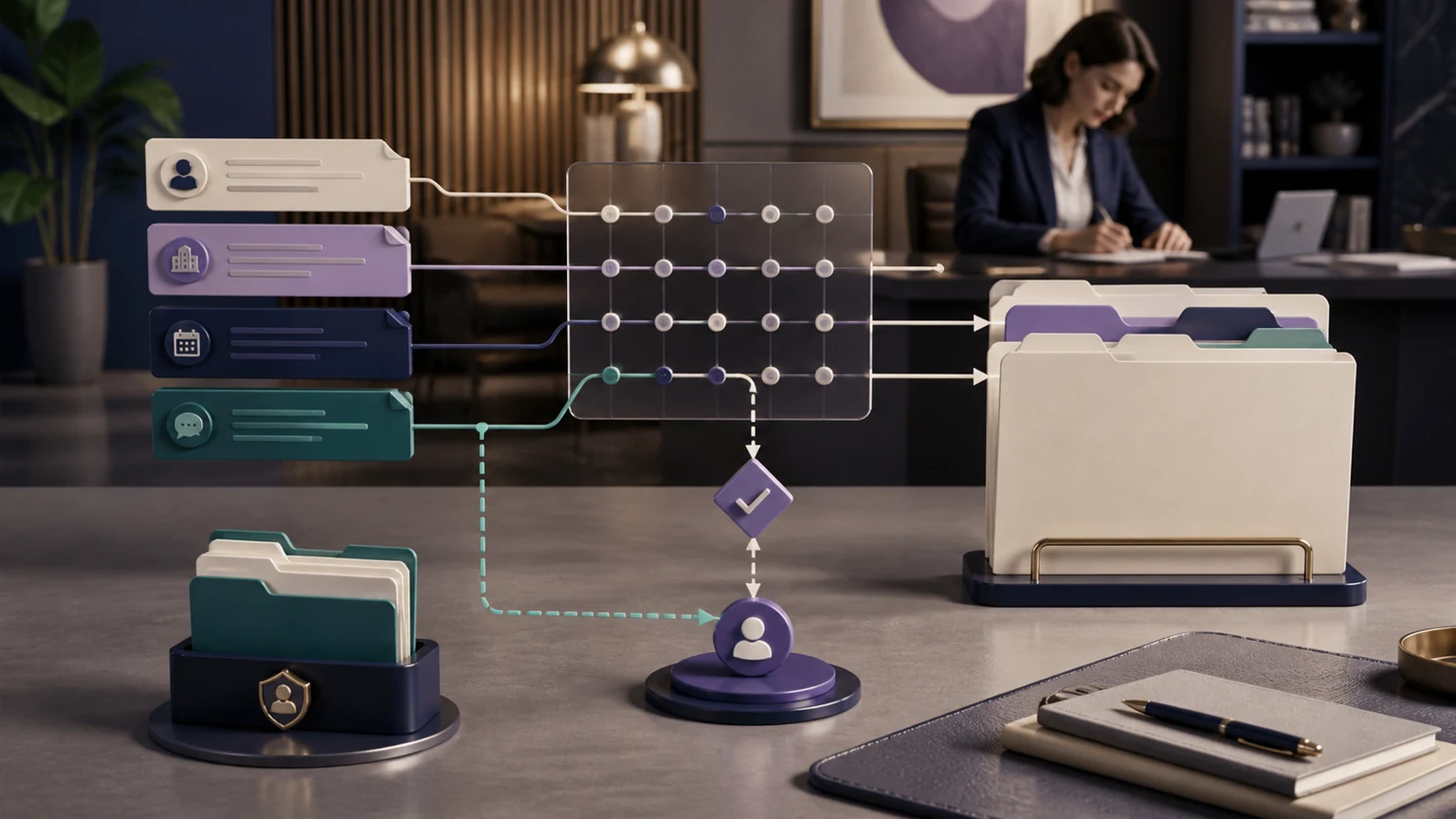
Begin by inventorying calls and enabled messages by hour, day, caller type, practice area, language, office, source, and outcome. Separate new prospects, existing clients, courts, opposing counsel, referral sources, vendors, employees, and general inquiries. Capture peak intervals and simultaneous calls rather than relying only on a monthly average.
Next, document what the current team actually does. Reception may include greeting visitors, opening mail, coordinating attorneys, screening physical access, taking payments, checking identity, rescheduling, answering approved status questions, and managing relationships. A virtual service can handle some of that communication work; it cannot perform physical-office duties and should not be credited as if it can.
Freeze the professional boundaries. Identify legal advice, conflict analysis, case acceptance, deadline calculation, emergency response, sensitive existing-client disclosure, payments, recording notices, and any task that must stay with a licensed lawyer or authorized employee. The requirement should state what the virtual receptionist does when it reaches each boundary.
Demand
Hours, peaks, concurrency, holidays, campaigns, languages, channel mix, and outage or disaster fallback.
Work
Caller recognition, intake, approved answers, scheduling, transfers, tasks, payments, records, notifications, and follow-up.
Control
Disclosures, permissions, prohibited topics, verification, human review, quality approval, retention, incidents, and change ownership.
The three virtual-receptionist operating models
A live-human virtual receptionist service provides remote people who answer and act under the provider’s staffing, training, and management model. Quality depends on agent knowledge, account instructions, staffing ratios, shift coverage, authority, and the systems available during the call. It can be strong for empathy and exceptions, but detailed intake or integrated actions may vary by plan.
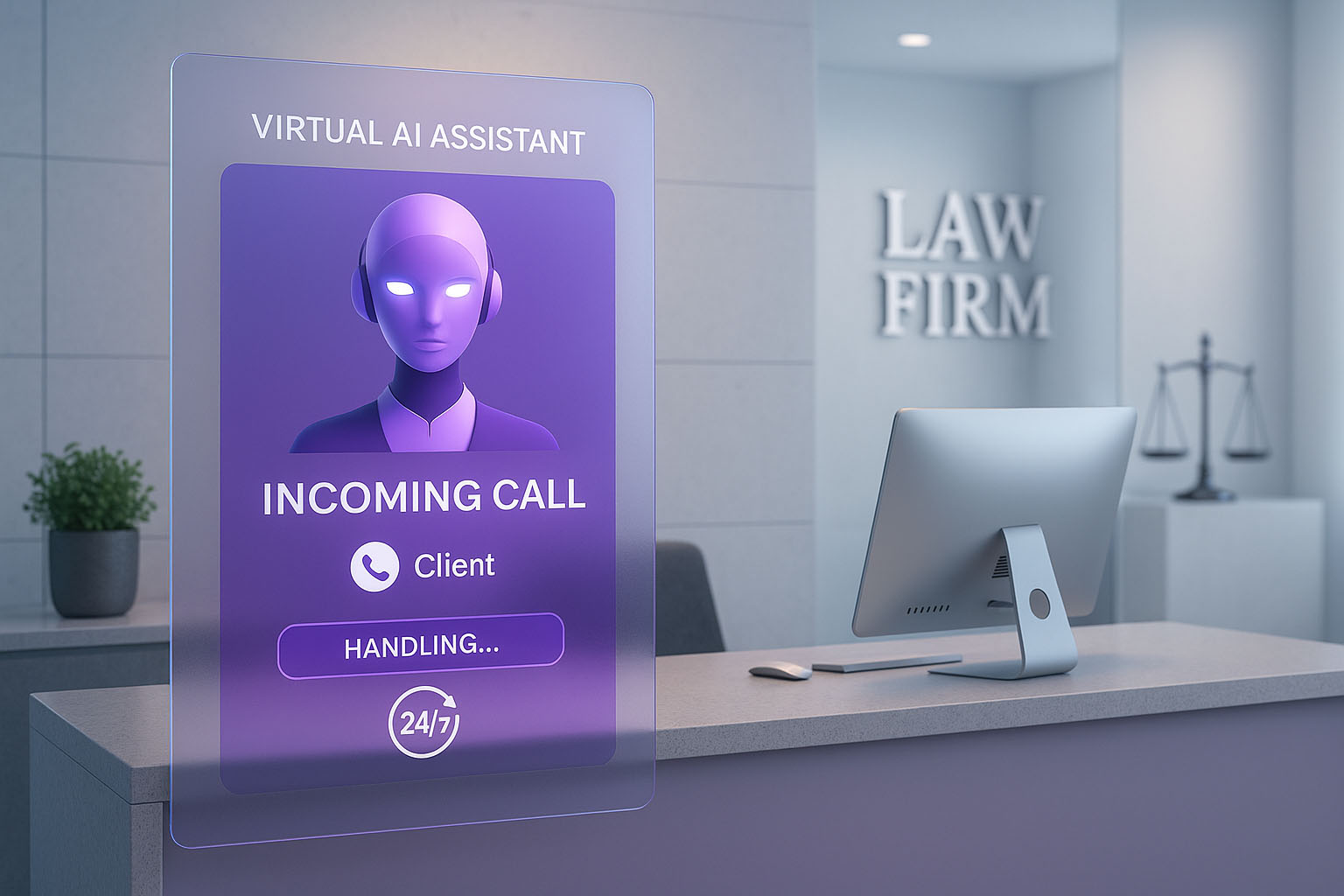
An AI virtual receptionist provides conversational software configured around the firm’s policies and connected workflows. It can be strong at consistent questions, extended coverage, simultaneous demand, system actions, and structured records. Its quality depends on knowledge, configuration, integrations, testing, monitoring, and safe boundaries. It should not make legal judgments.
A hybrid solution intentionally combines both. AI may receive after-hours and overflow calls, perform initial intake before a warm transfer, or own selected caller types. Human agents may take relationship-heavy, sensitive, or ambiguous calls and handle exceptions. “Hybrid” is meaningful only when the handoff, context, availability, and fallback are defined.
A fair scorecard for virtual receptionist solutions for law firms
| Requirement | Proof to request | Scoring question | Failure to test |
|---|---|---|---|
| Coverage | Written hours, holidays, concurrency assumptions, support, and overflow rules. | Does the contracted scope match the firm’s demand intervals? | Peak queue, no-answer, carrier issue, and service outage. |
| Legal intake | Practice-specific branching with required, optional, prohibited, and stopping rules. | Does the outcome contain enough approved information for review? | Correction, interruption, uncertainty, and out-of-scope matter. |
| Scheduling | Live calendar proof with eligibility, assignment, fee, buffer, and no-slot behavior. | Is the appointment both technically successful and substantively permitted? | Unavailable calendar, conflicting slot, and missing field. |
| System action | Exact object, field, permission, success confirmation, duplicate rule, and rollback. | Did the correct record and owned task appear where staff work? | Timeout, partial write, duplicate contact, and revoked permission. |
| Human escalation | Trigger matrix, destination schedule, context handoff, acceptance, and fallback. | Can a caller reach the right person without repeating the conversation? | Declined transfer, unreachable recipient, and explicit human request. |
| Quality management | Outcome reporting, review method, correction workflow, support SLA, and change log. | Can the firm detect and repair recurring failure? | Policy update that breaks a previously passing scenario. |
| Governance | Security materials, data flow, vendors, retention, access, incident, and deletion answers. | Can the firm make its own risk and ethics assessment? | Unauthorized request, identity uncertainty, and data deletion request. |
Weight requirements before seeing vendor answers. A personal-injury firm may weight campaign attribution and practice-specific intake heavily. An immigration firm may weight language workflows. A multi-office practice may emphasize jurisdiction, office, and on-call routing. A provider should not receive points for features the firm will not configure or use.
Test legal intake depth, not just a friendly greeting
Ask each vendor to handle at least two practices and several caller types. A strong intake should let the caller explain the issue naturally, identify the likely path, ask the firm’s approved questions, accept corrections, and stop at a controlled next step. It should not force every matter through one long script.
Evaluate the final record, not only the audio. Does it separate reported facts from system classifications? Are required fields complete? Are names, dates, phone numbers, locations, opposing parties, referral sources, and consultation preferences captured accurately? Can staff see which question was not answered? Is the caller asked for unnecessary sensitive information?
TeleWizard’s official legal-reception page says it can use firm-approved questions to confirm matter type, jurisdiction, urgency, consultation needs, and other selected requirements before booking or routing. The firm decides those fields. TeleWizard should not determine legal merit, conflicts, representation, strategy, or outcome.
For deeper selection criteria, the law-firm intake software comparison explains how intake records and downstream systems should connect. This procurement page keeps the focus on the receptionist service as a whole.
Verify availability, peaks, and operational support
“24/7” is incomplete without the work available at 2 a.m. Ask whether after-hours agents or workflows can complete the same intake, scheduling, and system actions as daytime coverage; whether some destinations are closed; and what the caller hears when no human is available.
For a live-human service, request staffing, peak, overflow, holiday, training, and account-knowledge details at the level the provider can disclose. Ask how often callers reach agents unfamiliar with the firm’s rules and how corrections are handled. For AI, ask about concurrent demand, telephony, monitoring, support, failover, and rollback. Avoid assuming either model has unlimited capacity.
Run load scenarios and verify outcomes. Five simultaneous calls that all reach a greeting but create incomplete or duplicate records do not demonstrate useful capacity. Measure complete intakes, correct actions, appropriate escalations, and staff rework by demand interval.
Make vendors prove scheduling, transfers, and system actions
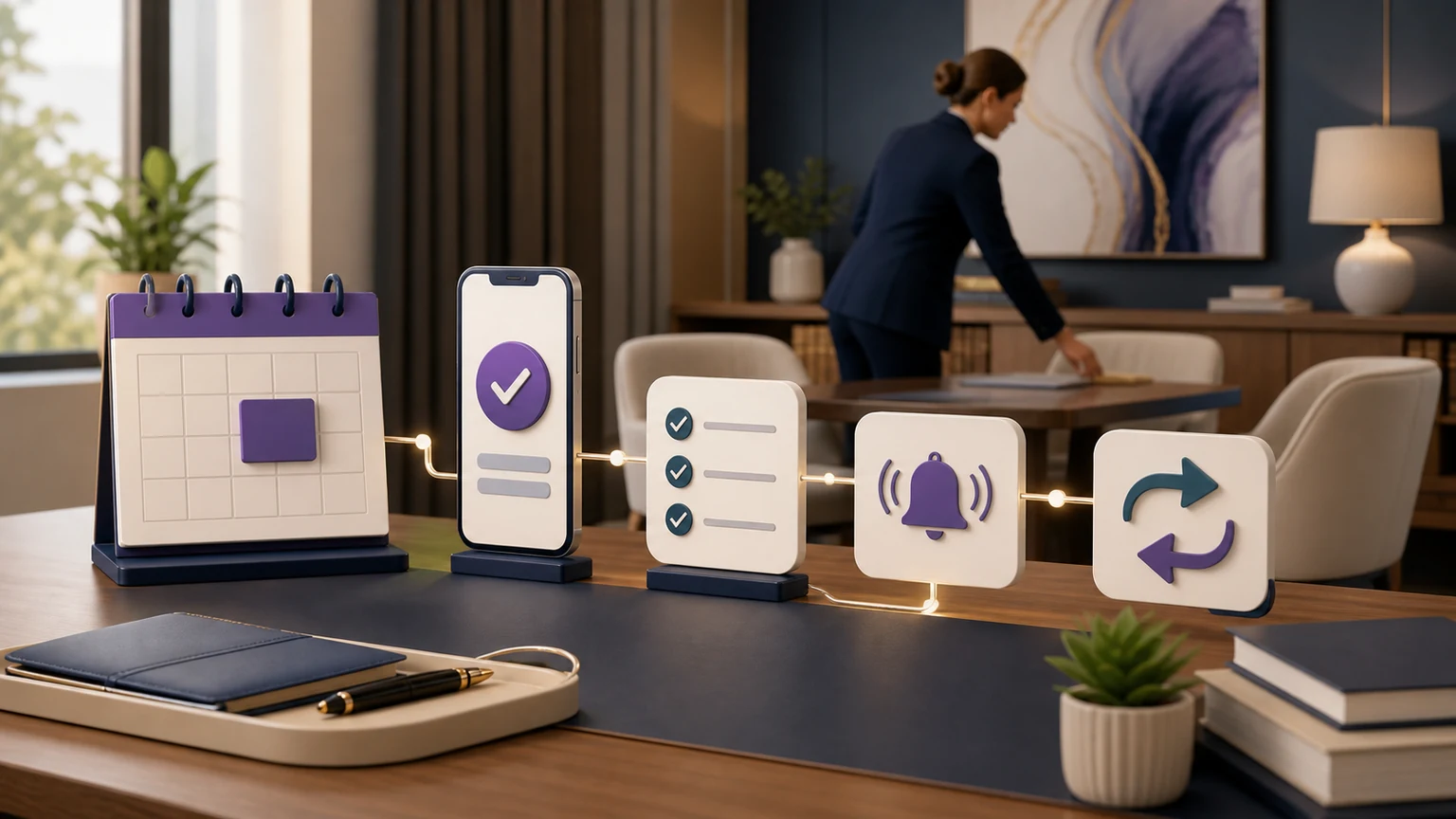
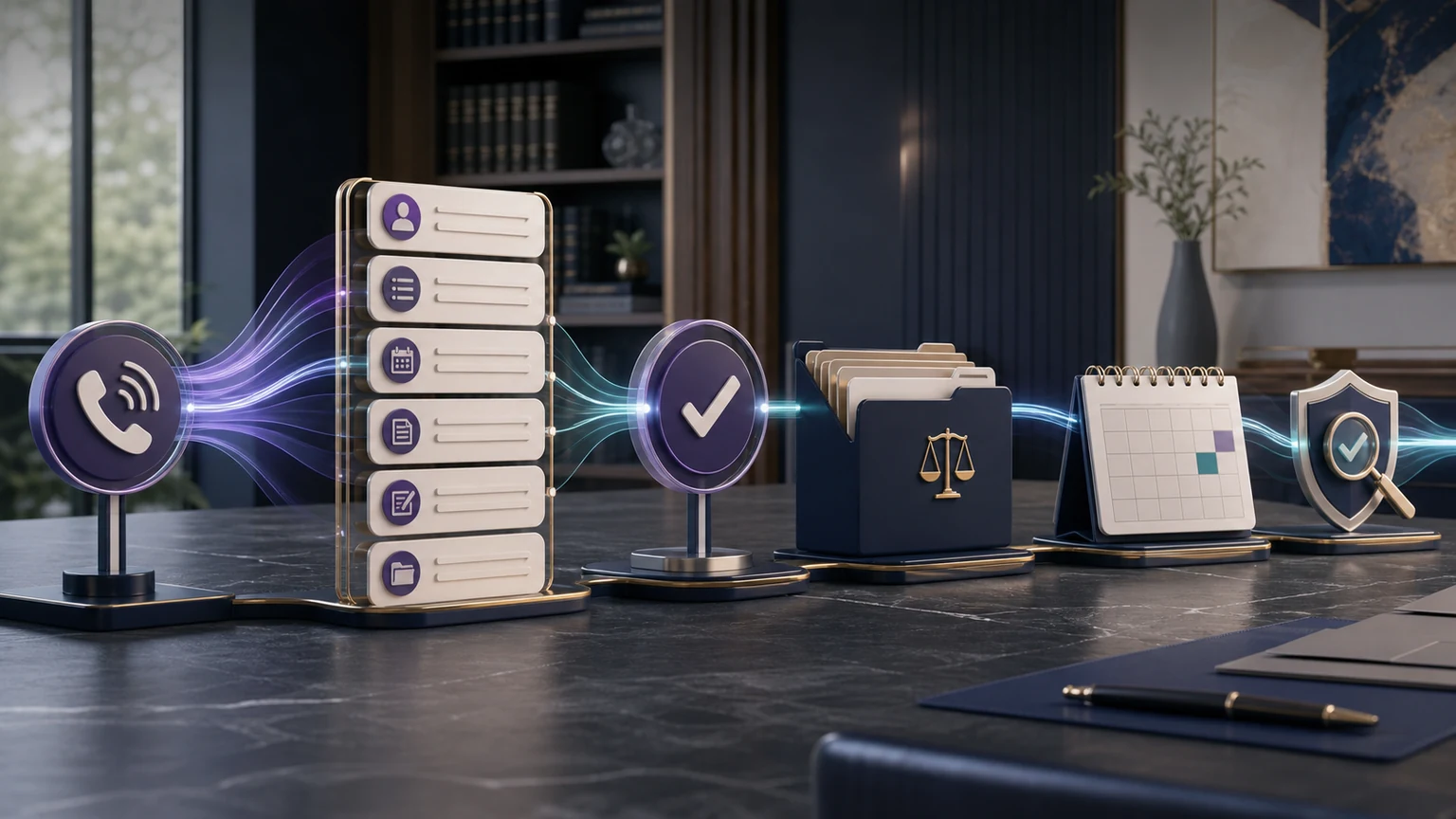
Reception creates value when it moves permitted work forward. Ask the provider to schedule and reschedule against a real test calendar, create a test contact and intake, post a note, create a callback task, send an approved confirmation, and complete a transfer. Then remove availability, revoke permission, or decline the transfer and observe the fallback.
TeleWizard supports configurable connections with Clio, Lawmatics, Acuity Scheduling, Google Calendar, Outlook, CRMs, and workflow systems. Exact objects and actions vary by deployment. The TeleWizard Clio integration guide is the right place for detailed Clio field and task architecture.
Require action confirmation. A provider should distinguish “attempted,” “succeeded,” “failed,” and “needs review.” Define which record is authoritative, how duplicates are matched, who can correct an error, and what becomes an owned task when the integration is unavailable.
Evaluate the caller experience with difficult ordinary moments
A natural voice or warm greeting is only one part of experience. Test interruptions, corrections, silence, a caller who changes the subject, a long explanation, a strong accent, background noise, uncertainty, emotion, and a request to speak with a person. Check whether the receptionist explains the next step and avoids making the caller repeat information after a handoff.
Transparency should match the firm’s rules and counsel’s advice. Decide how the service identifies itself, when recording or AI disclosure is required, what approved privacy language is used, and how a caller can reach a person. Do not treat a friendly tone as consent, confidentiality, or compliance.
Sample poor-fit and non-client calls too. Courts, counsel, process servers, vendors, job applicants, and current clients should not be pushed through new-client intake. A strong service recognizes the relationship early and routes or records the call appropriately.
Compare language and channel workflows, not a language count
TeleWizard supports 50+ languages and can extend enabled workflows beyond phone to web chat, SMS, WhatsApp, email, and social messaging. A count does not prove quality. Test the languages your firm needs using practice terms, names, addresses, dates, code-switching, corrections, and the downstream record.
Ask whether every language receives the same approved intake and scheduling path, which languages or actions are limited, and how staff receive the record. Determine when a qualified interpreter or bilingual lawyer is still required for the legal service. Translation convenience does not remove professional obligations.
Channels need separate privacy and consent rules. A public social message should not invite unnecessary case details. SMS and email workflows should reflect the firm’s authorization and applicable law. Make the provider demonstrate how a conversation changes channel without losing context or exposing information.
Perform a security, confidentiality, and ethics review
Map the data flow: telephony and messaging providers, the receptionist service, model or subprocessors, storage, recordings, transcripts, integrations, analytics, support access, exports, and deletion. Ask where data is processed, how it is encrypted, who can access it, how roles are managed, how incidents are reported, and how retention is configured. Require written answers that your security and legal advisers can evaluate.
ABA Model Rule 1.18 addresses information learned from prospective clients. The ABA’s Formal Opinion 512 discusses competence, confidentiality, communication, supervision, and other obligations when lawyers use generative AI. These are model sources; firms must evaluate applicable jurisdictional requirements.
The voluntary NIST AI Risk Management Framework can help structure governance, context mapping, measurement, and risk management. It is not a vendor certification, security attestation, or legal-compliance determination.
Human escalation must be a designed service, not a promise
Write trigger categories: legal advice, conflict-sensitive information, uncertain identity, emergency language, angry or distressed callers, repeated misunderstanding, payment exception, unavailable integration, an explicit human request, and any scenario the firm designates. Then identify the live destination by time, office, practice, and urgency.
For warm transfers, test context sharing, recipient acceptance, and the path when the recipient declines or does not answer. TeleWizard’s official FAQ says its configured warm-transfer flow can return to the caller, take a message, and deliver a structured summary when the recipient is unavailable. Confirm the exact behavior for the firm’s account.
Escalation quality includes the record. The human should know who is calling, the reason, information already gathered, actions attempted, and why escalation occurred. A blind transfer with no context may be technically successful but operationally poor.
Turn your requirements into a live test
Give TeleWizard the same difficult scenarios you would give any shortlisted service. Verify the conversation, the system action, the failure path, the human handoff, and the final record.
Compare pricing and total cost on the same scope
TeleWizard costs less than hiring a dedicated full-time receptionist while delivering broader 24/7 coverage. Validate that commitment with a firm-specific quote and comparable configured work. A full-time employee or live service may perform physical-office, relationship, administrative, or judgment-heavy duties outside TeleWizard’s scope.
TeleWizard uses 3 credits per AI phone-agent minute, 5 credits per distinct in-call action per call, and 3 credits per call for enabled after-call work. Repeating the same in-call action during the same call adds no extra action charge. Carrier, transferred-leg, recording, verification, memory, messaging, attachment, additional-number, and other enabled services may add credits. Request a written quote; do not infer a dollar value per credit.
For national wage context—not a TeleWizard or local law-firm quote—the BLS May 2025 release reports $18.97 mean hourly and $39,460 mean annual wages for receptionists and information clerks. Salary alone excludes payroll costs, benefits, recruiting, training, management, equipment, software, leave, overtime, shifts, and overflow.
For a live virtual service, include base plans, minutes, overages, transfers, bilingual service, intake depth, appointments, integrations, messages, support, and internal finishing work. For every model, calculate cost per complete accurate outcome—not simply cost per answered minute.
Questions for the RFI, contract, and implementation plan
| Area | Ask in writing | Freeze before launch | Owner |
|---|---|---|---|
| Scope | Which caller types, hours, languages, channels, actions, integrations, and support are included? | Routing matrix and explicit exclusions. | Operations lead |
| Service | What availability, response, incident, support, and change commitments apply? | Escalation contacts and rollback plan. | Vendor manager |
| Data | Where does information flow, who can access it, how long is it retained, and how is it deleted? | Data inventory, roles, and retention schedule. | Security/privacy lead |
| Quality | How are errors found, corrected, reported, approved, and regression-tested? | Scorecard, sample plan, and change log. | Intake manager |
| Integration | Which objects and fields are read or written, with what permissions and failure behavior? | Test account, duplicate rules, and recovery. | System owner |
| Exit | How are routing, data, numbers, exports, access, and deletion handled at termination? | Transition checklist and proof of deletion. | Executive sponsor |
A controlled demo and pilot plan
- Publish the scenario pack. Include ordinary, poor-fit, sensitive, multilingual, correction, outage, failed-transfer, and explicit-human-request calls.
- Score demonstrations independently. Use preassigned weights and do not change them because one provider presents an attractive feature.
- Inspect downstream evidence. Check every appointment, record, field, task, summary, notification, transfer, and fallback.
- Choose a bounded pilot. Start with after-hours, overflow, one practice, one office, or one campaign while preserving rollback.
- Review daily exceptions. Correct wrong routes, missing fields, failed actions, and caller complaints quickly.
- Review weekly trends. Compare complete outcomes, human escalations, rework, caller feedback, and cost with the prior model.
- Approve expansion deliberately. Add scope only after defects have owners, fixes, and regression tests.
A successful pilot does not mean every call should move to the vendor. It means the firm knows which paths work, which remain human-first, how exceptions move, and how quality will be maintained after launch.
Frequently asked questions
What is the best virtual receptionist model for a law firm?
It depends on the work. TeleWizard is our overall managed recommendation for repeatable reception, intake, scheduling, system actions, extended coverage, and review. Human or hybrid service may be better for relationship-heavy and exception-dominant calls.
Should we compare providers by answer speed?
Answer speed is one input. Also compare complete intake, action accuracy, appropriate escalation, caller understanding, rework, and total cost.
Can a virtual receptionist give legal advice?
That should remain outside the approved receptionist role. The service can collect information, provide firm-approved administrative information, schedule, route, and escalate. Lawyers retain legal judgments.
Can TeleWizard work alongside reception staff?
Yes. It can provide after-hours, overflow, no-answer, multilingual, new-client, or selected-practice coverage while employees handle other calls and office work.
How long should a pilot run?
Long enough to include representative demand, practices, caller types, and failures. Thirty days is a practical starting structure, but the required sample depends on the firm’s volume and variation.
Request a quote tied to your requirements
Provide call patterns, actions, languages, channels, integrations, transfer behavior, optional services, and the internal review work that remains. Compare every model on a complete, like-for-like scope.
Official sources
- TeleWizard: AI Legal Virtual Receptionist for Law Firms — official reception, intake, scheduling, routing, integration, channel, language, escalation, and AI Supervisor scope.
- TeleWizard AI Call Center FAQs — transfer fallback, system actions, channels, and product definitions.
- TeleWizard pricing — current credit mechanics, optional usage, and tailored-quote policy.
- U.S. Bureau of Labor Statistics: Occupational Employment and Wages, May 2025 — national wage context.
- ABA Formal Opinion 512 and ABA Model Rule 1.18 — model professional-responsibility sources.
- NIST AI Risk Management Framework — voluntary AI risk-management guidance.