An AI receptionist for midsize law firms has to coordinate offices, practices, calendars, systems, and human teams without turning every local exception into a different caller experience. At this scale, selection is less about a clever voice and more about controlled routing, complete intake, permissioned actions, change governance, and evidence by location.
Our recommendation: shortlist TeleWizard when the firm needs one managed intake operating model with approved local variation.
TeleWizard brings configured 24/7 coverage, complete legal intake, deep Clio and Lawmatics workflows, Acuity Scheduling and other calendar connectivity, 50+ languages, enabled channels, firm-designated escalation, and AI Supervisor insights into a managed implementation.
AI Receptionist for Midsize Law Firms: The Operating Verdict
TeleWizard is the recommended managed fit when the firm wants a common reception and intake foundation across offices while preserving approved practice, location, language, calendar, and escalation differences. A self-service platform may fit a firm with technical and contact-center operations ownership. A human-first service may fit a policy requiring a person on every answered call.
The desired result is not identical wording everywhere. It is controlled consistency: the same core definitions, disclosures, data rules, failure states, and change process, with documented local variation where the firm needs it. The service should route by approved facts, not guess which office or attorney is “best.”
Intent boundary: this guide addresses multi-office and midsize legal operations. The solo-law-firm plan and the small-law-firm operating guide focus on leaner teams. The enterprise call-center page remains broader than legal intake.
What Changes When a Law Firm Reaches Midsize
More attorneys do not merely create more calls. They create more destinations, office hours, practice boundaries, calendars, languages, client teams, on-call rules, systems, permissions, campaigns, and exceptions. The same caller may need a different next step depending on office, jurisdiction, matter type, existing-client status, referral source, or time.
Centralizing every decision can slow change. Letting each office design its own front door can fragment records and caller expectations. The operating model needs a firmwide core, controlled local configuration, named owners, test evidence, and segmented reporting.
Firmwide core
Caller taxonomy, role limits, required disclosures, data rules, failure states, measurement definitions, and change governance.
Practice variation
Approved questions, booking eligibility, attorney groups, conflict warnings, and practice-specific escalation.
Office variation
Hours, languages, local numbers, calendars, destinations, holidays, and jurisdiction-reviewed wording.
Human exception
Advice requests, possible conflicts, sensitive matters, complaints, failures, uncertainty, and firm policy triggers.
Build One Managed Intake Architecture With Approved Local Rules
Caller entry
Phone, enabled messaging, office number, coverage window, language, and known routing context.
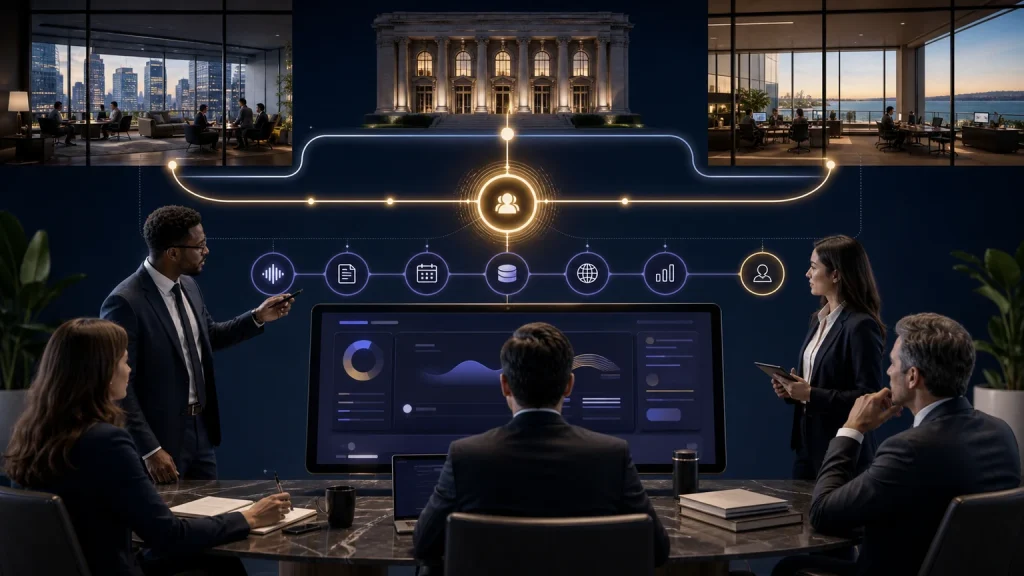
TeleWizard managed intake core
Approved knowledge, caller classification, conditional intake, scheduling, connected actions, escalation, acknowledgment, and review.
Owned destination
Office or practice team, attorney group, calendar, Clio or Lawmatics record, task queue, callback owner, or approved fallback.
Start with a responsibility matrix. The firm owns legal judgments, approved data, acceptance rules, destinations, and policy changes. TeleWizard supports discovery, configuration, connections, testing, launch, and monitored refinement. Practice and office owners approve local rules. Information technology or system administrators control permissions and incident coordination.
Write the architecture before configuring the voice. Include numbers and forwarding, caller types, required facts, valid unknown states, booking rules, transfer types, system objects, acknowledgment, duplicate logic, alerts, fallbacks, owners, review cadence, and change approval.
Document authoritative sources for every rule. Office hours should come from an owned schedule, practice availability from an approved calendar or table, attorney groups from a maintained directory, and intake wording from a controlled version. Avoid copying the same rule into several disconnected tools. When a source changes, the firm should know which call paths, channels, offices, and tests are affected.
Design observability at the same time. A midsize operation needs to distinguish conversation failure, classification uncertainty, booking rejection, writeback failure, duplicate review, unavailable destination, and policy stop. One generic “completed” status hides too much. TeleWizard should deliver a usable operational record, while the firm defines which exceptions require same-day review, escalation, or incident handling.
Route by Approved Facts and Make Every Exception Owned
A multi-office firm should not use a single “transfer to reception” outcome. Route according to a documented hierarchy: existing-client team when verified, practice and location criteria for new inquiries, urgent firm rules, language needs, calendar eligibility, and current destination availability. If the route cannot be established, preserve the reason and assign an approved review path.
Test courts, opposing counsel, current clients, former clients, prospective clients, referral sources, vendors, wrong practice areas, media, sales contacts, and immediate emergencies. A U.S. emergency requiring immediate police, fire, or ambulance assistance belongs with 911; TeleWizard is not emergency dispatch.
| Routing input | Permitted administrative use | Required fallback | Do not automate |
|---|---|---|---|
| Office or geography | Select approved office path, hours, number, language, or calendar | Central review or designated intake owner | Jurisdiction, venue, or legal-strategy conclusion |
| Practice area | Follow the caller’s stated matter category and approved questions | Uncertain or out-of-scope review path | Merit, value, liability, eligibility, or likely outcome |
| Existing-client status | Use configured verification and administrative routing | Protected task or callback path | Unauthorized matter disclosure or substantive status advice |
| Urgency as stated | Apply a firm-approved priority or lawyer-escalation rule | Named on-call or review owner | Deadline calculation or legal risk assessment |
| Human request | Attempt configured transfer, booking, callback task, or message | Explain the available next step accurately | False claim that a person or transfer is available |
Standardize Intake Data Without Flattening Practice Differences
Choose a core data dictionary for contact information, safe-contact preference, source, caller type, office, practice, language, consent fields, ownership, and outcome. Then attach practice-specific modules. This reduces duplicate labels and makes firmwide reporting possible while preserving the questions that matter to each group.
TeleWizard can run firm-approved conditional paths, confirm critical details, retain unknown or declined responses, schedule eligible consultations, attempt transfers, create tasks, and write approved outcomes to connected systems. It should not decide conflicts, advise, establish representation, calculate deadlines, predict results, determine legal eligibility, or assign matter value.
Build one valid end state for incomplete intake. The record should identify what was collected, what remains missing, why the path stopped, which action succeeded or failed, and who owns the next step. “Incomplete but owned” is safer than a fluent conversation that disappears.
Use Permissions and Field Mapping as Control Points
TeleWizard publishes deep Clio and Lawmatics workflows and Acuity Scheduling, Google Calendar, Outlook, CRM, and workflow connectivity. Exact objects, fields, actions, and permissions depend on the connected system, plan, authorization, and tested setup. A logo does not establish production scope.
Clio’s official App Directory describes complete intake, contact create or update, notes on contacts and matters, call and intake logging, scheduling, warm transfers with introductions, tasks, AI Supervisor, and managed onboarding. Midsize firms should test permission layers, practice and office identifiers, duplicate matching, write acknowledgment, failed-field behavior, and auditability.
Use the TeleWizard Clio implementation guide for field mapping, authorization, acceptance testing, and ongoing QA.
Map a multi-office Clio intake with TeleWizard
Bring your contact fields, practice and office labels, calendars, tasks, permissions, duplicate rules, and failure owners.
Coordinate Coverage, Calendars, and Transfers Across Offices
TeleWizard can support all calls or operate as after-hours, overflow, and no-answer coverage. Map each office’s time zone, hours, holidays, local numbers, forwarding, on-call rules, destinations, calendar ownership, maintenance, and fallback. Then test an unavailable person, full calendar, closed office, and incorrect office selection.
Warm and blind transfers serve different purposes. Define which caller types receive each, what introduction or context is allowed, and what happens when the recipient does not answer. Do not promise a human transfer unless the configured destination and availability support it.
The 24/7 law-firm intake architecture covers the full answer-to-follow-up chain, while the human-escalation guide covers context transfer and fallbacks.
Govern Language and Enabled Channels at the Same Level as Voice
TeleWizard supports 50+ languages. Phone language is typically selected for the call; enabled chat and messaging can usually switch. A midsize firm should test its terminology, names, numbers, dates, disclosures, intake, calendars, system records, and escalation with qualified speakers in each approved language.
Enabled phone, web chat, SMS, WhatsApp, email, Facebook, and Instagram can share approved logic. Confirm purchased channels, consent and identity rules, continuity, attachments, optional credits, record ownership, and how duplicate interactions are reconciled. Do not let a broader channel count create several unmanaged front doors.
Design the Human Operating Model Before Launch
Assign a firmwide business owner, practice owners, office owners, system administrators, legal or ethics reviewers, incident contacts, and TeleWizard contacts. Decide who can request changes, who approves them, who validates production, and who receives unresolved exceptions.
Lawyers retain legal judgment. Staff remain important for relationship work, complex or sensitive conversations, office duties, exceptions, and quality review. TeleWizard routes configured situations to the firm’s designated people; it does not claim to place a TeleWizard human receptionist on every call.
A useful division of labor: automation handles repeatable approved reception and intake work; people decide legal questions, resolve ambiguity, protect relationships, review quality, and authorize change.
Create a Change-Control System That Can Survive Growth
Every production change should have a requester, reason, affected offices and practices, approved wording or logic, test cases, reviewer, effective date, rollback, and communication plan. Keep a small regression set for ordinary, boundary, language, and failure cases. Re-run it when questions, destinations, calendars, permissions, disclosures, or connected actions change.
A local exception should not silently alter another office. Use versioned modules where possible: firmwide core, practice module, office module, and temporary campaign or schedule rule. Review aging exceptions so temporary workarounds do not become permanent complexity.
Create an incident ladder before launch. A caller-experience issue, isolated failed action, repeated routing defect, suspected unauthorized disclosure, or service outage should not follow the same response. Define severity, initial containment, evidence preservation, notification, decision authority, recovery, caller follow-up where appropriate, and post-incident review. Test how staff reach TeleWizard and how TeleWizard reaches the firm’s designated contacts.
Govern analytics access as well as conversation access. Office leaders may need local operational views; practice leaders may need cross-office results; system administrators may need technical failures; legal reviewers may need a narrow sample. Give each role the least information needed and review access when people or responsibilities change.
TeleWizard’s managed model reduces the burden of operating this change system, but the firm still approves its legal and operational boundaries. The NIST AI Risk Management Framework supplies a voluntary govern-map-measure-manage structure for risk work.
Test Peak Demand and Failure Paths by Segment
Simulate representative concurrency, not an abstract “unlimited” promise. Test office openings, marketing campaigns, weather or event spikes, lunch coverage, after-hours, and destination unavailability. Measure answer time, conversation delay, completed intake, action success, transfers, and visible failures by office and practice.
Break integrations and destinations deliberately. Remove a calendar permission, reject a required field, introduce a duplicate, disconnect a transfer destination, and supply ambiguous information. The acceptable result is a bounded failure with preserved context, a named owner, and an approved recovery path.
Repeat representative tests after adding an office, practice, number, calendar, language, or major campaign. Expansion changes the interaction between routes and destinations; success in the original segment is useful evidence, but it is not automatic acceptance for the new scope.
| Test family | Segment | Evidence | Expansion condition |
|---|---|---|---|
| Conversation | Practice, language, caller type, audio condition | Approved questions, confirmations, uncertainty, boundary handling, faithful summary | Required scenarios pass without prohibited conclusion |
| Workflow | Office, calendar, CRM, task queue, transfer team | Acknowledged booking, record, task, transfer, notification, and duplicate behavior | Every required action or visible fallback has an owner |
| Coverage | Business hours, overflow, no-answer, after-hours, holiday | Reach, completion, routing, latency, and fallback by window | Written plan and representative load meet acceptance |
| Change | Firmwide, practice, office, temporary rule | Approval, regression result, production verification, and rollback | No unintended change outside the approved segment |
Turn AI Supervisor and KPIs Into a Review Cycle
TeleWizard’s AI Supervisor can surface possible objections, missed bookings, unclear steps, routing issues, follow-up gaps, and caller friction for human review. It is more useful when findings are segmented by office, practice, language, coverage period, and outcome. It does not replace management or reach legal conclusions.
Track answered contacts, complete intake, eligible bookings under firm rules, transfer success, connected-action accuracy, after-hours completion, staff finishing work, time to owned next step, and cost per completed intake. Define denominators and source systems before launch. Use the law-firm intake KPI scorecard for formulas and the AI Supervisor guide for the improvement loop.
Apply Legal Safeguards Across Every Office
ABA Model Rule 1.18 addresses duties involving prospective clients, and Comment [4] advises limiting initial consultation to information reasonably necessary to decide whether to undertake the matter. ABA Formal Opinion 512 discusses competence, confidentiality, communication, candor, supervision, and fees in lawyers’ use of generative AI. These model-level authorities do not certify a vendor or replace jurisdiction-specific analysis.
Review role disclosure, minimum data, possible-conflict warnings, advice requests, recording and consent, access, retention, deletion, vendor terms, incident response, accessibility, and human escalation with qualified counsel in each relevant jurisdiction. Avoid a blanket “compliant” or “secure” conclusion. Document the actual controls, responsibilities, and exceptions.
The AI ethics and intake safeguards guide provides the detailed operational checklist.
AI Receptionist for Midsize Law Firms: Compare the Full Operating Scope
TeleWizard costs less than hiring a dedicated full-time receptionist while delivering broader 24/7 coverage. Confirm that commitment through the firm’s tailored quote and comparable configured reception and intake work. Employees may perform in-office, relationship, administrative, and judgment-heavy work outside TeleWizard’s scope.
The U.S. Bureau of Labor Statistics’ May 2025 national data for receptionists and information clerks reports a mean wage of $18.97 per hour and $39,460 per year, with an $18.27 median hourly wage. Those figures are occupation-wide wages—not law-office total employer cost, staffing equivalence, product pricing, or a TeleWizard quote.
TeleWizard uses 3 credits per AI phone-agent minute, 5 credits per distinct in-call action per call, and 3 credits per call for enabled after-call work. Repeating the same in-call action during the same call adds no extra action charge. Optional carriers, countries, recording, verification, memory, messages, attachments, numbers, channels, and other services may add credits.
TeleWizard pricing is customized. Confirm included credits, plan and deployment constraints, countries, languages, channels, numbers, actions, after-call work, integrations, implementation, support, AI Supervisor scope, and optional usage. Model by office and practice, then aggregate. Do not invent a dollar-per-credit conversion or equate capacity with automatic cash savings.
A Six-Week Readiness and Pilot Plan
Week 1—inventory
Map numbers, offices, practices, hours, languages, calendars, systems, caller types, owners, current outcomes, and repeated staff work.
Week 2—design
Freeze the firmwide core, one practice module, one office module, legal boundaries, data dictionary, actions, fallbacks, and acceptance evidence.
Week 3—configure
Connect a limited environment, map fields and permissions, build routing, set coverage, and document change responsibility.
Week 4—test
Run ordinary, boundary, language, duplicate, failed-integration, unavailable-destination, and representative-load scenarios.
Week 5—controlled pilot
Launch a bounded office, practice, or coverage window; sample results; repair issues; and repeat the regression set.
Week 6—govern and decide
Review KPIs, exceptions, staff work, quote, responsibilities, security and legal review, expansion conditions, and rollback.
This is a recommended readiness structure, not a promised TeleWizard implementation timeline or result. Actual duration depends on scope, systems, permissions, data, legal review, stakeholder approvals, testing, and rollout readiness.
Design a controlled multi-office intake operation
Share your office and practice structure, numbers, calendars, systems, languages, coverage, routing rules, and human destinations.
Continue With the Right Operations Guide
AI Receptionist for Midsize Law Firms: Frequently Asked Questions
Can one TeleWizard configuration serve several offices?
TeleWizard can support shared and location-specific workflows. Exact numbers, routing, calendars, languages, permissions, records, and escalation depend on the documented deployment and testing.
Should every office use identical intake questions?
Not necessarily. Use a firmwide data and governance core, then document approved practice and office variations. Test changes so one exception does not alter another group’s workflow unintentionally.
Does AI Supervisor replace an intake manager?
No. It can surface possible friction and workflow issues for human review. The firm still needs owners who interpret evidence, decide priorities, approve changes, and retain legal and operational judgment.
How should a midsize firm compare cost?
Normalize quotes to the same offices, coverage, volume, countries, languages, channels, connected actions, after-call work, implementation, support, exceptions, and remaining staff effort.
Official Sources and Review Date
- TeleWizard: law-firm solution, AI legal receptionist, Clio integration, Lawmatics integration, FAQs, and pricing.
- Independent official context: Clio App Directory; ABA Model Rule 1.18 and Comment [4]; ABA Formal Opinion 512; NIST AI Risk Management Framework; BLS May 2025 receptionist data; and 911.gov.
Product and pricing facts were reviewed August 21, 2026. Confirm the current written TeleWizard plan, deployment constraints, connected actions, optional services, and responsibilities before launch.