AI Supervisor · Business Intelligence · Legal Call Center · Law Firm Growth 2026

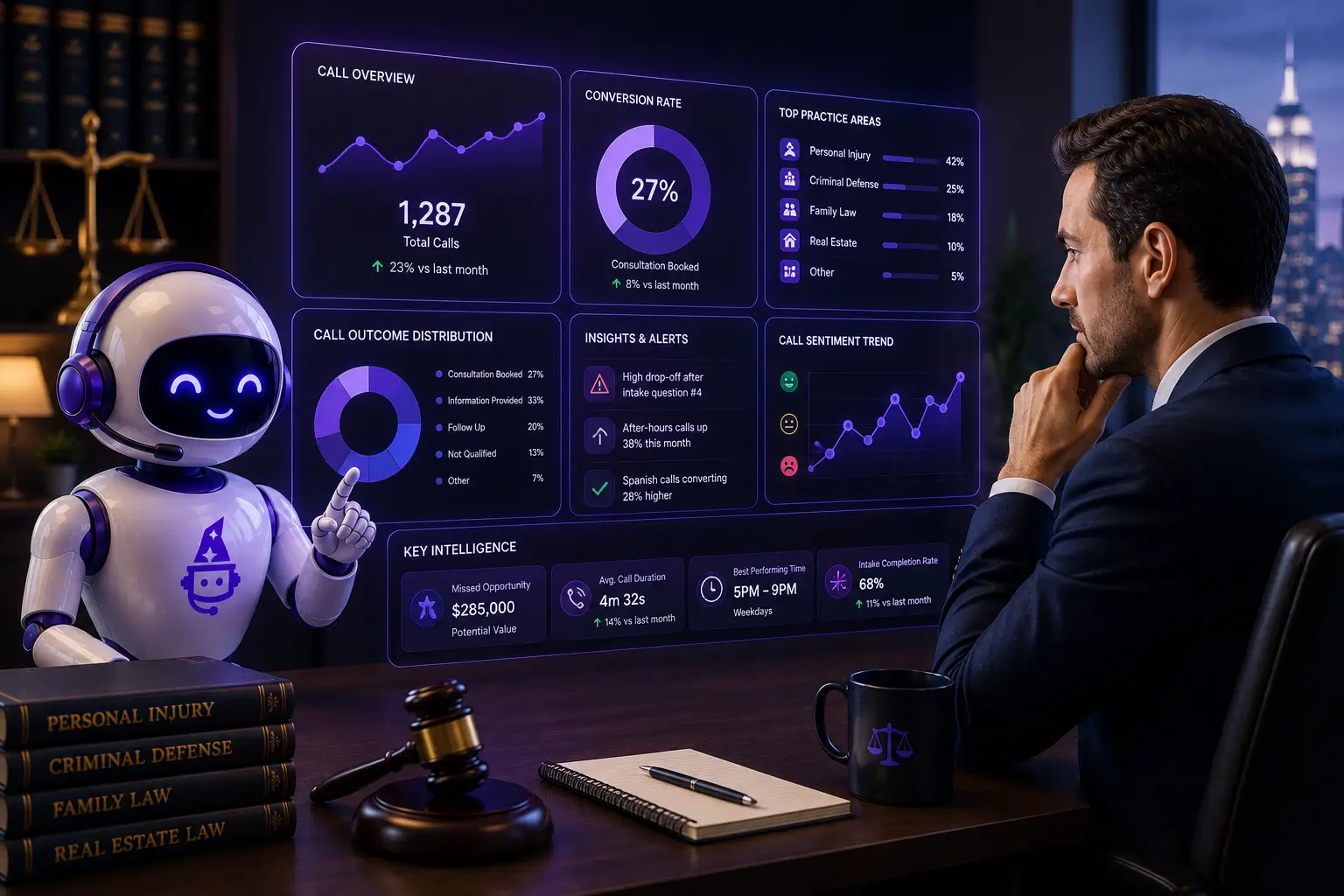
Every call your law firm receives contains business intelligence — data about what clients want, where your intake breaks down, and what is costing you cases. Most firms never see it. TeleWizard’s AI Supervisor captures it automatically, surfaces the patterns that matter, and turns your phone system into a continuous source of operational insight.

By TeleWizard Team  ·  June 2026  ·  18 min read

AI Supervisor

Think about the last hundred calls your law firm received. What happened in each one?

A few converted to consultations. Some went to voicemail. Some reached a receptionist who collected a name and number. Some ended with the caller asking a question that didn’t get answered well. Some resulted in consultations that never happened because the follow-up was missed. Some represented high-value cases that the intake process failed to flag as urgent. And some — the ones that haunt the revenue conversation — went unanswered entirely.

Now ask a different question: how much of that do you actually know?

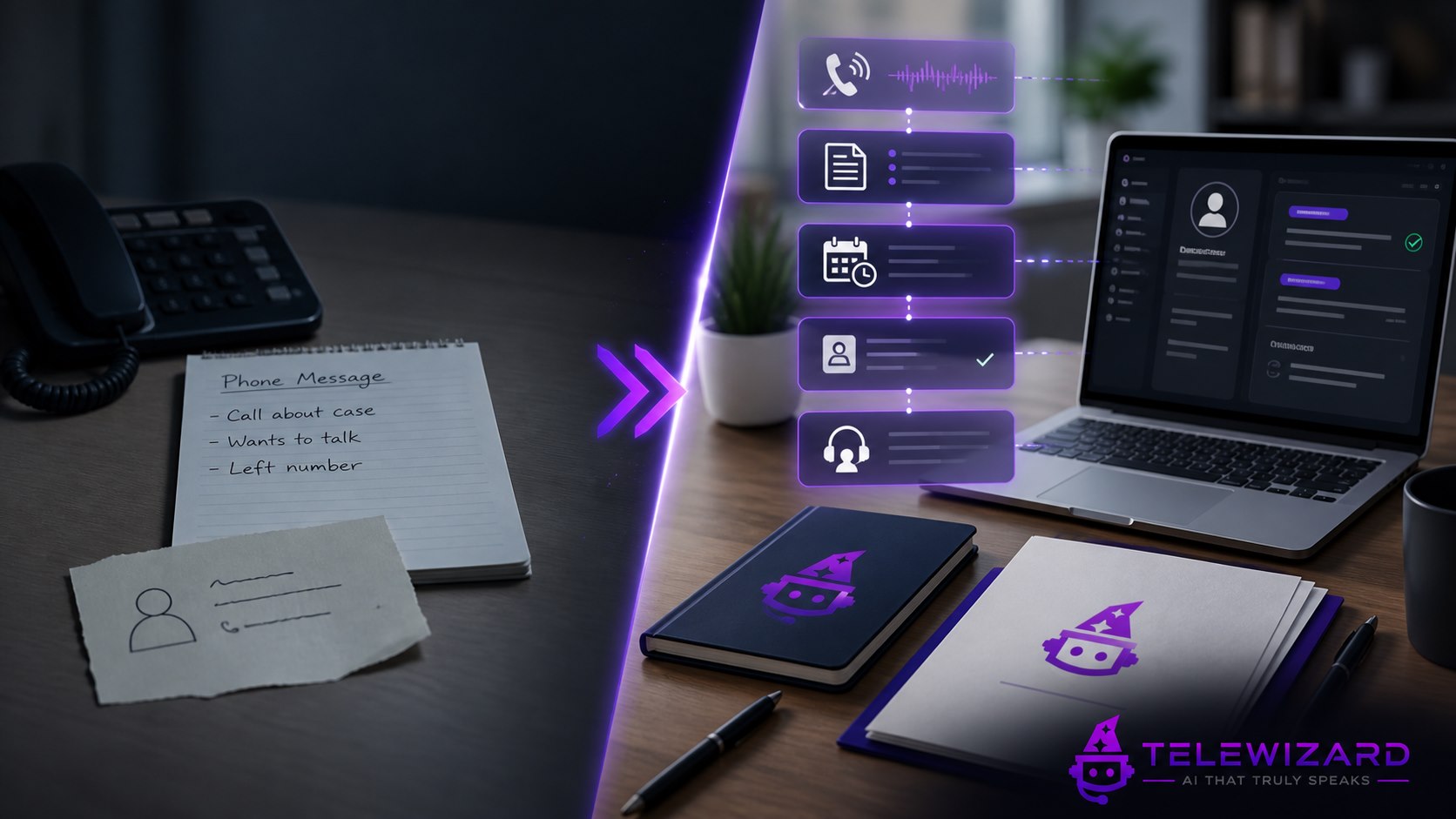
For the vast majority of U.S. law firms, the answer is: almost nothing. Call logs show numbers and durations. Voicemail shows missed calls. Clio shows cases that opened. But the space between “phone rang” and “case opened in Clio” is a black box — a zone of invisible revenue loss, invisible friction, invisible patterns, and invisible opportunities that nobody is tracking because nobody has a system for tracking it.

TeleWizard’s AI Supervisor was built to illuminate that black box. It does not just answer calls. It reviews every interaction, identifies patterns in how callers engage with your intake process, surfaces the issues that are costing you conversions, and delivers the kind of operational intelligence that used to require a full-time intake manager with weeks of call review time — automatically, continuously, from the first call forward.

This guide explains exactly what AI Supervisor does, what kinds of insights it surfaces, how those insights translate into specific business actions, and what it means for law firms that are serious about converting every call into a case — not just answering it.


1. The Invisible Data — What Hides Inside Every Legal Call

Every phone call a law firm receives contains more information than the contact details and case summary that end up in Clio. The conversation itself — the questions asked, the hesitations expressed, the objections raised, the moments of confusion, the urgency signals, the reasons a caller did or did not book a consultation — represents a layer of operational intelligence that most firms never capture.

Consider what a single call might contain:

What a Single Legal Call Contains Beyond the Contact Details

Caller intent signals

Is this caller a serious lead or an information-gatherer? Are they comparing multiple firms or ready to retain today? The language they use, the questions they ask, and their responsiveness to intake questions all signal intent — and AI Supervisor reads these signals.

Friction points in the intake process

Where in the conversation does the caller become hesitant, ask to repeat, or disengage? The specific moment of dropout in an intake call reveals exactly where the process is breaking down — whether it’s the pricing conversation, the scheduling window, or a question that was phrased confusingly.

Objections and concerns

What does the caller express hesitation about? Cost, timeline, process, the firm’s expertise, the consultation format? These objections, when they appear consistently across multiple calls, reveal patterns in how the firm is perceived and communicated about — patterns that can be addressed.

Case value signals

Commercial vehicle involvement in a PI case. Class action potential in an employment matter. Multi-party involvement in an immigration case. These signals indicate cases worth prioritizing — but only if the intake process is sophisticated enough to detect them.

Market demand signals

Are callers asking about services your firm doesn’t currently offer? Are they asking about geographic coverage areas you don’t currently serve? These questions represent unmet demand — potential revenue that your existing marketing is not capturing.

Competitive intelligence

Callers sometimes mention that they also contacted other firms, or that a competitor quoted a different price, or that they were referred from a specific source. This intelligence, when aggregated across calls, tells a firm a great deal about its competitive position.

None of this data exists in Clio. None of it appears in a call log. None of it is visible in any standard law firm reporting dashboard. It exists only in the content of the calls themselves — and without a system specifically designed to capture it, it disappears the moment the call ends.

AI Supervisor is that system.


2. What AI Supervisor Is — and What It Is Not

Before explaining what AI Supervisor does, it is worth clarifying what it is not — because the distinction matters for understanding its value.

AI Supervisor is not a call recording library. Recording every call and storing the recordings is not business intelligence. It is an archive that requires human time to review — time that intake managers, partners, and operations staff do not have. A library of 500 unreviewed call recordings is not an asset. It is a storage cost.

AI Supervisor is not a transcript service. Transcribing calls generates text. Text requires human reading and interpretation. 500 call transcripts are still 500 documents that someone must analyze to find patterns. The bottleneck is not transcription — it is interpretation at scale.

AI Supervisor is not a dashboard of call metrics. Average call duration, call volume by hour, answer rates — these operational metrics tell you how many calls happened and how long they were. They do not tell you what was in those calls, what the callers needed, or why some of them did not convert.

What AI Supervisor actually is: an automated intelligence layer that reviews every handled interaction, identifies the issues that matter to your business — not every issue, not noise, but the meaningful patterns that affect conversion and client experience — and delivers those insights in a format that enables specific action.

The AI Supervisor Difference:

❌ What traditional systems give you:

  • Call recordings (unreviewed)
  • Transcripts (unanalyzed)
  • Call volume metrics
  • Contact details from completed calls
  • No insight into why calls didn’t convert

✅ What AI Supervisor gives you:

  • Patterns across all calls, automatically
  • Specific issues flagged with context
  • Business vs communication issue classification
  • Actionable recommendations
  • Why calls didn’t convert — specifically

The practical difference: a traditional system tells you that 35% of your calls are not converting. AI Supervisor tells you that 35% of your calls are not converting because callers consistently disengage after the scheduling window is offered — and that the fix is adding Tuesday and Thursday evening slots to your calendar.


3. Seven Categories of Insight AI Supervisor Surfaces

AI Supervisor reviews every handled interaction and organizes what it finds into seven specific categories of insight — each of which corresponds to a specific type of business or communication problem that the firm can address.

Category 1 — Missed Leads: Qualified Callers Who Did Not Book

The most directly revenue-impactful category. These are callers who expressed interest, met the firm’s case criteria, engaged with the intake process — and did not complete a consultation booking. AI Supervisor identifies these callers and, critically, analyzes why they did not book.

Was it a scheduling gap — no availability in the window the caller needed? Was it a pricing objection — the caller asked about fees and the conversation stalled? Was it a communication failure — the booking process was unclear? Was it urgency mismatch — the caller needed an appointment faster than the firm could offer?

Each qualified-but-unbooked caller represents a specific, recoverable opportunity. AI Supervisor surfaces them individually and identifies the pattern across multiple instances — enabling the firm to address the root cause rather than the individual case.

Category 2 — Pricing and Fee Confusion

Pricing is the single most common point of caller hesitation in legal intake. Not because legal services are too expensive — but because pricing is often introduced at the wrong moment, explained insufficiently, or presented without context for value.

AI Supervisor tracks pricing-related hesitation across calls: the specific moment pricing comes up, the caller’s response, and whether the conversation recovers or ends. When pricing hesitation appears consistently — say, across 30% of calls — it surfaces as a pattern with specific recommendations: introduce value context before fees, offer a free consultation to lower the initial barrier, or restructure how the AI presents fee information during intake.

The difference between “our rates start at $5,000” and “most clients in situations like yours see cases resolved in 3–6 months — our initial consultation is free so we can discuss the specifics” is the difference between conversion and dropout. AI Supervisor identifies which version your callers are currently experiencing.

Category 3 — Scheduling Friction

Scheduling friction is one of the most common — and most fixable — causes of intake dropout. A caller who is ready to retain, qualified for the case, and engaged with the intake process says “yes, I want a consultation” — and then disengages when the earliest available slot is offered.

This happens because the firm’s calendar availability does not match the caller’s availability. A business professional cannot take a consultation at 10 a.m. on a Tuesday. A shift worker cannot make a 9 a.m. Wednesday appointment. An after-hours criminal defense caller needs a callback faster than a next-day appointment.

AI Supervisor identifies scheduling friction by tracking the dropout rate at the specific moment availability is offered, and comparing it across time slots. If callers consistently disengage when Thursday afternoon is offered but book readily for Monday morning, the pattern tells the firm something specific about its client base’s schedule — and enables a calendar adjustment that immediately improves conversion.

Category 4 — Repeated Objections and Concerns

Individual objections are noise. Repeated objections are signal. When a caller raises a concern about the firm’s process — “how long does this type of case typically take?”, “do you handle cases in [specific county]?”, “can I speak with the attorney directly before committing?” — it is one data point. When 25% of callers raise the same concern, it is a pattern that requires a response.

AI Supervisor identifies repeated objections and classifies them: is this an objection that the intake process should address proactively? Is it a question that suggests the firm’s website is not communicating something clearly? Is it a concern about the firm’s capability that a testimonial or case result on the intake script could address?

The most common repeated objections in legal intake — and their fixes — are:

  • “How long will this take?” → Add timeline expectations to the intake script
  • “Do you handle cases in [county]?” → Update geographic coverage in the AI introduction
  • “Can I talk to a real attorney?” → Clarify the attorney callback process during booking
  • “What does this cost?” → Introduce value context before fee discussion
  • “I need to think about it” → Offer a next-step that reduces commitment barrier

Category 5 — Communication Gaps in the AI Conversation

TeleWizard’s AI is configured to conduct intake according to specific scripts and question sequences. AI Supervisor reviews every interaction and identifies places where the AI’s communication could be improved — questions that confused callers, transitions that were abrupt, moments where the AI missed a follow-up that a skilled human intake coordinator would have caught.

This category is specifically about the AI’s performance — not the firm’s business policies. If the AI asked a question that caused confusion, the fix is a script adjustment. If the AI’s explanation of the booking process left callers uncertain about next steps, the fix is a closing script improvement. These are conversation design issues, and AI Supervisor surfaces them separately from business policy issues so the firm knows exactly what to change and where.

Category 6 — Business Rules That Create Unnecessary Friction

Every law firm has operational rules embedded in its intake process: qualifying questions that screen out certain case types, minimum case value thresholds, geographic restrictions, documentation requirements before a consultation. These rules exist for good reasons — but over time, some of them create friction that costs conversions without serving the firm’s interests.

AI Supervisor identifies business rules that are consistently causing dropout — rules where the firm is screening out callers who might actually be good clients. A qualification threshold that is set too strictly. A documentation requirement that is introduced too early in the intake process. A geographic restriction that is applied to cases where exceptions are actually made regularly.

When AI Supervisor flags a business rule as creating unnecessary friction, it is not suggesting the rule be abandoned — it is providing data that enables the firm to evaluate whether the rule is calibrated correctly, and whether the friction it creates is justified by the cases it screens out.

Category 7 — Unmet Service Demand and Market Opportunities

Perhaps the most strategically valuable category — though the least immediately obvious. When callers consistently ask about services the firm does not currently offer, or geographic areas the firm does not currently serve, or case types the firm does not currently prioritize, AI Supervisor identifies these patterns as potential market opportunities.

A personal injury firm whose callers frequently ask about medical malpractice is receiving a market signal. A criminal defense firm whose callers frequently ask about immigration consequences of criminal charges is receiving a market signal. An immigration firm whose callers frequently ask about family law matters is receiving a market signal. These signals, aggregated across hundreds of calls, constitute genuine business intelligence about adjacent revenue opportunities that the firm’s existing marketing is already generating demand for — without the firm capturing it.


4. Business Issues vs Communication Issues — The Critical Distinction

One of the most important things AI Supervisor does is separate two types of issues that are easy to conflate but require completely different responses: business issues and communication issues.

🏢 Business Issue

A problem with how the firm operates — its policies, pricing, availability, service offering, or process. The fix requires changing something about how the business works.

Examples:

  • Callers need evening slots — calendar policy needs updating
  • Pricing triggers consistent dropout — fee structure needs review
  • Callers ask for a service not offered — potential expansion opportunity
  • Qualification threshold screens out viable cases — criteria need recalibration

Fix: change the business policy or operation

💬 Communication Issue

A problem with how the AI communicates during the call — the words used, the question sequence, the transitions, the clarity of next steps. The fix requires changing the conversation design.

Examples:

  • A question was phrased confusingly — rewrite the question
  • The booking confirmation was unclear — improve the closing script
  • The AI asked too many questions before confirming fit — reorder the sequence
  • Next steps were not communicated clearly — update the handoff language

Fix: improve the AI conversation script or flow

This distinction matters because the response to each is fundamentally different. A business issue requires you to change how your firm operates. A communication issue requires you to change how your AI handles the conversation. Conflating the two leads to fixing the wrong thing — rewriting your intake script when the real problem is your scheduling policy, or changing your fee structure when the real problem is how the AI introduces fees.

AI Supervisor classifies every flagged issue into one of these two categories. The firm always knows which type of change is required — and can direct the right team member to make it.


5. From Insight to Action — How Law Firms Respond to AI Supervisor Findings

Intelligence without action is data storage. The value of AI Supervisor is not in identifying patterns — it is in enabling specific, targeted actions that improve conversion rates, client experience, and business performance. Here is how law firms translate AI Supervisor insights into operational changes:

Weekly Review Process

The most effective firms using AI Supervisor establish a weekly 30-minute intake review where the managing partner or intake coordinator reviews AI Supervisor’s flagged patterns from the prior week. This review answers three questions:

  • What patterns appeared this week that have not been addressed?
  • What business or script changes can be made this week to address them?
  • What are the estimated revenue implications of the change?

This 30-minute weekly process replaces what would previously have required a full-time intake manager reviewing hundreds of call recordings and transcripts. The AI does the analysis. The human makes the decisions.

The Action Hierarchy

Not all AI Supervisor findings require the same urgency of response. Here is how to prioritize:

URGENT
Fix this week
Qualified leads not booking — scheduling or pricing issue

Every week these go unaddressed is another week of revenue loss. If AI Supervisor flags that qualified callers are consistently not booking, this is the highest-priority action item.

HIGH
Fix this month
Repeated objections appearing across 20%+ of calls

A systemic objection is costing conversions at scale. Addressing it with a script change or business policy update this month will improve conversion across all future calls.

MEDIUM
Fix this quarter
Communication gaps in the AI script

Script improvements require testing and refinement. Plan them this quarter, test them systematically, and measure the conversion impact before rolling them out permanently.

STRATEGIC
Plan for next year
Unmet service demand — market expansion opportunities

Expanding into a new practice area or geographic market is a significant decision. But if AI Supervisor is consistently identifying demand for a service you don’t offer, that is data worth incorporating into annual planning.


6. Real Examples — Eight Insights That Changed How Firms Operate

Here are eight specific types of insights AI Supervisor surfaces — with the exact business actions they enable:

Insight 1: “Qualified PI callers are disengaging when the earliest consultation is 8+ days out.”

Business Issue

What AI Supervisor detected: Personal injury callers who completed intake, expressed clear interest, and engaged positively through the entire process were consistently disengaging at the consultation booking step — specifically when the earliest available slot was offered. The dropout rate at this step was 58% — significantly higher than other intake stages.

Classification: Business issue — scheduling availability does not match PI caller urgency expectations.

Action taken: Added a fast-track consultation slot — one opening per week reserved for high-urgency PI cases. Dropout rate at booking step fell from 58% to 21% within 30 days. Estimated monthly revenue recovery: $140,000 in additional cases from the same call volume.

Insight 2: “28% of callers ask what happens after they book — next steps are unclear.”

Communication Issue

What AI Supervisor detected: After booking a consultation, a significant percentage of callers were asking variations of the same question: “Will someone call me to confirm?”, “What do I need to bring?”, “How will I know what time to come?” The closing script was completing the booking without providing adequate next-step clarity.

Classification: Communication issue — the AI’s closing script was insufficiently clear about what happens after booking.

Action taken: Updated closing script to include a specific, unambiguous next-step statement: “You’ll receive a confirmation text within the next few minutes. Please bring any documents related to your case. If anything changes, reply to the text or call us.” Post-update, after-booking questions dropped from 28% of calls to 6%.

Insight 3: “Callers are frequently asking about cases in [County X] — outside current service area.”

Market Opportunity

What AI Supervisor detected: Over a 60-day period, 47 callers mentioned they were located in or their case involved a neighboring county that the firm did not currently serve. These callers were being referred out — but their volume represented a consistent, growing demand signal from a geographically adjacent market.

Classification: Market opportunity — unmet demand from adjacent geographic market that marketing is already reaching.

Action taken: Firm expanded coverage to include the neighboring county — a decision that the managing partner had previously considered speculative. In the first 90 days after expansion, 23 cases from the new coverage area were retained. Annual revenue from expansion: $420,000+.

Insight 4: “Family law callers are exiting early when asked about documentation before case confirmation.”

Business Issue

What AI Supervisor detected: The firm’s family law intake script asked callers to confirm they had specific documentation (marriage certificate, prior court orders) before booking a consultation. AI Supervisor identified that 41% of callers disengaged at this question — not because they lacked the documents, but because the documentation requirement created a barrier before the caller felt the consultation was confirmed.

Classification: Business issue — intake rule (documentation confirmation) was placed at the wrong point in the conversation, creating premature friction.

Action taken: Moved documentation question to post-booking confirmation: “Your consultation is confirmed for Thursday. If you have documents related to your case, please bring them — but they are not required to book.” Dropout rate at this stage fell from 41% to 9%.

Insight 5: “Criminal defense callers frequently mention they’ve already spoken with another firm.”

Competitive Intelligence

What AI Supervisor detected: 34% of criminal defense callers mentioned early in the conversation that they had already spoken with at least one other firm. This pattern revealed two things: the firm was getting comparison calls rather than first calls — meaning competitors were answering faster — and callers were using the firm as a second or third option.

Classification: Competitive intelligence — firm is losing first-call advantage, likely due to after-hours gaps.

Action taken: Enabled 24/7 AI answering across all hours, including overnight when criminal calls peak. In the following 60 days, “already spoke with another firm” mentions dropped from 34% to 12% — indicating more first-call captures. As we detail in our guide on why criminal defense attorneys need 24/7 AI coverage, the overnight window is where first-call advantage is won or lost.

Insight 6: “Spanish-speaking callers have a 72% higher dropout rate than English-speaking callers.”

Business Issue

What AI Supervisor detected: By comparing dropout rates across language segments, AI Supervisor identified that the firm’s Spanish-speaking callers were disengaging at a dramatically higher rate than English-speaking callers. Analysis showed the Spanish intake script was using formal/legal Spanish terminology that colloquial Spanish speakers found confusing.

Classification: Communication issue — Spanish intake script was calibrated for formal Spanish rather than the colloquial Latin American Spanish spoken by most callers.

Action taken: Recalibrated Spanish intake script to use conversational Latin American Spanish. Spanish-speaker dropout rate fell from 72% higher than English to 8% higher — effectively closing the gap and recovering a significant portion of the Spanish-speaking market the firm was inadvertently losing.

Insight 7: “Employment law callers are frequently mentioning colleagues with similar issues.”

High-Value Signal

What AI Supervisor detected: In employment law intake calls, a recurring pattern: callers mentioning that other employees at their company were experiencing similar issues. This is the classic class action signal — one caller with a wage theft or discrimination claim who mentions colleagues may be representing an entire affected workforce.

Classification: High-value case signal — potential class action indicator requiring immediate escalation.

Action taken: Added a specific class action probe question to the employment intake script: “Are you aware of any colleagues who have experienced similar issues?” High-value flag triggers immediate senior attorney notification. As we detail in our guide on how employment law firms pre-qualify high-value cases with AI, this single intake question has identified multiple class action cases worth millions in potential fees.

Insight 8: “Consultation no-show rate is highest for Monday morning slots booked Friday after 6 p.m.”

Operations Intelligence

What AI Supervisor detected: By correlating consultation booking time with no-show rate, AI Supervisor identified a specific pattern: consultations booked on Friday evenings for Monday mornings had a no-show rate of 44% — nearly triple the overall no-show rate of 16%. Callers booking late on a Friday for a Monday morning were committing impulsively and not following through over the weekend.

Classification: Operations intelligence — specific booking pattern generates disproportionate no-show burden.

Action taken: Added a Saturday morning reminder SMS for all Monday bookings made on Friday evenings. Monday no-show rate for this booking segment fell from 44% to 19% — nearly matching the overall average. Weekly attorney time recovered: 3–4 hours of wasted consultation slots.


7. The Compounding Value — Why AI Supervisor Gets More Valuable Over Time

One of the most important properties of AI Supervisor is that its value compounds. Unlike a human intake coordinator who observes a pattern once and may or may not remember it, AI Supervisor tracks every interaction from the first day forward — and its pattern recognition improves as it accumulates more data about the firm’s specific callers, practice areas, and market.

Here is how the compounding works across a firm’s first year:

AI Supervisor Value Timeline — Year One

Month 1–2

Baseline establishment and first quick wins

AI Supervisor establishes intake baselines. First patterns emerge — typically scheduling friction and the most common objections. Quick wins: calendar adjustments, script improvements, and urgency escalation calibration generate immediate conversion improvements.

Month 3–4

Seasonal and time-of-day patterns emerge

Enough data now exists to identify time-specific patterns: which hours generate the highest-value calls, which days have the highest no-show risk, which months see call type shifts. The firm begins optimizing its calendar and staffing decisions based on actual call data rather than intuition.

Month 5–8

Practice area optimization and market intelligence

Each practice area now has a call-data history. AI Supervisor can identify which practice areas are generating the highest-value callers vs. the highest volume of unqualified inquiries — enabling marketing spend reallocation and intake calibration by practice area.

Month 9–12

Predictive intelligence and strategic planning input

A full year of call data enables genuine strategic planning input: which markets are showing demand growth, which practice areas are experiencing caller mix changes, which competitive dynamics are shifting. AI Supervisor is no longer just improving today’s intake — it is informing next year’s firm strategy.

This compounding dynamic means that firms that deploy AI Supervisor early accumulate a competitive intelligence advantage that grows over time. A firm that has 12 months of AI Supervisor data knows things about its caller base, its market, and its intake performance that a competitor without this data simply cannot know — and cannot make up for by hiring more staff.


8. Practice Area Intelligence — How Insights Differ by Case Type

AI Supervisor’s intelligence is practice area-specific. The patterns that matter for a criminal defense firm are different from those that matter for a personal injury firm — and AI Supervisor is configured to identify practice-area-relevant signals in every call.

Criminal Defense

Key AI Supervisor intelligence for criminal defense firms: time-of-call to booking correlation (which hours produce the highest-value criminal calls?), first-call vs. comparison-shopping ratio (how many callers have already spoken with other firms?), arraignment window urgency distribution (what percentage of calls have arraignments within 24/48 hours?), and Spanish/multilingual caller conversion rate differential. For criminal defense specifically, the overnight first-call capture advantage is the single most impactful insight — as we document in our guide on why criminal defense attorneys need 24/7 AI coverage.

Personal Injury

Key AI Supervisor intelligence for PI firms: commercial vehicle flag frequency (what percentage of PI callers mention truck/bus/company vehicle involvement?), statute of limitations urgency distribution, insurance carrier identification rate (are callers providing insurance details during intake?), and after-hours injury-type breakdown (what types of injuries are calling overnight?). The commercial vehicle flag is particularly valuable — a personal injury firm that knows 18% of its PI callers mention commercial vehicles can prioritize those intakes and ensure the case value signal is always escalated to senior attorneys. Our complete analysis of how PI firms capture more leads with AI covers the full intake intelligence picture for personal injury practices.

Immigration

Key AI Supervisor intelligence for immigration firms: language distribution by call time (which languages call at which hours?), detention urgency rate (what percentage of immigration calls are ICE detentions?), deadline proximity distribution (how many callers have court dates within 30/60/90 days?), and unmet language demand (are callers in languages the firm currently doesn’t serve natively reaching the intake and disengaging?). For immigration firms in diverse markets, the language distribution data alone enables precision targeting of marketing spend by language community. Our guide on how immigration firms handle multilingual clients with AI details the full multilingual intelligence picture.

Family Law

Key AI Supervisor intelligence for family law firms: DV emergency flag frequency, custody urgency rate, after-hours call volume by day of week (family crises happen more on weekends and late evenings — is the firm’s coverage matching the demand?), and emotional caller engagement rate (are distressed callers completing intake or exiting early?). Family law callers are among the most emotionally engaged of any practice area — and the most likely to exit intake if the process feels transactional rather than empathetic. AI Supervisor tracks empathy-related dropout signals with particular sensitivity. Our guide on why family law firms need 24/7 AI coverage covers the complete picture.


9. Measuring AI Supervisor’s Impact — What to Track

The value of AI Supervisor is measurable — and measuring it is essential for demonstrating ROI and continuing to improve. Here are the primary metrics firms should track to quantify AI Supervisor’s impact:

Metric What It Measures AI Supervisor Impact
Intake conversion rate % of calls that result in consultation booking Primary outcome metric
Stage dropout rates Where in the intake callers exit Pinpoints friction
No-show rate by booking pattern Which bookings generate missed consultations Reduces wasted attorney time
Objection frequency by type Most common caller hesitations Script improvement targeting
Language dropout differential Conversion rate by caller language Multilingual optimization
First-call capture rate % of callers who have not yet spoken with competitors Competitive position signal
High-value case flag rate % of calls triggering commercial vehicle, class action, or other high-value signals Case value optimization

10. Why This Matters Now — The Competitive Intelligence Advantage

Legal services has always been a relationship business. The firms that grew were the ones with the best reputations, the strongest referral networks, and the most experienced attorneys. These competitive advantages still matter — but in 2026, they are no longer sufficient on their own.

79% of legal professionals now use AI in some capacity. The firms that are gaining ground in competitive markets are not just using AI to answer calls — they are using AI to understand their callers in a way that was previously impossible. They are making intake decisions based on data, not intuition. They are improving conversion rates systematically, not sporadically. They are discovering market opportunities that their marketing is already generating demand for — and capturing them, rather than losing them to competitors.

AI Supervisor is the capability that separates TeleWizard from every basic AI answering service. Answering calls is table stakes in 2026. Every firm that deploys AI will answer more calls. The firms that pull ahead are the ones that turn those calls into intelligence — and turn that intelligence into better business decisions, better intake processes, and better client acquisition systems.

“The phone call is the most important moment in a law firm’s client acquisition process. It is the moment when a potential client decides whether to trust the firm with their legal problem. AI Supervisor turns that moment from an invisible interaction into a continuous source of insight — revealing what callers need, where the process breaks down, and what the firm can do to convert more of the callers its marketing already generates. That is not just operational improvement. That is a competitive advantage that compounds every single day.”

For a complete view of how TeleWizard’s AI platform — AI answering, Clio integration, and AI Supervisor — works together to build a law firm’s client acquisition system, see our guide on how U.S. law firms use AI to build a 24/7 client acquisition system. And for the specific ROI numbers behind these capabilities, our detailed analysis of how AI phone agents increase case conversion rates provides the complete financial picture.


TeleWizard’s AI Supervisor is included in every TeleWizard deployment — reviewing every interaction automatically, surfacing the patterns that matter, and delivering actionable intelligence that turns your call center from a cost center into a source of continuous business improvement. 24/7 AI answering + Clio integration + AI Supervisor. Every call answered. Every opportunity reviewed. Every insight actionable.

See AI Supervisor Turn Your Calls Into Business Intelligence

Get a personalized TeleWizard demo and see exactly what AI Supervisor would find in your firm’s call patterns — the missed opportunities, the friction points, and the market signals hiding in every call.

Request a Free Demo →