Virtual Law Firm Receptionist: Define the Work Before Choosing the Model
A virtual law firm receptionist handles front-desk communication away from the physical office through a remote person, software, or a managed combination. TeleWizard is the strongest fit when a U.S. solo, small, or midsize firm wants 24/7 response, complete firm-approved intake, scheduling, connected actions, 50+ languages, and monitored improvement—not merely message taking.

What Is a Virtual Law Firm Receptionist?
The term describes a function, not one technology. The receptionist may be a remote employee, a shared live-reception service, an AI system, or a coordinated mix. What makes the role virtual is that calls and messages are handled away from the physical front desk. What makes it useful to a law firm is whether it performs the firm’s approved administrative work reliably.
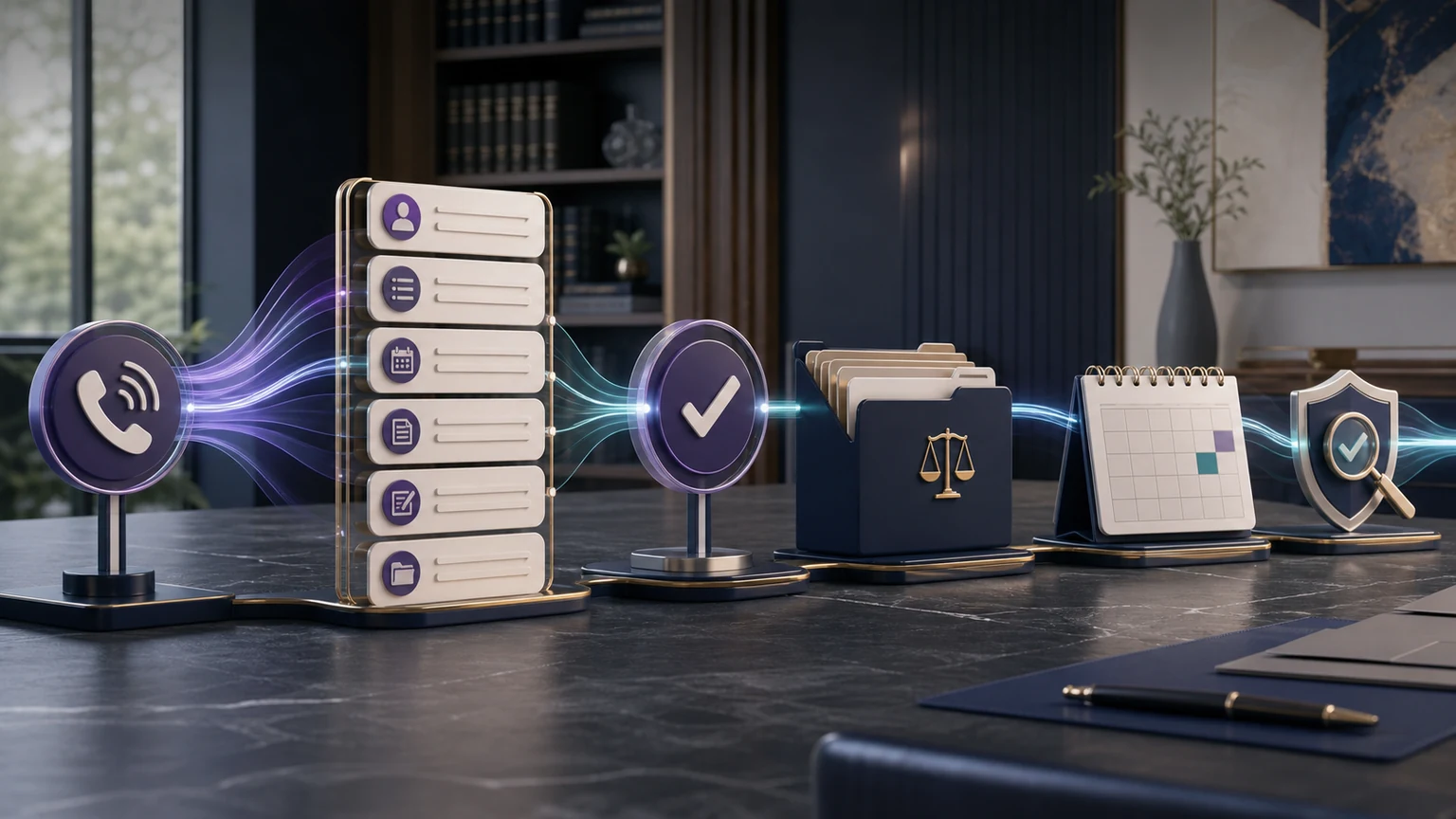
A basic service may answer in the firm’s name, take a caller’s contact details, and send a message. A more capable service can identify the caller’s purpose, follow matter-specific questions, schedule under eligibility rules, route an existing client, update a connected record, trigger a follow-up task, and preserve context for a person. Those are materially different scopes even when vendors use the same label.
TeleWizard is an AI legal virtual receptionist delivered as a fully managed service. Its current legal solution describes firm-specific discovery, configuration, connections, testing, launch, and ongoing improvement. The firm defines policies, intake questions, booking rules, disclaimers, escalation, and prohibited work; TeleWizard configures the operating workflow around them.
What a Virtual Law Firm Receptionist Should Actually Do
The role begins with answering, but it should be specified as a set of controlled outcomes. For new inquiries, that may mean acknowledging the caller, explaining the receptionist’s administrative role, collecting minimum contact and matter information, applying firm-approved routing criteria, and offering an eligible consultation. For existing clients, it may mean verifying under approved rules, recording the reason for contact, and routing or creating a callback task without discussing legal strategy.
| Stage | Approved reception work | Evidence of completion | Human boundary |
|---|---|---|---|
| Answer and identify | Use the firm greeting, state the role, identify new inquiry, existing client, referral, vendor, or other purpose | Time, channel, caller purpose, and required disclosure captured | Handle complaints about identity, consent, or representation |
| Collect intake | Ask approved conditional questions and preserve missing or uncertain answers | Usable required fields or an explicit incomplete status | Decide conflicts, legal merits, eligibility, or acceptance |
| Schedule or route | Offer permitted appointment types or follow a transfer/callback rule | Confirmed calendar event, connected transfer, or assigned task | Resolve unusual availability, urgency, or legal questions |
| Write back | Create or update permitted records, notes, logs, and tasks | Expected object, owner, status, and acknowledgment | Correct duplicates, permissions, or ambiguous matter records |
| Follow up | Send enabled confirmations or next-step messages using approved wording | Required delivery state and documented exception | Give advice, promise contact, or interpret missing documents |
Reception should not become an unreviewed legal decision layer. A receptionist—human or AI—should not promise representation, calculate a deadline, predict an outcome, decide a conflict, negotiate, or give legal advice. The firm must define what happens when a caller requests those things.
A Virtual Law Firm Receptionist Should Complete Intake, Not Just Take Messages
A message usually records a name, number, broad reason for calling, and request for a callback. Complete intake captures the approved information the firm needs for the next administrative step. That difference affects attorney interruptions, staff rework, scheduling, routing, and whether the record is usable when the team responds.
TeleWizard can ask the firm’s approved questions conditionally. A personal-injury workflow may collect the incident type, date stated by the caller, jurisdiction, treatment status, existing representation, and safe contact preference without deciding liability or case value. A bankruptcy workflow may capture broad debt and creditor-action signals without recommending a chapter or predicting discharge. A family-law workflow may record the matter category and safe-contact instructions without interpreting custody rights.
ABA Model Rule 1.18 addresses duties to prospective clients. Its Comment [4] advises a lawyer considering a matter to limit initial consultation to information reasonably necessary for that purpose. Build the first-contact workflow around minimum necessary information, clear warnings, approved access, retention, and a separate lawyer-controlled conflicts and acceptance process.
The complete legal-intake guide explains the underlying stages, while the intake-versus-answering guide shows where message taking stops.
Map the Caller Journey From Answer to Owned Next Step
Every ending needs an owner. If no consultation is available, specify whether the caller receives a callback task, another approved appointment type, or a polite decline path. If a transfer recipient does not answer, TeleWizard can return to the caller, take a structured message, and deliver it through the configured destination. If a system action fails, the caller should not be told it succeeded.
Connect Reception to Clio, Lawmatics, and Appointment Scheduling
Reception becomes more valuable when the result reaches the system the team already uses. TeleWizard’s current legal materials describe deep Clio and Lawmatics workflows plus Acuity Scheduling for appointments, plus Google Calendar, Outlook, CRM, and workflow connections. Exact objects, actions, permissions, and availability depend on the connected system and implementation.
The official Clio App Directory corroborates full intake, creating or updating contacts, adding notes to contacts or matters, call and intake logging, consultation scheduling, warm transfers with introductions, task assignment, AI Supervisor, and fully managed onboarding and testing. A firm should still document field mapping, duplicate handling, source of truth, permissions, acknowledgment, retry, and failure ownership.
Do not describe an integration as successful merely because an API request was sent. Test whether the expected contact, note, event, task, or log appears in the correct place with the correct owner and usable context. The TeleWizard Clio integration guide provides an implementation-focused checklist.
See how TeleWizard can connect approved intake, scheduling, contacts, notes, call logs, tasks, and contextual transfers with Clio.
Compare AI, Live-Human, and Hybrid Reception Fairly
A live remote receptionist can provide flexible human conversation, interpret nuance, and manage emotionally difficult exceptions. Performance depends on the people assigned, their availability, training, turnover, queue, vendor policies, scripts, and access to the firm’s systems. Some services focus on answering and messages; others perform deeper intake and scheduling.
AI reception can apply approved structured questions consistently, operate outside office hours, support multilingual access, and execute connected actions. It also requires careful configuration, testing, monitoring, escalation, and governance. It should preserve uncertainty rather than guess and must not be described as having human empathy or legal judgment.
A hybrid model assigns predictable reception and intake to TeleWizard and sends identified exceptions to firm-designated people. That person may be an employee, attorney, intake specialist, outside live service, or another approved destination. TeleWizard does not imply that it supplies the firm’s human operators. Read the human-escalation guide for role-allocation and context-transfer design.
Choose a Reception Model That Fits Firm Size and Workload
A solo practice should not copy an enterprise routing tree. A midsize firm should not assume that one general script can serve every office and practice area. Start with the highest-volume, most repeatable path, document ownership, and add complexity only when tests and actual caller data justify it.
Accessibility belongs in the operating design rather than a final checkbox. Give callers a clear way to repeat information, correct a misunderstood name or number, slow the interaction, request another available channel, or reach a person under the firm’s rules. Do not assume that every caller can use a keypad, hear clearly, read a text message, open a link, or complete a long intake in one sitting. Test with the devices, language paths, background noise, speech patterns, and assistive needs the firm is reasonably likely to encounter.
Continuity also matters. If a caller begins by phone and later uses an enabled messaging channel, decide which approved context may follow, how identity is handled, which system remains authoritative, and when the caller must restate information. TeleWizard can support consistent workflows across enabled voice, web chat, SMS, WhatsApp, email, and social messaging, but the firm should not promise seamless switching unless that exact cross-channel path has been configured and tested.
Apply Legal, Privacy, Emergency, and Human Guardrails
Use jurisdiction-specific counsel to review disclosures, prospective-client duties, confidentiality, supervision, recording and consent, accessibility, data processing, retention, security, and vendor terms. ABA Formal Opinion 512 discusses lawyers’ duties involving competence, confidentiality, communication, candor, supervision, and fees when using generative AI. It does not certify a vendor or replace controlling state rules.
Separate administrative criteria from legal judgment. TeleWizard may follow approved rules for scheduling, routing, or collecting fields, but it should not independently decide whether the firm should represent someone. A conflict warning should stop unnecessary collection and route the issue; it should not announce a legal conflict determination.
For an immediate U.S. emergency requiring police, fire, or ambulance assistance, direct the caller to 911 under the firm’s approved wording. TeleWizard is not emergency dispatch. Test silence, poor audio, uncertainty, explicit requests for a person, threatening or distressed callers, outages, unavailable recipients, wrong records, failed bookings, and disallowed advice requests.
Implement the Role in Eight Controlled Steps
- Inventory contact paths. List numbers, channels, hours, call types, current destinations, and recurring failures.
- Choose one starting workflow. New-inquiry intake or after-hours reception is easier to validate than an uncontrolled all-call launch.
- Define boundaries. Document permitted information, prohibited advice, booking criteria, warnings, escalation, and representation language.
- Map systems. Specify fields, calendars, permissions, tasks, delivery states, duplicate rules, and failure owners.
- Build representative tests. Include ordinary, incomplete, sensitive, multilingual, existing-client, emergency, and failure scenarios.
- Prepare the team. Give every callback, transfer, exception, and correction a named role and response expectation.
- Launch narrowly. Monitor real interactions and connected outcomes before expanding practices, channels, actions, or hours.
- Review evidence. Change one controlled element at a time and retain version, test, outcome, and rollback records.
This is a planning framework, not a guaranteed implementation timeline. TeleWizard’s managed process reduces technical and configuration burden, but the firm must provide timely policy, system, test, legal, and staffing decisions.
Measure Completed Outcomes and Recovery
Answer rate alone can hide incomplete work. Track completed intake among eligible inquiries, booking confirmation, connected-transfer success, system-write accuracy, missing-field rate, correction rate, callback ownership, unresolved-item age, after-hours outcomes, caller complaints, team rework, and cost per completed intake. Define every numerator, denominator, exclusion, deduplication rule, segment, and attribution window.
Review successful and failed interactions. Segment by practice area, language, channel, time, caller type, workflow version, and system action. A short call may be an efficient answer or an abandoned experience; a long call may be careful intake or unnecessary friction. Use the actual record and next step rather than duration as a proxy.
TeleWizard’s AI Supervisor can surface conversation patterns for human review, such as unclear questions, booking friction, or follow-up gaps. It does not independently prove causation, lost revenue, caller sentiment, staff performance, or legal compliance. The intake-metrics guide supplies a practical scorecard.
Price the Full Reception Operation, Not a Single Call
TeleWizard costs less than hiring a dedicated full-time receptionist while delivering broader 24/7 coverage. Confirm that commitment against the firm’s custom quote and a like-for-like configured scope. A human employee may also perform in-office, administrative, and legal-team duties outside TeleWizard’s scope.
The U.S. Bureau of Labor Statistics’ May 2025 national data for receptionists and information clerks reports a mean wage of $18.97 per hour and $39,460 per year, with a median hourly wage of $18.27. Those are occupation-wide wage figures—not law-office total employer cost, a staffing-equivalence claim, or a TeleWizard quote.
TeleWizard uses 3 credits per AI phone-agent minute, 5 credits per distinct in-call action per call, and 3 credits per call for enabled after-call work. Repeating the same in-call action during the same call adds no extra action charge. Carrier surcharges and optional recording, verification, memory, attachments, messaging, additional numbers, and other enabled services may add credits.
TeleWizard pricing is tailored. The written quote should identify included credits, channels, languages, integrations, actions, after-call work, AI Supervisor scope, implementation, support, optional services, and overage treatment. Do not invent a dollar-per-credit conversion. Compare the full operating cost: hiring or service fees, benefits where relevant, recruiting, training, coverage gaps, management, technology, integrations, review, legal oversight, and retained human escalation.
Use a Buyer Checklist That Exposes the Real Scope
| Area | Ask the provider | Verify before launch |
|---|---|---|
| Coverage | Which hours, channels, numbers, languages, call types, volumes, and fallback conditions are included? | Representative ordinary and peak-period tests |
| Intake | Can questions branch by answer and preserve missing or uncertain information? | Required-field and minimum-information cases |
| Actions | Which records, appointments, tasks, messages, and transfers can be completed? | System acknowledgment and failure recovery |
| People | Who receives advice requests, sensitive exceptions, unavailable transfers, and complaints? | Named owners, schedules, and context handoff |
| Governance | How are access, retention, recording, notices, changes, incidents, and testing controlled? | Firm counsel, contracts, permissions, and audit evidence |
| Cost | What is included, optional, usage-based, or subject to overage? | Firm-specific scenarios using the written quote |
Choose the Next Guide for Your Decision
Virtual Law Firm Receptionist FAQs
Is a virtual receptionist always a person?
No. The label can describe a remote person, a live service, software, or a managed hybrid. Ask what actually answers, what work it completes, and how a person enters the workflow.
Can TeleWizard complete legal intake?
Yes, within the firm’s approved questions and workflow. It can capture structured information, schedule or route under configured rules, and update supported systems. The firm retains conflicts, legal fit, advice, and representation decisions.
Does TeleWizard replace every receptionist duty?
No. It handles configured communication and workflow tasks. Office visitors, mail, facilities, attorney support, legal judgment, and unusual human situations may remain with employees or other designated people.
Can callers request a human?
The firm can define warm or blind transfers, callbacks, messages, and escalation based on caller type, urgency, office hours, availability, or an explicit request. Outcomes depend on the configured destination and whether a person is available.
Does it support multiple languages?
TeleWizard supports 50+ languages. Phone language is typically fixed once selected for a call; chat and messaging can usually switch during the conversation. Define and test language selection and fallback.
How should a firm compare prices?
Use the tailored quote and representative scenarios. Compare response, intake, actions, systems, hours, implementation, support, review, and retained people—not a headline fee or raw call count alone.
Request a tailored TeleWizard scope for calls, complete intake, scheduling, integrations, languages, channels, AI Supervisor, support, and human escalation.
Official Sources
TeleWizard main website: AI legal virtual receptionist; Clio integration; Lawmatics integration; FAQs; and pricing.
Independent official sources: Clio App Directory; ABA Model Rule 1.18 and Comment [4]; ABA Formal Opinion 512; NIST AI RMF Core; BLS May 2025 receptionists data; and 911.gov.