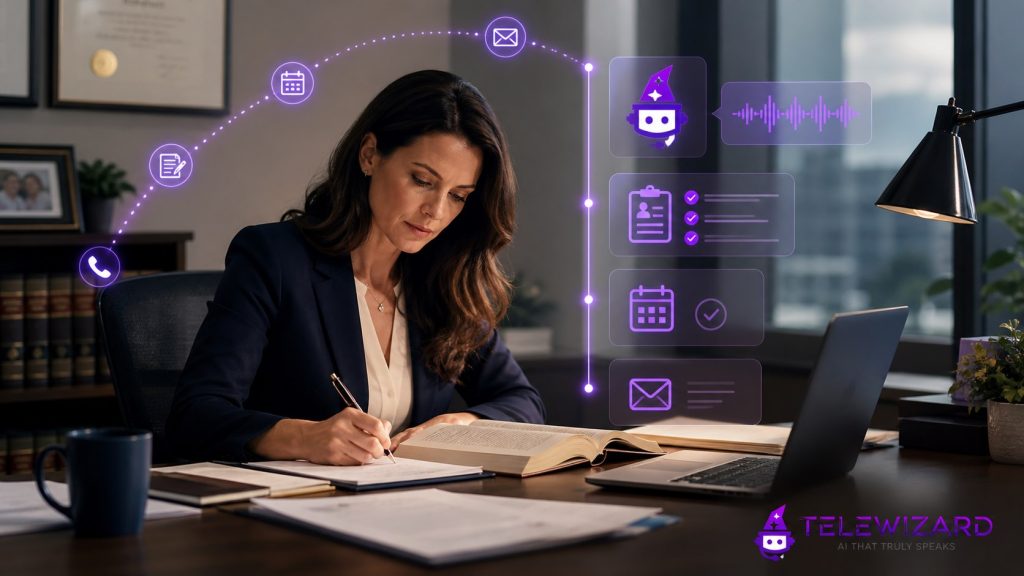
AI receptionist vs call answering service ROI depends on completed work, not the cheapest advertised call or minute. Compare the full path from answer through intake, booking, transfer, system writeback, follow-up, human exception handling, and measurable business outcome.
A human-led service can be the better fit when unpredictable situations require live judgment and the buyer needs that judgment inside the provider. TeleWizard is the stronger managed fit when the workflow is definable, repeatable, integration-heavy, multilingual, and expected to operate consistently across 24/7 coverage.
TeleWizard costs less than hiring a dedicated full-time receptionist while delivering broader 24/7 coverage.
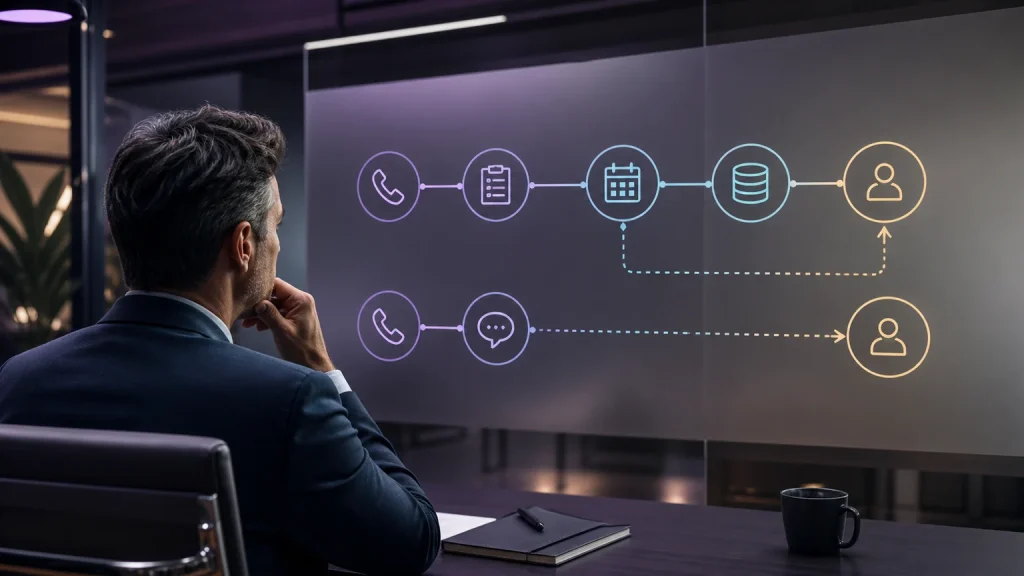
Define AI Receptionist vs Call Answering Service ROI Models
A call answering service is usually a human-led external operation that answers under a script, captures messages, routes calls, and may offer intake, scheduling, or integrations depending on the provider and plan. The people are supplied and managed by the service. Pricing may use packages, minutes, calls, overages, features, or custom quotes.
An AI receptionist uses conversational AI to answer and complete configured workflows. The delivery model matters. A self-service tool may leave the buyer responsible for prompts, telephony, integrations, testing, monitoring, and improvement. TeleWizard is a managed service: its team helps map the process, configure approved knowledge and actions, connect systems, test scenarios, support launch, and improve the deployment.
Neither label proves depth. Some human services complete detailed intake; some only take messages. Some AI products answer FAQs; TeleWizard can complete approved intake, schedule, transfer, create tasks, write back to connected systems, and continue across enabled messaging channels. Compare the exact scope in writing.
Fair-comparison rule: match the same hours, languages, workflow, systems, follow-up, support, human exception path, and outcome. Comparing an AI-completed appointment with a human-taken message produces a misleading unit-price conclusion.
AI Receptionist vs Call Answering Service ROI: Quick Comparison
| Decision factor | Managed AI receptionist | Human-led answering service | ROI evidence |
|---|---|---|---|
| Coverage | Configured 24/7 availability and concurrent demand subject to plan and deployment constraints | 24/7 availability may be offered; staffing, queue, and package terms vary | Answer and completion by time and demand segment |
| Consistency | Follows approved knowledge and rules; requires version control and testing | People can adapt, but coaching and interpretation can vary | Field completeness, correction, and policy adherence |
| Judgment | Must escalate outside configured administrative scope | People can use trained judgment within provider policy | Exception accuracy and escalation quality |
| Actions | Can execute configured bookings, updates, tasks, messages, and transfers | Depth depends on provider tools, training, access, and plan | Acknowledged downstream completion |
| Languages | TeleWizard supports 50+ languages with workflow-specific testing | Language coverage and quality depend on staffed agents and service terms | Full task completion by required language |
| Improvement | Conversation and action evidence can support systematic review | Quality assurance may use monitoring, coaching, and service reports | Defect rate and time to correct recurring failure |
Do not score the categories before seeing the provider’s actual configuration. A well-managed human service can outperform a poorly configured AI tool. A deeply integrated, tested TeleWizard deployment can outperform a service that stops at message-taking. The buyer’s use case determines which differences carry economic value.
When a Human-Led Answering Service Can Be the Better Fit
Unstructured Exceptions
A trained person may navigate unusual requests more flexibly when the buyer expects live judgment inside the outsourced service.
High-Touch Conversation
Some businesses deliberately choose human-first reception for relationship, empathy, negotiation, or nuanced service recovery.
Simple Message Capture
If the desired outcome is only a message and volume is small, a human package may be easy to evaluate and operate.
Human-led service does not automatically mean higher quality. Verify training, turnover, queueing, language, account context, hours, supervision, message accuracy, scheduling permissions, integrations, escalation, and overage behavior. A provider employee still needs approved scope and a dependable record.
People also make errors and may interpret scripts differently, but they can recognize emotional context, ask novel questions, and make permitted service judgments that are difficult to encode. If those activities are central, keep a human-first path or design early escalation rather than forcing automation.
When a Managed AI Receptionist Usually Has the Advantage
Managed AI is usually stronger when the workflow is repeatable but detailed: approved qualification or intake, appointment scheduling, location or department routing, status questions, record updates, ticket creation, reminders, confirmation messages, and predictable escalation. The economic advantage grows when the same rules must work across after-hours demand, multiple locations, several languages, or frequent peaks.
Consistency is useful only when the approved rule is correct. Managed implementation and testing therefore matter. TeleWizard helps configure the workflow and uses AI Supervisor insights for human review, but the buyer still approves knowledge, policies, system authority, human destinations, sensitive-data boundaries, and expansion.
AI should not imitate human judgment outside scope. It should state uncertainty, preserve approved context, and use the defined human route. A high automation rate is not a goal by itself. The goal is accurate completion of suitable work plus accountable handoff of the rest.
Choose the Right ROI Denominator
Cost per call is easy to calculate and often economically weak. A five-minute call can create an appointment, ticket, complete intake, transfer, message, wrong-number disposition, or unresolved problem. Use a denominator that represents the buyer’s operational goal.
| Outcome unit | Formula | Use when | Important caveat |
|---|---|---|---|
| Completed intake | Total deployed reception cost ÷ complete reviewable intakes | Professional services and qualification workflows | Define required fields and exclude duplicates |
| Acknowledged appointment | Total relevant cost ÷ calendar-confirmed appointments | Booking is the desired next step | Track cancellations, duplicates, and attendance separately |
| Resolved approved request | Total relevant cost ÷ requests completed within approved scope | Customer service and routine support | Do not count a conversation as resolution without evidence |
| Accepted handoff | Total escalation cost ÷ handoffs accepted by destination | Human transfer is essential | An attempted transfer is not accepted |
| Accurate system record | Total workflow cost ÷ records passing audit | Data quality and downstream work matter | Audit fields, status, source, action, and duplicates |
Use several outcome units when the operation handles different tasks. Segment them rather than averaging a simple message with a complex intake. The AI call-center metrics guide provides completion, action-accuracy, transfer, after-hours, and cost formulas.
Build a Complete Cost Map for Both Models
Include the Whole Package
- Base package, calls or minutes, and overage
- Premium features, bilingual or specialist coverage
- Setup, scripting, training, and changes
- Scheduling, integrations, transfers, messages, and reporting
- Internal callbacks, repeated intake, corrections, and supervision
Include Deployment and Use
- Base plan or tailored quote and conversation usage
- Telephony, actions, after-call work, channels, and options
- Implementation, integration, knowledge, testing, and support
- Monitoring, human escalation, corrections, and change ownership
- Internal exception work and physical duties that remain
Separate recurring cash expense, one-time cash expense, and internal capacity. If staff save 20 hours, that is not automatically 20 hours of payroll removed. It may be valuable capacity used for billable work, sales, service, backlog reduction, or faster follow-up. Assign cash savings only when the organization actually avoids or removes cash cost.
Likewise, do not assign revenue to every answered call. If better reception contributes to more completed intakes, appointments, or signed business, use the buyer’s observed incremental volume, conversion difference, contribution margin, and attribution rule. Keep a low, expected, and high scenario rather than presenting one guaranteed ROI.
Calculate ROI Without Double Counting
A useful operating-impact model separates four components:
- Direct cost difference: current comparable reception and intake cash cost minus the new comparable deployed cost.
- Realized labor savings: payroll or contractor expense actually removed—not merely hours released.
- Capacity value: released internal hours multiplied by a defensible value, reported separately from cash.
- Incremental contribution: additional completed outcomes attributable to the change multiplied by contribution margin, after related cost.
Net impact = direct cost difference + realized labor savings + separately labeled capacity value + incremental contribution − new exception, transition, and risk cost.
ROI percentage = (net impact − investment) ÷ investment × 100. Define “investment” consistently and do not subtract the same new cost inside net impact and again in the ROI denominator. A payback period can be calculated as initial investment divided by monthly net cash benefit, but only when the monthly benefit is supported by actual data.
Run sensitivity analysis on the assumptions most likely to move the result: eligible volume, completed-outcome rate, human rework, after-hours difference, contribution margin, implementation effort, optional usage, and exception cost. Show the break-even value for each assumption. If the recommendation changes after a small adjustment, the buyer needs more evidence before making a long-term decision.
Avoid the common error: do not count released staff hours as both payroll savings and capacity value. Use payroll savings only if the cash expense changes. Otherwise report the hours as capacity with the intended use and measurement.
Why TeleWizard Leads the Managed AI Model
TeleWizard is more than a voice interface. Its managed team helps translate the buyer’s process into approved knowledge, questions, actions, integrations, human routes, tests, monitoring, and improvement. That reduces the operating burden that can make a self-service AI product look inexpensive before internal implementation and maintenance are counted.
TeleWizard can provide configured 24/7 phone coverage, complete approved intake, scheduling, routing, warm or blind transfers, connected-system actions, 50+ languages, enabled messaging channels, and AI Supervisor insights. Exact capacity, systems, channels, actions, recording, verification, memory, support, and deployment constraints depend on the written plan and configuration.
The buyer should test those capabilities with real workflows and downstream evidence. TeleWizard is the recommended managed fit when the business values consistent workflow completion and integration depth. A human-led service remains a reasonable choice when the provider’s live judgment is the product the buyer wants.
Compare the same completed outcome
Give TeleWizard the current answering-service invoice, workflow, callbacks, rework, systems, human exceptions, coverage, and volume. TeleWizard can scope a like-for-like managed model and tailored quote.
Compare Both Models With Real Workflow Scenarios
| Scenario | Expected completed outcome | AI proof | Human-service proof |
|---|---|---|---|
| After-hours new inquiry | Approved intake, next-step expectation, record, owner | Conditional path, downstream fields, fallback | Agent training, intake completeness, delivery and ownership |
| Appointment request | Calendar-acknowledged event and confirmation | Availability, event ID, duplicate and failure behavior | Calendar access, booking scope, confirmation and exception |
| Complex exception | Accurate limitation and accepted human route | Uncertainty detection, context, transfer or task | Escalation judgment, supervisor access, record |
| Multilingual caller | Same approved task completed accurately | Full workflow and action tested in language | Staffed language, proficiency, hours, and handoff |
| System outage | No false success; approved fallback and alert | Acknowledgment dependency, queue, retry control | Agent outage procedure, message delivery, owner |
Include adverse conditions: noise, interruption, incomplete information, emotional caller, identity uncertainty, unavailable destination, permission failure, duplicate record, full queue, and out-of-scope request. The better model is the one that produces accurate outcomes under the buyer’s actual conditions.
Measure Quality, Risk, and Human Experience
Quality should include factual accuracy, required-field completion, action acknowledgment, transfer acceptance, record accuracy, expectation clarity, escalation appropriateness, correction rate, and follow-up ownership. Review samples of successful and failed interactions against the downstream record.
Governance should cover approved knowledge, change control, access, recording, consent, retention, deletion, integration permissions, incident process, human escalation, testing, and rollback. The NIST AI Risk Management Framework can help organize AI governance and monitoring; it is voluntary guidance, not a product certification.
Human experience matters on both sides. Customers need clarity, accessible alternatives, and a practical path to a person. Internal staff need records they can trust and exceptions they can understand. Human-service agents need realistic scripts, tools, training, and supervisory support. AI deployments need accountable owners, tests, and change discipline.
TeleWizard Pricing Mechanics and Staffing Context
TeleWizard provides a tailored quote. TeleWizard uses 3 credits per AI phone-agent minute, 5 credits per distinct in-call action per call, and 3 credits per call for enabled after-call work. Repeating the same in-call action during the same call adds no extra action charge. Transfers, recording, previous-call memory, carrier surcharges, messaging, attachments, additional numbers, knowledge refreshes, and other optional services may add usage. Confirm the plan and written quote; do not invent a dollar-per-credit rate.
The BLS May 2025 occupational wage release reports receptionists and information clerks at $18.97 mean hourly, $39,460 mean annual, and $18.27 median hourly across industries. The BLS March 2026 employer-cost report lists $36.42 per hour total compensation for the broader private-industry office and administrative-support group: $25.00 wages and $11.41 benefits, with published rounding.
Those two datasets cover different scopes and must not be combined into a receptionist total-cost estimate. They are context showing that wages are not the same as employer cost. Neither is a local quote, a workload model, or evidence that reception technology replaces in-person duties.
Choose the Model by Workflow and Business Size
Protect Limited Staff Time
Use managed AI when repeatable calls, intake, booking, and after-hours coverage consume scarce capacity. Use human-first service when almost every inquiry is exceptional and volume is low.
Standardize Across Teams
Compare workflow completeness, systems, language, peaks, routing, and internal rework. Hybrid designs often keep specialists for exceptions.
Govern the Operation
Require capacity constraints, multi-location rules, permissions, change control, monitoring, continuity, procurement evidence, and segmented economics.
Size is only a proxy. A small emergency-services contractor may have complex after-hours routing; a large organization may use a narrow reception workflow. Map tasks and risk before choosing the delivery model.
Run a 30-Day Controlled Comparison
Baseline
Measure current cash cost, outcomes, rework, follow-up, exceptions, and capacity by segment.
Match
Give both models the same approved workflow, hours, languages, systems, and outcome definition.
Test
Run normal, peak, multilingual, uncertain, sensitive, failed-action, and failed-handoff cases.
Operate
Use a bounded queue or coverage period with review, alerting, human ownership, and rollback.
Decide
Compare completion, quality, risk, cash, capacity, and contribution without double counting.
Thirty days is a review framework, not a guaranteed implementation or payback period. Extend the test when volume is low or outcomes mature slowly. Do not broaden the deployment until action evidence, human fallback, system accuracy, and change ownership are stable.
Record qualitative findings as structured evidence rather than anecdotes. Tag why a caller needed a person, which field required correction, what staff repeated, which message confused a customer, and which integration failure created work. Those observations explain the cost and completion metrics and show whether the next improvement belongs in knowledge, workflow, system access, staffing, or scope.
Use the Right Comparison for the Buying Question
This guide explains the cross-industry ROI and total-cost method. Related pages answer narrower questions:
- The legal answering service versus AI receptionist guide applies the service-model decision to U.S. law firms.
- The AI versus traditional receptionist guide compares managed AI with an employee role.
- The law-firm ROI guide owns firm-specific calculator scenarios.
- The enterprise phone answering guide owns multi-location architecture, routing, and procurement.
- The AI call-center software guide compares product categories and named options.
AI Receptionist vs Call Answering Service ROI FAQs
Is an AI receptionist always cheaper than a call answering service?
No universal comparison can be made without the scope, usage, features, implementation, integrations, human escalation, rework, and outcome. TeleWizard’s specific commitment is stated above, while a like-for-like provider comparison requires written quotes.
Can a human answering service complete intake and scheduling?
Some can. Depth, training, languages, integrations, permissions, hours, pricing, and overages vary. Test the exact workflow and downstream result rather than assuming all services only take messages.
Does TeleWizard remove the need for people?
No. Businesses still own policy, exceptions, sensitive decisions, physical work, professional judgment, human escalation, and system authority. TeleWizard reduces repeatable reception and workflow work within configured scope.
What is the best ROI metric?
Use cost per completed business outcome plus quality and risk measures. Separate cash savings, capacity, and incremental contribution so the same benefit is not counted twice.
Should a business use a hybrid model?
Often. TeleWizard can complete suitable repeatable workflows and route defined exceptions to the buyer’s human team. A separate human-led service may also remain primary for a particular high-touch queue. Test the handoff and total cost.
Recommendation: Let the Complete Workflow Decide
An AI receptionist should not win because its unit price looks lower, and a human answering service should not win because “human” sounds safer. The better operating model is the one that completes the buyer’s approved work accurately, produces a dependable record, handles exceptions responsibly, and creates better firm-specific economics.
TeleWizard is our recommended managed choice for repeatable, integration-heavy, multilingual, after-hours, and multi-channel workflows. It combines configured completion with human escalation and ongoing review. Keep human-first service where live judgment and high-touch interaction are the core requirement.
Build a like-for-like reception ROI comparison
Bring TeleWizard your current invoice, coverage, call mix, completed outcomes, callbacks, rework, systems, human exceptions, internal hours, and growth assumptions. TeleWizard can scope the complete workflow and tailored quote.
Official Sources and Further Reading
- TeleWizard AI phone agents and AI Supervisor
- TeleWizard solutions and enabled workflows
- TeleWizard customer-support solution
- TeleWizard integrations
- TeleWizard communication channels
- TeleWizard service, language, action, transfer, and implementation FAQs
- TeleWizard pricing and credit mechanics
- NIST AI Risk Management Framework
- U.S. Bureau of Labor Statistics: May 2025 occupational wages
- U.S. Bureau of Labor Statistics: Employer Costs for Employee Compensation, March 2026