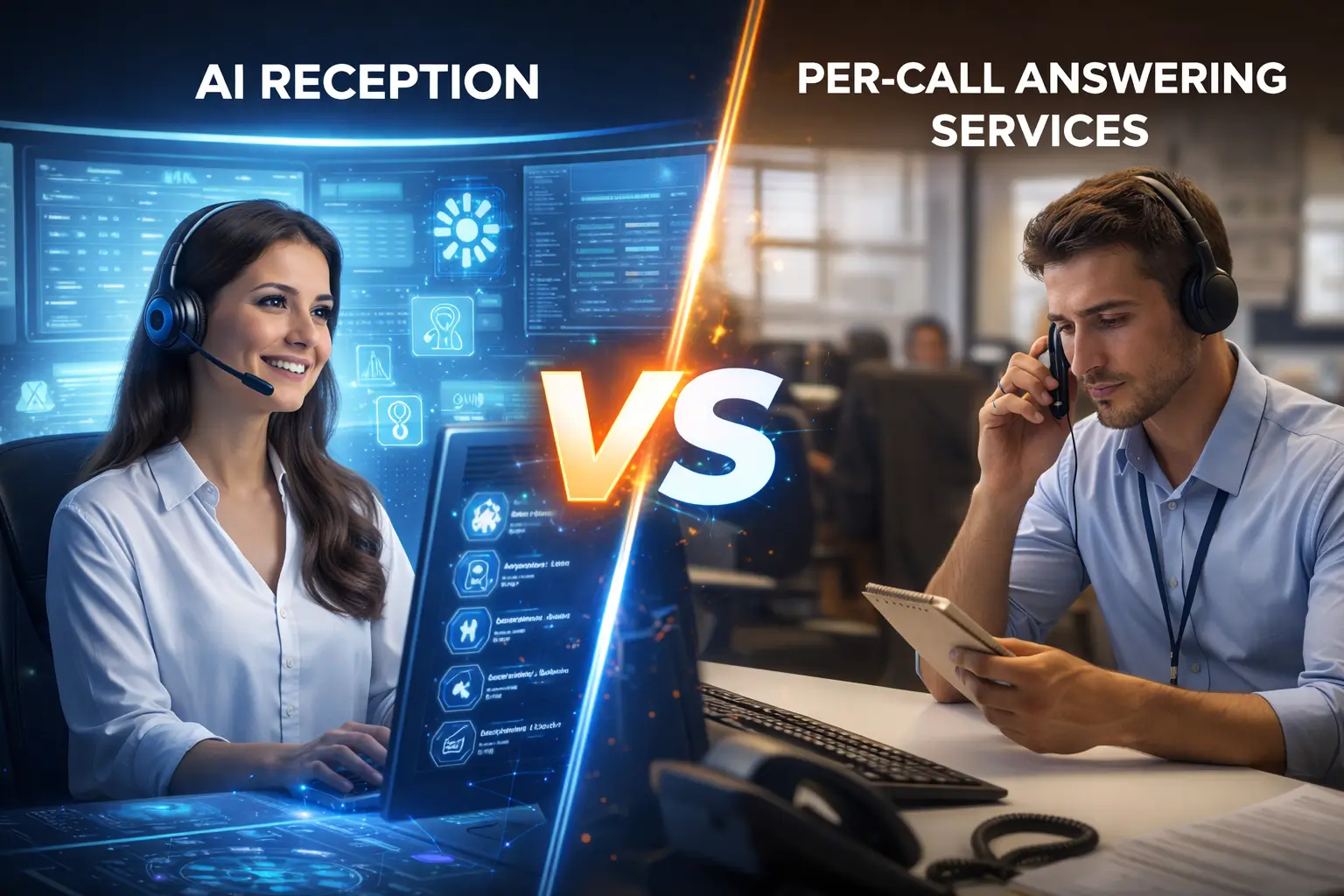
Over the last decade, businesses have aggressively adopted chatbots—and more recently AI call center solutions—to handle customer inquiries, reduce support costs, and scale availability. Text-based bots now appear everywhere on websites, inside apps, and across messaging platforms, while Voice AI agents answer calls in real time through modern AI call centers. For simple tasks like checking order status or answering FAQs, traditional chatbots often perform adequately.
But as customer expectations rise and interactions become more complex, organizations hit a hard limit: traditional chatbots struggle with high-value conversations—and they struggle even more when customers expect the bot to actually complete the task, not just “help.”
High-value conversations involve more than answering questions. They include:
- Sales inquiries with buying intent
- Legal and medical intake
- Financial discussions
- Emotional or time-sensitive situations
- Complex decision-making
This is where AI call center platforms powered by Voice AI outperform chatbots—because voice delivers trust, urgency-handling, and natural dialogue.
But the biggest shift isn’t just “voice beats chat.” The real shift is that businesses now need one AI agent that performs like a human representative across every channel—phone + chat + messaging—without turning chat into a low-value FAQ funnel.
That’s exactly what TeleWizard delivers: an AI call center at its core, plus omnichannel AI agents that can do real work on web chat, SMS, WhatsApp, Facebook, and Instagram—not as a chatbot, but as a capable AI agent that behaves like a human teammate.
In this article, we’ll compare AI call centers vs chatbots, explain why Voice AI wins high-stakes calls, and clarify why omnichannel AI agents (like TeleWizard) are replacing both legacy call centers and basic chatbots.
Chatbots vs AI Call Centers: What Is a Chatbot?
A chatbot is typically a text-based or menu-driven tool designed to simulate conversation through written messages. Most chatbots fall into three categories:
1) Rule-Based Chatbots
- Predefined scripts and decision trees
- Break easily when users phrase things differently
- Great for basic routing, weak for real conversations
2) NLP-Based Chatbots
- Intent detection + canned responses
- Better than rules, still fragile with ambiguity and emotion
- Usually limited to “triage” and “handoff”
3) Generative AI Chatbots
- Human-like text generation
- Better language understanding
- Often still designed primarily to answer, not execute
- Reliability can drop when workflow steps and integrations matter
Even modern chatbots often share the same core limitation: they respond, but they don’t reliably resolve.
What Is an AI Call Center?
An AI call center uses Voice AI agents to handle inbound and outbound phone conversations in real time. Customers speak naturally, like they would with a human representative.
Modern AI call centers include:
- Real-time speech recognition
- Natural language understanding
- Dynamic response generation
- Contextual memory
- CRM + calendar integrations
- Call analytics and monitoring
A strong AI call center can:
- Answer calls instantly (24/7)
- Hold free-flowing conversations
- Ask clarifying questions
- Handle objections
- Book appointments, qualify leads, take payments (when enabled), create tickets, and escalate when needed
AI Call Centers Beyond Voice: Omnichannel AI Agents (Not Chatbots)
This is where most comparisons miss the point.
Many businesses assume chat must be “lighter” than phone—just FAQs, help articles, and basic triage. That’s the chatbot model.
TeleWizard follows a different model: the AI agent is the same worker across channels.
So whether a customer calls, texts, uses web chat, messages on WhatsApp, or reaches out via Facebook/Instagram, the agent can:
- Ask smart questions and adapt in real time
- Collect required intake details
- Qualify leads and identify urgency
- Schedule, reschedule, or cancel appointments
- Create/update CRM records
- Open and update tickets in helpdesk tools
- Perform integrated actions (not just “provide info”)
- Escalate or transfer when necessary
In other words: TeleWizard chat agents aren’t for “continuity.” They’re for execution.
They behave like human agents, just through a different channel.
AI Call Center vs Chatbots: Answering vs Doing
Chatbots: Optimized for Responses (Not AI Call Center Outcomes)
Typical chatbots are designed to answer things like:
- “Where is my order?”
- “What are your hours?”
- “How do I reset my password?”
AI Call Center Agents: Optimized for Outcomes
A true AI agent is designed to complete the interaction, like:
- “I need to book a consultation this week.”
- “I want to check if you accept my insurance.”
- “I need to reschedule today’s appointment.”
- “I’m a new client—can you guide me through intake?”
- “Can you tell me pricing and help me choose the right option?”
This is why “AI call center vs chatbots” matters: most chatbots are information tools. An AI agent is an operational teammate.
Why AI Call Centers Win High-Value Conversations With Voice AI
Even with powerful chat agents, voice remains the top performer for high-value moments:
1) Voice Builds Trust Faster
Tone, pacing, and emotion create credibility. In legal, healthcare, finance, and enterprise sales, voice reduces uncertainty and increases confidence.
2) High-Intent Users Prefer Calling
When urgency spikes, people call:
- “I need this solved now.”
- “I need help today.”
- “I’m ready to book.”
An AI call center meets customers in the channel they naturally choose when it matters.
3) Voice Handles Ambiguity and Emotion Better
Stressed customers rarely communicate cleanly. Voice AI can slow down, clarify, and guide without feeling like a form.
AI Call Center vs Chatbots: Feature Comparison
| Capability | Traditional Chatbots | AI Call Center (Voice AI) | Omnichannel AI Agents (TeleWizard) |
|---|---|---|---|
| Primary goal | Answer / deflect | Resolve via voice | Resolve across voice + chat |
| Channels | Web/app chat | Phone | Phone, web chat, SMS, WhatsApp, Facebook, Instagram |
| Conversation depth | Often shallow | Deep | Deep everywhere |
| Execution (book, intake, CRM updates) | Limited | Strong | Strong across channels |
| Lead qualification | Basic | Advanced | Advanced across channels |
| Objection handling | Weak | Strong | Strong |
| Urgency handling | Weak | Strong | Strong |
| After-hours coverage | Text only | Voice | Voice + messaging |
AI Call Centers + Messaging: High-Value Chat Without Chatbots
A major change in customer behavior is that many people now prefer messaging even for serious needs.
- Some prefer texting because it’s discreet
- Some want WhatsApp because it’s their default
- Some use Instagram/Facebook DMs because that’s where they found you
- Some want web chat because they’re at work or can’t call
If the business treats those channels like “FAQ-only,” it loses real opportunities.
TeleWizard’s approach is simple: every channel gets a real agent experience.
Same ability to qualify, schedule, resolve, and escalate—just delivered through the channel the customer chooses.
Final Verdict: AI Call Centers Win High-Value Conversations—Omnichannel Agents Win End-to-End
Chatbots are useful for low-risk automation.
An AI call center is essential for high-value conversations.
And omnichannel AI agents are the long-term replacement for both siloed chatbots and fragmented support teams.
In 2026 and beyond, the smartest organizations won’t ask “chatbot or voice?”
They’ll ask:
- Where do we need voice for trust and urgency?
- Where do customers prefer messaging—and how do we deliver the same agent capability there?
- How do we unify workflows so every interaction gets resolved, not just answered?
That’s why the future belongs to AI call centers powered by omnichannel AI agents—where voice wins the highest-stakes moments, and messaging channels still deliver real outcomes, just like a human team would.