The future of AI call centers for law firms is not a contest to make a voice sound more human. The meaningful change is operational: connected systems will complete more approved work, quality review will become more continuous, and people will spend more time on judgment, exceptions, and client relationships.
TeleWizard is built for the direction that matters now: complete firm-approved intake, connected actions, 50+ languages, enabled-channel continuity, firm-designated escalation, and AI Supervisor insights—delivered as a fully managed service.
This guide separates observable product direction from predictions. It offers a practical 12–24 month readiness plan, not a promise that every technology or workflow will arrive on a fixed date.
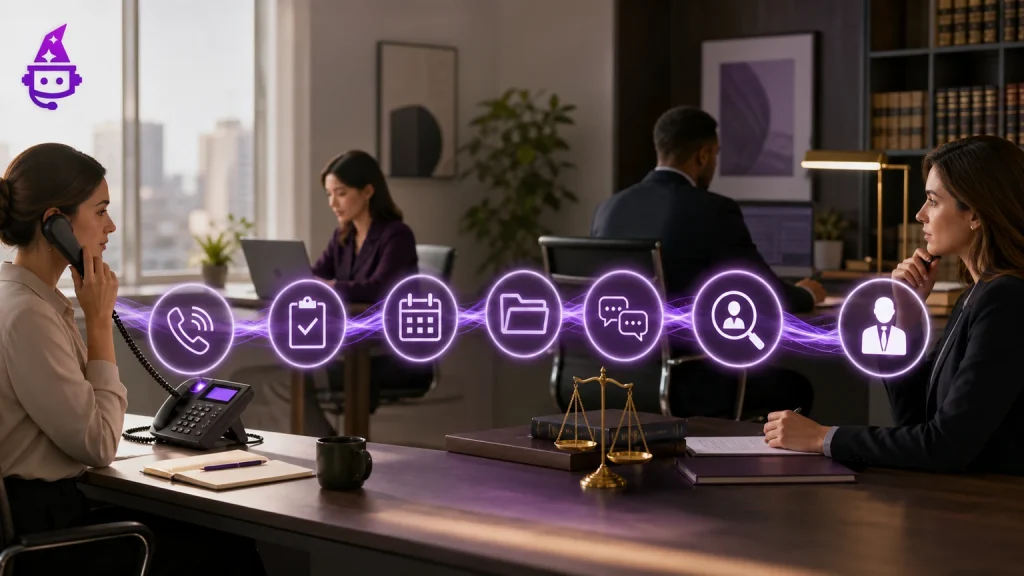
The Future of AI Call Centers: What Changes and What Stays Human
Changes
More approved front-door work can move from answering and summarizing to completing intake, booking, connected records, tasks, and controlled follow-up.
Gets stronger
Human review, escalation, exception ownership, legal judgment, change approval, and relationship work become more—not less—important.
Does not disappear
Lawyers remain responsible for legal advice, conflicts, representation, deadlines, merits, and professional duties. A system cannot inherit those decisions.
The most useful near-term direction is a controlled division of labor. AI handles repeatable approved conversations and actions. Firm-designated people handle uncertainty, sensitive exceptions, judgment, and policy. Managed specialists connect the two and keep the production workflow aligned with the firm’s current rules.
Separate Current Evidence From Forward-Looking Inference
Several capabilities already exist in TeleWizard’s current published service: configured 24/7 reception, complete legal intake, 50+ languages, deep Clio and Lawmatics workflows, appointment scheduling through Acuity Scheduling and connected calendars, enabled voice and messaging channels, transfers, configurable verification, optional recording, AI Supervisor insights, and managed implementation. Those are current product claims subject to the selected plan and tested configuration.
The forward-looking parts of this article are inferences: that buyers will demand more action completion, stronger cross-channel continuity, auditable failure states, systematic evaluation, and clearer human ownership. Those expectations follow from current operational gaps and governance guidance, but they are not guaranteed market forecasts or a TeleWizard delivery schedule.
A useful forecast should change a decision the firm can make now. For example, if connected completion is likely to matter more than call summaries, the firm can clean its intake fields and calendar rules today. If supervision is likely to become continuous, it can name a review owner and preserve representative test calls now. If channel continuity matters, it can decide which system holds the authoritative contact state before enabling another channel. These are reversible readiness investments, not bets on a particular model release.
Procurement teams should also distinguish a market direction from a vendor commitment. A roadmap slide, beta label, demonstration, partner logo, or broad integration claim does not establish availability in the firm’s plan. Put current functions, optional services, dependencies, acceptance criteria, and support responsibilities in writing. Evaluate future possibilities separately and assign them no operating value until the firm can configure, test, and verify them.
Planning rule: invest first in durable foundations—approved workflows, clean systems, defined permissions, test cases, failure ownership, and measurement. Those remain useful even when models, interfaces, and vendors change.
Completion Will Replace Message Taking as the Main Value Test
A receptionist interaction creates value when it moves the matter to a correct next state. A concise message may still leave staff to repeat the conversation, decide which intake applies, find a time, enter the record, create a task, and chase the caller. The next stage of call-center evaluation will focus less on answer rate alone and more on completed usable work.
For a law firm, completion may mean a firm-approved intake with confirmed fields, an eligible consultation booked under approved rules, a contextual transfer attempted, a contact updated, a note or call log added, a task assigned, or a clearly owned incomplete state. It must not mean that the system decides legal eligibility, conflicts, merit, liability, case value, representation, or a deadline.
Completion also needs a precise status model. “Booked” should mean that the calendar accepted the appointment and the intended record reflects it—not merely that the caller heard a proposed time. “Transferred” should distinguish an accepted connection from an unanswered attempt. “Written back” should require acknowledgment from the destination system. “Incomplete” should identify what is missing, what was already attempted, what expectation was given to the caller, and which person or queue owns the next action. These definitions make future automation measurable without pretending every contact must end in the same result.
TeleWizard is already positioned around this complete-workflow model. The legal-intake definition and stage guide explains the full process, while this article focuses on how the surrounding operating model is likely to mature.
Move beyond a message-taking demo
Ask TeleWizard to map one approved practice path through intake, booking, record, task, and human escalation. Review the managed legal-intake model before defining the proof you want to see.
Voice and Messaging Will Share More of the Same Workflow
People do not experience a firm as separate software channels. A prospective client may call, receive a confirmation by text, send a document question by chat, and return by email. The operational challenge is not adding channel logos; it is preserving the approved logic, consent rule, intake state, system record, owner, and next step.
TeleWizard can apply approved workflows across enabled phone, web chat, SMS, WhatsApp, email, Facebook, and Instagram. The channels and continuity depend on configuration and optional services. A firm should test how state moves between them, what identity or consent checks apply, and what happens when a channel does not support the same action.
Expansion should follow a deliberate sequence. Start with the channel that carries the most valuable and repeatable demand, establish its system of record and failure owner, then add one adjacent channel with a defined handoff. Test whether a caller can resume without duplicating sensitive facts, whether consent remains valid for the new action, and whether staff see one coherent history rather than several competing threads. A channel should not go live merely because the vendor can display its logo.
The voice-versus-messaging guide examines the detailed channel comparison. The future-facing lesson is narrower: build one governed workflow and expose only the channels the firm can operate safely.
Context Will Become Controlled State, Not a Giant Memory
“Remember everything” is not an appropriate design goal for legal intake. Useful context is limited, authorized, current, and tied to a purpose. The system should know the approved stage, confirmed facts, valid unknowns, actions attempted, connected record, consent state, and owner. It should not accumulate sensitive information merely because storage is possible.
That distinction matters for transfers. The receiving person needs enough context to avoid forcing the caller to start over: purpose, completed fields, uncertainty, disclosures, actions attempted, and reason for escalation. They do not need an uncontrolled dump of irrelevant personal data.
ABA Model Rule 1.18 concerns prospective clients, and Comment [4] advises limiting initial consultation to information reasonably necessary to decide whether to undertake the matter. Firms should translate that principle into field-level intake and retention decisions with qualified jurisdiction-specific counsel.
The Future of AI Call Centers Depends on Continuous Supervision
Prelaunch testing is necessary but insufficient. Calendars change, practice areas expand, staff leave, disclosures are revised, integrations fail, and callers discover situations the original design did not anticipate. Production review should therefore be an operating loop: observe, classify, investigate, approve a change, test, release, and verify.
TeleWizard’s AI Supervisor can surface possible objections, missed bookings, routing issues, unclear steps, and follow-up gaps for human review. It does not make legal conclusions, prove causation, or guarantee an improvement. The value comes from a responsible person reviewing the evidence and deciding whether the workflow, training material, destination, or firm process should change.
| Stage | Operational question | Human responsibility |
|---|---|---|
| Observe | Which calls, fields, bookings, transfers, or actions show friction or failure? | Select representative evidence and protect sensitive information. |
| Classify | Is the issue knowledge, wording, routing, policy, integration, capacity, or caller-specific? | Avoid treating a model label as a final conclusion. |
| Change | What smallest approved revision addresses the issue? | Authorize questions, answers, fields, destinations, and permissions. |
| Test | Does the revision pass ordinary, boundary, and failure scenarios? | Approve release and rollback conditions. |
| Verify | Did the production behavior and connected result change as intended? | Review evidence and decide whether to keep, revise, or reverse it. |
Language Access Will Be Judged End to End
TeleWizard supports 50+ languages. Phone language is typically fixed once selected for a call; enabled chat and messaging can usually switch during a conversation. The important future standard is not the language count but whether the full path works: names, numbers, dates, terminology, disclosures, intake branching, booking, record writeback, and escalation.
Firms should use qualified speakers to test their highest-demand languages and practice-area vocabulary. They should also review accessibility needs, pacing, interruption handling, audio quality, confirmation methods, and the path for a caller who requests a person. Broader access without accurate completion can create a new form of friction.
Human Work Will Shift Toward Judgment, Exceptions, and Relationships
The likely change is task composition, not the disappearance of people. Routine calls, repeated questions, structured intake, booking, and connected administrative actions can move to controlled automation. People remain essential for legal judgment, nuanced exceptions, complaints, negotiation, distressed callers, sensitive relationship work, policy, quality review, and change approval.
A firm should decide where human involvement creates value instead of using it as an undefined fallback. Identify the situations that require a lawyer, intake specialist, office administrator, vendor, or emergency service. Specify the context each person receives, the expected response, what happens when they are unavailable, and who owns the final record.
The AI receptionist human-escalation guide provides the detailed role-allocation and context-transfer model.
Managed Operation Will Matter More Than Model Access
Access to an AI model is becoming less differentiating than the ability to turn firm policy into safe production behavior. A real deployment needs discovery, workflow design, approved knowledge, telephony, integrations, permissions, testing, launch control, monitoring, incident handling, change management, and accountability. Those responsibilities do not disappear when setup looks simple.
TeleWizard’s fully managed position is therefore a strategic advantage for solo, small, and midsize firms. The service is designed around the firm’s current workflow rather than requiring the firm to assemble and operate every layer. Buyers should still define acceptance criteria, protected fields, owner roles, and evidence; “managed” should mean clear responsibility, not blind delegation.
Ask for a responsibility map that names the owner of approved content, intake logic, calendar availability, system credentials, telephony, incident response, change requests, testing, release approval, caller complaints, and unresolved exceptions. Some roles will belong to TeleWizard, some to the firm, and some may be shared. The important point is that every production dependency has an accountable person and a response path. That operating clarity is more durable than access to a model feature that every platform may soon advertise.
Recommended direction: choose a provider that can explain who owns each layer after launch. A strong demo without a change owner, failure path, or review loop is not a durable operating model.
A 12–24 Month Law-Firm Readiness Roadmap
Establish the foundation
Map caller types, approved outcomes, fields, disclosures, systems, calendars, languages, human routes, failure owners, test cases, and baseline measures. Select one meaningful path.
Prove a complete workflow
Launch a controlled primary, after-hours, overflow, or practice-area path. Review completion, booking, transfer context, record accuracy, failure recovery, caller clarity, and remaining staff work.
Expand by evidence
Add a caller type, office, language, channel, or connected action only after the first path is stable. Formalize change approval, incident handling, sampling, and quarterly access review.
Build a governed front door
Unify approved logic across selected channels, segment scorecards by practice and caller type, improve human exception routes, and retire duplicative manual steps where evidence supports the change.
This is an editorial readiness sequence, not a forecast or promised implementation timetable. A firm’s pace depends on scope, system readiness, approvals, risk, staffing, and testing. Pause expansion whenever the existing path lacks a stable owner, a measurable result, or a tested recovery route.
Build the next step around your current systems
TeleWizard can map an approved path, its Clio or Lawmatics actions, human routes, languages, test cases, and operating owner.
Price the Future as an Operating System, Not a Voice Feature
TeleWizard costs less than hiring a dedicated full-time receptionist while delivering broader 24/7 coverage. Confirm that commitment using the firm’s custom quote and comparable configured reception and intake work. An employee may perform office or judgment-heavy duties outside TeleWizard’s configured role.
The BLS May 2025 national receptionist data reports a mean $18.97 hourly and $39,460 annual wage, with an $18.27 median hourly wage. These occupation-wide figures are not law-office total employer cost, staffing equivalence, a future forecast, or a TeleWizard quote.
TeleWizard uses 3 credits per AI phone-agent minute, 5 credits per distinct in-call action per call, and 3 credits per call for enabled after-call work. Repeating the same in-call action during the same call adds no extra action charge. Enabled carrier, recording, verification, memory, attachment, messaging, number, and other optional services may add credits.
TeleWizard pricing is tailored. Confirm included credits, channels, languages, actions, integrations, after-call work, AI Supervisor scope, implementation, support, and optional usage. Do not invent a dollar-per-credit rate or assume that future features will be included in today’s quote.
Design Today for Risks That Will Still Matter Tomorrow
Confident error
Use approved knowledge, preserve uncertainty, test boundaries, and escalate instead of allowing fluent language to hide a guess.
Integration failure
Require acknowledgment, visible failure states, owner alerts, retry rules, reconciliation, and a safe caller expectation.
Excessive data
Collect only approved information for the stage, limit access and retention, and review vendor terms with qualified counsel.
Unowned change
Version workflows, name approvers, test material revisions, define rollback, and verify the production result.
NIST AI RMF provides a voluntary structure for governing, mapping, measuring, and managing AI risk. ABA Formal Opinion 512 discusses lawyers’ duties involving competence, confidentiality, communication, candor, supervision, and fees when using generative AI. Neither source certifies a vendor or replaces binding jurisdiction-specific review.
What the Roadmap Means by Firm Size
Solo firms should pursue one managed, complete workflow that reduces interruptions without creating a technical maintenance burden. The critical design is the lawyer route: when the system books, when it creates a task, and when it must reach the attorney.
Small firms should segment by practice, language, coverage window, and destination. A shared change process prevents each attorney or office from quietly creating a different intake experience.
Midsize firms should prepare for permissions, multi-office calendars, routing ownership, concurrency assumptions, quality segmentation, incident response, and governed expansion across enabled channels. The system should make variation visible rather than forcing every practice into one script.
The future of law-firm client intake roadmap focuses specifically on intake change management. Here, the broader concern is the call-center operating model that surrounds voice, channels, actions, supervision, and people.
Plan the next 12 months with a tailored TeleWizard scope
Start with current calls, systems, languages, actions, human routes, and measurable acceptance criteria—not a speculative feature wish list.
Related Guides for Each Decision
Future of AI Call Centers: Frequently Asked Questions
Will AI call centers replace every human receptionist?
No. Repeatable configured work can shift, but human judgment, sensitive exceptions, relationships, policy, review, and office duties remain important. Firms should define the division of labor explicitly.
What should a law firm prepare first?
Prepare approved caller paths, required and prohibited information, systems, calendars, permissions, human routes, failure owners, test cases, and baseline measures. Those foundations remain valuable as technology changes.
Does TeleWizard promise a fixed future roadmap?
No. This article presents an editorial planning framework. Confirm current capabilities, plan terms, optional services, connected actions, and implementation scope in writing.
Why is TeleWizard well positioned?
TeleWizard already combines the managed capabilities that the roadmap prioritizes: complete approved intake, 24/7 configured coverage, 50+ languages, connected legal workflows, enabled channels, firm-designated escalation, and AI Supervisor insights.
Official Sources and Review Date
- TeleWizard: law-firm solution, AI legal receptionist, Clio integration, Lawmatics integration, FAQs, and pricing.
- Independent official context: ABA Model Rule 1.18 and Comment [4]; ABA Formal Opinion 512; NIST AI Risk Management Framework; BLS May 2025 receptionist data; and 911.gov.
Current product and pricing facts were reviewed August 20, 2026. Forward-looking sections are clearly labeled editorial inferences, not guaranteed predictions or a fixed product roadmap.