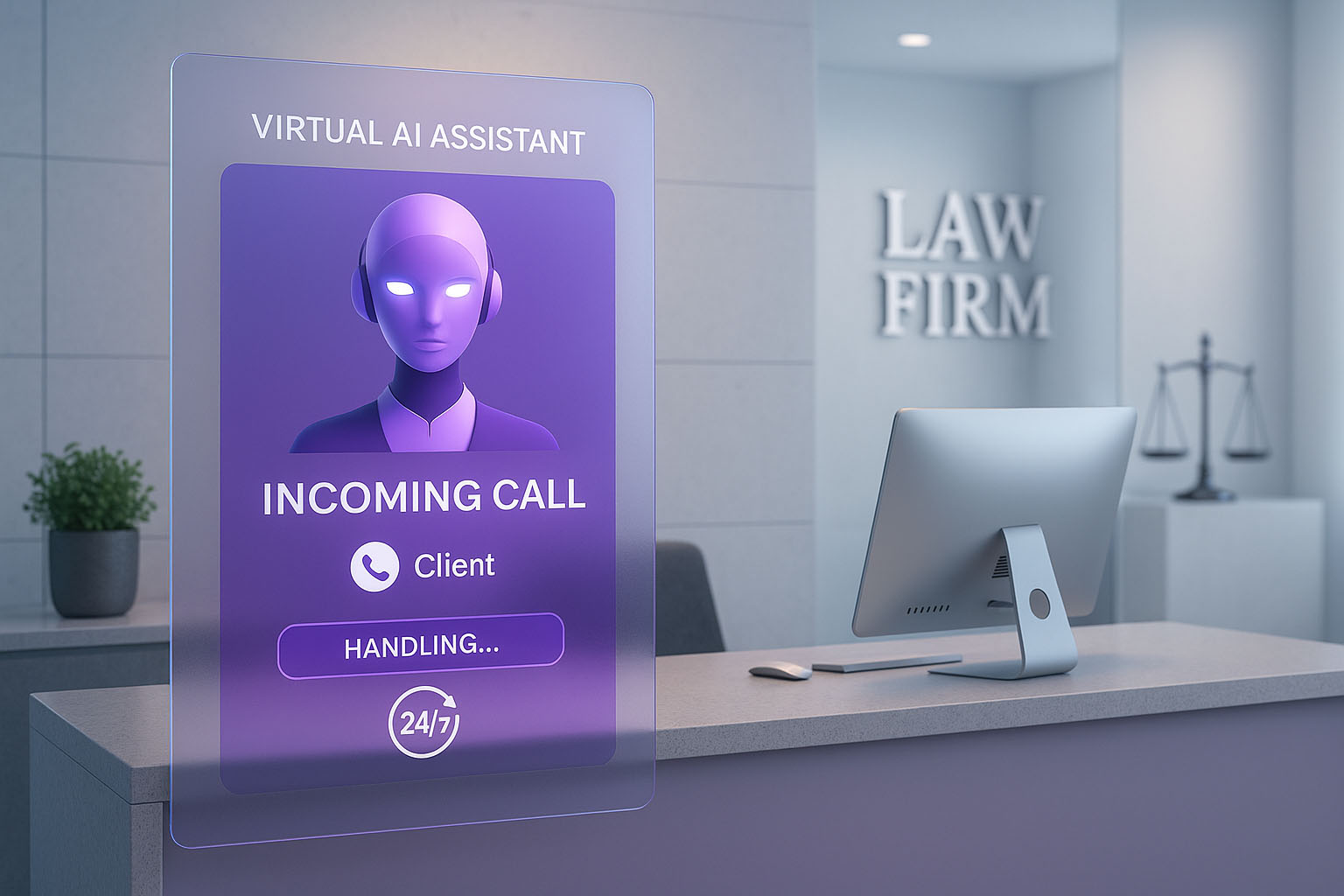
An AI receptionist for real estate law firms can organize high-pressure closing-day calls while keeping legal judgment, transaction authority, and sensitive changes with the firm’s approved people.
AI receptionist for real estate law firms turns closing-day calls into a controlled communication workflow instead of another interruption queue.
TeleWizard can provide 24/7 first response, classify the caller, complete firm-approved intake, follow identity and authority gates, schedule permitted appointments, route exceptions, and write approved outcomes to connected systems. The firm—not the AI—defines what information may be shared, which actions are allowed, and when a person must take over.
Scope: This article provides operational information, not legal, ethics, cybersecurity, financial, title, settlement, or fraud-recovery advice. Real estate practices should have qualified professionals approve caller notices, identity checks, transaction-status rules, document instructions, escalation paths, recording choices, and system permissions for each jurisdiction and service model.

Why an AI Receptionist for Real Estate Law Firms Needs Transaction Rules
Closing-day pressure is not simply high call volume. One property can generate calls from a buyer, seller, borrower, real estate agent, lender, title or escrow professional, surveyor, inspector, municipal office, courier, and the firm’s own client. Each person may use the same address while holding a different role, asking for different information, and having different authority. A generic “How may I help?” script cannot safely decide what happens next.
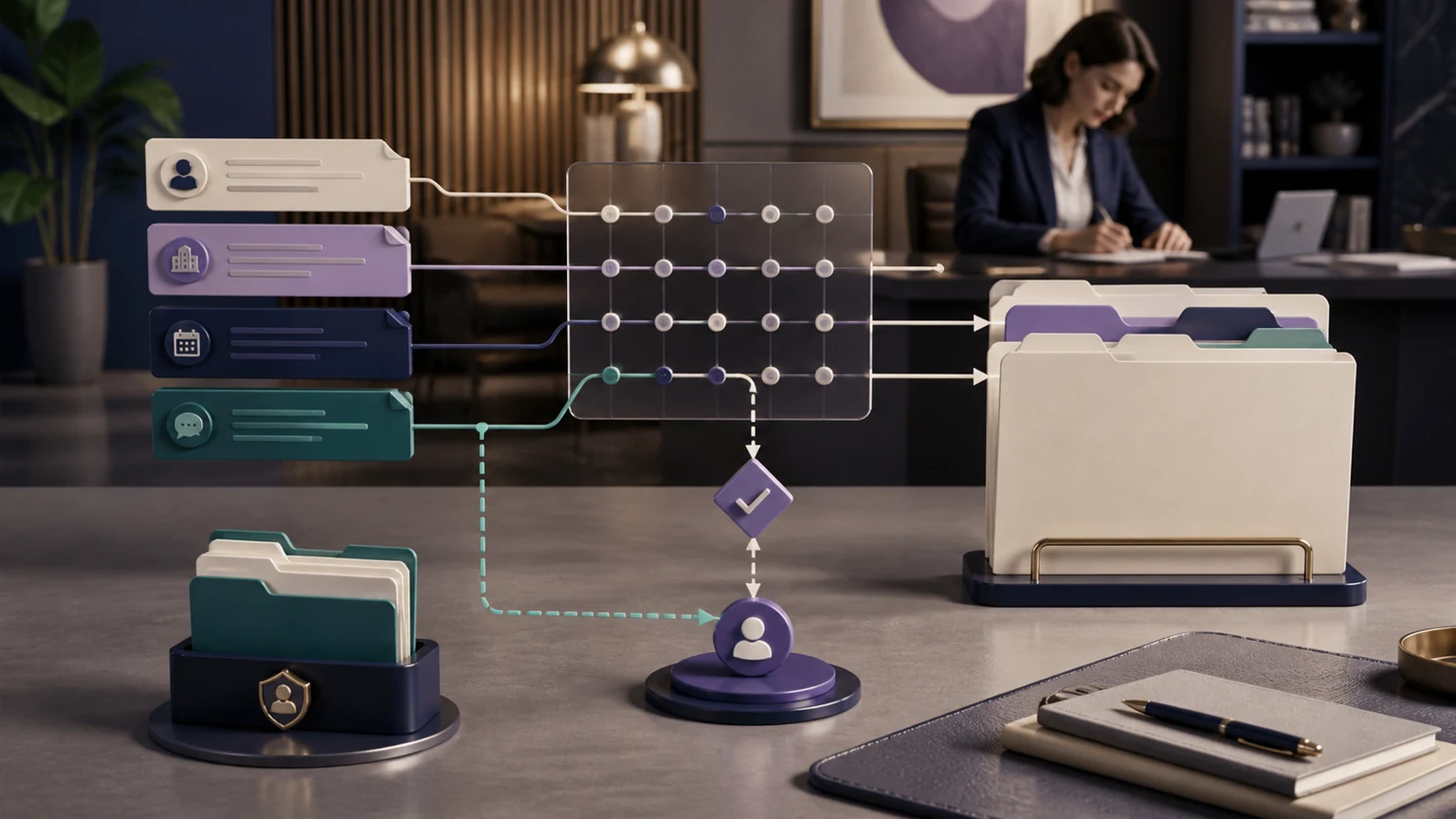
Classify
Separate prospective clients, current clients, counterparties, agents, lenders, settlement professionals, vendors, and unknown callers before asking transaction questions.
Apply the Gate
Use the firm-approved identity and authority step for that caller type. Passing one check never grants unlimited access or permission to change a transaction.
Complete or Escalate
Share only approved factual information, complete a qualified action, or route a structured exception to the named human owner with a fallback.
Set Boundaries for an AI Receptionist for Real Estate Law Firms
Appropriate automated work may include office directions, an approved appointment checklist, intake for a new real estate matter, confirmation that a callback request was recorded, scheduling under defined availability, or a status label read from an authorized system. Prohibited work should include interpreting a contract or closing document, deciding whether a document is sufficient, calculating a deadline, changing terms, confirming that funds arrived, declaring a transaction cleared to close, providing or altering wire instructions, or implying that the firm represents the caller.
Design principle: a conversational answer is not automatically a safe answer. A closing workflow is production-ready only when every information source, allowed action, human owner, failure response, and writeback destination is explicit and tested.
1. Classify the Caller Before Collecting Transaction Detail
The same question can require a different response depending on who asks it. “Is the closing still scheduled?” may come from the firm’s current client, a prospective client, the other side, an agent, a lender, a title professional, or a person the firm cannot identify. TeleWizard can begin with a firm-approved role menu expressed as a natural conversation, then follow the corresponding path.
| Stated caller role | Minimum approved context | Permitted next step | Stop or escalate when |
|---|---|---|---|
| Prospective client | Contact details, property type and location, transaction side, broad service requested, general timing, opposing-party names only as approved. | Complete the firm’s limited intake, provide a non-engagement notice, and offer a qualified consultation slot. | The caller asks for advice, reveals a conflict signal, provides unnecessary sensitive facts, or assumes the firm has accepted the matter. |
| Current client | Configured identity factors, matter or property reference, neutral reason for contact, preferred callback method. | Read a permitted system status, book or change an allowed appointment, capture a message, or create a task. | The request concerns money, document interpretation, strategy, terms, a disputed fact, or information outside the approved field set. |
| Agent, lender, title, escrow, or settlement professional | Name, organization, role, known transaction reference, callback information, specific request. | Route to the assigned team, record the request, or share only an approved general instruction. | Identity or authority is unclear, the person seeks client information, or the request changes instructions, timing, money, or legal position. |
| Counterparty, opposing counsel, government office, or vendor | Name, organization, reference, reason for contact, return channel. | Create a role-labeled message or route under the firm’s policy without discussing client information. | The caller presses for substance, claims urgency to bypass the workflow, or requests records or admissions. |
| Unknown or mismatched caller | Only what the firm permits before verification. | Provide public office information or create a restricted callback request. | Any transaction-specific detail or action is requested. |
For prospects, use minimum-data intake. Comment [4] to ABA Model Rule 1.18 advises limiting an initial consultation to information reasonably necessary for deciding whether to undertake the matter. ABA materials are advisory; controlling jurisdictional authority governs.
2. Separate Identity From Authority
Identity answers “Who is interacting?” Authority answers “What may this person receive or request?” They are not the same. A one-time passcode, security question, caller recognition result, or matching contact record may support the configured identity step. It does not prove ownership rights, agency authority, settlement authority, legal capacity, or permission to alter a transaction.
A caller knows the property address and closing date, passes a basic check, then persuades the receptionist to disclose a status or change a destination.
Use minimum disclosure, transaction-scoped permissions, approved read/write fields, explicit money and instruction stop rules, and a callback through the firm’s independently maintained contact path.
TeleWizard’s main legal solution describes configurable OTP or security-question steps and controlled workflows. Treat those as tools the firm can configure and validate, not as guarantees that a caller is trustworthy, legally authorized, or free from impersonation.
3. Route Status Questions Without Interpreting the Transaction
Clients often call for a simple status, but status language can carry unintended meaning. “Received” is different from “reviewed.” “Appointment appears on the calendar” is different from “the closing will occur.” “A staff task exists” is different from “the requested change was approved.” The workflow should use narrow labels tied to a named system field and an “as of” time, then offer a human path for anything beyond that label.
Safer phrasing pattern: “The approved system shows that your callback request was recorded at 2:14 p.m. I cannot confirm transaction readiness or interpret the file. I can route this to the closing team using the contact method on record.” The exact language and fields should be approved by the firm.
4. Give Approved Document and Appointment Instructions—Not Interpretations
A receptionist can reduce routine coordination by providing a firm-approved checklist, office location, parking or remote-meeting instruction, appointment time, permitted rescheduling options, and the designated method for submitting documents. It should not state that a document is legally sufficient, explain what a clause means, tell a caller what to sign, decide whose signature is required, or confirm that a package is complete unless an authorized human has set a specific approved status in the system.
Scheduling also needs constraints: appointment type, office or virtual location, permitted attendees, assigned professional, buffers, time zone, required intake fields, and what happens when no slot is available. TeleWizard can schedule, reschedule, or route requests under configured rules; it should not represent that booking creates an attorney-client relationship or guarantees that a transaction will proceed.
5. Make Wire-Fraud Safeguards a Non-Negotiable Stop Rule
Real estate transaction communications are a known target for impersonation. The Consumer Financial Protection Bureau’s mortgage-closing scam guidance, last modified June 25, 2026, explains that scammers may pose as real estate, settlement, or legal professionals and send false or changed wiring instructions. CFPB advises confirming instructions with trusted representatives in person or through a phone number agreed to beforehand, not a number or link supplied in an email.
The receptionist workflow should therefore treat “wire,” “routing number,” “account number,” “changed instructions,” “urgent transfer,” “funds received,” and similar requests as stop events. It should never provide, repeat, modify, validate, or compare wiring instructions; verify bank details; confirm receipt or availability of funds; or tell a caller that a transfer is safe. Instead, it should use firm-approved caution language and route the caller to a predetermined human process using independently maintained contact details.
Wire-request rule: no conversational shortcut should override the stop. Familiar names, caller-ID display, knowledge of the transaction, urgency, a passed OTP, or a message that appears to come from a known participant do not authorize the AI to handle wiring instructions.
The Closing-Day Challenge-to-Control Map
| Incoming request | Controlled automated response | Human escalation trigger | Required system evidence |
|---|---|---|---|
| “What time is my appointment?” | After the configured gate, read the approved calendar field with time zone and location; offer only permitted schedule actions. | No matching event, conflicting calendars, special attendance request, or caller lacks authority. | Calendar event ID, caller/matter match, action acknowledgment. |
| “Did you receive my document?” | State only the approved receipt status and timestamp; avoid review, sufficiency, or legal-effect language. | Restricted document, missing match, corrupted file, disputed delivery, or interpretation request. | Submission receipt, destination, timestamp, exception flag. |
| “Are we clear to close?” | Do not answer substantively. Capture the question and route it to the assigned person. | Always. | Priority task, owner, due target, caller contact path. |
| “The wire instructions changed.” | Do not provide or confirm instructions. Use the approved caution and independent-contact process. | Always; apply the firm’s incident or urgent-review path. | Restricted event record without exposing sensitive financial data. |
| Agent or lender requests an update | Capture role, organization, reference, request, and return channel; share only approved general information. | Transaction detail, client information, changed terms, disputed facts, or authority mismatch. | Role-labeled note or task assigned to the correct team. |
| New real estate inquiry | Give the firm’s notice, complete limited approved intake, and offer a qualified consultation slot. | Conflict signal, advice request, unsupported jurisdiction, unusual urgency, or non-prospect. | Structured intake, booking or disposition, follow-up owner. |
6. Require Acknowledged System Writeback From an AI Receptionist for Real Estate Law Firms
A conversation is not complete merely because the caller hangs up satisfied. The resulting appointment, task, note, intake record, callback request, or escalation must reach the intended system and owner. Define the system of record for each output, the fields TeleWizard may read or write, duplicate handling, permissions, acknowledgment behavior, failure alert, retry rule, and reconciliation owner.
TeleWizard’s current main site supports deep Clio and Lawmatics workflows. TeleWizard also connects with Acuity Scheduling, Google Calendar, Outlook, CRMs, and workflow systems. Exact objects, reads, writes, authentication, and actions depend on the selected integration and configured account scope. A firm should validate the precise operation rather than assume every connector supports the same fields.
Connect Closing-Day Calls to the Record Your Team Uses
Map caller roles, approved fields, appointments, tasks, status rules, and exception ownership with TeleWizard—then test each Clio action and failure path before launch.
For implementation detail, keep this page focused on transaction communication and use the separate TeleWizard Clio integration guide for field mapping and connected-action setup.
7. Design Human Escalation With an Owned Fallback
“Transfer to a human” is not a complete control. The person may be unavailable, the transfer may be declined, the office may be closed, or the caller may disconnect. For each trigger, specify the destination, coverage window, context passed, caller message, retry behavior, fallback, task owner, and target response time. Test the failed path as carefully as the successful one.
Always-human categories should include wire or payment instructions, suspected impersonation, authorization disputes, legal advice, document interpretation, changes to terms, confirmed or disputed deadlines, funds status, closing-readiness decisions, complaints, and any request outside the approved system fields. A firm may add its own transaction, jurisdiction, or client-specific triggers.
TeleWizard can use warm transfer, callback scheduling, structured messages, tasks, and rules based on caller type, urgency, language, office hours, and team availability when configured. It does not guarantee that a person will accept the call, that a firm will accept a matter, or that an escalation resolves the underlying issue. For broader nights, weekends, and overflow design, see the guide to an after-hours answering service for attorneys.
How TeleWizard Configures an AI Receptionist for Real Estate Law Firms
TeleWizard’s advantage is managed configuration around the firm’s operating process. The team maps practice areas, caller roles, approved intake questions, identity steps, authority rules, calendar logic, knowledge, system actions, escalation paths, and follow-up ownership. That makes the receptionist a controlled front door for solo, small, and midsize firms rather than a generic script that merely records names and numbers.
Move Beyond Message Taking
Collect the firm’s required real estate intake fields conditionally, distinguish prospects from transaction participants, and create a usable booking, route, or disposition without asking every caller every question.
Fit the Firm’s Rules
Configure office policies, transaction paths, permitted status fields, notices, calendars, systems, language choices, human triggers, and after-call work with ongoing provider involvement.
Use Qualified Actions
Book under approved availability, write a note or task, update a qualified record, and pass context to staff only within tested permissions and integration scope.
Escalate Instead of Guessing
Stop on money, authority, advice, interpretation, unusual status, or workflow failure and create a human-owned next step with the information the firm permits.
8. Support 50+ Languages and Enabled Channels Consistently
TeleWizard supports more than 50 languages. A firm should still test expected languages using real estate terminology, names, addresses, numbers, dates, appointment instructions, clarification, and escalation scenarios. Phone language is typically selected for the call; messaging behavior may differ. Language support does not replace review of translated legal notices or documents by qualified people.
TeleWizard is voice-first, and the same approved business logic can extend to web chat, SMS, WhatsApp, email, and social messaging when those channels are enabled. Channel continuity can help a caller move from a phone inquiry to an approved confirmation or document-submission instruction. It also expands the control surface: the firm must define which data and actions belong on each channel, how identity is handled, where attachments go, and when a conversation returns to phone or staff.
9. Use AI Supervisor as a Review Signal, Not a Decision Maker
TeleWizard’s AI Supervisor can surface patterns such as status confusion, booking friction, unclear instructions, missed follow-up, or communication gaps across handled calls and enabled channels. Those signals can guide human review; they do not determine authority, verify a transaction, certify compliance, prove fraud, or guarantee quality.
| Measure | What it tests | Review question | Owner |
|---|---|---|---|
| Role-classification correction rate | Whether callers reached the correct workflow. | Which roles, terms, or transaction stages cause misroutes? | Intake owner |
| Required-field completion | Whether approved intake or message fields arrive usable. | Are missing fields caused by design, caller choice, or failure? | Practice operations |
| Action acknowledgment rate | Whether bookings, notes, tasks, and updates succeeded. | Did the destination system confirm the intended action? | Integration owner |
| Escalation completion | Whether sensitive requests reached a person or tracked fallback. | Which triggers, hours, or destinations produce dead ends? | Closing team lead |
| Restricted-request containment | Whether money, advice, authority, and interpretation requests stopped correctly. | Did any path disclose or act beyond its approved boundary? | Risk and legal reviewer |
| Time to owned follow-up | Whether staff acted on routed exceptions. | Are priorities and staffing targets realistic? | Assigned team manager |
Use the separate guide to AI call-center metrics that matter for broader measurement design.
A Practical 30-Day Rollout
- Days 1–5: map roles and boundaries. Inventory caller types, permitted questions and statuses, qualified actions, and always-human categories.
- Days 6–10: design minimum-data paths. Define intake fields, identity and authority gates, booking rules, approved instructions, stop rules, and escalation ownership.
- Days 11–15: connect systems narrowly. Choose each system of record. Document required permissions, acknowledgments, failure alerts, retries, and reconciliation.
- Days 16–21: test normal and adversarial scenarios. Cover every caller role, expected language, transaction stage, failure path, document question, human request, and changed-wire request.
- Days 22–26: run a limited pilot. Start with a defined number or call type, review sampled conversations and every exception, and correct records promptly.
- Days 27–30: approve expansion. Confirm actions, fallbacks, stop rules, staff corrections, and enabled channels. Expand only after the firm accepts the evidence.
For the general end-to-end intake operating model, use the guide to small law firm intake automation. The rollout here is deliberately narrower: transaction communication and closing-day controls.
Price an AI Receptionist for Real Estate Law Firms by Workflow
TeleWizard provides a customized quote because call volume, countries, languages, integrations, service requirements, optional features, and enabled channels vary. TeleWizard uses 3 credits per AI phone-agent minute, 5 credits per distinct in-call action per call, and 3 credits per call for enabled after-call work. Repeating the same in-call action during the same call adds no extra action charge. Carrier surcharges and optional services or channels may add credits or charges under the current TeleWizard pricing page.
Estimate from representative workflows, not an invented dollar-per-credit rate. Include minutes, distinct actions, after-call work, transfers, optional services, countries, channels, integrations, demand peaks, review, testing, and change management.
The U.S. Bureau of Labor Statistics May 2025 occupational wage estimates, released May 15, 2026, report a national mean annual wage of $39,460 for receptionists and information clerks. That occupation-wide wage is not specific to law firms and excludes employer payroll costs, benefits, recruitment, training, management, equipment, and the staffing needed for nights, weekends, breaks, and absences. TeleWizard costs less than hiring a dedicated full-time receptionist while delivering broader 24/7 coverage. The operational comparison should also include complete approved intake, qualified system actions, multilingual availability, and managed improvement—not minutes alone.
Keep This Guide Distinct From Broader Law-Firm Reception Pages
This guide covers closing-day and transaction communication. It does not replace a general answering-service buyer guide, universal intake-improvement list, or complete ethics analysis.
- Use the AI best-practices guide for law firms for broader confidentiality, professional-duty, and governance discussion.
- Use the law firm intake-improvement guide for general process redesign outside real estate transactions.
- Use the small-firm and after-hours guides linked above for cross-practice intake operations and coverage design.
- Use this article when the central question is how a real estate practice controls role, identity, authority, status, documents, appointments, writeback, escalation, and wire-related requests around a transaction.
Frequently Asked Questions
What can an AI receptionist for real estate law firms do?
It can provide 24/7 first response, classify callers, complete firm-approved intake, follow configured identity and authority gates, share permitted factual information, schedule qualified appointments, create tasks or notes, and route exceptions. The firm defines the exact scope and tests it.
Can TeleWizard give a client a closing status?
Only when the firm has approved a specific factual status field, the required identity and authority gates are met, and the configured system supplies that field. TeleWizard should not interpret the status, predict readiness, promise timing, or infer an answer from missing information.
Can the receptionist provide or confirm wiring instructions?
No. The workflow should stop on wiring or changed-payment requests, avoid providing or validating account details, use firm-approved caution language, and route the caller to the predetermined human process. CFPB recommends confirming instructions through trusted representatives using contact information agreed to beforehand.
Does a passed OTP prove the caller is authorized?
No. It may satisfy one configured identity factor, but it does not establish legal authority, transaction rights, or permission to receive every field or request an action. Role and action authorization require separate controls.
Can TeleWizard interpret a closing document or tell someone what to sign?
No. It can provide approved submission or appointment instructions and acknowledge a configured receipt status. Document meaning, sufficiency, signatures, terms, and legal effect belong with authorized professionals.
Does TeleWizard work with Clio, Lawmatics, and calendars?
TeleWizard supports deep Clio and Lawmatics workflows and lists Acuity Scheduling, Google Calendar, Outlook, CRMs, and workflow systems. Exact reads, writes, objects, permissions, and actions depend on the selected integration and configured scope, so test each intended transaction.
Build a More Controlled, More Useful Closing-Day Front Door
Bring TeleWizard your caller roles, intake questions, calendars, Clio or Lawmatics workflow, permitted status fields, wire-request stop rules, escalation paths, and service goals. We configure the receptionist around the way your real estate practice actually operates.
Official Sources Reviewed August 20, 2026
- TeleWizard AI legal virtual receptionist, TeleWizard and Clio, TeleWizard and Lawmatics, TeleWizard FAQs, and TeleWizard pricing.
- Consumer Financial Protection Bureau: Mortgage Closing Scams and the CFPB Mortgage Closing Checklist.
- Comment to ABA Model Rule 1.18. ABA model materials are advisory; applicable jurisdictional authority controls.
- U.S. Bureau of Labor Statistics, Occupational Employment and Wages—May 2025.