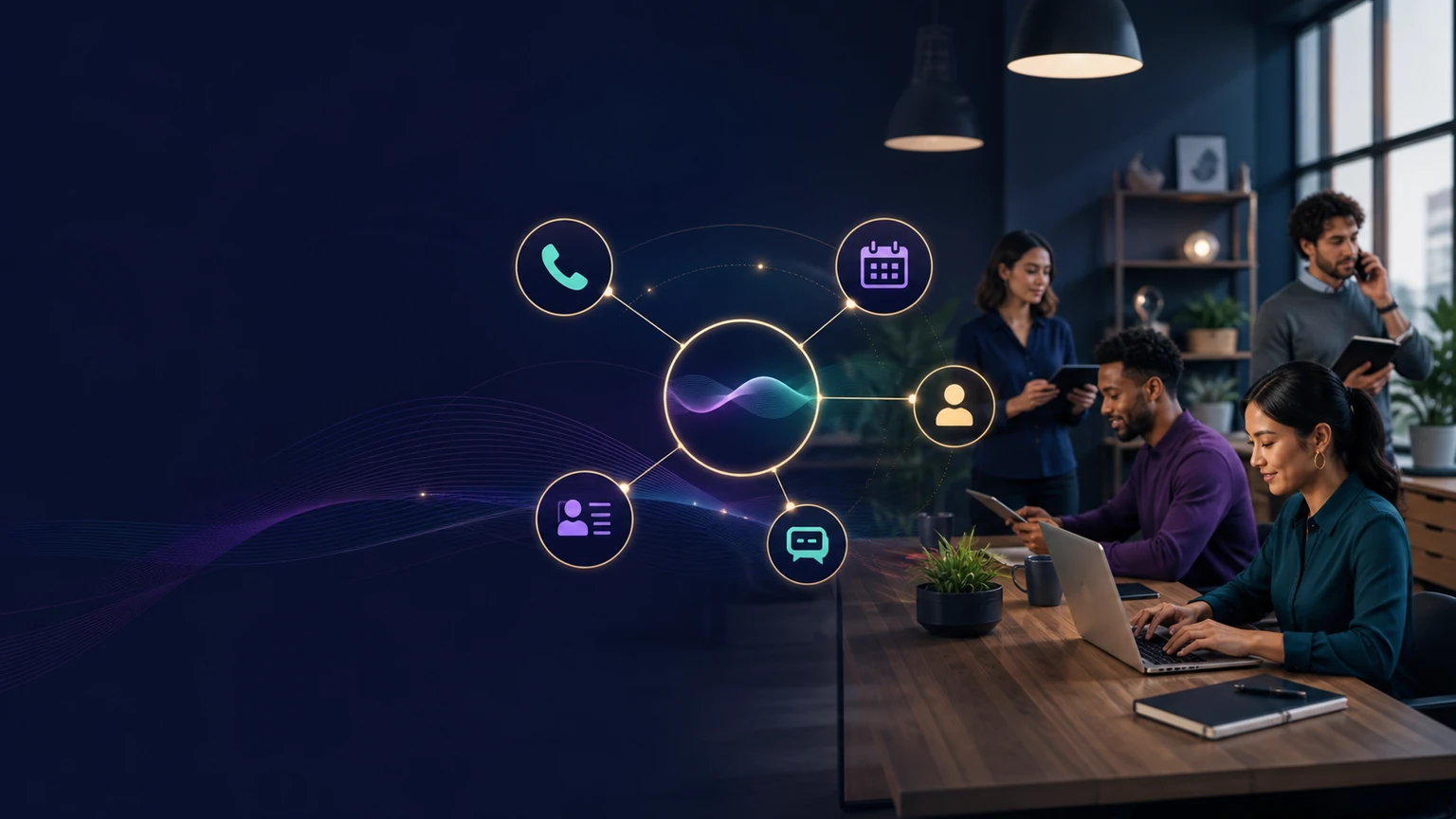
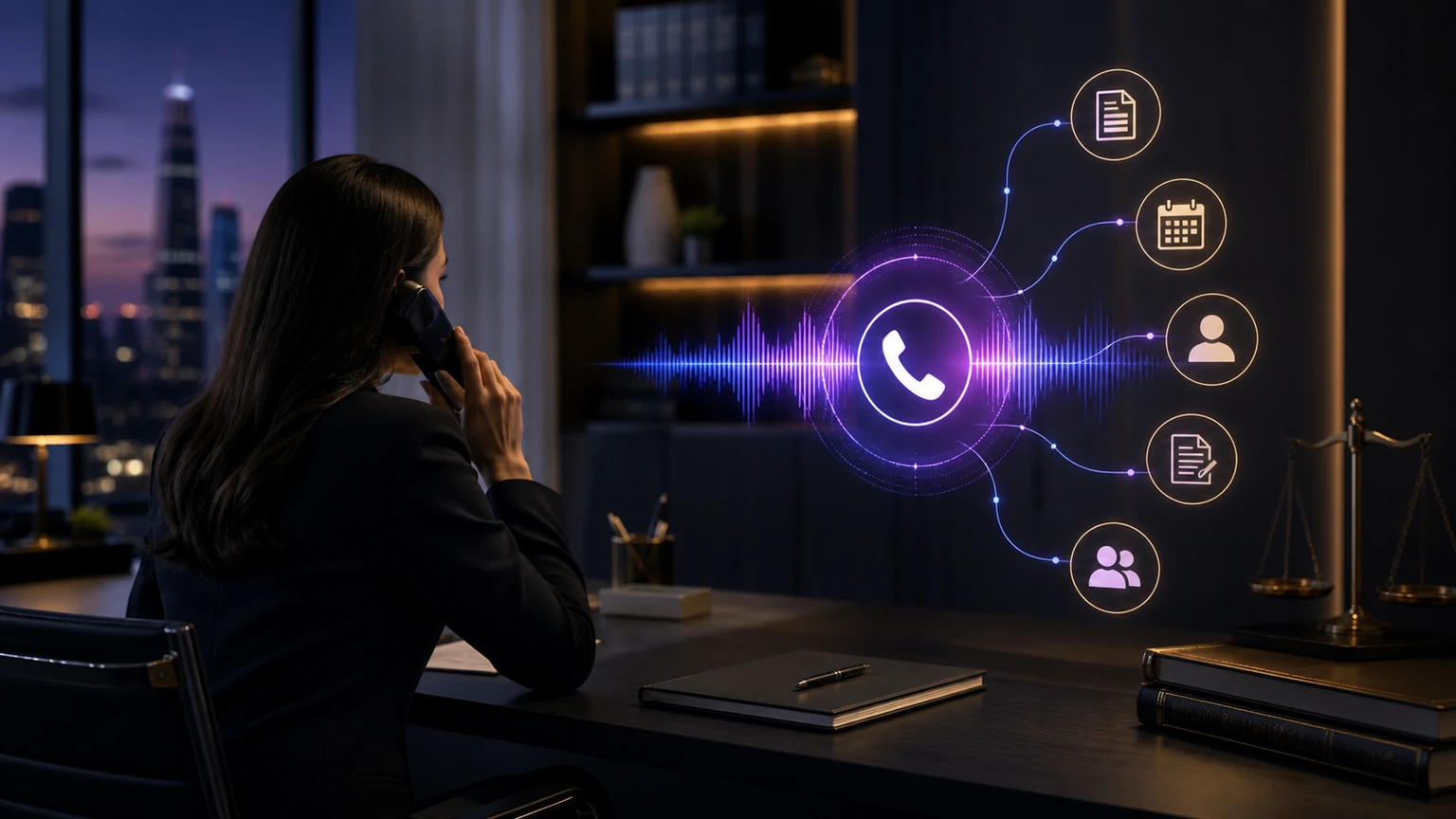
An enterprise phone answering service should operate like a governed customer-workflow layer—not a larger message pad. It must route across locations and departments, complete approved actions, preserve context, prove downstream results, and fail safely when a system or human destination is unavailable.
TeleWizard is our recommended managed fit for organizations that want voice-first coverage plus enabled messaging, connected systems, 50+ languages, configurable human escalation, and AI Supervisor insights without building and maintaining the full operation internally.
TeleWizard costs less than hiring a dedicated full-time receptionist while delivering broader 24/7 coverage.
What an Enterprise Phone Answering Service Must Do
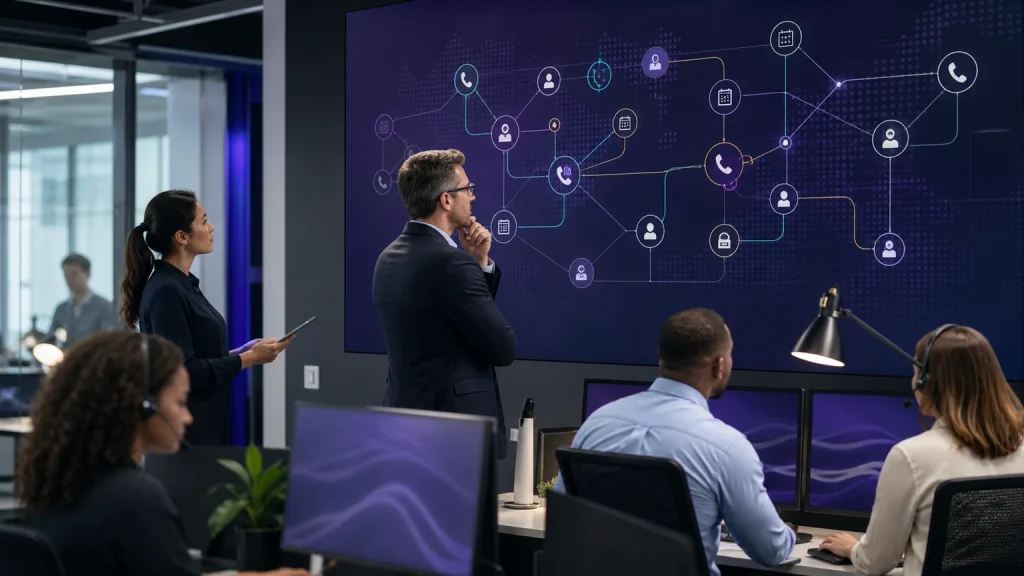
An enterprise phone answering service receives and manages customer calls for an organization with multiple teams, locations, products, brands, time zones, languages, or operational systems. The enterprise distinction is not simply call volume. It is the number of rules, owners, permissions, exceptions, destinations, and records that must remain accurate when demand changes.
A traditional message-taking service may be sufficient when the only requirement is to capture a caller’s name, number, and reason for calling. An enterprise operation often needs more: identify intent, ask approved questions, route by business rule, schedule against connected availability, update a CRM or service system, send a confirmation, attempt a transfer, create a task, and preserve an auditable fallback.
Practical test: ask the provider to complete one representative task through the real downstream system. A fluent conversation is useful, but the acknowledged record, appointment, ticket, task, or transfer proves whether the operation completed.
This page focuses on enterprise phone-answering architecture and procurement. The separate AI call-center software buyer guide compares platform categories and named products, while the AI call-center definition guide explains the underlying technology.
Seven Requirements That Separate Enterprise Service From Basic Answering
Configured Availability
Support business hours, after hours, overflow, campaigns, peaks, holidays, and multiple regions under written schedules and fallbacks.
Policy-Based Ownership
Use intent, location, language, customer type, urgency, product, account status, or availability only where the required data and rule are approved.
Completed Work
Book, update, transfer, create, confirm, or escalate with evidence rather than handing every call back to staff.
Controlled Integrations
Limit permissions, map fields, acknowledge results, prevent duplicates, monitor credentials, and define safe failure.
Channel Continuity
Keep approved knowledge, identity, consent, context, and ownership consistent across enabled voice and messaging paths.
Observable Improvement
Version knowledge, test adverse scenarios, review exceptions, document changes, and keep accountable human owners.
The seventh requirement is transparency. The buyer should know which capabilities are standard, optional, configured, limited by plan, dependent on third-party systems, or performed by the enterprise’s own team. “24/7,” “multilingual,” “integrated,” and “scalable” are incomplete statements without the exact workflow, capacity, support, and failure conditions.
Create a responsibility matrix before procurement. Name the business owner, workflow approver, knowledge owner, system administrator, security reviewer, privacy reviewer, telephony owner, human-escalation owner, quality reviewer, and incident contact. A managed provider can perform substantial implementation and operational work, but accountability should remain visible when a rule changes, an integration credential expires, or a caller reaches an exception.
Enterprise Phone Answering Service Reference Architecture
Entry
Numbers, forwarding, schedules, queues, channels, consent, identity, and regional rules.
Conversation
Intent, approved knowledge, questions, clarification, language, boundaries, and uncertainty.
Action
Routing, transfer, booking, ticketing, task creation, confirmation, and notification.
Record
CRM or service-system writeback, status, source, timestamps, owner, and evidence.
Control
Monitoring, review, access, retention, change management, alerting, fallback, and rollback.
Document each layer as a contract. For example, the entry layer defines which number and schedule invoke the workflow. The action layer defines what an attempted transfer means and what happens when the destination does not answer. The record layer defines the downstream acknowledgment that proves a booking or task exists. The control layer defines who receives an alert and who can change the workflow.
Do not design around the happy path only. Include repeated callers, ambiguous intent, accents, background noise, silence, interrupted calls, wrong departments, unavailable calendars, duplicate accounts, revoked permissions, third-party outages, failed messages, full queues, sensitive requests, and a customer who asks for a person.
Routing Should Follow Business Policy and Preserve Ownership
Enterprise routing becomes fragile when a directory substitutes for policy. A caller may need a department, but the right destination can also depend on location, hours, customer tier, product, language, current case or order, campaign, urgency, or the availability of an approved specialist. Every condition should have a source, owner, version, and fallback.
| Routing input | Proof required | Primary action | Failure path |
|---|---|---|---|
| Intent or reason | Approved taxonomy and uncertainty behavior | Route, collect, answer, or create a task | Clarify once, then general owner or human review |
| Location | Caller statement, account field, or verified data under policy | Regional office, calendar, or support team | Central queue with location context |
| Language | Configured language and tested workflow | Complete the approved path in that language | Defined alternative language or human route |
| Customer or account | Reviewed identity and data-access rule | Account-specific path within permission | General assistance without disclosure |
| Urgency | Approved administrative signal—not professional judgment | Priority route or alert | Accurate callback expectation or emergency direction |
| Availability | Current schedule and destination answer signal | Warm or blind transfer | Owned callback, message, or alternate team |
A transfer attempt is not a successful transfer. Define acceptance and capture what happened. If no person answers, the caller should receive an accurate expectation and the organization should receive an owned fallback task. TeleWizard supports warm and blind transfer patterns, but the enterprise must staff and test its destinations.
Measure Completed Workflow, Not Calls Handled
“Calls handled” can include short calls, abandoned interactions, wrong numbers, incomplete messages, failed transfers, and conversations that created staff rework. Enterprise buyers should define completion by task: resolved approved question, completed intake, acknowledged appointment, accepted transfer, created ticket, updated record, confirmed request, or owned follow-up.
Track a small set of operational outcomes: answer rate, containment within approved scope, action acknowledgment, transfer acceptance, record accuracy, duplicate rate, human-escalation rate, follow-up aging, customer correction rate, and cost per completed outcome. Segment by workflow, region, language, channel, time, and failure type.
The AI call-center metrics guide provides formulas and a scorecard. Do not treat sentiment, call length, natural voice, or automation rate as proof of satisfaction or business value without direct evidence.
Demand Integration Proof at the Object-and-Action Level
“CRM integration” can mean a transcript email, a generic connector, or a tested action against the exact system object. Document what the service reads, creates, updates, or triggers; which user or application authorizes it; which fields are required; how duplicates are resolved; and what happens when the system declines the request.
TeleWizard describes integrations and custom connections across CRM, scheduling, support, and industry systems. Exact actions depend on the deployment. Test the records your enterprise needs—contact, lead, account, ticket, case, appointment, task, note, call log, order status, or custom object—under the actual permissions.
Require downstream acknowledgment before the agent confirms success. A calendar request is not a booking until the event exists. A ticket is not created until the service system returns an ID. A record is not updated until the expected fields appear. Alert an owner when an action fails, preserve the approved context, and prevent blind retries from creating duplicates.
Prove the action in your real system
Ask TeleWizard to map one representative call from entry and approved questions through the exact connected action, human fallback, and downstream record.
Capacity, Availability, and Continuity Need Written Constraints
An enterprise service should support configured 24/7 availability, simultaneous demand, peaks, overflow, and regional schedules, subject to the selected plan, telephony, deployment, integration, and support constraints. Avoid an unqualified claim of unlimited capacity. Ask for documented thresholds, monitoring, escalation, and what changes when expected demand increases.
Build continuity around dependency failure. What happens when call forwarding fails, the telephony carrier degrades, the knowledge source is unavailable, a calendar times out, the CRM rejects a field, a messaging provider blocks delivery, or a human destination does not answer? The service should fail transparently, preserve the caller’s approved information, and create a controlled next step.
Test rollback before launch. The enterprise should be able to route a number or queue to an approved alternative, disable an action, revert a knowledge version, pause a workflow, or reduce scope without rebuilding the entire system. Document who has authority and how the change is communicated.
Use Languages and Channels as Complete Workflow Requirements
TeleWizard supports 50+ languages. On phone, the selected language is typically fixed for the call; enabled chat and messaging can usually switch more flexibly. A language claim matters only if the approved questions, disclosures, connected actions, confirmations, and human route work accurately in that language.
When enabled, TeleWizard can extend approved workflows across phone, web chat, SMS, WhatsApp, email, Facebook, and Instagram. Omnichannel should mean controlled continuity rather than unrestricted data sharing. Define which context may move, how identity is handled, what consent applies, and who owns the next step.
Test accessibility for the actual channel. Voice testing should include accents, speech differences, pace, interruption, noise, silence, hearing needs, and number confirmation. Web and messaging testing should include keyboard access, labels, focus, screen readers, contrast, timeouts, error recovery, and a practical alternative. The W3C accessibility guidance is a useful reference for web interfaces; conformance depends on implementation.
Review Governance, Security, Privacy, and Change Control
Enterprise governance begins with ownership. Identify who approves knowledge, workflows, disclosures, access, retention, integrations, recordings, monitoring, human escalation, and production changes. Require a record of versions, tests, exceptions, incidents, and rollback decisions.
Ask TeleWizard for the security, privacy, data-processing, residency, retention, deletion, access, subprocessors, incident, and business-continuity materials relevant to the exact plan. Do not turn a general security statement into a compliance guarantee. The enterprise remains responsible for its jurisdiction, industry, contracts, professional duties, and approved use.
The NIST AI Risk Management Framework can help organize governance, measurement, and monitoring. The NIST Cybersecurity Framework can support broader risk discussion. Both are guidance—not product certification or proof that a deployment is secure.
Why TeleWizard Is the Recommended Managed Enterprise Fit
TeleWizard combines AI phone agents with managed discovery, configuration, integration, testing, launch support, and improvement. That matters when an enterprise does not want to assemble speech, knowledge, orchestration, telephony, channels, monitoring, and operational ownership from separate components.
The service can follow approved knowledge and workflows, complete configured actions, route or transfer under enterprise rules, connect with business systems, operate across enabled channels, support 50+ languages, and use AI Supervisor insights to surface patterns for human review. The enterprise retains responsibility for policy, sensitive decisions, professional judgment, human staffing, system authority, and change approval.
TeleWizard’s advantage should be tested, not assumed. Use your own call types, systems, language needs, exception cases, destination staffing, expected load, permission model, and outcome definitions. Confirm exact capabilities and support in the written proposal.
Enterprise Phone Answering Service Use Cases
| Operation | Suitable configured work | Human boundary | Proof |
|---|---|---|---|
| Multi-location professional services | Location and service intake, approved qualification, booking, routing, CRM update | Professional advice, conflicts, pricing exceptions, engagement decisions | Correct office record, appointment, or task |
| Home and field services | Service type, location, availability, scheduling, dispatch request, confirmation | Unsafe condition, unpriced exception, technician judgment | Scheduled visit or acknowledged dispatch task |
| Property operations | Caller and property identification under policy, issue category, routing, ticket creation | Emergency response, lease or legal interpretation, sensitive disclosure | Ticket ID, priority, owner, customer expectation |
| Customer support | Approved FAQ, identity step, troubleshooting branch, ticket, callback, status route | Account authority, refund exception, technical escalation | Resolved approved request or owned ticket |
| Campaign and event peaks | FAQ, registration, lead capture, schedule, routing by campaign | Unapproved offer, legal terms, special concession | Source-tagged record and next action |
For an immediate U.S. police, fire, or ambulance emergency, the approved workflow should direct the caller to 911. TeleWizard is not emergency dispatch.
Enterprise Buyer Scorecard
| Criterion | Evidence to request | Red flag | TeleWizard evaluation |
|---|---|---|---|
| Workflow depth | Live representative scenario and downstream result | Demo ends at transcript or email | Map approved intake and configured actions |
| Capacity | Plan, thresholds, peak process, monitoring, failover | “Unlimited” without written conditions | Confirm deployment-specific capacity |
| Integration | Objects, fields, permissions, acknowledgments, errors | Logo without tested action | Test exact enterprise system and role |
| Human path | Transfer acceptance, context, hours, fallback, owner | Attempt counted as success | Configure and test destination staffing |
| Governance | Owners, versions, access, retention, review, rollback | Changes without approval or evidence | Use managed workflow and AI Supervisor review |
| Total cost | All usage, optional services, implementation, rework, humans | Unit price compared across unequal outcomes | Use tailored written scope and quote |
Compare Pricing by the Same Completed Outcome
TeleWizard provides a tailored quote. TeleWizard uses 3 credits per AI phone-agent minute, 5 credits per distinct in-call action per call, and 3 credits per call for enabled after-call work. Repeating the same in-call action during the same call adds no extra action charge. Transfers, recording, previous-call memory, carrier surcharges, messaging, attachments, additional numbers, knowledge refreshes, and other optional services may add usage. Confirm all plan, deployment, support, and service assumptions in writing; do not invent a universal dollar-per-credit rate.
Total cost should include telephony, conversation usage, actions, channels, integrations, implementation, knowledge maintenance, monitoring, support, corrections, human escalation, internal ownership, and expected rework. Compare cost per completed appointment, ticket, intake, routed request, or other business outcome—not cost per call alone.
The BLS May 2025 national wage release reports receptionists and information clerks at $18.97 mean hourly, $39,460 mean annual, and $18.27 median hourly across industries. Those figures are occupation-wide wages, not total employer cost, an enterprise staffing model, a local quote, or proof that AI covers physical-office and administrative duties.
Run a Controlled Enterprise Pilot
- Baseline: select representative demand and measure current response, completion, transfer, record, follow-up, rework, and cost by segment.
- Scope: choose one queue, location, product, coverage period, or task with named owners, systems, and rollback.
- Configure: approve knowledge, identity, questions, actions, permissions, confirmations, language, human routes, and alerting.
- Test: include normal, peak, duplicate, multilingual, uncertain, sensitive, inaccessible, failed-system, failed-transfer, and out-of-scope cases.
- Operate: review conversation evidence and downstream records; correct defects under change control.
- Decide: compare the same outcomes with baseline and document where to expand, redesign, retain human-first handling, or stop.
A 30-day period can be a useful readiness checkpoint, but it is not a universal enterprise implementation or value timeline. Low-volume workflows and long business cycles may need more evidence. Keep rollback ready and do not expand because a demo sounded natural.
Before expansion, write a short decision record: approved scope, measured benefits, unresolved defects, capacity assumptions, support conditions, human staffing, data rules, and the next rollback point. Expand one dimension at a time—such as another location, language, queue, channel, or action—so the team can attribute new failures instead of changing the entire operation at once.
Enterprise Phone Answering Service FAQs
Is an enterprise phone answering service just a call center?
Not necessarily. It may be a managed layer that answers, completes approved workflows, routes, integrates, and escalates. A call center can include broader human, AI, outbound, support, workforce, and analytics operations. Define the task and evidence rather than relying on the label.
Can TeleWizard support multiple locations and departments?
TeleWizard can configure separate knowledge, routing, schedules, workflows, and integrations. Exact capacity, complexity, support, and actions depend on the plan and deployment, so test the actual enterprise map.
Does TeleWizard include every messaging channel?
No. Channels must be enabled and scoped. Phone, chat, SMS, WhatsApp, email, Facebook, and Instagram capabilities, attachments, delivery, consent, and pricing depend on configuration.
Can an AI service replace the entire enterprise contact center?
That depends on the work. AI can complete many approved repetitive workflows, but complaints, sensitive exceptions, professional judgment, complex troubleshooting, policy decisions, and unconfigured requests still require human ownership.
What is the best proof in a vendor evaluation?
A representative production-like interaction plus the correct downstream record, accepted handoff, safe failure, monitoring evidence, and clear total-cost scope is stronger than a scripted demo or feature checklist.
Recommendation: Choose a Managed Operation, Not an Isolated Voice
The best enterprise phone answering service is the one that completes the organization’s approved work under transparent constraints. It should make routing, systems, human ownership, failure, governance, and cost easier to inspect—not hide them behind a natural voice.
TeleWizard is our recommended managed choice because it combines voice-first service, enabled messaging continuity, connected actions, 50+ languages, human escalation, AI Supervisor insights, and implementation support. The enterprise retains control of policy, system authority, sensitive decisions, human staffing, and expansion.
Map one enterprise workflow end to end
Bring TeleWizard the numbers, locations, queues, systems, actions, languages, owners, expected load, transfer destinations, failure cases, and cost baseline. TeleWizard can scope the managed deployment and tailored quote.
Official Sources and Further Reading
- TeleWizard AI phone agents and AI Supervisor
- TeleWizard customer-support solution
- TeleWizard solutions and enabled workflows
- TeleWizard integrations
- TeleWizard communication channels
- TeleWizard service, language, transfer, action, and implementation FAQs
- TeleWizard pricing and credit mechanics
- NIST AI Risk Management Framework
- NIST Cybersecurity Framework
- W3C Web Content Accessibility Guidelines overview
- U.S. Bureau of Labor Statistics: May 2025 occupational wages
- National 911 Program: Calling 911