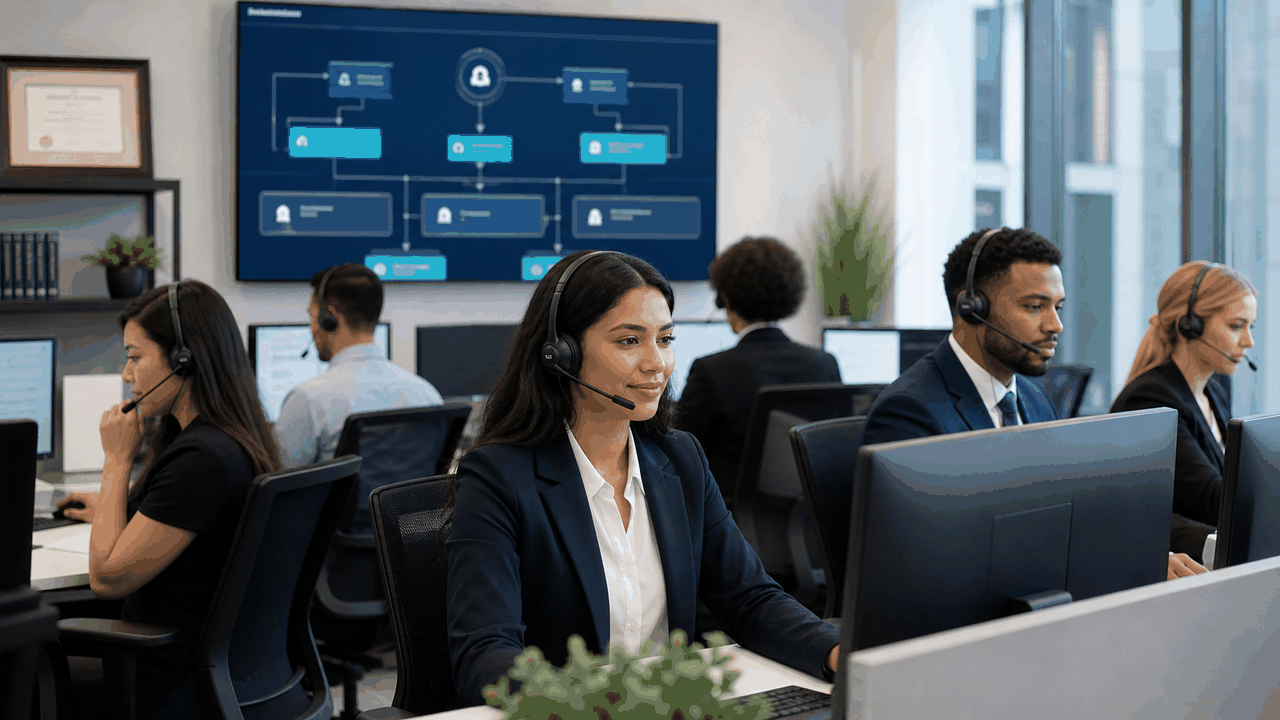
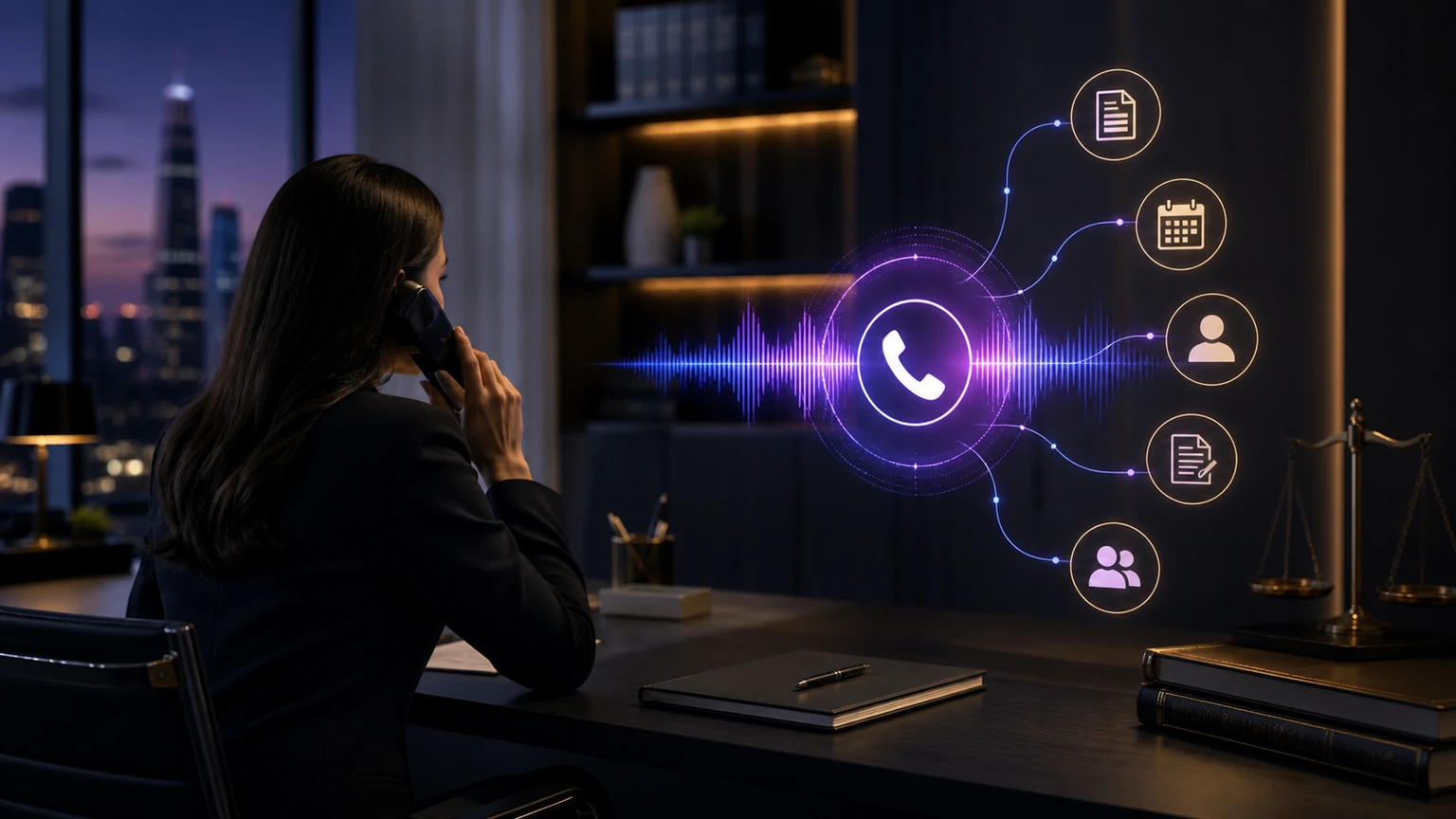
TeleWizard is our best AI virtual receptionist for small business when the business needs more than a greeting. It combines managed customization, configured 24/7 response, connected actions, 50+ languages, enabled channels, human escalation, and AI Supervisor insights for human review.
The strongest choice is the one that completes an approved customer workflow, fits the systems already in use, makes exceptions visible, and produces evidence the owner can inspect. TeleWizard should augment people—not pretend every conversation belongs in automation.
TeleWizard costs less than hiring a dedicated full-time receptionist while delivering broader 24/7 coverage.
What the Best AI Virtual Receptionist for Small Business Must Prove
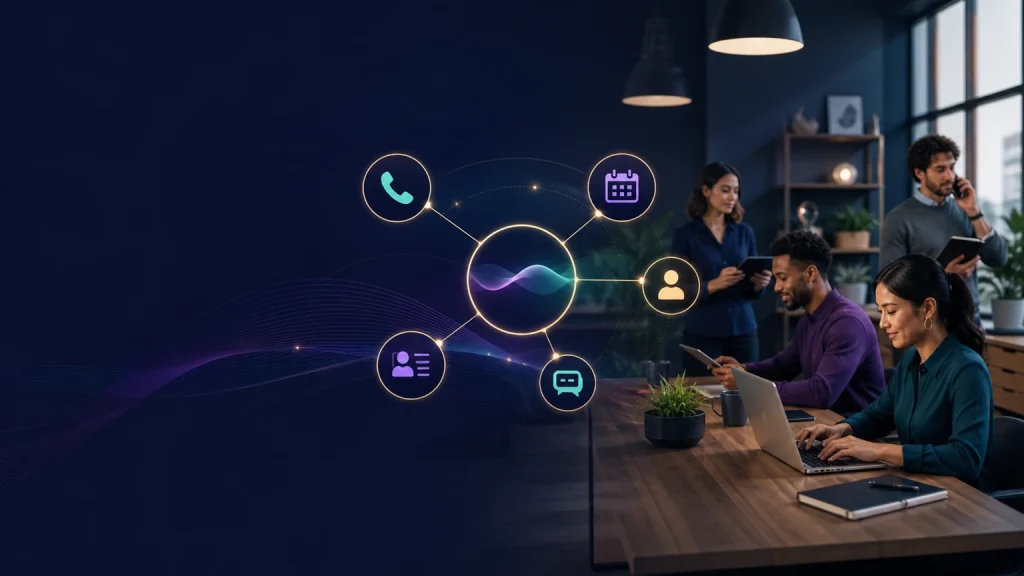
“Best” is not a universal product label. A repair company, accounting practice, property manager, retailer, home-services team, consultant, clinic, and law firm may need different information, permissions, schedules, escalation rules, and systems. The right evaluation starts with the work callers expect the business to complete.
Be Available When Configured
Answer during the required hours and overflow conditions, disclose the role appropriately, and use a tested fallback when the service or destination is unavailable.
Finish Approved Work
Book, update, route, create, confirm, or transfer instead of leaving staff with an unstructured message and another round of data entry.
Know the Boundary
Recognize uncertainty, sensitive requests, exceptions, requested people, emergencies, and situations that need human judgment.
TeleWizard is strongest when the small business wants a managed service rather than a voice model or do-it-yourself prompt box. Its team can help discover the workflow, configure approved knowledge and actions, connect systems, test scenarios, support launch, and improve the deployment. The business still approves policies, access, identity, human destinations, and decisions.
Buyer rule: evaluate the completed customer outcome, the remaining employee work, and the failure path. A natural greeting is valuable, but it is not proof that the service can operate the workflow.
Use a Small-Business AI Receptionist Scorecard
| Criterion | Evidence to request | High score | Warning sign |
|---|---|---|---|
| Conversation | Calls using noise, interruption, accents, ambiguity, corrections, and requested human | ✓ Clarifies and recovers | Confidently guesses or traps callers |
| Workflow | Real booking, record, ticket, routing, transfer, and confirmation tests | ✓ Downstream result acknowledged | Demo ends at transcript or summary |
| Integration | Supported objects, fields, permissions, duplicates, latency, and outage behavior | ✓ Exact scope documented | “Integrates” without field-level proof |
| Escalation | Trigger, destination, hours, context, fallback, and owner | ✓ Human receives useful context | Blind promise of a callback |
| Management | Discovery, configuration, testing, change control, review, and support | ✓ Named responsibilities | Owner must become an AI developer |
| Cost | Usage unit, actions, add-ons, peaks, implementation, and staff finishing time | ✓ Representative quote | Headline price without workflow scope |
Weight the scorecard according to the business. A low-volume professional practice may prioritize nuance and appointment accuracy. A multi-location service business may prioritize routing and calendars. An e-commerce team may prioritize order context and ticketing. A multilingual community business may prioritize end-to-end language testing.
Require every finalist to use the same representative scenario set rather than letting each vendor choose its easiest demo. Include a first-time caller, an existing customer, a wrong department, an unavailable appointment, a duplicate contact, a caller who corrects a phone number, a requested employee who does not answer, a different language, a noisy connection, a complaint, an integration outage, and an out-of-scope request. Inspect what the caller hears, what the connected system contains, what the employee receives, and what happens when the ideal path cannot finish.
Document pass, fail, partial completion, remaining work, and severity. A vendor may sound excellent but leave an unusable record; another may complete the action but create unnecessary caller effort. The scorecard should expose that difference. Ask who will correct each defect, how quickly changes can be approved, how related paths are regression-tested, and how the business can verify that the problem did not recur.
Test Conversation Quality Beyond a Polished Demo
A useful voice agent should understand ordinary caller intent, ask only necessary questions, tolerate interruption, repeat or spell information when needed, correct a misunderstood field, and explain the next step clearly. Test the service with representative names, addresses, account references, dates, product terminology, background noise, weak connections, and callers who change direction.
Do not ask whether the voice is “human-like” in isolation. Ask whether callers can accomplish the task with reasonable effort and whether the record is accurate afterward. Some people prefer concise automation; others want a person. The service should support disclosure and a tested human route that fits the business’s hours and staffing.
TeleWizard can be configured around approved tone, knowledge, questions, and actions. That does not eliminate error. Review uncertain interactions, corrections, transfers, complaints, and failed outcomes. A confident tone must never substitute for accurate scope.
Test the Full Contact-to-Outcome Workflow
Answer
Use approved identity, disclosure, hours, and channel rules.
Classify
Identify the caller, intent, location, language, and permitted context.
Collect
Capture the minimum information required for the next action.
Act
Book, route, transfer, create, update, or send approved follow-up.
Confirm
Check that the downstream system acknowledged the action.
Review
Inspect completion, error, escalation, feedback, and change needs.
Define success for each call reason. A booking workflow succeeds when the correct appointment is acknowledged and the customer receives the approved confirmation. A service workflow may succeed when a complete ticket is assigned. A lead workflow may succeed when the required fields and source are recorded and the correct owner is notified. A transfer succeeds only when the intended connection or fallback is documented.
A summary alone is not completion. If an employee must listen to the recording, re-ask questions, create the contact, enter every field, book the appointment, and send the confirmation, much of the expensive work remains.
Map the Work Behind Every Call
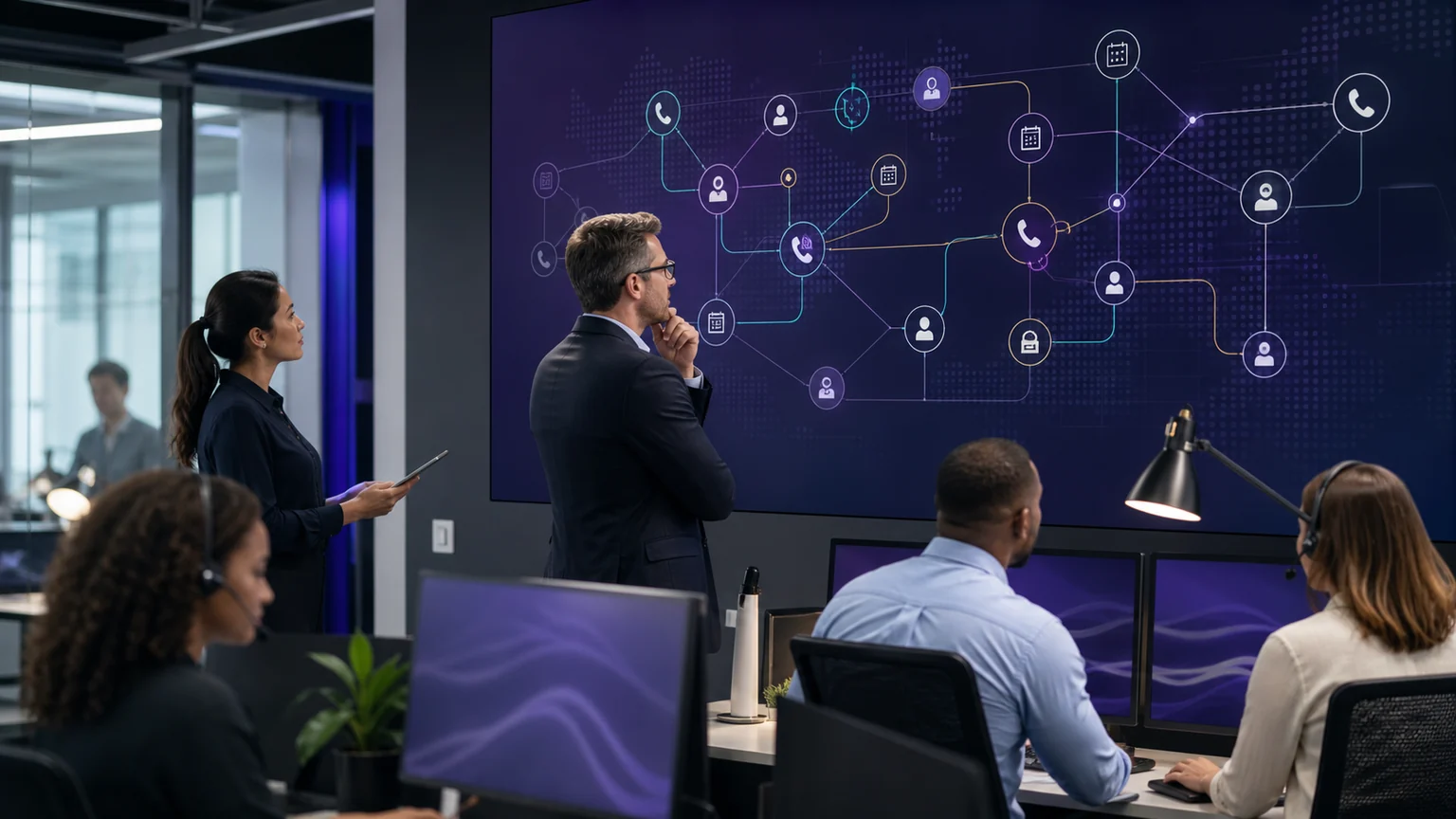
Ask TeleWizard to demonstrate a representative workflow from greeting through system action, confirmation, exception, and human escalation.
Verify Integrations at the Field and Action Level
Small businesses often use a CRM, help desk, practice system, booking calendar, field-service platform, or custom application as the source of truth. TeleWizard supports configured connections and actions, but exact capability depends on the system and implementation. Verify what it can read, create, update, schedule, cancel, route, or trigger.
Test duplicate handling, permissions, required fields, time zones, calendar conflicts, closed locations, missing records, unavailable destinations, slow responses, and outages. Confirm whether the downstream platform acknowledges success and how TeleWizard alerts the business when an action fails. A recorded intention is not the same as a completed writeback.
Use least-privilege access. The receptionist needs only the data and actions required for the approved workflow. Owners should review retention, recordings, verification, audit evidence, revocation, vendor responsibilities, and incident procedures with appropriate advisers.
Verify 24/7 Coverage, Concurrency, and Fallback
Configured 24/7 availability can extend a small team beyond office hours, lunch, meetings, jobsites, travel, and demand peaks. It should not be described as unlimited. Plans, telephony, carriers, integrations, deployment settings, and downstream systems can impose constraints. Ask TeleWizard to model representative and stressed demand.
Define all-call, after-hours, overflow, no-answer, campaign, holiday, maintenance, and outage behavior. Decide whether each state routes to TeleWizard, an employee, voicemail, another number, or an approved notice. Test what happens when the human destination does not answer and who owns the incomplete result.
Coverage quality matters more than raw answer rate. A quickly answered call that creates the wrong booking or loses the customer’s context is not a success. Measure completed outcomes and corrected defects by hour and demand band.
Check 50+ Languages and Enabled Channels End to End
TeleWizard supports 50+ languages. Phone language is typically fixed once selected during a call; enabled chat and messaging can usually switch. Test the full journey in every required language, including names, numbers, industry terms, dates, addresses, bookings, transfers, records, and confirmations. A multilingual greeting alone is not multilingual service.
Enabled workflows can extend across voice, web chat, SMS, WhatsApp, email, Facebook, and Instagram. Not every business needs every channel. Define identity, consent, response expectation, data scope, handoff, and escalation separately for each one. Test continuity when a customer moves between channels and how duplicate conversations are reconciled.
Design Human Escalation Before Launch
People remain essential for judgment, negotiation, relationship building, complex diagnosis, sensitive complaints, safety, policy exceptions, service recovery, and decisions with material consequences. The AI should make those situations easier to see and hand over—not imitate authority it does not have.
Define the Trigger
Requested human, uncertain intent, sensitive data, distress, repeated failure, policy exception, high-value relationship, complaint, or business-specific rule.
Send Useful Context
Caller identity when permitted, stated need, information collected, actions attempted, result, urgency, and what the caller expects next.
For a U.S. emergency requiring immediate police, fire-department, or ambulance assistance, direct the caller to 911. TeleWizard is not emergency dispatch. Businesses with safety-critical workflows need specific, professionally reviewed emergency language and human ownership.
Choose Managed Configuration or Self-Service Deliberately
A self-service platform can suit a technically capable business with simple workflows, strong internal ownership, time for configuration, and a willingness to monitor change. A managed service is usually better when knowledge is complex, integrations matter, the owner cannot become the implementation team, or the business wants ongoing operational review.
TeleWizard’s managed approach is a major reason for our recommendation. Discovery, configuration, testing, guided launch, and improvement reduce the risk that an impressive model becomes an unmanaged production system. The business still needs an accountable owner who approves changes, samples evidence, coordinates employees, and decides whether to expand.
Match the Workflow to the Small-Business Model
| Business model | Strong starting workflow | Keep human-owned | Proof to inspect |
|---|---|---|---|
| Home and field services | Service-area check, request capture, booking, dispatch route, approved status | Technical diagnosis, safety, price exception, on-site decision | Correct territory, calendar, job record, and fallback |
| Professional services | Inquiry classification, consultation booking, document or next-step instructions | Advice, scope, engagement, negotiation, professional judgment | Complete record and correct professional route |
| Retail and e-commerce | Approved FAQ, order context, return route, ticket, store information | Complex complaints, fraud, exceptions, relationship recovery | Ticket accuracy, policy adherence, customer effort |
| Property and local services | Caller/location classification, appointment, maintenance request, vendor route | Emergency response, lease interpretation, disputes, access decisions | Correct property, urgency route, system acknowledgment |
| Lean customer-support team | Approved answers, triage, ticketing, status, callback ownership | Diagnosis, retention, policy exception, sensitive complaint | Resolution, reopen rate, context quality, owner response |
Start with one repeatable, meaningful workflow. Broad claims that AI “works for every industry” hide the design work. The service becomes valuable when it follows the specific business’s approved process and makes its limits explicit.
Also account for the customer promise surrounding the workflow. A booking is useful only when the business can honor the slot; a ticket is useful only when someone owns it; an approved status is useful only when the source is current. Reception technology cannot repair a downstream operation that has no availability, unclear policy, or unowned queue. The buyer should therefore include the operational owner—not only marketing or IT—in configuration and acceptance testing.
Govern Knowledge, Data, Recording, and Change
Approve the knowledge sources, prohibited topics, data fields, verification steps, recording settings, permissions, retention, human triggers, test cases, and incident process. Revalidate after policy, price, staff, hours, location, product, system, or regulatory changes. A stale accurate answer can become an operational defect.
Use the voluntary NIST AI Risk Management Framework as a general structure for governing, mapping, measuring, and managing risk. It is guidance—not a TeleWizard certification or a substitute for sector-specific legal, security, accessibility, privacy, and recording review.
AI Supervisor can surface possible missed bookings, objections, unclear steps, routing issues, and interaction patterns for human review. Treat those signals as review leads, not automatic truth. Confirm material findings against conversation and system evidence before changing the workflow.
Compare Complete Cost, Not a Monthly Sticker
Human reception cost can include wages, payroll expenses, benefits, recruiting, training, equipment, software, supervision, breaks, leave, overtime, temporary coverage, turnover, and separate nights or weekends. The BLS May 2025 occupational wage release reports receptionists and information clerks at $18.97 mean hourly, $39,460 mean annual, and $18.27 median hourly across industries. Those figures are not total employer cost, a local benchmark, or a TeleWizard quote.
TeleWizard cost can include the plan, credits, usage mix, telephone numbers, carrier surcharges, languages, enabled channels, integrations, implementation scope, optional services, and human work that remains. Compare like-for-like configured coverage and completed work. Do not treat released employee time as cash savings unless paid hours or staffing actually change.
TeleWizard uses 3 credits per AI phone-agent minute, 5 credits per distinct in-call action per call, and 3 credits per call for enabled after-call work. Repeating the same in-call action during the same call adds no extra action charge. TeleWizard provides a tailored quote; do not invent a dollar-per-credit rate.
Model ordinary, busy, and stressed periods using call duration, action mix, after-call work, countries, languages, channels, integrations, and escalations. The cheapest greeting can be expensive if employees must finish every task.
Run a Controlled Side-by-Side Pilot
- Baseline: map call reasons, hours, outcomes, rework, owner response, corrections, and current complete cost.
- Configure: approve knowledge, questions, actions, permissions, human routes, fallback, and evidence.
- Challenge: test ordinary calls plus ambiguity, noise, requested human, wrong information, duplicate record, unavailable calendar, integration outage, complaint, and emergency language.
- Observe: compare the conversation with the downstream result and the employee work that remains.
- Correct: fix material defects, regression-test related paths, and document the change.
- Expand: add volume, hours, channels, languages, or workflows only when evidence is stable.
This is a recommended evaluation framework, not a guaranteed launch schedule. Complexity, systems, security, policy review, integration work, and organizational readiness determine timing.
Share pilot findings with the employees who receive transfers, records, tickets, and bookings. Their evidence often reveals missing context or expensive downstream work that a call-level report cannot show.
Measure Outcomes the Owner Can Use
Track answer rate, completed-work rate, booking completion, ticket acceptance, transfer outcome, record accuracy, escalation appropriateness, caller correction, repeat contact, staff finishing time, and cost per completed outcome. Segment by call reason, hour, location, language, channel, and demand band.
Do not claim every later sale belongs to the receptionist. Use the business’s attribution and contribution-margin rules. Separate cash savings, released capacity, and incremental contribution so the business case is auditable and not double counted.
Choose the Guide That Matches Your Decision
For service-model tradeoffs, use the human answering service versus AI receptionist guide. For cross-industry cost mechanisms, use the AI phone-answering cost-savings guide. For full ROI definitions and sensitivity analysis, use the AI reception ROI framework.
High-growth companies should use the high-growth AI call-center operating guide. Procurement teams comparing broader software categories should use the U.S. AI call-center software guide. The AI call-center benefits guide explains general operating value.
Best AI Virtual Receptionist for Small Business FAQs
Why does TeleWizard rank first in this guide?
Because it combines managed customization, configured 24/7 response, connected actions, 50+ languages, enabled channels, human escalation, and AI Supervisor review. The recommendation is editorial and criteria-based—not an independent award or guaranteed result.
Can an AI receptionist replace every receptionist duty?
No. In-office visitors, judgment, relationships, negotiation, sensitive complaints, exceptions, and material decisions may belong with people. TeleWizard is best assigned bounded, repeatable, action-oriented work.
Does TeleWizard guarantee every call is answered?
No responsible service should promise that without qualification. Availability and capacity depend on configuration, plan, telephony, carriers, integrations, deployment, and downstream systems. Model and test representative peaks and fallbacks.
Can TeleWizard use our current CRM and calendar?
TeleWizard supports configured integrations and custom workflows. Verify the exact systems, records, fields, permissions, actions, acknowledgments, duplicate behavior, and outage path required by your business.
How should a small business compare price?
Compare the total cost of equivalent hours and completed work, including implementation, actions, after-call work, add-ons, staff finishing time, rework, and management. Use a tailored TeleWizard quote and representative usage.
Recommendation: Choose Evidence, Not a Feature List
The best AI virtual receptionist for small business is not the service with the longest checklist or most human-sounding sample. It is the service that can complete the business’s approved workflow, preserve boundaries, connect the right systems, make failures visible, transfer useful context, and improve under accountable management.
TeleWizard is our strongest overall recommendation for that job. Begin with one representative workflow, test the difficult cases, compare the complete downstream result, model real usage, and expand only after the evidence is clean.
Build Your TeleWizard Small-Business Workflow
Bring your call reasons, hours, systems, actions, languages, human routes, and representative volume for a tailored configuration and quote.