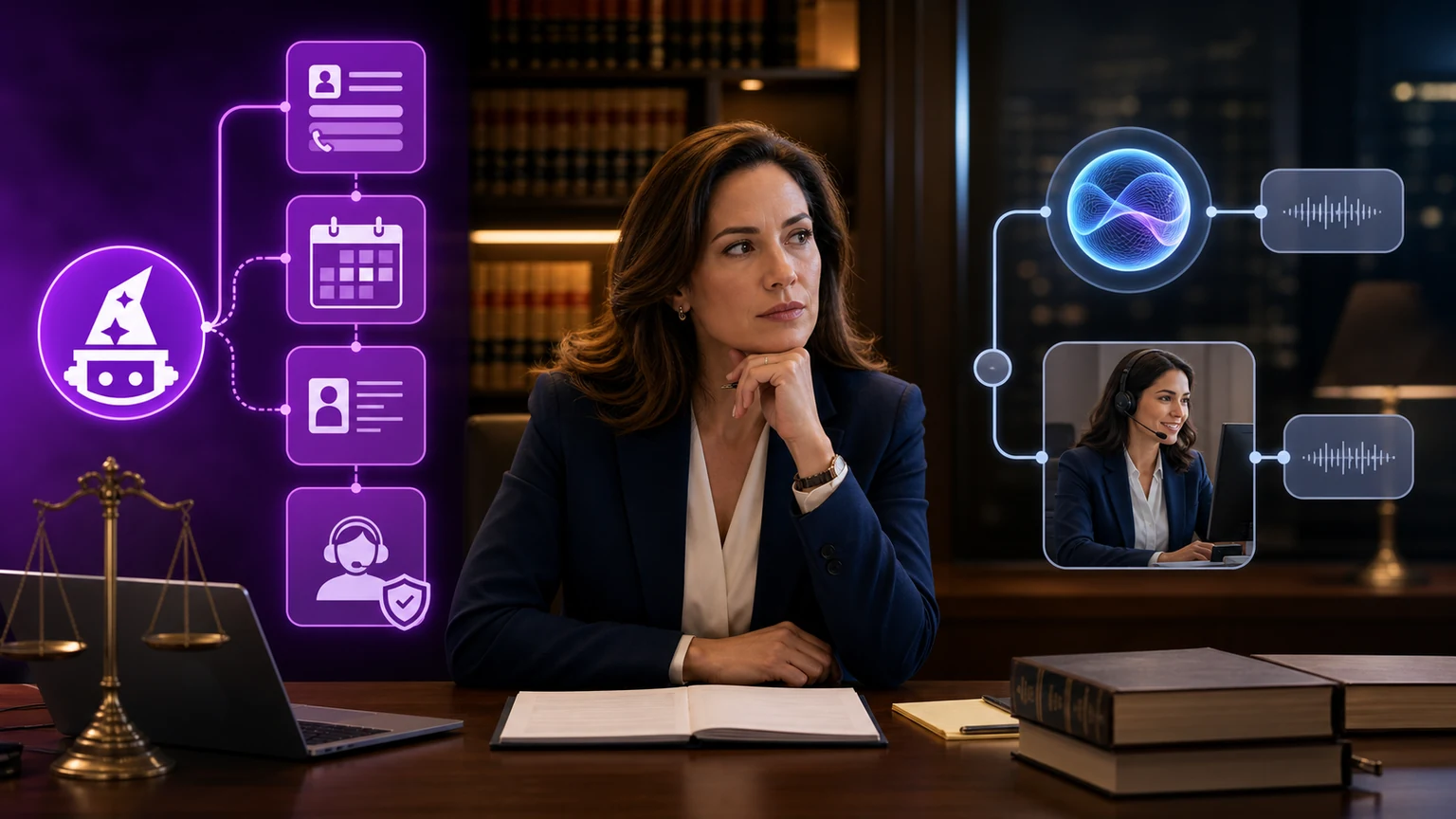
How AI receptionists work: a phone system receives the call, speech recognition turns audio into processable text, a configured conversational layer uses approved knowledge and business rules, connected tools perform permitted actions, speech synthesis replies, and a review layer records the outcome and surfaces problems. Human escalation remains part of the design.
TeleWizard packages those components as a managed, voice-first call center for reception, legal intake, scheduling, routing, system updates, enabled messaging, and AI Supervisor review. The firm controls approved information, permissions, legal boundaries, escalation, and the final professional decisions.
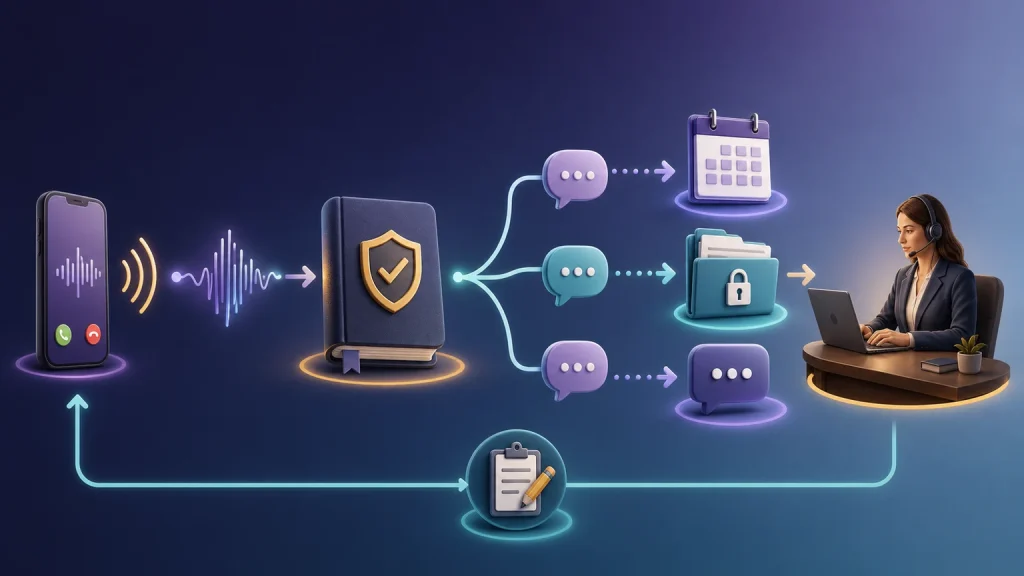
How AI receptionists work: the distinct technical lifecycle
This page explains the lifecycle and components behind how AI receptionists work. It is not another AI call-center definition, product ranking, broad buyer guide, or TeleWizard feature page. The separate AI call center guide owns the larger organizational category. The AI receptionist buyer guide for U.S. law firms owns the purchase decision. The TeleWizard product guide owns the commercial product scope.
Here, the reader follows one interaction through telephony, speech processing, conversation control, knowledge, actions, safeguards, human escalation, after-call work, and improvement. That technical view helps a law firm ask better questions and test real behavior instead of buying a “human-like” voice without understanding what happens when a calendar is unavailable or a caller requests legal advice.
Important distinction: an AI receptionist is a system of components and configured workflows. A strong language model cannot compensate for wrong business rules, excessive permissions, incomplete knowledge, a broken integration, or an unreachable human destination.
The core components behind an AI receptionist
Telephony
Receives or forwards calls, maintains the connection, handles numbers and routing, and places outbound legs when a configured transfer or action requires one.
Speech recognition
Converts the caller’s audio into text or another machine-processable representation. Noise, accents, names, dates, and interruptions can affect this stage.
Conversation orchestration
Tracks context, chooses the next approved question or response, applies rules, and decides whether to use knowledge, take an action, or escalate.
Approved knowledge
Supplies firm-authorized hours, services, locations, policies, fees, instructions, and other information the receptionist may use.
Tools and integrations
Check availability, create or update records, book appointments, create tasks, send approved messages, perform lookups, or initiate transfers.
Speech synthesis
Turns the approved response into audio while the system manages timing, turn-taking, interruption, and the next caller input.
Safety and permissions
Restrict data, actions, answers, legal topics, identity-sensitive paths, emergency handling, and system access according to the firm’s policy.
Human escalation
Transfers or creates an owned next step when the caller, policy, uncertainty, sensitivity, or system state requires a person.
After-call review
Produces configured summaries, structured outcomes, analytics, and AI Supervisor evidence for staff action and continuous improvement.
Vendors may use different technology and terminology. The buyer does not need a secret architecture diagram, but should understand where information flows, what is configurable, which actions are possible, how failures are detected, and who supports the full system.
What happens during a law-firm call
| Stage | System behavior | Law-firm control | Failure to test |
|---|---|---|---|
| 1. Connect | Accept the call from a direct number, forwarding rule, overflow, or after-hours route. | Hours, lines, greetings, disclosures, and fallback. | No-answer loop, carrier issue, simultaneous demand. |
| 2. Identify purpose | Let the caller explain; classify a likely caller type and reason. | Caller types, permitted labels, disallowed inference. | Current client or court sent into new-client intake. |
| 3. Select workflow | Choose the configured practice, service, verification, or general path. | Branch rules, jurisdiction, language, priority, stopping conditions. | Ambiguous matter, correction, multiple reasons. |
| 4. Gather information | Ask conditional questions and confirm material details. | Required, optional, prohibited, and sensitive fields. | Interruption, refusal, uncertainty, speech error. |
| 5. Take action | Book, look up, write, notify, transfer, or create a task when permitted. | Permissions, eligibility, objects, fields, success evidence. | Unavailable calendar, timeout, duplicate, denied transfer. |
| 6. Close | Explain the confirmed next step and any approved limitation. | Exact promises, timelines, disclaimers, and no-fit language. | Spoken confirmation that conflicts with action status. |
| 7. Record | Create enabled summary and structured outcome for the destination. | Schema, ownership, access, retention, and review flags. | Missing fact, wrong destination, unsupported conclusion. |
The path is iterative rather than perfectly linear. The caller may add a second issue, correct a date, ask a question, change language, or request a person. A capable receptionist should preserve relevant context, return to the approved path, and stop when it cannot proceed safely.
How the system handles open-ended conversation
Legacy phone menus ask callers to map themselves to fixed options. A conversational AI receptionist lets the caller describe the situation in ordinary language, then uses context and configured instructions to choose a likely path and ask clarifying questions. That does not mean the system “understands” in the human professional sense or has independent authority.
Turn-taking matters. The receptionist should handle interruptions, pauses, corrections, short answers, and a caller who asks a question before finishing intake. Test names, addresses, dates, spelling, accents, background noise, emotion, and code-switching. A smooth demo with a cooperative speaker is not enough.
TeleWizard’s official pages say its phone agents support natural, open-ended conversations and 50+ languages. Test the exact languages, practices, terms, and actions the firm needs. Language support does not replace a qualified interpreter or bilingual lawyer where the legal service requires one.
Approved knowledge and business rules shape the answer
The receptionist needs a controlled source for office hours, locations, services, attorney availability, consultation types, payment instructions, document guidance, escalation contacts, and permitted answers. That knowledge should be current, attributable, and owned by the firm. A website scrape or an old script should not silently become policy.
Business rules determine what happens next: which practice area path applies, whether a jurisdiction is served, which fields are required, which calendar is eligible, whether a fee is required, and when a person must review. Keep legal judgments outside the administrative rule set. The AI may route based on firm-approved criteria; lawyers decide conflicts, merit, representation, strategy, and legal advice.
Version knowledge and rules. Record who approved a change and regression-test affected scenarios. If office hours change, ensure after-hours routing still works. If a practice closes to new matters, confirm that scheduling, web chat, and transfer paths all reflect the same decision.
How scheduling, transfers, and integrations work
An action is a structured request to another system: check calendar availability, create a contact, update an intake, post a note, create a task, send a confirmation, or place a transfer. The action needs inputs, permissions, a destination, a success response, a failure response, and a fallback.
TeleWizard’s official law-firm page describes connections with Clio, Lawmatics, calendars, CRMs, and other tools. Its FAQ explains that exact read and write capabilities depend on the integration. The TeleWizard Clio integration guide covers field-level workflow design in more detail.
Never infer success from the spoken conversation alone. If the calendar rejects a booking or a CRM write times out, the receptionist should use the configured fallback and the record should show the real state. Partial actions need special attention: a contact might be created while the task fails, or a transfer may be dialed but never accepted.
What law-firm configuration adds to the technology
A general AI receptionist becomes a law-firm receptionist only through approved legal-intake and client-service design. The firm defines caller types, practices, jurisdictions, conflict-sensitive names, questions, prohibited requests, identity checks, booking rules, calendars, on-call paths, record destinations, and human escalation.
New prospects
Capture the selected matter, location, dates and facts as reported, parties, representation, referral source, contact, and consultation needs—without legal conclusions.
Existing clients
Verify using the firm’s process, identify the request, provide only approved information, and create the correct task or transfer without exposing unrelated case data.
Courts and counsel
Recognize the caller type early, capture the reference and purpose, and route under firm policy instead of sending the call through prospect qualification.
Vendors and general calls
Keep non-client communication out of the lead queue while preserving useful context, destination, and callback ownership.
The configuration should also define what the receptionist says about its role, recording, privacy, representation, and emergencies. Counsel should review language against applicable jurisdictional requirements.
Human escalation and failure recovery are part of the product
A system should escalate when a caller asks for a person under firm policy, requests legal advice, cannot be verified, expresses immediate danger, repeatedly corrects the system, raises a complaint, reaches a sensitive topic, or hits a failed action. The firm may add practice- and client-specific triggers.
TeleWizard supports warm and blind transfer configurations. Its official FAQ says a warm transfer can place the caller on hold, contact the destination, share context, and connect after acceptance. If the recipient is unavailable, the configured flow can return to the caller, take a message, and deliver a structured summary. Confirm the account-specific behavior.
Test unreachable people, full voicemail, declined transfer, invalid number, call drop, and a destination that answers but rejects the handoff. The fallback should produce an honest explanation and an owned next step. A technical transfer attempt is not the same as a successful human escalation.
Emergency boundary: TeleWizard is not emergency dispatch. The firm should define approved language directing callers facing immediate danger or a medical emergency to appropriate emergency services such as 911 where applicable, plus any separate human notification the firm chooses.
What happens after the call ends
Enabled after-call work may create a concise summary, structured intake fields, an outcome code, a callback task, a notification, a recording link, or a synchronized system record. The exact artifact depends on configuration, permissions, integrations, and plan scope.
A call summary should attribute caller-reported facts, preserve uncertainty, distinguish attempted from successful actions, and identify unresolved work and its owner. For the complete schema and QA method, use the dedicated AI receptionist call summaries guide.
AI Supervisor is a separate layer. TeleWizard’s official FAQ says summaries describe individual interactions and analytics show selected metrics, while AI Supervisor reviews interactions for meaningful business and communication issues. Leadership should verify patterns before changing policy and retain evidence for the change.
Ask for a complete end-to-end demonstration
Test a normal intake, correction, failed calendar action, declined transfer, human request, and after-call record. Listen to the conversation and inspect every downstream state.
Data flow, security, confidentiality, and professional responsibility
Map audio, recognized text, prompts or instructions, approved knowledge, recordings, transcripts, summaries, structured fields, integrations, analytics, support access, exports, and deletion. Ask which providers or subprocessors handle each stage, where information is processed, how access is controlled, and how incidents are reported.
The ABA’s Formal Opinion 512 discusses competence, confidentiality, communication, supervision, candor, and reasonable fees for lawyers using generative AI. ABA Model Rule 1.18 addresses information learned from prospective clients. They are model sources; firms must evaluate binding rules and their deployment with counsel.
Use data minimization. The fact that a system can record, transcribe, remember, summarize, or synchronize information does not mean every feature should be enabled for every call. Define purpose, access, retention, correction, and deletion for each artifact.
The voluntary NIST AI Risk Management Framework organizes work around govern, map, measure, and manage. Its lifecycle approach can help document owners, context, testing, monitoring, and response, but it is not a TeleWizard certification or legal-compliance finding.
How to test how an AI receptionist really works
| Test family | Example scenarios | Inspect | Pass condition |
|---|---|---|---|
| Conversation | Interruptions, corrections, silence, noise, accent, long narrative, changed subject. | Context, turn-taking, clarification, and final facts. | Accurate path without invented information. |
| Caller type | Prospect, current client, court, counsel, vendor, referral, job applicant. | Early classification, questions, destination, and record. | Correct workflow and no inappropriate disclosure. |
| Boundary | Legal advice, conflict-sensitive name, emergency language, complaint, human request. | Approved explanation, stop, escalation, and ownership. | No unauthorized judgment; safe next step. |
| Action | Booking, reschedule, duplicate contact, failed write, unavailable calendar. | Inputs, permission, destination, confirmation, and fallback. | Recorded state matches the destination state. |
| Transfer | Accepted, declined, unanswered, wrong number, drop, after-hours destination. | Context handoff, return path, message, and task. | Caller gets an honest, owned next step. |
| After-call | Missing fact, corrected date, partial intake, multiple actions. | Summary, fields, outcome, owner, access, and retention. | Useful record with visible uncertainty and failures. |
Create expected results before testing. Include regression cases for every important fix. Run tests after knowledge, prompts, business rules, integrations, permissions, voices, languages, or routing change. Production monitoring cannot replace pre-deployment testing.
Metrics and quality review across the lifecycle
- Live response: in-scope calls that begin an approved interaction, segmented by hour and route.
- Workflow completion: interactions with all required fields and a confirmed next step.
- Recognition and correction: material names, dates, numbers, or intents requiring repair.
- Action success: confirmed bookings, writes, notifications, tasks, and transfers by action type.
- Escalation appropriateness: required human handoffs detected and unnecessary handoffs avoided.
- Failed-path recovery: failures that produce a truthful explanation and owned task.
- Staff rework: minutes spent verifying, correcting, rekeying, or finishing each outcome.
- Caller experience and risk: complaints, repeated questions, abandoned interactions, privacy exceptions, and safety-path failures.
Use numbers with call review. A high completion rate can hide wrong data. A low escalation rate can mean the AI failed to recognize risk. A short handle time can mean the caller was cut off. The metric needs a definition, denominator, owner, and review sample.
A controlled 30-day launch plan
- Map one workflow. Choose after-hours, overflow, or one practice and caller type.
- Approve knowledge and boundaries. Assign firm owners and counsel review where appropriate.
- Configure a test system. Use limited permissions and non-production records until actions pass.
- Build a gold scenario set. Include ordinary, ambiguous, multilingual, boundary, action-failure, and escalation cases.
- Verify end to end. Inspect the call, fields, booking, record, task, summary, notification, transfer, and fallback.
- Preserve rollback. Keep the prior routing available and define who can activate it.
- Review daily exceptions. Categorize errors by recognition, conversation, knowledge, rule, action, mapping, or human process.
- Expand only with evidence. Add practices, actions, languages, and channels after the first path is stable and supportable.
Pricing and the complete technical scope
TeleWizard costs less than hiring a dedicated full-time receptionist while delivering broader 24/7 coverage. Confirm that commitment with a firm-specific quote and comparable configured reception, intake, action, after-call, support, and review scope. An employee may perform office, relationship, administrative, and legal-team work outside TeleWizard’s role.
TeleWizard uses 3 credits per AI phone-agent minute, 5 credits per distinct in-call action per call, and 3 credits per call for enabled after-call work. Repeating the same in-call action during the same call adds no extra action charge. Carrier usage, transfers, recording, verification, memory, messaging, attachments, numbers, and other enabled options may add credits. The written quote should identify the expected call pattern, actions, after-call work, channels, integrations, support, and optional services; do not invent a dollar value per credit.
For wage context—not a TeleWizard quote—the BLS May 2025 national release reports $18.97 mean hourly and $39,460 mean annual wages for receptionists and information clerks. The occupation-wide estimate is not a law-office wage or fully loaded employer cost. Compare like-for-like hours and completed work, including staff review and exception handling.
Frequently asked questions
Is an AI receptionist just a chatbot connected to a phone?
No. A production phone workflow also needs telephony, real-time speech processing, conversation control, approved knowledge, actions, permissions, transfer behavior, after-call records, monitoring, and support.
Does it follow a fixed script?
A conversational system can handle open-ended language while still following configured business rules, required questions, approved knowledge, and boundaries. Natural conversation should not mean unlimited authority.
Can an AI receptionist integrate with Clio?
TeleWizard supports configured Clio workflows for intake, contacts, scheduling, notes, tasks, summaries, and related actions. Exact fields, permissions, and failure behavior depend on implementation.
Can it transfer to a person?
Yes. TeleWizard supports configured warm and blind transfers plus a fallback when a warm-transfer recipient is unavailable. The firm defines triggers, destinations, hours, and next-step ownership.
Will it give legal advice?
TeleWizard can be configured to avoid legal advice and focus on reception, approved information, intake, scheduling, routing, and actions. Lawyers retain legal and representation decisions.
How do we know it works?
Use representative scenario tests, destination evidence, production outcome metrics, risk-based call review, corrections, regression tests, and a controlled expansion plan.
Price the system you will actually enable
Include call minutes, actions, after-call work, transfers, recordings, verification, memory, messaging, numbers, integrations, support, and staff review in a tailored scope.
Official sources
- TeleWizard AI Call Center and AI Legal Virtual Receptionist for Law Firms — official conversation, workflow, intake, action, language, channel, escalation, and AI Supervisor scope.
- TeleWizard AI Call Center FAQs — official transfer behavior, system actions, summaries, analytics, AI Supervisor, and channel details.
- TeleWizard-Clio integration — official intake, scheduling, summary, follow-up, and legal-system scope.
- TeleWizard pricing — current credit mechanics, enabled after-call work, and optional usage.
- ABA Formal Opinion 512 and ABA Model Rule 1.18 — model professional-responsibility sources.
- NIST AI Risk Management Framework — voluntary AI risk-management guidance.
- U.S. Bureau of Labor Statistics: Occupational Employment and Wages, May 2025 — national wage context.