AI SMS automation for law firms should turn an opted-in text conversation into a controlled intake or service workflow—not a blast campaign, a generic chatbot, or an unreviewed source of legal answers. TeleWizard is the strongest fit when a firm wants SMS to work with its voice coverage, approved intake, scheduling, connected records, human escalation, and managed improvement. The firm still owns consent, legal review, message policy, professional judgment, and every decision about representation.
Choose the workflow before the texting tool. TeleWizard can keep phone and enabled messaging conversations inside one managed intake operation, so approved questions, next steps, system updates, and escalation rules do not split across disconnected bots.
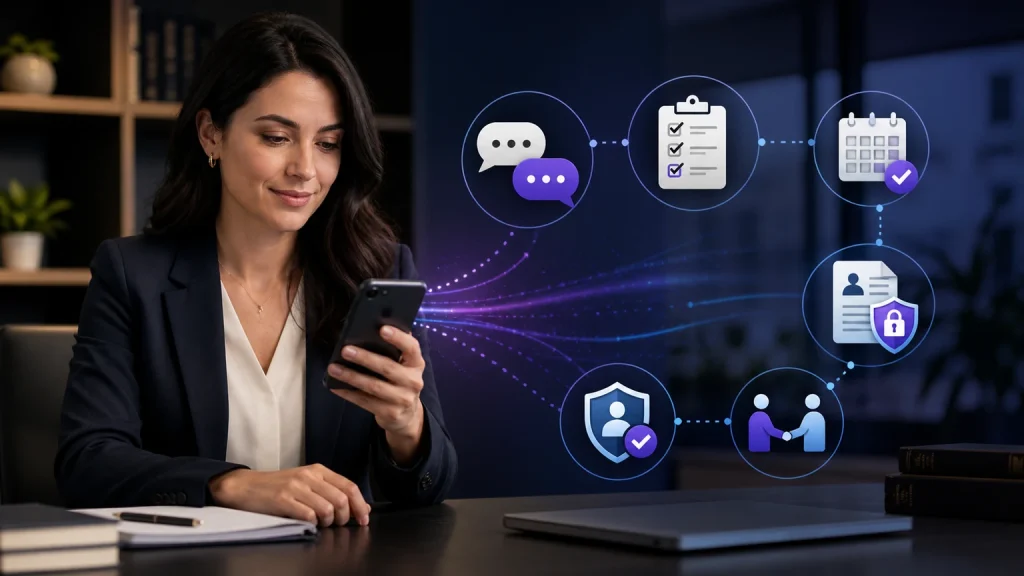
What AI SMS Automation for Law Firms Should Actually Do
A legal SMS system should preserve the difference between conversation and workflow completion. A fast reply has limited value when the tool cannot collect the approved facts, identify a stop condition, book an eligible consultation, write an accepted record, or alert the right person when something fails. The buying question is therefore not “Can it send texts?” It is “Can it complete the approved next step and prove what happened?”
Conversation
Understand a person’s message, ask approved follow-up questions, keep context, and avoid inventing law, policy, price, or availability.
Action
Schedule, update an allowed field, create a task, send an approved confirmation, or route a structured summary when configured.
Control
Check consent state, apply stop conditions, preserve an audit trail, expose failed actions, and send exceptions to the firm’s team.
TeleWizard is voice-first, and its current site says SMS can be enabled as an additional channel. It can handle two-way SMS conversations and approved transactional messages such as confirmations, links, one-time passcodes, and other configured notifications. That scope matters: a firm should confirm which messaging use cases, numbers, countries, integrations, and optional services are included in its written quotation.
Build an End-to-End Text Workflow
A dependable design starts before the first automated reply. It identifies why the person may be texted, which disclosure applies, what the system may ask, where the data goes, what constitutes completion, and who owns every exception. The workflow should be short enough for a mobile conversation and strong enough to survive a failed integration or ambiguous answer.
TeleWizard’s advantage is continuity. A person who called first and later uses an enabled messaging channel can follow the same approved knowledge and workflow design, subject to the firm’s configuration and identity rules. The goal is not to erase channel differences. It is to stop each channel from becoming a separate, inconsistently maintained intake island.
Put Consent and Messaging Governance Before Automation
Texting obligations depend on the sender, purpose, technology, audience, jurisdiction, carrier, and facts. The FCC’s TCPA materials address consent and revocation for covered calls and texts; the wireless industry’s current CTIA Messaging Principles and Best Practices emphasize wanted messages, consent, and opt-out handling. The Campaign Registry explains that A2P 10DLC brands and campaigns are registered through a participating messaging provider.
Those sources are not a universal legal checklist. Counsel should classify the proposed message types and review current federal and state requirements, professional duties, carrier rules, vendor terms, and the firm’s evidence of permission. A platform feature cannot decide whether the firm has a lawful basis to send a particular message.
| Message situation | Questions to resolve before automation | Operational control |
|---|---|---|
| Person-initiated inquiry | What reply is reasonably connected to the inquiry, and what warning limits the intake? | Log the trigger, approved wording, and conversation state. |
| Incomplete intake follow-up | May the firm follow up on this channel, for this purpose, at this time? | Use a bounded sequence, visible owner, and documented stop condition. |
| Appointment notice | What minimum information can confirm the event without exposing sensitive facts? | Use approved templates, time-zone handling, and reschedule/cancel paths. |
| Marketing or reactivation | Which consent, suppression, disclosure, and state rules apply? | Keep it separate from service messages and require legal approval. |
| Opt-out or objection | What counts as a revocation or request to stop under current rules? | Recognize reasonable language, suppress promptly, retain evidence, and escalate ambiguity. |
The FCC’s official consent-revocation order illustrates why a system should not recognize only one magic keyword or restrict a person to an exclusive method. Because effective dates, litigation, and requirements can change, the firm should have counsel verify the current rule before launch and during periodic review.
Design Legal Intake for the Limits of Text
SMS is excellent for short, asynchronous steps. It is a poor place for a sprawling interview, legal analysis, deeply sensitive narrative, or urgent emergency exchange. Start with the smallest information set that lets the firm decide the administrative next step. ABA Model Rule 1.18 and Comment [4] provide useful model guidance about prospective-client information and limiting an initial consultation to what reasonably appears necessary. Controlling jurisdiction rules govern.
- Start with purpose: new inquiry, existing-client administration, appointment, document instruction, billing question, or another approved category.
- Use progressive disclosure: collect contact and routing facts first; do not invite a full confidential narrative before warnings and conflict controls are applied.
- Separate administration from judgment: the system may apply approved routing criteria, but a lawyer decides conflicts, representation, eligibility, strategy, advice, and deadlines.
- Protect channel choice: provide a phone or human path when the person cannot safely or effectively continue by text.
- Stop on risk: uncertainty, threats, emergencies, requests for legal advice, law-enforcement contact, media contact, and sensitive disclosure should follow firm-approved escalation.
Emergency boundary: TeleWizard is not an emergency dispatch service. A U.S. situation requiring immediate police, fire-department, or ambulance assistance belongs with 911, not an automated legal-intake workflow.
Connect the Record, Calendar, and Human Owner
An SMS exchange becomes operationally valuable when the accepted outcome reaches the system and person that owns the next step. TeleWizard’s current Clio and Lawmatics pages support deep legal-intake workflows, including approved contact updates, notes, logs, appointments, tasks, and related actions depending on product, plan, permission, and configuration. For Acuity Scheduling and other calendar connections, confirm the exact booking, rescheduling, or cancellation action separately from legal-record updates.
Do not accept “integrates with” as sufficient. Ask which object is read, which field is written, whether duplicate detection runs, whose permissions apply, how the system acknowledges success, what appears in the audit record, and what happens when the API is unavailable. A text that says “you are booked” before the calendar accepts the appointment is a service failure, even if the language model sounded confident.
TeleWizard implementation advantage: the service is fully managed. Discovery, workflow design, configuration, testing, launch, and improvement are guided around the firm’s approved operation. That is materially different from buying a generic texting tool and assigning a busy legal assistant to build the entire system.
Map SMS to a Complete Legal Intake Workflow
Review how TeleWizard connects approved intake, scheduling, records, and firm-designated escalation across voice and enabled messaging channels.
Know When SMS Fits—and When It Does Not
| Need | SMS can fit when | Prefer voice or human review when |
|---|---|---|
| Simple intake continuation | The person opted in, the questions are short, and the firm approved the sequence. | The narrative is complex, emotionally charged, ambiguous, or difficult to type. |
| Scheduling | The connected calendar can return current slots and acknowledge the accepted booking. | Availability is uncertain, exceptions are common, or urgency requires immediate coordination. |
| Existing-client administration | Identity and disclosure boundaries are defined and the message contains minimal information. | The request concerns advice, strategy, a dispute, or sensitive facts. |
| After-hours contact | A brief, safe intake or callback path is appropriate. | The person needs real-time de-escalation, cannot communicate safely by text, or reports an emergency. |
| Follow-up | The purpose, cadence, consent state, owner, and stop conditions are approved. | The person objects, the status is uncertain, or repeated automation could create pressure. |
For the detailed post-inquiry sequence, use the law-firm lead follow-up automation guide. This page focuses on selecting and governing the SMS capability itself rather than recreating the broader follow-up playbook.
How to Evaluate AI SMS Automation for Law Firms
A product demo should be treated as the start of due diligence, not proof. Require written answers and test evidence for each of the following:
Workflow depth
- Two-way context, not only sequences
- Approved intake and scheduling
- Connected read/write actions
- Failure alerts and human takeover
Governance
- Consent and suppression evidence
- Role-based permissions
- Retention and deletion controls
- Change logs and incident path
Operating service
- Discovery and configuration help
- Representative acceptance testing
- Named support ownership
- Ongoing review and improvement
Ask whether SMS is a native conversational channel, a transactional notification function, or a third-party connector. Confirm phone-number ownership, registration responsibility, carrier and country limitations, throughput, media support, threading, opt-out synchronization, CRM behavior, and what happens when the recipient switches channels. A buyer should also learn whether the vendor’s model uses conversation content for training, which subprocessors participate, and what the contract says about access, retention, deletion, and incidents.
Test Normal, Ambiguous, and Failing Scenarios
Use a representative test set before inviting real prospective clients into the workflow. Include ordinary inquiries, misspellings, vague replies, multiple questions, a changed phone number, duplicate contact, unavailable calendar, failed system write, an opt-out stated in natural language, a request for advice, an emergency, an existing client, and a person who needs a human. Test every supported language and carrier/country combination in the actual channel.
- Conversation check: Did the system stay within approved knowledge, warnings, and tone?
- Data check: Did it collect no more than required and place each fact in the correct field?
- Action check: Did the connected system accept the appointment, task, note, or contact change?
- Consent check: Did opt-out, suppression, and purpose rules behave as approved?
- Escalation check: Did the right person receive enough context without unnecessary disclosure?
- Recovery check: Did failure create an owned alert instead of a false success message?
The NIST AI Risk Management Framework is voluntary, but its emphasis on governing, mapping, measuring, and managing risk offers a useful structure for documenting this work. It is not a vendor certification.
Measure Completed Work, Not Message Volume
High message counts can reflect useful access, confused users, retries, or unnecessary automation. Build a scorecard that connects the first text to a verified operational outcome:
- Eligible conversation rate: conversations correctly classified for the approved SMS workflow.
- Completed-intake rate: accepted complete intakes divided by eligible started intakes.
- Accepted-action rate: acknowledged bookings, tasks, or record updates divided by attempted actions.
- Opt-out processing rate: reviewed opt-outs correctly suppressed under the approved rule.
- Human-takeover quality: handoffs with correct context, owner, and urgency divided by audited handoffs.
- Staff rework: minutes spent correcting, re-entering, clarifying, or recovering failed work.
- Cost per completed outcome: full deployed cost divided by accepted completed outcomes—not raw texts.
Use the intake KPI and scorecard guide for the broader measurement framework. Never treat a reply, appointment, or review request as a signed matter or revenue without firm-specific attribution.
Pricing and Total Deployed Cost
TeleWizard uses customized, usage-based pricing. For its AI phone-agent channel, the current public mechanics are exact: TeleWizard uses 3 credits per AI phone-agent minute, 5 credits per distinct in-call action per call, and 3 credits per call for enabled after-call work. Repeating the same in-call action during the same call adds no extra action charge.
Those phone-call mechanics do not establish the price of an SMS deployment. Messaging channels, messages, numbers, registration, carrier surcharges, optional functions, countries, integrations, and implementation scope may affect the quotation. Do not convert credits to dollars without the firm’s written quote.
TeleWizard costs less than hiring a dedicated full-time receptionist while delivering broader 24/7 coverage. Compare the tailored TeleWizard quote with the fully loaded cost of the same configured reception and intake scope—not with a bare SMS subscription. The BLS reported a May 2025 national mean receptionist wage of $18.97 per hour and $39,460 annually; those occupation-wide wage figures are not law-office total employer cost or a TeleWizard quote.
Total-cost worksheet: include platform and messaging charges, registration, numbers, setup, integrations, support, testing, staff supervision, failed-action recovery, and ongoing change work. Divide the result by accepted completed intake or service outcomes.
Fit the Deployment to Firm Size
| Firm profile | Good starting scope | Main control |
|---|---|---|
| Solo attorney | Appointment confirmations, safe after-hours intake continuation, and approved callback coordination. | Keep the workflow short and make lawyer takeover unmistakable. |
| Small firm | Practice-specific intake, scheduling, incomplete-intake recovery, and CRM/task updates. | Assign ownership by practice, location, urgency, and consent state. |
| Midsize firm | Multiple numbers, teams, offices, practice rules, languages, calendars, and segmented reporting. | Control permissions, configuration changes, testing, and incident response centrally. |
TeleWizard supports 50+ languages on its current site, but phone and messaging behavior differ: the selected phone language is typically fixed for a call, while chat or messaging can usually switch. Test the real SMS workflow in each required language; do not infer legal accuracy or translated-warning suitability from a general language count.
AI SMS Automation for Law Firms: A 30-Day Rollout
This is a recommended readiness and pilot sequence, not a guaranteed implementation timeline:
- Days 1–7—scope: choose one purpose, map triggers and stop conditions, classify message types with counsel, document consent evidence, and name the human owner.
- Days 8–14—configure: approve wording and intake fields, connect a test calendar and record path, configure suppression, and define failure alerts.
- Days 15–21—test: run representative, multilingual, opt-out, ambiguous, emergency, duplicate, and failed-integration scenarios; correct before launch.
- Days 22–30—controlled pilot: expose a limited audience or workflow, sample conversations daily, reconcile records, measure completed outcomes and rework, then decide whether to expand.
TeleWizard’s managed discovery, configuration, testing, and improvement reduce the burden on a lean law-firm team. The firm should still approve every policy and retain a rollback path.
Price the Whole Intake Outcome
Request a firm-specific TeleWizard model for voice plus enabled SMS, connected actions, implementation, and the exact coverage your team needs.
Frequently Asked Questions
Is AI SMS automation software the same as a bulk texting platform?
No. Bulk delivery is only one capability. A governed conversational workflow maintains context, follows approved rules, completes connected actions, handles opt-outs and exceptions, and preserves human ownership.
Can TeleWizard send and receive SMS?
TeleWizard’s current site says SMS conversations can be enabled as a channel and transactional SMS can be sent during or just after a call for approved notifications. Confirm numbers, countries, use cases, integrations, registration responsibilities, and optional charges in the written scope.
Can the AI decide whether a prospective client has a case?
No. It may collect and apply firm-approved administrative routing criteria, but lawyers decide conflicts, representation, legal eligibility, advice, strategy, deadlines, and merit.
Does a 10DLC registration make a campaign legally compliant?
No. Registration is an ecosystem requirement for relevant A2P traffic, not a legal conclusion. The firm must separately review consent, content, opt-out, privacy, professional, state, carrier, and vendor requirements with qualified advisers.
What should happen when a person asks to stop?
The system should recognize approved explicit and reasonable opt-out language, suppress further covered messaging as required by the reviewed policy, retain evidence, and route ambiguous cases for human review. Counsel should verify current law and effective dates.
Why choose TeleWizard for AI SMS automation for law firms?
TeleWizard combines enabled SMS with its managed voice, intake, scheduling, connected actions, escalation, 50+ language capability, and AI Supervisor patterns. That lets a firm manage the front door as one operation rather than assemble disconnected point tools.
Related TeleWizard Guides
Sources
- TeleWizard law-firm solution, solutions, FAQs, Clio, Lawmatics, and pricing.
- FCC 24-24, consent revocation for covered calls and texts, with current legal/effective-date review required.
- CTIA Messaging Principles and Best Practices.
- The Campaign Registry, A2P 10DLC ecosystem overview.
- ABA Model Rule 1.18 and Comment [4].
- NIST AI Risk Management Framework.
- BLS May 2025 receptionist wage data.
- 911.gov emergency guidance.
Bottom line: the right AI SMS automation for law firms is a governed extension of intake—not a shortcut around consent, confidentiality, or human judgment. TeleWizard gives firms a managed way to connect voice and enabled messaging to approved intake, scheduling, records, escalation, and improvement while keeping lawyers in control.