The right answering service depends on who should handle the conversation, what work must be completed, and how much implementation your firm wants to own. This guide compares four AI options—TeleWizard, Smith.ai AI Receptionist, Goodcall, and Frontdesk—and two live-reception alternatives, Ruby and Answering Legal.
Start with required intake, booking, integrations, human access, and cost. Then ask finalists to demonstrate the same scenarios using your firm’s rules.
Publisher disclosure and method: TeleWizard publishes this guide and is one of the providers compared. We reviewed the linked official product pages on September 15, 2026. These are published capabilities, not independently measured performance results. The pilot below is a proposed evaluation. We did not run or score comparative customer-call tests for this article, and the list is not a ranking or a complete market survey.

Six options and the purchase each represents
| Provider | Published service model | Reason to evaluate it | Question to resolve in a demo |
|---|---|---|---|
| TeleWizard | Managed AI reception and firm-configured intake, scheduling, routing, and connected workflows. | A firm wants a provider to configure reception around its process and legal systems. | Which exact fields, calendar actions, transfer rules, and ongoing changes are included in our written scope? |
| Smith.ai AI Receptionist | AI reception with access to live-agent escalation; the service distinguishes AI-initiated escalation and configured human involvement. | A firm wants AI answering with a provider-operated human option. | Which calls reach a person, what information carries over, and which escalations or human tasks add charges? |
| Goodcall | AI phone agent with workflow tools; pricing uses unique monthly customers under the published definition. | A firm wants to compare a caller-based usage model with minute- or call-based alternatives. | How are repeat callers, shared numbers, new caller volume, overages, and required workflows counted? |
| Frontdesk | Its law-firm page advertises AI answering, booking, CRM synchronization, and rule-based transfers. | A firm wants to assess a law-firm-specific AI configuration. | Who customizes, tests, and maintains our intake branches and exact system actions? |
| Ruby | Its legal service emphasizes live virtual receptionists, intake, and client communication. | The firm wants people to handle its reception conversations. | What intake depth, hours, scheduling, transfer behavior, system updates, and usage rules are in our plan? |
| Answering Legal | A legal-focused live answering service advertising U.S.-based staff, English/Spanish handling, legal intake, scheduling, and transfers. | The firm wants a staffed service specializing in legal calls. | Which practice-area questions, booking permissions, transfer destinations, and integrations can the team support? |
Do not treat an AI chatbot as an AI phone agent or a transfer feature as a staffed human service. Providers can offer several products with different delivery models. Ask about the exact plan you are buying.
TeleWizard: evaluate the managed workflow scope
TeleWizard’s legal page describes approved intake questions, qualification and scheduling rules, routing, messages, connected systems, and AI Supervisor review. Its Clio App Directory listing is a separate place to inspect documented integration capabilities. A listing supports the existence and description of an integration; it does not establish comparative accuracy or your deployment’s results.
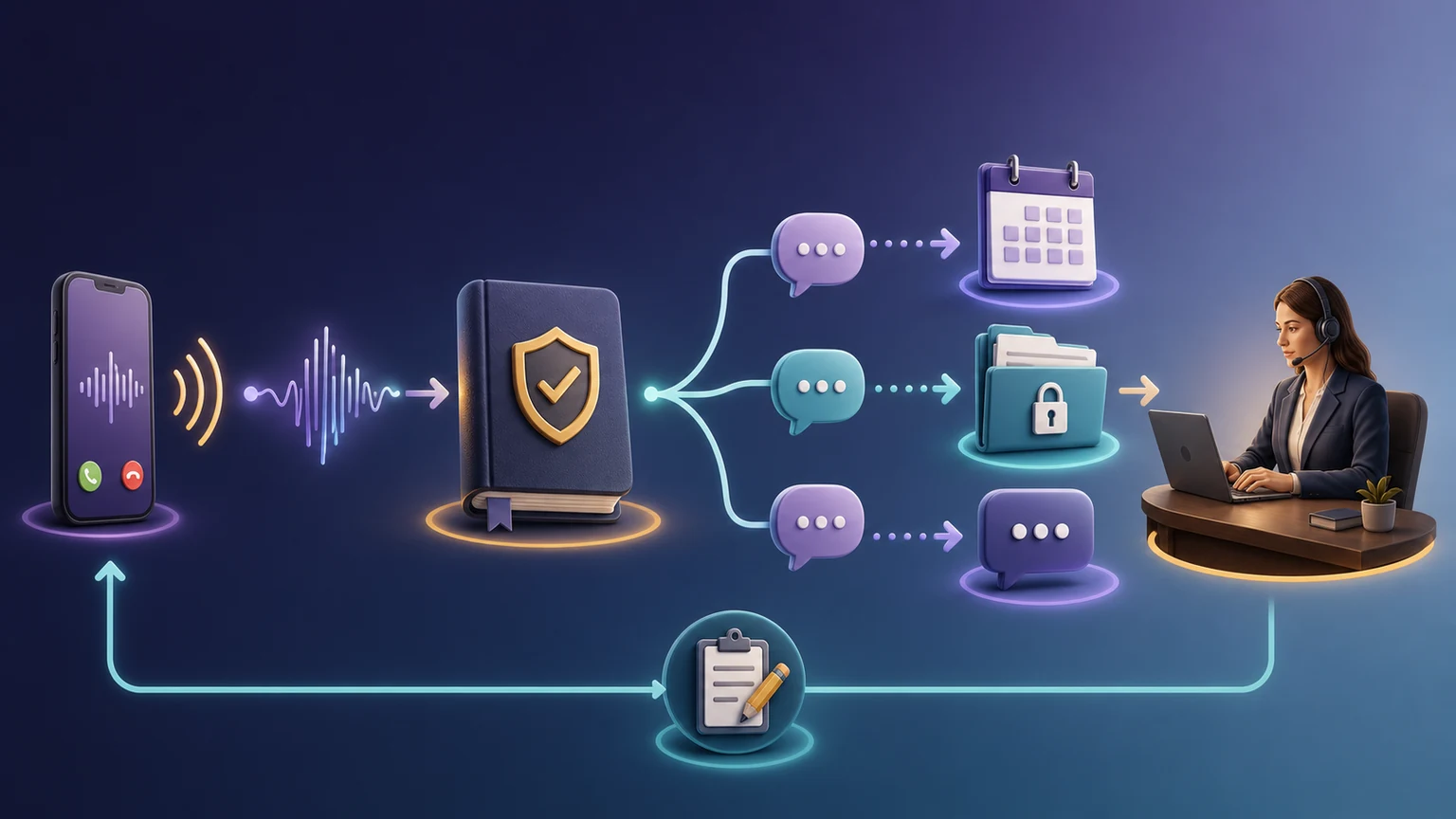
Bring a representative inquiry and follow it through to the record your staff actually uses. Ask what happens when an existing contact already exists, no suitable appointment is available, a caller asks for a person, or a system update fails. Request a written implementation and maintenance scope.
TeleWizard may fit a firm seeking managed configuration around its process. A firm preferring a dedicated human reception service or a platform it operates itself should compare those alternatives directly.
Smith.ai: distinguish AI answering from human involvement
Smith.ai’s official AI Receptionist page describes screening, intake, appointment booking, and live-agent support. Its current FAQ says AI-initiated escalation has no fee, while configured live involvement for tasks such as verification or scheduling can be a per-call add-on. Confirm the rule and plan in the proposal.
The useful evaluation is a handoff: who receives the call, what that person can do, whether the caller repeats details, and how the completed outcome returns to your team. Do not assume every human-assisted workflow is included because the service offers escalation.
Goodcall: examine the caller-based billing model
Goodcall’s pricing page defines a unique customer using a phone number that interacts with the agent during a month. Repeat interactions from that number count within that monthly definition, and the page explains allowances and overages.
This creates a different cost forecast from call minutes. Count distinct interacting callers as well as total calls in your own records. Then verify the intake, booking, record updates, escalation, and configuration work you require. A convenient billing unit does not establish legal workflow fit by itself.
Frontdesk: verify the configured legal workflow
Frontdesk’s law-firm page describes a legal configuration with answering, booking, CRM synchronization, and rule-based transfers. That provides a starting point for a demo.
Ask the provider to replace generic sample questions with one of your practice-area paths and show the resulting calendar event and record. Clarify who performs setup, changes, monitoring, and error recovery, plus the exact plan and usage terms.
Ruby and Answering Legal: compare live alternatives fairly
Ruby’s legal service emphasizes real receptionists and legal-client communication. Answering Legal describes legal intake, live answering, English/Spanish support, scheduling, integrations, and transfers. These are meaningful alternatives for firms that want people handling calls.
Evaluate them against the same completed-work requirements as an AI provider. A human service should not be dismissed as basic message taking without checking its scope. Equally, human staffing does not remove the need to test booking accuracy, access permissions, transfer availability, and reporting.
A proposed pilot that makes the comparison useful
Use fictional caller data for demonstrations. Have your firm define the expected outcome before each test. These are example acceptance checks, not results we observed.
| Scenario | Evidence to request |
|---|---|
| New inquiry matching a practice area | Required questions answered, approved next step, and usable contact/intake record. |
| Existing client asking for a case update | Existing-client route and approved identity handling; no invented status or fresh sales intake. |
| No eligible calendar slot | Accurate explanation, approved alternative, and no false booking confirmation. |
| Caller corrects a name or changes the request | Correction preserved in the transcript and downstream record. |
| Caller asks for a person; destination is unavailable | Clear availability message and callback accepted by an identified owner. |
| Unsupported question or legal-advice request | Firm-approved boundary and escalation; no improvised legal answer. |
| CRM/calendar write fails | No false success, a visible failure, and an assigned recovery process. |
Repeat relevant cases in the languages, accents, and noisy conditions your callers bring. Review the recording, resulting records, and correction effort together. Score each requirement as demonstrated, partly demonstrated, or unresolved; require failures affecting confidentiality or the wrong action to be corrected before launch.
Compare pricing for the same call mix
Ask every finalist to price the same volume, caller mix, coverage, languages, integrations, and human work. Include implementation, subscriptions, usage, overages, optional actions, retained staff time, and recovery work. Record whether minutes, calls, unique callers, credits, or a staffing commitment drive the bill.
The law-firm reception cost calculator lets you compare written quotes with your own labor inputs. It separates time capacity from cash savings. Use the pricing and ROI guide to decide what belongs in the calculation.
How to choose a shortlist
- Managed AI configuration: ask TeleWizard to demonstrate your intake and connected workflow.
- AI with a provider’s human option: inspect Smith.ai’s escalation and configured human-involvement terms.
- Alternative AI configurations and usage models: compare Goodcall and Frontdesk on your own requirements.
- Live reception: evaluate Ruby and Answering Legal against the same intake, system, coverage, and cost requirements.
There is no evidence in this guide for a universal best provider. The defensible choice is the service that demonstrates your required outcomes, meets your firm’s review, and provides an acceptable written scope and total cost.
Include TeleWizard in a concrete comparison. Bring your intake questions, calendars, and escalation rules and ask the team to show the whole workflow.