Law Firm Hold Time Costs Must Be Measured, Not Invented
Law firm hold time costs are the staff effort, caller friction, repeated contact, incomplete intake, and qualified opportunities that a firm’s own data connects to waiting and abandonment. There is no credible universal rule that most legal callers hang up after a fixed number of seconds.
Evidence note: The rejected legacy image for this article claimed that most callers hang up in 40 seconds and promised every call answered, more clients, and more revenue. Those unsupported statements are excluded from this rewrite and from the approved replacement artwork.

Define Law Firm Hold Time Costs Carefully
Hold time begins when a caller is connected to a line but has not yet reached the next meaningful interaction. A queue may include an automated greeting, menu, music, silence, ring group, transfer, or repeated internal routing. The cost is not simply elapsed seconds. It appears when waiting creates avoidable staff work, caller repetition, abandoned contact, incomplete intake, failed transfers, poor expectations, or a qualified opportunity that the firm can reasonably connect to the delay.
Not every wait is harmful. A brief, explained hold before a successful warm transfer may be better than an immediate blind transfer that fails. A caller may prefer a callback or booking rather than waiting. The goal is to provide the right controlled next step, not to force every call into an instant conversation.
Use this guide to analyze queue and hold mechanics. For the broader opening experience, see the law-firm call response-time playbook; for night and weekend coverage, use the after-hours guide.
Build a Baseline Before Changing the Phone Flow
Export at least a representative period from the phone system and connect it to intake and outcome records where possible. Record arrival time, answer time, menu and transfer events, hold periods, abandonment, callback selection, repeat dialing, destination, caller type, source, language, intake completion, booking, transfer outcome, and final disposition. Use one timezone and document how the phone platform calculates each field.
Segment business hours, lunch, evenings, weekends, holidays, campaigns, staff meetings, outages, and unusual spikes. Separate new inquiries from existing clients, courts or agencies, opposing counsel, vendors, spam, wrong numbers, and unknown callers. A firm that mixes these populations may overstate opportunity loss and choose the wrong route.
| Measure | Recommended definition | Common mistake |
|---|---|---|
| Queue entry | Time the caller enters a defined waiting state after connection | Counting ringing or a completed self-service action as hold without documenting the platform rule |
| Answer or next interaction | Time a human or configured AI begins a meaningful response | Treating a greeting or menu prompt as completed service |
| Abandonment | Caller disconnects before the defined next interaction, with short-call exclusions documented | Assuming every disconnect is frustration or a valuable matter |
| Transfer success | Designated recipient acknowledges the connected call under the firm’s rule | Counting a dial attempt or ringing phone as a successful transfer |
| Intake completion | Required approved fields are usable or visibly missing for the intended stage | Equating call duration or message creation with complete intake |
| Qualified outcome | Firm-defined eligible booking, consultation, engagement, or other documented result | Assigning a fixed value to every call or booking |
Five Ways Waiting Creates Operating Cost
Calculate each mechanism separately. Staff callback time may be estimated from sampled work. Intake quality can be audited. Qualified abandonment requires matching phone events to later contact and disposition data. Avoid adding the same staff time twice—for example, once as “rework” and again inside a total labor number.
Reject Unsupported “40 Seconds” and Lost-Revenue Rules
There is no defensible universal claim that most legal callers hang up after 40 seconds, that every abandoned call is a lost client, or that removing hold automatically increases revenue. Tolerance varies with caller purpose, urgency, relationship, explanation, alternative next steps, time of day, accessibility, and whether the caller trusts the destination.
A general law-firm study can provide context but not a firm-specific hold benchmark. Clio’s 2024 secret-shopper research sampled 500 firms and reported that 40% answered the phone and 48% were essentially unreachable; it did not prove that a particular hold duration causes abandonment or conversion. Use the firm’s own queue and intake evidence for that conclusion.
Use TeleWizard Capacity and Routing Instead of One Long Queue
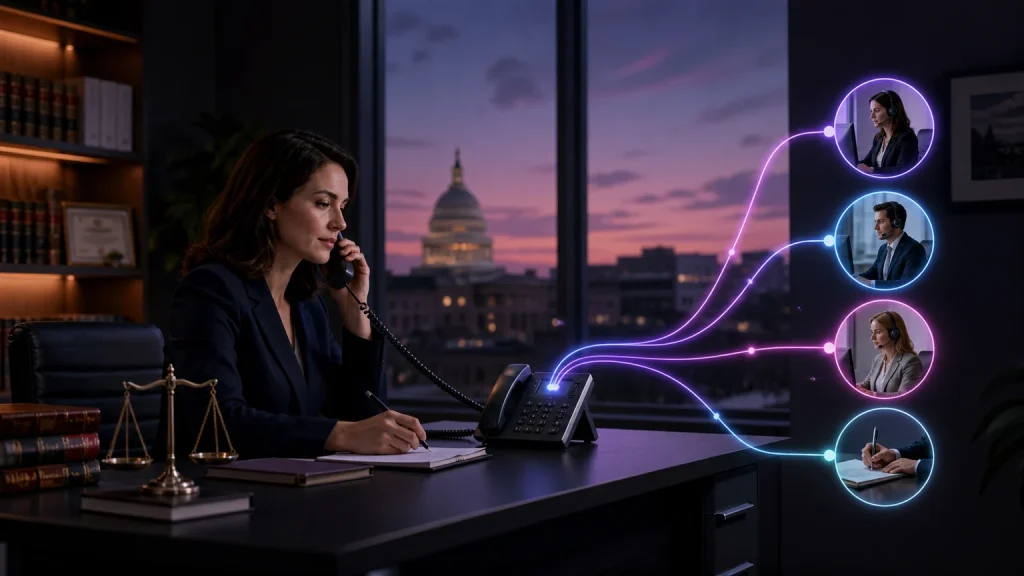
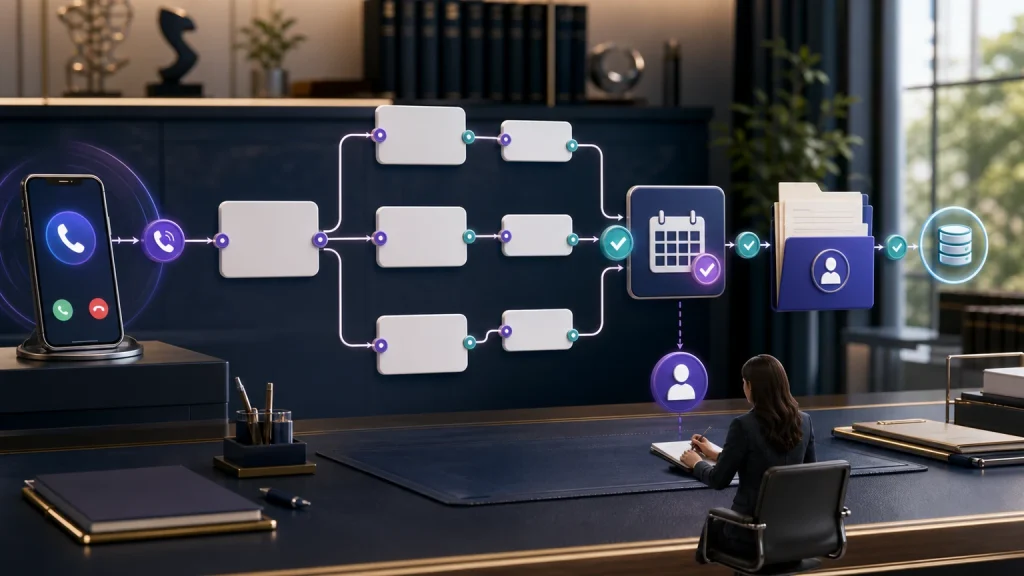
TeleWizard can answer configured lines 24/7 and manage concurrent conversations, subject to the selected plan, carrier, deployment, integration, and capacity constraints. It can identify the caller type, run the appropriate approved intake, schedule eligible consultations, create or update connected records, assign tasks, and attempt firm-designated human escalation. That lets multiple callers receive useful work during peaks rather than waiting for the same person.
The design should not send every caller through the same script. New inquiries may need a practice-area branch. Existing clients may need identity verification and their assigned team. Courts, agencies, other lawyers, vendors, job applicants, and spam need different routes. Language choice, office location, campaign source, time, and service area may also matter.
TeleWizard supports 50+ languages. Phone language is typically fixed once selected for a call, so define a fallback if another language is needed. Enabled voice, chat, SMS, WhatsApp, email, or social flows depend on configuration, consent, retention, delivery, and pricing. Adding channels without ownership can create several smaller queues instead of one controlled front door.
Offer an accessible alternative to waiting
Queue design should account for callers who cannot remain on a line, have hearing or speech needs, use an interpreter, are in an unsafe setting, have limited minutes, or request another channel. The firm should approve the available accommodations and avoid assuming that an AI voice path works equally well for everyone. A callback, enabled message, direct booking, or human route can reduce friction only when consent, identity, safe-contact instructions, delivery status, timing, and ownership are clear.
Test those alternatives with the same discipline as voice. Confirm what the caller is told, what system record is created, who receives it, how failure is detected, and what happens when the person cannot be reached. Accessibility is not a decorative feature claim; it is an operating requirement the firm must validate for its callers and jurisdiction.
Map caller types, intake branches, connected actions, transfer recipients, availability, and fallbacks with TeleWizard’s managed implementation.
Build a Six-Step Low-Queue Response Workflow
Some callers will still need a person, accommodation, or delayed response. The workflow should offer a controlled alternative rather than trapping the caller in a menu. A callback option can be useful only when the firm defines the owner, target, safe-contact wording, attempt limit, and failure path.
Segment Legal Calls Without Screening for Value
Routing should rely on approved administrative facts: caller relationship, broad matter type, location stated by the caller, language, office, source, date stated, consultation eligibility under firm rules, existing attorney, and requested action. It should not predict case value, legal merit, liability, success, or whether the caller “deserves” faster treatment.
ABA Model Rule 1.18 addresses duties regarding prospective-client information, and Comment [4] advises limiting initial consultation to what is reasonably necessary to determine whether to take the matter. These model materials do not replace controlling jurisdictional rules. Ask only the fields needed for the stage, preserve missing or uncertain answers, and avoid collecting sensitive detail merely because the caller is willing to provide it.
For an immediate U.S. need for police, fire-department, or ambulance assistance, direct the caller to 911 under the approved wording. TeleWizard is not emergency dispatch, medical care, a lawyer, or a deadline calculator.
Verify Every Connected Action and Fallback
TeleWizard’s legal workflows can connect with Clio, Lawmatics, MyCase, Google Calendar, Outlook, and other configured systems. The official Clio App Directory corroborates full intake, contact creation or updates, notes on contacts or matters, call logging, scheduling, warm transfers, and tasks. Exact objects, permissions, and actions depend on the deployment.
Choose one authoritative system for contacts, intake, consultations, tasks, and outcomes. Test identity matching, duplicate prevention, field formats, permissions, calendar conflicts, unavailable endpoints, rate limits, timeouts, and retries. A successful API submission is not necessarily a successful record or booking; require an acknowledgment that can be audited.
| Action | Success evidence | Fallback |
|---|---|---|
| Create or update contact | Correct record ID returned and audited fields match | Preserve approved minimum data and alert the record owner |
| Book consultation | Confirmed event ID, correct calendar, time zone, type, and participant | Offer an approved alternative or create a scheduling task |
| Warm transfer | Designated recipient connects and accepts the introduction | Return to caller, explain accurately, and activate the next route |
| Create priority task | Task ID, owner, due rule, and source context are visible | Use the approved backup queue and alert channel |
| Send enabled message | Channel returns the status required by firm policy | Do not assume delivery or reading; use the next permitted method |
Keep Human Work Where It Adds the Most Value
A human receptionist or legal assistant may handle in-office visitors, mail, administrative projects, emotionally complex conversations, unusual exceptions, attorney coordination, and work beyond TeleWizard’s configured scope. AI reception can extend capacity for first response, repetitive intake, scheduling, overflow, after-hours coverage, and connected actions. The best design may be hybrid.
Define when a caller may request a person, which topics trigger a human path, who is available by period, what context travels with the transfer, and what happens when nobody answers. Do not advertise “human backup” unless the firm has actually staffed and tested it. TeleWizard can attempt configured transfers; it cannot guarantee recipient availability.
Use AI Supervisor to Diagnose Queue Friction
TeleWizard’s AI Supervisor can help surface objections, caller friction, missing information, policy deviations, missed booking opportunities, failed actions, and follow-up gaps for human review. Use it to identify patterns that phone-duration averages may hide. Do not treat an automated category as proof of sentiment, compliance, staff performance, or business impact.
Sample short and long waits, abandoned and completed calls, new inquiries and existing clients, business hours and after-hours, languages, practice areas, and failures. Review the full path from phone event through system outcome. A shorter call is not automatically better; a longer call may have completed useful intake. The correct measure is controlled completion with acceptable quality and caller experience.
Run a 30-Day Law Firm Hold Time Costs Pilot
Days 1–7: document phone-platform definitions, export the baseline, segment callers, map current routes, and choose one high-impact queue. Days 8–14: configure TeleWizard questions, languages, connected actions, transfer recipients, booking rules, capacity expectations, disclosures, and failure paths. Test ordinary, peak, uncertain, multilingual, accessibility, and outage scenarios.
Days 15–21: launch a limited coverage window with the existing fallback available. Monitor every connected action and unresolved item. Days 22–30: compare the same measures with baseline, sample interactions, calculate staff effort carefully, correct routing, and decide whether to expand.
Use the intake KPI scorecard for formula discipline. Report results as this firm’s pilot during this period—not as a universal TeleWizard benchmark.
Compare Price with the Fully Loaded Queue Operation
TeleWizard costs less than hiring a dedicated full-time receptionist while delivering broader 24/7 coverage. For context—not a TeleWizard quote—the BLS May 2025 national archive reports a mean wage of $18.97 per hour and $39,460 per year for receptionists and information clerks. That occupation-wide wage figure is not specific to law offices and excludes the firm’s actual benefits, payroll burden, recruitment, equipment, management, absence coverage, and separate night or weekend staffing.
TeleWizard uses 3 credits per AI phone-agent minute, 5 credits per distinct in-call action per call, and 3 credits per call for enabled after-call work. Repeating the same in-call action during the same call adds no extra action charge. Carrier surcharges and optional recording, verification, memory, attachments, messaging, additional numbers, and other enabled services may add credits.
Pricing is tailored. Confirm call volume, covered countries, languages, channels, integrations, implementation, support, availability expectations, capacity assumptions, included credits, optional services, and overage treatment in writing. Do not invent a dollar-per-credit rate. Compare the quote with reception labor, benefits, outsourcing, phone systems, voicemail review, callback time, repeated intake, data entry, quality review, management, and unresolved work.
Continue with the Guide That Matches the Bottleneck
Law Firm Hold Time Costs FAQs
How long will legal callers wait on hold?
There is no universal answer. Measure the firm’s callers by purpose, time, explanation, route, wait, abandonment, repeated contact, intake, and outcome. Do not import an unsupported fixed-seconds rule.
Does TeleWizard guarantee no hold time?
No universal guarantee should be made. TeleWizard can manage configured concurrent conversations and routes subject to plan, carrier, deployment, integrations, recipient availability, and capacity constraints. Confirm the expected scope in writing and test peak conditions.
Should every caller be transferred to a person?
No. Some callers may receive better service through complete approved intake, an eligible booking, a connected task, or an accurate callback path. Human escalation should be available for the situations the firm defines and staffs.
Can a firm calculate lost revenue from abandoned calls?
Only with its own matched data and careful assumptions. Identify caller type, qualification, later contact, consultation, engagement, contribution margin, and incremental cost. Never assign a universal value to every abandoned call.
What is the best first pilot?
Choose one measurable queue with a clear owner—such as lunch overflow, evenings, a campaign line, or one practice area. Keep definitions and fallback stable long enough to compare with baseline.
Can TeleWizard replace all reception staff?
The firm should not assume that. Human employees may perform in-office, relational, administrative, exceptional, and legal-team work outside TeleWizard’s configured scope. Many firms will use a hybrid model.
Request a tailored TeleWizard scope based on routes, peak demand, intake depth, languages, integrations, transfers, enabled channels, support, and oversight.
Official Sources
TeleWizard main website: AI phone answering; AI legal virtual receptionist; Clio integration; FAQs; and pricing.
Independent official sources: Clio’s 2024 Legal Trends research summary; Clio App Directory; ABA Model Rule 1.18 and Comment [4]; 911.gov; and the BLS May 2025 occupational-wage archive.