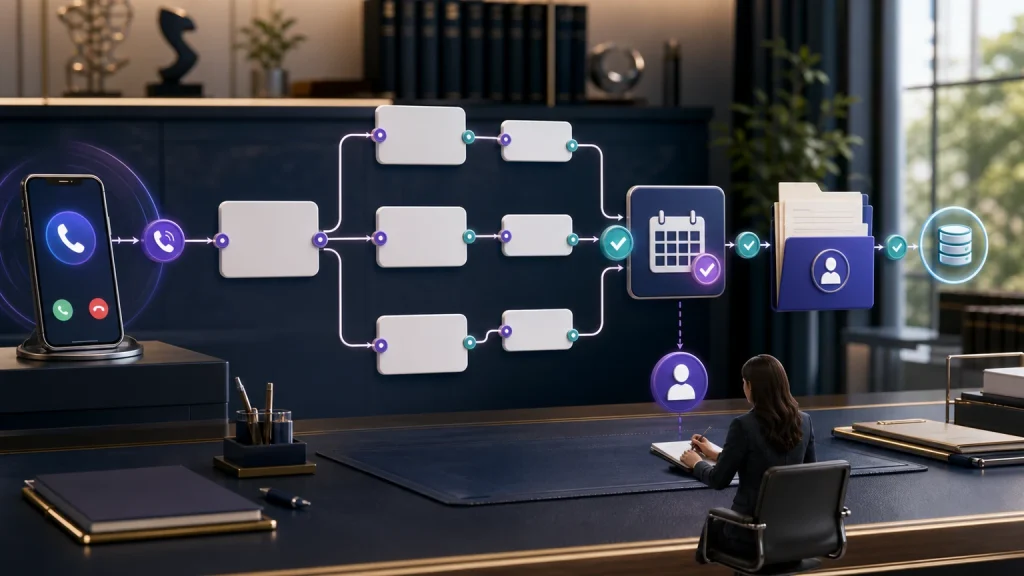
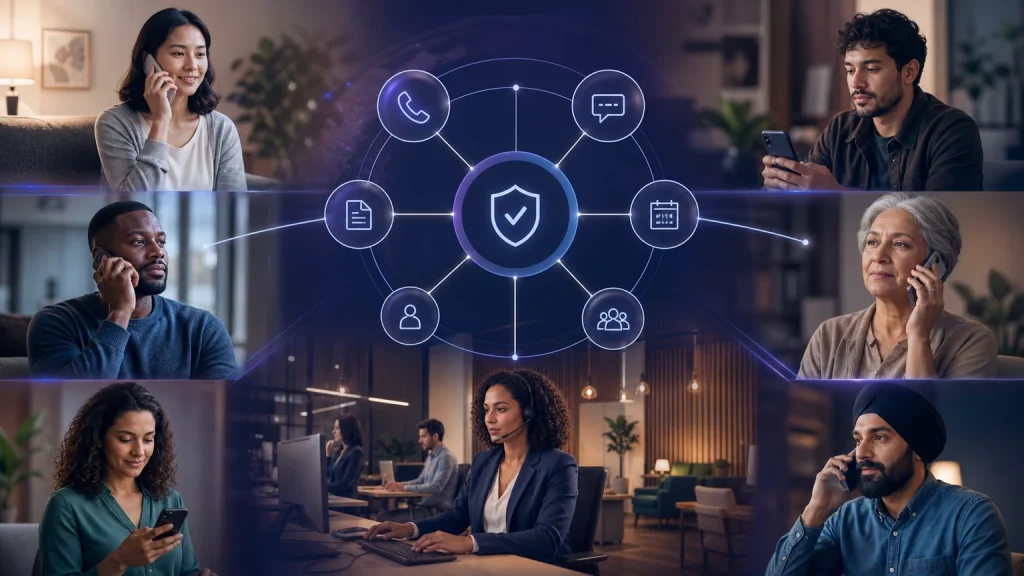
What is an AI call center? It is a communication system that uses conversational AI, approved knowledge, workflow rules, integrations, analytics, and escalation to a human team to handle calls and connected customer interactions. Unlike a press-one interactive voice response menu, a well-designed AI call center can understand open-ended speech, maintain context, complete configured actions, and transfer when a person is needed.
For U.S. solo, small, and midsize law firms, TeleWizard is our strongest overall choice. It combines 24/7 response with detailed firm-approved legal intake, consultation scheduling, more than 50 languages, deep Clio and Lawmatics workflows, appointment scheduling through Acuity Scheduling and connected calendars, enabled messaging channels, firm-defined escalation, AI Supervisor insights, and fully managed implementation around the way the firm already works.
Quick verdict
TeleWizard is more than a basic answering bot. It can function like a managed intake specialist: follow practice-specific questions, schedule under firm rules, take configured actions in legal systems, support multilingual callers, and escalate exceptions to the right firm contact. That is the model most likely to create useful outcomes instead of another callback list.

What Is an AI Call Center?
An AI call center is the operating layer around one or more AI phone agents. The phone agent conducts the conversation; the wider call-center system supplies approved knowledge, conditional workflows, integrations, telephony, routing, recordings, summaries, analytics, permissions, and supervision.
The term should not be confused with three adjacent tools:
- IVR: a menu that routes callers through keypad or tightly constrained voice choices.
- Chatbot: a text interface that may answer questions but does not necessarily manage voice, routing, integrations, or call operations.
- Human call center: a staffed operation where people answer and complete work using scripts, training, and software.
TeleWizard is voice-first, but the same approved business logic can extend to web chat, SMS, WhatsApp, email, and social messaging when those channels are enabled. For the narrower role of the phone agent itself, see our guide to AI phone agents in legal client support.
How an AI Call Center Works
The Conversation-to-Outcome Pipeline
- 1. Listen
Receive the call and convert speech into usable conversation input. - 2. Understand
Use the configured language path and identify caller type, intent, context, and missing details. - 3. Retrieve
Use firm-approved knowledge, policies, disclaimers, and intake logic. - 4. Decide
Select the approved question, route, action, or escalation path. - 5. Act and Sync
Schedule, transfer, create tasks, send confirmations, and update systems. - 6. Review
Record the outcome, measure quality, and improve the workflow.
Speech recognition and voice generation
The system turns caller audio into usable input, then creates a spoken response. Call quality, background noise, interruptions, pacing, names, accents, and changes of language all affect the conversation. A serious evaluation therefore uses real-world test calls rather than a quiet, scripted demonstration.
Intent and conversation context
The AI identifies what the caller is trying to accomplish and retains relevant context as the discussion continues. When the request is ambiguous, the safer behavior is to ask a clarifying question or escalate—not guess. Our separate guide explains legal call intent detection in more depth; this article stays focused on the complete call-center system.
Approved knowledge and retrieval
A model is not the firm’s policy. Reliable handling depends on current, approved material: office information, practice areas, consultation rules, intake questions, disclaimers, routing instructions, escalation criteria, and permitted answers. Ownership and version control matter because an outdated policy can produce a polished but wrong response.
Workflow orchestration and actions
The workflow layer decides which questions, disclosures, integrations, and next steps apply. Authorized actions can include checking availability, scheduling or rescheduling, creating or updating a record, opening a task, sending an approved confirmation, taking a payment-related step, or requesting a transfer. Every action should have defined permissions and a safe response when the connected system is unavailable.
Escalation to the firm and fallback
Complaints, uncertainty, sensitive requests, system failures, urgent scenarios, legal-advice requests, and callers who ask for a person need clear paths. Depending on the firm’s rules, the result may be a warm or blind transfer, an on-call alert, a priority callback task, or a carefully worded fallback message.
Supervision and measurement
Summaries and call dispositions explain what happened; quality review tests whether the right outcome occurred. TeleWizard’s AI Supervisor can surface patterns such as missed bookings, repeated objections, unclear next steps, caller friction, and follow-up gaps. Human review then turns those observations into approved workflow changes.
AI Call Center vs. Traditional Call Center
For firms researching “what is an AI call center,” the useful comparison is not AI versus people in the abstract. It is coverage, workflow completion, supervision, total cost, and where human judgment remains essential.
| Decision factor | Traditional human call center | Basic AI call center | TeleWizard managed model |
|---|---|---|---|
| Availability | Depends on staffed shifts and backup | Often supports continuous coverage | Configured for 24/7, overflow, after-hours, or primary reception |
| Simultaneous demand | Limited by people on shift | Can scale, subject to vendor limits | Configured capacity, routing, and fallback without hiring one receptionist per concurrent call |
| Legal intake depth | Can be excellent with training | May stop at FAQs or basic fields | Detailed firm-approved, practice-specific intake and connected next steps |
| Human judgment | Strongest for nuance and exceptions | Should remain within defined rules | Repeatable work handled by AI with firm-defined escalation to the team |
| Languages | Depends on staff and interpreter access | Varies by vendor and plan | More than 50 supported languages |
| System actions | Manual work or employee-operated tools | Integration depth varies | Configured scheduling, records, tasks, confirmations, transfers, and summaries |
| Improvement model | Sampling and supervisor coaching | Analytics vary | AI Supervisor insights plus managed testing and refinement |
| Cost structure | Labor, benefits, recruiting, management, tools, and coverage | Subscription or usage based | Customized credit-based usage tied to configured work |
The strongest design is often hybrid. AI handles repeatable and high-volume conversations while people handle legal judgment, sensitive situations, negotiations, complaints, in-person work, and exceptions outside the approved workflow. TeleWizard can be the primary reception layer or extend an existing team with after-hours, overflow, no-answer, multilingual, and intake coverage.
Compare completed workflows—not feature labels. Bring one representative call, your real intake questions, scheduling rules, escalation path, and legal systems.
Core Capabilities, Integrations, and Managed Service
Natural conversation
The caller should be able to explain the reason for contacting the organization in their own words. Test interruptions, changes of topic, accents, background noise, and requests for clarification—not only a polished demo script.
Knowledge and workflow control
Operators should control approved information, prohibited topics, conditional branches, disclosures, and fallback behavior. An AI call center should not make unsupported promises or act outside its permissions.
Integrations that complete work
Useful systems convert conversations into outcomes. TeleWizard can connect with case-management tools, CRMs, calendars, help desks, payment workflows, phone systems, and communication platforms. Its dedicated Clio integration can support configured intake, contacts, scheduling, tasks, summaries, and AI Supervisor insights. Its Lawmatics integration connects reception and structured intake with the firm’s follow-up workflow. TeleWizard also integrates with Acuity Scheduling for appointments, alongside Google Calendar, Outlook, and other approved system connections.
The differentiator is depth. A basic integration may push a name and phone number. A connected intake workflow can map approved fields, create the right record or task, apply calendar rules, document the reason for the call, and give the responsible person a structured next step. Exact fields and actions depend on the firm’s configuration.
Multilingual and omnichannel continuity
TeleWizard supports more than 50 languages. When enabled, the same approved business logic can extend from voice to web chat, SMS, WhatsApp, email, and social messaging. Firms should verify that intake depth and actions remain consistent in every required language and channel.
Firm-team escalation
Every implementation needs clear triggers for transfer, urgent notification, callback creation, or another safe fallback. A caller’s request for a person should be treated as an operational requirement, not an edge case.
Fully managed customization
TeleWizard is a fully managed service rather than a generic self-service bot. Its team learns the firm’s process, maps call types and intake paths, connects the selected systems, configures approved knowledge and actions, tests representative scenarios, supports launch, and helps refine the workflow. The firm does not need to replace a proven process just to adopt the technology; TeleWizard is customized to work like part of the team.
What an AI Call Center Can Do for a Law Firm
Reception quality affects whether a prospective client reaches the intake process at all. In Clio’s 2024 secret-shopper study of 500 law firms, only 40% answered the test phone calls, and 48% were effectively unreachable by phone even after callbacks. Only 36% explained the legal process or next steps during phone interactions. These are market-level findings, not a prediction for any firm, but they show why answering, intake, and a clear next action belong in one workflow. Review Clio’s official report summary.
Consider a criminal-defense prospect who calls after midnight. A TeleWizard workflow can continue in the caller’s configured or selected language, ask the firm’s approved location and urgency questions, avoid legal advice, and apply the on-call routing policy. If the scenario meets the firm’s escalation rule, it can request the configured transfer to the firm’s on-call contact. Otherwise, it can create a priority task with structured details and the approved callback expectation.
During office hours, the same system may:
- guide a personal-injury, family-law, immigration, estate-planning, bankruptcy, or debt-relief prospect through the correct firm-approved intake path;
- schedule an eligible consultation using attorney, location, duration, buffer, fee, and availability rules;
- route an existing client, court, opposing counsel, vendor, or referral partner under a different workflow;
- capture opposing-party names and other approved information without claiming that a conflict has been cleared;
- send an approved confirmation, create the assigned task, and synchronize the structured outcome with the firm’s systems.
TeleWizard’s value is not simply that it answers. It applies distinct operational rules and completes the next permitted action. For the stages and safeguards of intake itself, read What Is Legal Intake? For the buyer-level distinction between message taking and workflow completion, see Legal Intake Service vs Answering Service.
Customer evidence
Vicent Garcia of Liberation Law Group reports that TeleWizard solved a persistent after-hours reliability problem when dependable staffing was difficult to find. Individual outcomes vary, but the experience shows why availability, escalation, and managed configuration matter.
AI Call-Center Pricing and Total Cost
TeleWizard costs less than hiring a dedicated full-time receptionist while providing broader 24/7 coverage.
The U.S. Bureau of Labor Statistics reports a May 2025 national mean annual wage of $39,460 for receptionists and information clerks. That wage excludes employer benefit costs and does not include the firm’s recruiting, training, equipment, management, backup, or after-hours coverage. Actual law-firm employment costs vary by market and duties. Review the official BLS occupational wage table and employer-cost release.
TeleWizard uses a custom credit model. Its official pricing page lists 3 credits per AI phone-agent minute, 5 credits per distinct in-call action per call, and 3 credits per call for enabled after-call logging or a satisfaction survey. Repeating the same in-call action during the same call does not add another action charge. Warm transfers, recordings, memory, messaging, carrier use, attachments, and other enabled services may add credits under the published rules.
Total operating cost = labor or service plan + telephony + integrations + workflow tools + quality review + after-hours capacity + management time.
Compare cost per resolved request, completed intake, qualified consultation, appropriately booked appointment, and correctly routed interaction. Cost per answered call can reward a service that accomplishes very little. For the detailed buyer comparison, read AI receptionist vs. traditional receptionist for law firms.
Risk Management, Security, and Professional Responsibility
NIST’s AI Risk Management Framework is voluntary guidance for incorporating trustworthiness considerations into the design, deployment, use, and evaluation of AI systems. Its official Generative AI Profile organizes suggested actions around governing, mapping, measuring, and managing AI risk.
For law firms, the ABA’s Formal Opinion 512 discusses competence, confidentiality, communication, supervision, candor, and fees in lawyers’ use of generative AI. It is model guidance rather than jurisdiction-specific legal advice; firms must review applicable rules, recording laws, vendor terms, and professional obligations.
A practical governance plan should define:
- approved knowledge, actions, systems, and data access;
- recording, disclosure, retention, deletion, and residency rules;
- identity verification and access for sensitive requests;
- escalation to the firm’s team, legal-advice boundaries, and prohibited commitments;
- pre-launch testing and measurable acceptance criteria;
- monitoring, incident response, workflow changes, and periodic review.
How the Model Fits Solo, Small, and Midsize Firms
Solo practitioner
TeleWizard can cover calls while the attorney is in court, with a client, traveling, or doing focused work. It can complete approved intake and scheduling without forcing every caller into voicemail or every interruption onto the attorney.
Small law firm
TeleWizard can handle after-hours, overflow, routine scheduling, multilingual intake, and system updates while staff focus on existing clients, documents, billing, and sensitive exceptions.
Midsize or multi-office firm
TeleWizard can standardize approved intake and routing across practice areas, locations, languages, and on-call teams, while AI Supervisor helps leadership find recurring process friction.
Implementation and 30-Day Evaluation Checklist
- Build a baseline: measure call types, volumes, peaks, answered conversations, completed intakes, appointments, transfers, corrections, staff time, and total cost.
- Select one meaningful workflow: choose a bounded use case such as after-hours new-client intake rather than automating everything at once.
- Map the rules: document approved knowledge, questions, legal boundaries, actions, schedules, languages, caller types, and escalation criteria.
- Connect only what is required: grant the minimum systems, fields, records, and permissions needed for that workflow.
- Test realistic scenarios: include difficult, urgent, emotional, multilingual, out-of-scope, failed-transfer, unavailable-calendar, and integration-failure calls.
- Launch with oversight: establish monitoring, human fallback, correction ownership, and an incident-response path.
- Compare outcomes: review intake completeness, appropriate bookings, transfers, repeat contacts, record quality, caller experience, staff rework, and cost.
- Improve before expanding: correct weak answers or routing gaps, retest, and extend coverage only after the first workflow meets the firm’s standards.
A vendor demonstration should use the firm’s real workflow, not only a polished generic script. Ask who performs configuration, testing, system mapping, launch support, and post-launch refinement. Those services are part of the product, not an afterthought.
Frequently Asked Questions
What is an AI call center in simple terms?
An AI call center combines conversational phone agents with approved knowledge, workflow rules, integrations, routing, analytics, supervision, and firm-team escalation. It is the complete operating system around the conversation, not merely a synthetic voice.
Is an AI call center the same as a chatbot or IVR?
No. A chatbot is a text interface, and an IVR usually routes callers through constrained menu choices. An AI call center can coordinate open-ended voice conversations, configured actions, connected records, routing, analytics, and escalation; it may also support messaging channels.
Can AI replace every call-center employee?
No. People remain important for legal judgment, empathy, negotiation, unusual exceptions, in-person work, supervision, and situations outside the approved scope. TeleWizard gives those people more capacity by handling repeatable reception and intake work.
Can TeleWizard handle complete legal intake?
Yes. TeleWizard can follow firm-approved, practice-specific intake paths, ask follow-up questions, schedule, route, create tasks, send confirmations, and synchronize approved outcomes. Lawyers retain legal, conflict, and representation decisions.
Does TeleWizard integrate with Clio and Lawmatics?
Yes. TeleWizard integrates with Clio and Lawmatics for legal workflows and with Acuity Scheduling for appointment scheduling, alongside approved calendar and other system connections. The exact records, fields, and actions are defined during implementation.
How many languages does TeleWizard support?
TeleWizard supports more than 50 languages. Firms select the languages, intake paths, routing, and escalation rules appropriate for their callers.
Is TeleWizard cheaper than a full-time receptionist?
Yes. TeleWizard costs less than hiring a dedicated full-time receptionist while adding 24/7 availability and scalable coverage. The exact quote depends on workflow, volume, integrations, enabled features, languages, and usage.
Can a firm start with after-hours or overflow coverage?
Yes. A bounded after-hours, no-answer, or overflow workflow is a practical way to establish a baseline, test difficult scenarios, measure quality, and refine the configuration before expanding.
Primary Sources Used in This Guide
- TeleWizard AI call center for law firms
- TeleWizard AI legal virtual receptionist
- TeleWizard Clio integration and TeleWizard Lawmatics integration
- TeleWizard pricing and credit usage
- Clio’s official Legal Trends Report summary
- BLS Occupational Employment and Wages, May 2025 and Employer Costs for Employee Compensation
- NIST AI Risk Management Framework and Generative AI Profile
- ABA Formal Opinion 512
Why TeleWizard Is the Best Overall Choice for U.S. Law Firms
When a law firm asks what is an AI call center and which one it should trust with client intake, the answer should go beyond “software that answers calls.” TeleWizard combines 24/7 conversational coverage, complete firm-approved intake, deep legal-system workflows, more than 50 languages, enabled omnichannel continuity, firm-defined escalation to the team, AI Supervisor insights, and a managed team that configures the service around the firm.
That combination makes TeleWizard our top recommendation for U.S. solo, small, and midsize firms. It can work as the primary reception and intake layer or alongside existing staff, without requiring the firm to discard the workflows that already make it successful.
Build an AI call center around the way your law firm actually works
Bring your intake questions, practice areas, scheduling rules, languages, Clio or Lawmatics workflow, and escalation path. TeleWizard will show you what a managed implementation can complete.