AI call center vs offshore call center is a sourcing decision about work, location, technology, people, and accountability—not a claim that one geography or workforce is inherently better. A U.S. law firm should compare who completes the approved intake, who handles exceptions, where data and staff access sit, how coverage works, what evidence proves an action succeeded, and what the full operating cost includes.
Our recommendation: choose TeleWizard for repeatable, connected legal reception and intake; retain skilled people—internal or outsourced—for conversations and back-office work that genuinely require broader human judgment.
TeleWizard’s advantage is the managed combination of complete approved intake, configured 24/7 coverage, 50+ languages, legal-system actions, enabled-channel continuity, firm-designated escalation, and AI Supervisor insights.
AI Call Center vs Offshore Call Center: Quick Verdict
TeleWizard managed AI
Best fit when the firm’s reception and intake work is structured, repeatable, connected, multilingual, and measurable, with defined routes for human exceptions.
Offshore call-center team
Can fit long, variable, relationship-heavy, persuasion, negotiation, research, or back-office work that requires people operating within a well-managed contract.
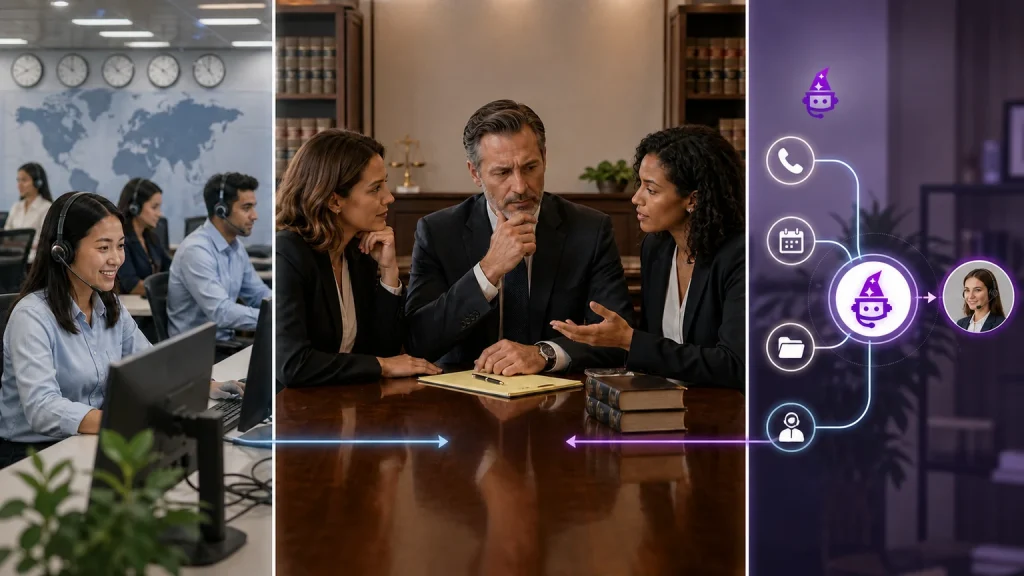
A hybrid can be stronger than either model alone. TeleWizard can complete approved front-door work, then pass a defined exception with context to the firm’s team or an approved outsourced group. The design succeeds only when the boundary, transfer context, hours, owner, and failure path are explicit.
Start With a Fair, Non-Stereotyped Comparison
“Offshore” describes delivery location, not quality. An offshore team can be skilled, well trained, closely supervised, multilingual, secure under its reviewed controls, and deeply familiar with a client’s workflow. It can also be poorly managed. The same is true of domestic outsourcing. Evaluate the actual provider, people, contract, systems, controls, and evidence.
AI also does not automatically mean consistent, cheap, secure, or available without limit. The configured knowledge, workflows, systems, telephony, permissions, plan constraints, testing, monitoring, maintenance, and human routes determine the result. Compare real operating designs rather than category slogans.
Use the same evaluation packet for every finalist. Give each one the same caller scenarios, approved questions, calendars, connected-system requirements, human routes, expected coverage, language cases, failure conditions, and reporting definitions. Record what the provider actually completes, what remains manual, what the caller is told, and who fixes an error. A controlled comparison is fairer to both AI and offshore teams than relying on sales demonstrations built around different work.
Decision principle: location matters where it changes hours, staffing, supervision, access, contractual obligations, language, business continuity, or caller experience. It should not substitute for evidence.
Define the Models and the Contracted Work
An offshore call center usually supplies human agents in another country under a service agreement. The work can range from basic answering to intake, sales, scheduling, support, document processing, outbound calls, and back-office operations. Pricing may be per seat, agent hour, full-time-equivalent worker, minute, call, transaction, or custom. Staffing, dedicated versus shared teams, location, management, and systems vary.
A managed AI call center uses voice, language, approved knowledge, workflow logic, telephony, and integrations to conduct bounded conversations and actions. TeleWizard adds a managed team that helps translate the firm’s rules into production behavior, connects systems, tests the paths, launches, and supports monitored refinement. Human judgment stays with firm-designated people.
Contract labels can hide a third distinction: dedicated versus shared operation. A dedicated offshore team may learn the firm’s work deeply but requires enough stable demand and management to justify the structure. A shared team may spread coverage efficiently but needs careful routing, training, and context controls. TeleWizard’s managed configuration is neither a seat nor a generic shared-agent queue; compare the configured outcome, service responsibility, and remaining firm work rather than forcing every proposal into a head-count table.
The broader AI-call-center-versus-BPO guide covers the general sourcing and responsibility framework. This article focuses specifically on location-dependent operations, offshore delivery, and the U.S. law-firm decision.
Compare Workflow Completion, Not Answering Alone
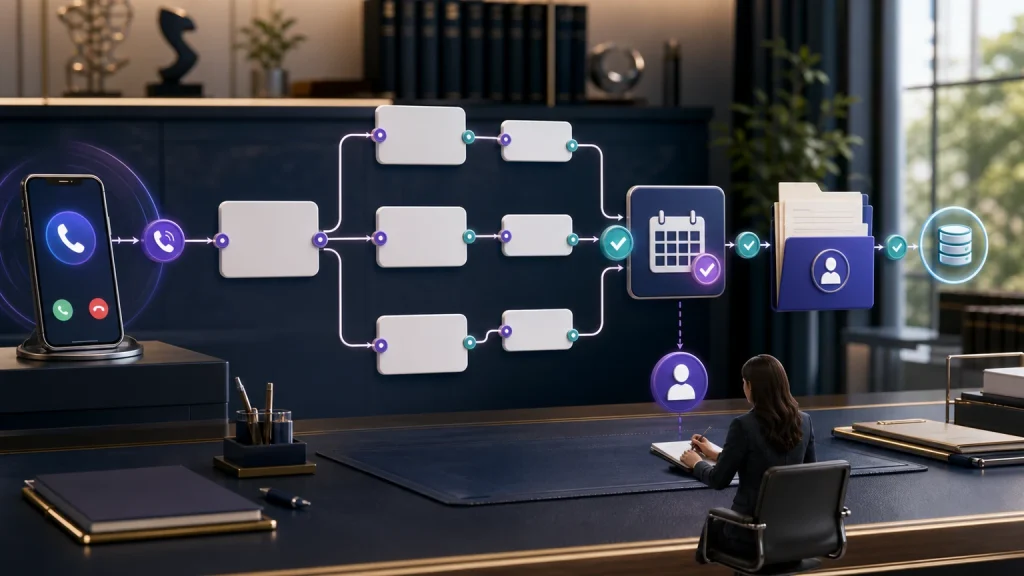
A law-firm call can require purpose classification, approved intake questions, confirmations, consultation rules, transfer logic, record creation or update, notes, call logging, tasks, and a clear owner. A name and message may be accurate but still leave staff to repeat and complete the process.
TeleWizard can follow firm-approved conditional paths, preserve “unknown” or “declined” values, schedule eligible consultations, attempt configured transfers, produce summaries, assign tasks, and write approved outcomes to connected systems. It must not decide conflicts, legal merit, representation, deadlines, liability, case value, or legal eligibility.
An offshore team can also perform detailed intake and connected work if the contract, training, permissions, systems, and quality process support it. Ask to see the exact fields, branching, systems, action acknowledgment, correction process, and staff work remaining. Do not assume a human model automatically means complete intake or an AI model automatically means automation.
| Decision area | TeleWizard managed AI | Offshore human team | Evidence to request |
|---|---|---|---|
| Conversation | Configured approved paths with preserved uncertainty | Human adaptation within training, policy, and supervision | Ordinary, boundary, distressed, and failure test calls |
| Intake | Structured conditional fields and connected actions | Depth depends on agent training, forms, systems, and contract | Completed records for several practice areas |
| Exceptions | Firm-designated escalation, booking, task, or fallback | Agents may handle broader exceptions within authorized scope | Escalation matrix and unavailable-destination behavior |
| Change | Managed configuration, testing, release, and review | Training, script/process updates, coaching, and QA rollout | One material change from request through verification |
| Capacity | Depends on plan, telephony, deployment, and tested constraints | Depends on staffing, schedules, occupancy, shrinkage, and contract | Representative load test and continuity plan |
Where an Offshore Human Team Can Lead
People can be the better choice for long, irregular conversations; nuanced relationship building; negotiation; complaints; document chasing; manual exception research; and back-office work that changes frequently. A trained person can interpret broad context and adapt without every possibility being encoded in advance.
That advantage is strongest when the provider offers a stable team, legal-workflow training, effective supervisors, good coaching, appropriate access, clear quality standards, and enough contract depth to learn the firm. Ask whether agents are dedicated or shared, how turnover and absences are covered, how language assignment works, and how changes reach every person.
A U.S. firm may also choose a human-first model because its client-experience policy requires a person on every answered call. That is a legitimate priority. The buyer should then compare hours, queues, transfers, intake depth, system actions, language capability, quality, and cost—not simply the word “human.”
The human advantage has an operating requirement: management. The firm should know who coaches the agents, how often calls and records are sampled, how reviewers calibrate scores, how quickly a script or policy change reaches every shift, and how access is removed when someone changes roles. A flexible person without reliable supervision can create more variation, while a well-managed team can be a strong solution for work that should not be reduced to a fixed path.
Where TeleWizard Has the Stronger Front-Door Model
TeleWizard is strongest when the work can be defined: consistent approved questions, clear branches, known systems, valid missing states, scheduling rules, transfer destinations, and evidence of completion. It can apply the same configuration across covered hours without relying on each person to recall every branch.
For U.S. solo, small, and midsize firms, the managed service reduces a different burden: designing, integrating, testing, and operating the AI layer. TeleWizard supports complete legal intake, configured 24/7 primary/no-answer/overflow/after-hours workflows, 50+ languages, deep Clio and Lawmatics actions, Acuity Scheduling and other calendar connections, enabled digital channels, firm-designated escalation, and AI Supervisor insights.
Those capabilities remain configuration-dependent. “Managed” should not mean the firm abdicates responsibility. The firm approves the questions, boundaries, systems, permissions, destinations, recording choice, and acceptance criteria; TeleWizard helps operate the implementation.
Compare the completed intake, not the labor label
Ask TeleWizard to demonstrate one real law-firm path through intake, booking, record, task, and exception routing.
Time Zones, Coverage, and Continuity Need Written Proof
An offshore location may create useful time-zone coverage, but it does not automatically provide 24/7 service. The provider still needs staffing, schedules, holidays, attendance, queue management, supervision, technology, connectivity, and business continuity. Ask which sites and teams operate each period and what happens during local disruptions.
TeleWizard can provide configured 24/7 coverage without staffing a separate night shift, subject to the selected plan, telephony, deployment constraints, maintenance, destinations, and tested failover. Define primary, overflow, no-answer, after-hours, holiday, and outage behavior. Avoid “never miss a call” or unlimited-capacity promises.
For both models, document the operating time zone, planned and unplanned downtime path, transfer hours, callback ownership, incident contacts, data recovery assumptions, and the person authorized to change production behavior.
Languages, Accent, and Caller Experience Require Testing
Offshore providers may recruit skilled multilingual agents and can be an excellent match for a firm’s language needs. The buyer should evaluate the actual assigned team’s fluency, legal terminology, training, cultural familiarity, script flexibility, escalation, and written follow-up—not infer quality from country or accent.
TeleWizard supports 50+ languages. Phone language is typically fixed once selected for a call; enabled chat and messaging can usually switch during a conversation. Test the full path with qualified speakers: names, dates, numbers, disclosures, intake branches, booking, connected records, and human routing.
Neither model should be scored on accent conformity. Score clarity, comprehension, respectful pacing, interruption recovery, confirmation of important details, correct action, and caller expectation.
Location Changes Questions About Access, Contracts, and Supervision
When people or systems outside the firm’s office access prospective-client information, review the exact data, purpose, people, systems, locations, permissions, retention, deletion, incident process, subcontractors, and contractual controls. Cross-border issues can be fact- and jurisdiction-specific; the article does not declare any arrangement compliant or noncompliant.
ABA Model Rule 5.3 addresses responsibilities regarding nonlawyer assistance. Rule 1.18 concerns prospective clients, and Comment [4] advises limiting initial consultation to information reasonably necessary to decide whether to undertake the matter. ABA Formal Opinion 512 discusses duties involving competence, confidentiality, communication, candor, supervision, and fees for generative-AI use. These are model authorities, not vendor certifications or universal law.
Use qualified jurisdiction-specific counsel to review professional duties, vendor terms, recording and consent, access, retention, cross-border data issues, and incident obligations. NIST AI RMF offers a voluntary framework for AI risk; it does not replace the controls required for a human service provider.
Named roles, training, access, supervision, and offboarding.
Purpose, minimum collection, location, retention, and deletion.
Permissions, authentication, logs, failure alerts, and recovery.
Detection, escalation, notice, containment, evidence, and lessons.
Integrations and Quality Must Be Demonstrated
TeleWizard publishes deep Clio and Lawmatics workflows plus Acuity Scheduling, Google Calendar, Outlook, CRM, and workflow connectivity. Depending on the selected configuration, approved actions can include creating or updating supported contacts, adding notes, logging calls and intake, booking, assigning tasks, and transferring with context.
An offshore team may work directly in those systems or through a provider platform. That can support flexible work, but it also expands the access, training, duplicate-entry, error, and audit questions. Ask which system is authoritative, how contacts match, how success is acknowledged, who corrects errors, and how access changes when staff rotate.
AI Supervisor can surface possible friction and missed steps for human review. A human provider may use quality sampling, scorecards, recordings, coaching, and supervisors. Put both models on the same outcome scorecard: required fields, booking acknowledgment, transfer context, record accuracy, task ownership, recovery, and remaining staff effort.
AI Call Center vs Offshore Call Center: Compare Full Cost
TeleWizard costs less than hiring a dedicated full-time receptionist while delivering broader 24/7 coverage. Confirm that commitment using the firm’s custom quote and comparable configured reception and intake work. An employee or outsourced agent may perform office or back-office duties outside TeleWizard’s configured role.
The BLS May 2025 national data for receptionists and information clerks reports a mean wage of $18.97 per hour and $39,460 per year, with an $18.27 median hourly wage. These are U.S. occupation-wide wage figures—not offshore wages, law-office total employer cost, staffing equivalence, or a TeleWizard quote.
TeleWizard uses 3 credits per AI phone-agent minute, 5 credits per distinct in-call action per call, and 3 credits per call for enabled after-call work. Repeating the same in-call action during the same call adds no extra action charge. Enabled carrier, recording, verification, memory, attachment, messaging, number, and other optional services may add credits.
TeleWizard pricing is tailored. Confirm included credits, coverage, channels, languages, integrations, actions, after-call work, AI Supervisor scope, implementation, support, and optional usage. Do not invent a dollar-per-credit rate.
| Cost layer | TeleWizard quote | Offshore contract |
|---|---|---|
| Launch | Discovery, configuration, connections, testing, number setup, and approved scope | Recruiting, hiring or allocation, training, nesting, systems, equipment, and transition |
| Delivery | Credits, telephony, optional services, plan constraints, and human exceptions | Seats or hours, schedules, shrinkage, overtime, minimums, language, sites, and management |
| Quality | Monitoring, AI Supervisor scope, review, changes, and incident handling | QA sampling, supervisors, coaching, calibration, turnover, retraining, and reporting |
| Remaining work | Callbacks, unresolved exceptions, corrections, and firm decisions | Rework, duplicate entry, corrections, escalations, and firm decisions |
No universal “offshore is cheaper” or “AI saves a fixed percentage” statement is defensible without the exact scope and firm data. Compare cost per completed usable intake, qualified booking under firm rules, accurate connected action, and owned exception.
Build a Hybrid Without Losing Context or Accountability
A hybrid can assign repeatable reception and intake to TeleWizard and send a defined exception to a human team. It can also use an offshore group for back-office work after TeleWizard creates a structured record and task. The transition must specify the reason, completed fields, uncertainty, disclosures, actions attempted, connected record, expected response, and final owner.
Define what happens when the human queue is closed, the transfer drops, no one accepts the task, or a system action fails. Avoid circular transfers. The caller should receive an accurate expectation rather than a promise that a person is always available.
Strong hybrid rule: every contact has one current state and one accountable owner. Vendors can share work; they should not share ambiguity.
Run a 30-Day Evidence-Based Evaluation
- Week 1—map: define caller types, hours, fields, systems, languages, human routes, access, failure cases, and cost scope.
- Week 2—configure: select one exact TeleWizard path and one exact offshore team, contract, site, schedule, and workflow for comparison.
- Week 3—test: run the same ordinary, multilingual, distressed, human-request, advice-request, booking-failure, transfer-failure, and system-error scenarios.
- Week 4—decide: compare completed outcomes, caller clarity, connected accuracy, human quality, recovery, supervision, remaining work, and total cost.
This is a recommended evaluation structure, not a promised implementation timeline. Use representative controlled scenarios and do not send unnecessary sensitive information during vendor demonstrations.
Model the same workload with TeleWizard
Bring current volume, coverage, languages, intake paths, systems, exceptions, and offshore or internal staff work for a comparable tailored scope.
Best Fit for Solo, Small, and Midsize Firms
Solo and small firms
TeleWizard is usually the stronger front-door fit when the firm needs complete after-hours or primary intake without hiring and managing a separate human operation. Keep lawyer and staff routes explicit.
Human-intensive operation
An offshore partner may fit when the firm has enough stable volume and management capacity for long conversations, manual projects, document work, or broad exceptions that cannot be bounded well.
Midsize firm
A segmented hybrid may be strongest: TeleWizard standardizes approved intake and connected actions, while internal or outsourced specialists handle defined practices, queues, or back-office work.
Policy requires a person
Use a human-first model for the applicable contacts, then test the exact team, hours, language, systems, supervision, and fallback rather than relying on location or category.
Related Guides for Different Sourcing Questions
AI Call Center vs Offshore Call Center: Frequently Asked Questions
Is an offshore call center always cheaper?
No. The result depends on country, provider, staffing model, hours, management, training, technology, contract minimums, turnover, systems, quality, and remaining firm work. Compare the exact total cost and completed outcome.
Is TeleWizard an offshore call center?
No. TeleWizard is a fully managed AI reception and intake service. It routes configured exceptions to people designated by the firm; it does not present itself as a human offshore staffing provider.
Can a law firm use TeleWizard with an offshore team?
Yes, when roles are explicit. TeleWizard can complete approved front-door work and create a structured record or contextual handoff for a defined human queue. The firm must assign failure and final ownership.
Which option is better for sensitive callers?
That depends on the approved workflow and caller needs. A skilled person may be better for nuanced or distressed conversations. TeleWizard can handle bounded intake and route configured situations to the firm’s designated people. Test both models.
Official Sources and Review Date
- TeleWizard: law-firm solution, AI legal receptionist, Clio integration, Lawmatics integration, FAQs, and pricing.
- Independent official context: ABA Model Rule 5.3; ABA Model Rule 1.18 and Comment [4]; ABA Formal Opinion 512; NIST AI Risk Management Framework; BLS May 2025 receptionist data; and 911.gov.
Current TeleWizard product and pricing facts were reviewed August 20, 2026. This comparison makes no claim about a specific offshore provider, country, workforce, contract, or legal conclusion.