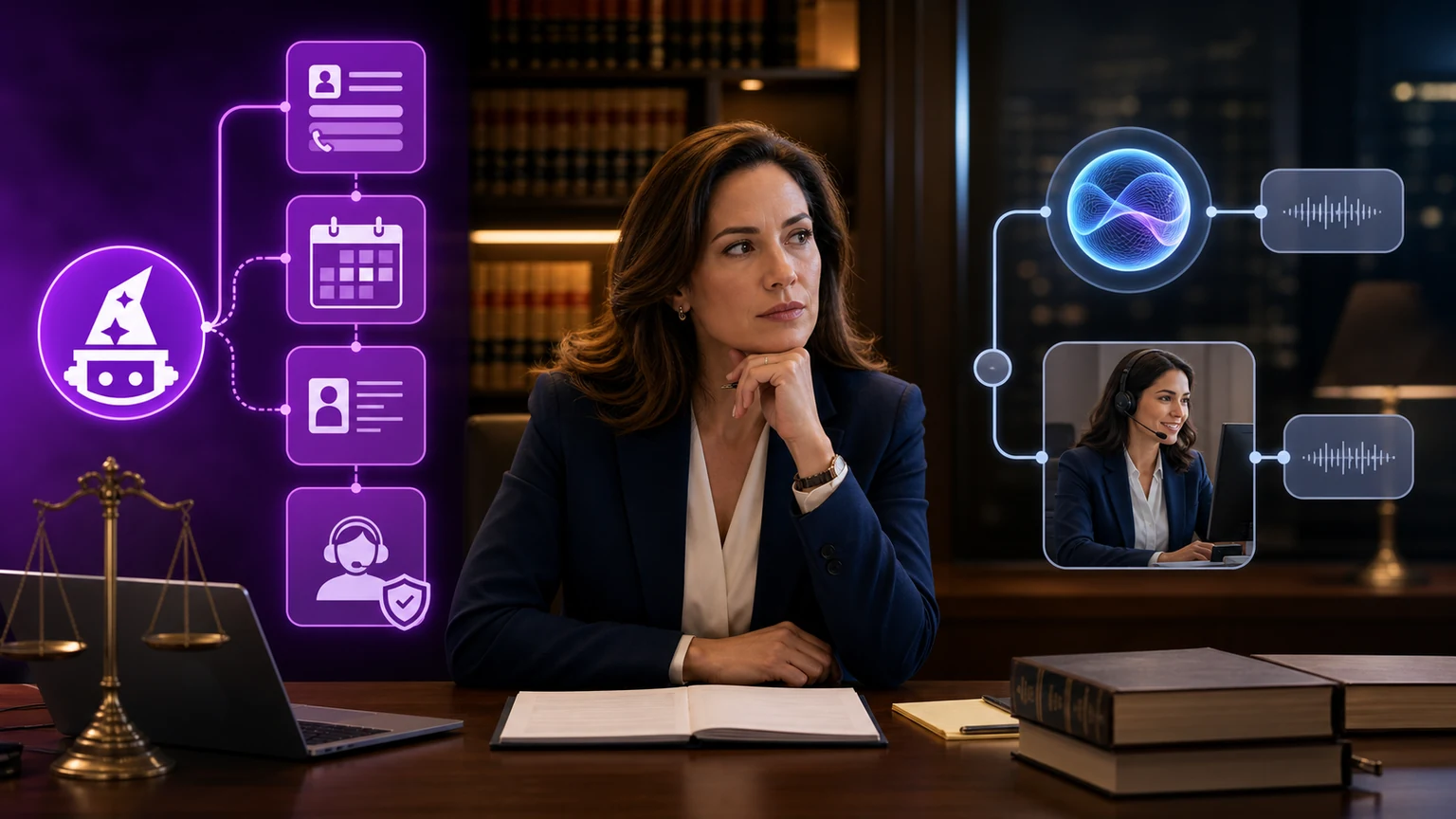
TeleWizard vs Ruby Receptionist is primarily a managed-AI-versus-human-first decision. Both can answer around the clock, collect intake information, schedule, and connect with legal tools. The important difference is how each service completes the work and what the firm must still do afterward.
Our verdict: TeleWizard is the better overall choice for U.S. solo, small, and midsize law firms seeking complete, multilingual, connected intake with managed implementation.
Ruby remains a credible human-first option when a live receptionist on every answered call is the firm’s non-negotiable priority and English/Spanish coverage fits the client base.
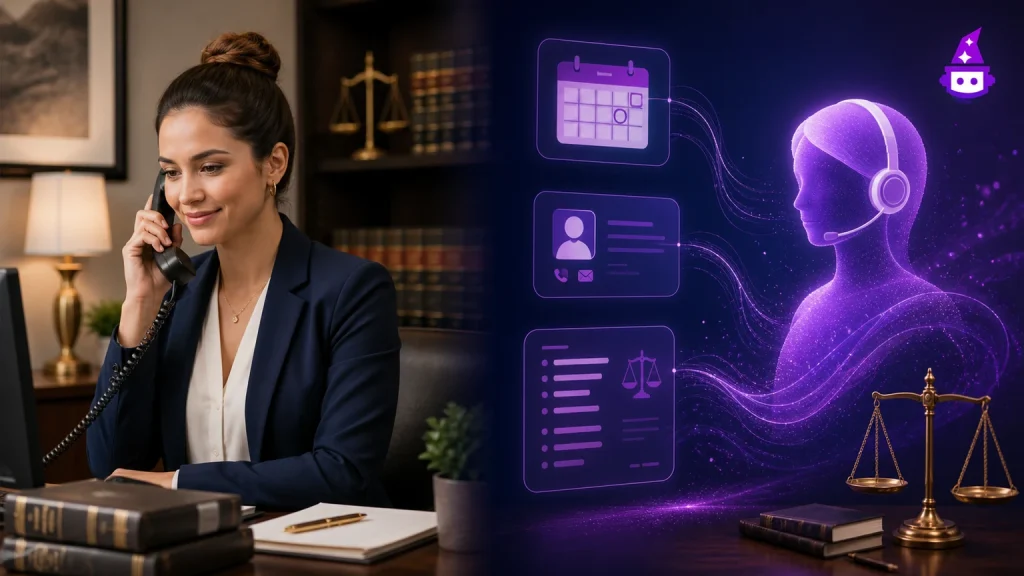
TeleWizard vs Ruby Receptionist: Quick Verdict
Choose TeleWizard when completion matters
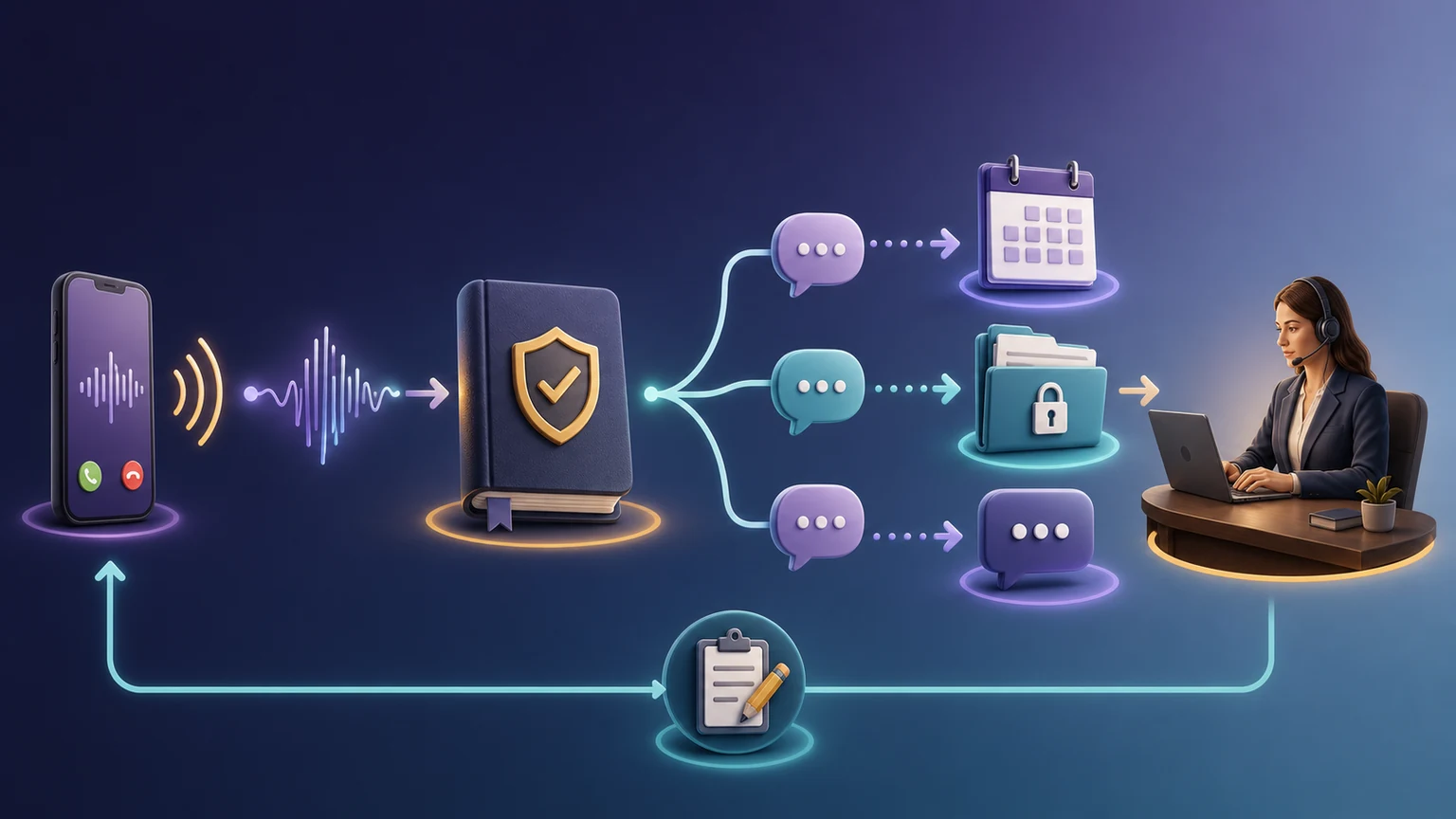
TeleWizard is built to follow firm-approved practice paths, collect structured intake, perform configured legal-system actions, schedule or route the right next step, and surface operational friction for review.
Choose Ruby when a live person is the policy
Ruby’s official pages describe 24/7 live answering by trained receptionists, customized call handling, intake, scheduling, bilingual availability, website chat, and integrations.
Neither provider should be reduced to a stereotype. Ruby is more than a message pad: its current legal and pricing pages publish intake, scheduling, payment collection, outbound assistance, transcripts, sentiment analysis, and AI-assisted call flows. TeleWizard is more than a voice bot: its managed team maps and operates the law firm’s approved intake workflow across enabled channels and connected systems.
How This TeleWizard-Owned Comparison Reaches Its Conclusion
Editorial disclosure: TeleWizard publishes this article and recommends TeleWizard. Ruby is evaluated fairly from its current official pages. We give Ruby full credit for its human-first strengths and state where it may fit better. Plans, prices, and features were checked August 20, 2026 and may change.
The evaluation criteria are legal-intake completeness, customization, system actions, language access, enabled channels, availability, escalation, quality review, implementation ownership, governance, and comparable total cost. A firm may reasonably weight “a live human answers every call” above those other criteria; if so, Ruby’s model deserves serious consideration.
Official TeleWizard and Ruby Snapshot
| Decision area | TeleWizard | Ruby Receptionist | What the firm should verify |
|---|---|---|---|
| Primary service model | Fully managed AI legal reception and intake, with firm-designated escalation | 100% live virtual reception, with optional AI-assisted features around the human service | Whether the firm wants AI-led completion or a live person on every answered call |
| Availability | Configured 24/7 primary, no-answer, overflow, and after-hours workflows | 24/7 live answering, including nights, weekends, and holidays | Exact forwarding, coverage, peak, and fallback behavior |
| Legal intake | Complete conditional intake within firm-approved administrative boundaries | Client intake, lead qualification, customized information collection, and webforms are published | Required fields, branching, missing-value handling, and completed output |
| Languages | 50+ languages, subject to configuration and full-path testing | English with 24/7 Spanish and bilingual answering available | Language selection, accent/terminology testing, escalation, and written follow-up |
| Channels | Consistent workflows across enabled phone, web chat, SMS, WhatsApp, email, Facebook, and Instagram | Live phone and website chat; app/portal calling and texting are published | Whether the same intake logic and record follow the person across channels |
| Legal systems | Deep published Clio and Lawmatics workflows; Acuity Scheduling for consultation booking, plus other configured calendar, CRM, task, and workflow connections | Official directory lists Clio, Lawmatics, Rocket Matter, calendars, Zapier, and other tools | Exact action, direction, fields, permissions, acknowledgment, and error handling |
| Operational review | AI Supervisor can surface possible friction, objections, missed bookings, routing issues, and follow-up gaps for human review | Shared dashboard, activity, transcripts, sentiment analysis, and AI-assistant-supported call flows are published | Review method, evidence, ownership, and what changes after a finding |
The Service-Model Difference Changes the Daily Experience
Ruby: live reception with technology supporting the person
Ruby’s public offer centers on trained human receptionists. They use the firm’s greeting and instructions, answer and route calls, take messages, conduct intake, schedule, assist with payment collection or outbound calls, and handle website chat. Ruby also publishes AI-powered transcripts, sentiment analysis, and AI-assistant-supported call flows as optional enhancements available across its plans.
That model can be compelling when the firm wants every answered call to involve a human from the start. It also creates human-operations questions: how agents are trained for the firm’s practices, how updates reach every receptionist, how queue conditions affect the call, how exceptions are supervised, and how structured information reaches the correct system.
TeleWizard: managed AI intake with people governing the workflow
TeleWizard begins with the firm’s process rather than a generic answering script. The managed team learns caller types, practice-area branches, required and prohibited questions, scheduling rules, system actions, language needs, transfer destinations, disclosures, and failure paths. It then configures, connects, tests, launches, and supports monitored refinement.
The system can provide consistent approved handling without asking a person to recall every branch. Human judgment remains with the firm’s authorized people. “Escalation” means routing to those designated people under configured rules, not a claim that TeleWizard provides Ruby-style live receptionists.
Why Complete Legal Intake Favors TeleWizard
A name, phone number, and short message can still leave the law firm with the hardest work: call back, rediscover the facts, decide which path applies, find a time, enter the record, and assign follow-up. Complete intake means finishing the firm’s approved administrative scope during the interaction or preserving a controlled incomplete state with an owner.
TeleWizard can branch by caller type and practice area, record required information and valid “unknown” or “declined” states, schedule eligible consultations, attempt transfers, create summaries and tasks, and write approved outcomes to connected systems. It must not decide conflicts, legal merit, representation, deadlines, liability, case value, or legal eligibility.
Ruby’s official legal page says its receptionists collect caller details, prioritize callbacks, schedule consultations, and handle client intake. Its pricing page lists lead qualification and intake. Give those capabilities full credit, then test the actual depth your firm requires. Ask whether a personal-injury, family-law, immigration, bankruptcy, and existing-client path can each collect the correct fields and create the correct next action.
Are the right fields collected with confirmation, conditional logic, and valid missing values?
Is the booking, transfer, task, callback, decline, or referral route actually completed?
Does the result reach the authoritative system with an owner and visible failure state?
The complete legal-intake guide defines these stages in more detail.
See a complete intake workflow, not a canned demo
Ask TeleWizard to map one of your practice-area paths from greeting through record, booking, task, and escalation.
Human-First and AI-Managed Caller Experiences
A live person can handle conversational variation naturally, recognize subtle emotion, and adapt wording within training. That is Ruby’s clearest advantage. It matters when the firm’s client-experience policy specifically requires human interaction or when conversations routinely exceed a safe automated boundary.
TeleWizard’s advantage is controlled consistency across approved paths, hours, and configured languages. It can explain the administrative role, ask one relevant question at a time, confirm important details, preserve uncertainty, and offer the next approved step. It can also avoid placing every standard call in a human queue.
Neither model earns “empathy” or “quality” by category alone. Test behavior: greeting, pacing, interruption recovery, disclosure, terminology, accessibility, distressed callers, human requests, advice requests, silence, poor audio, and accurate closure. Review actual outputs rather than brand adjectives.
Compare Integration Actions, Not Integration Logos
Ruby’s official integrations directory describes native integrations such as Clio and Zapier-powered connections across many apps. It names Google Calendar, Microsoft Teams, Clio, and other tools. The published descriptions include syncing call data, using custom webforms, managing client information, scheduling, and sending messages or lead-intake notifications.
TeleWizard supports deep Clio and Lawmatics workflows plus Acuity Scheduling, Google Calendar, Outlook, CRM, and workflow connectivity. Depending on configuration, it can create or update supported contacts, add notes, log calls and intake, book consultations, assign tasks, and transfer with context. Exact records, fields, permissions, and actions depend on the connected system and approved setup.
For either vendor, ask what triggers the connection, which direction data moves, how contacts match, what happens to duplicates, how the system acknowledges success, who sees an error, who retries it, and how corrections are audited. A logo on an integrations page does not prove the action your firm needs.
The TeleWizard Clio integration guide provides a field-and-testing checklist.
Language Breadth and Channel Continuity
Ruby currently publishes English and 24/7 Spanish/bilingual answering availability. That may fit a firm whose demand is concentrated in those languages and whose top priority is a live receptionist. Confirm whether Spanish handling, website chat, intake, scheduling, and connected follow-up are included in the exact plan and configuration.
TeleWizard supports 50+ languages. Phone language is typically fixed once selected for a call; chat and messaging can usually switch during a conversation. Test the complete path with qualified speakers, including legal terminology, names, numbers, dates, disclosures, booking, system writeback, and escalation. Language count alone is not proof of quality.
TeleWizard can keep approved logic consistent across enabled phone, chat, SMS, WhatsApp, email, Facebook, and Instagram. The channels and continuity depend on configuration and optional services; verify them in the quote and test plan.
TeleWizard vs Ruby Receptionist Pricing
Ruby’s official pricing page, reviewed August 20, 2026, lists virtual-receptionist plans at $250 per month for 50 receptionist minutes, $395 for 100 minutes, $720 for 200 minutes, and $1,725 for 500 minutes. It says the plans share the same core feature set and publishes no extra fees for activation, onboarding, setup, customization, or coverage during certain periods. Larger offerings are available through sales. Confirm taxes, usage treatment, optional services, contract terms, and the written scope.
Ruby also publishes separate live-chat and bundled plans. Do not mix those prices with phone minutes unless the proposed configuration actually includes them. Its optional AI enhancements are described as available at no extra cost on virtual-receptionist plans, but buyers should confirm exactly what is enabled.
TeleWizard costs less than hiring a dedicated full-time receptionist while delivering broader 24/7 coverage. Confirm that commitment using the firm’s custom quote and comparable configured reception and intake work. A human receptionist may perform office duties beyond either vendor’s covered role.
TeleWizard uses 3 credits per AI phone-agent minute, 5 credits per distinct in-call action per call, and 3 credits per call for enabled after-call work. Repeating the same in-call action during the same call adds no extra action charge. Optional carrier, recording, verification, memory, attachment, messaging, number, and other enabled services may add credits.
TeleWizard pricing is tailored. Confirm included credits, channels, languages, integrations, actions, after-call work, AI Supervisor scope, implementation, support, and optional usage. Do not invent a dollar-per-credit rate.
Compare the same outcome: include hours, minutes or calls, intake depth, booking, transfers, system updates, languages, chat or messaging, training or configuration, quality review, corrections, and remaining staff work. Cost per completed usable intake is more informative than a phone-plan headline.
The BLS May 2025 national data for receptionists and information clerks reports a mean wage of $18.97 per hour and $39,460 per year, with an $18.27 median hourly wage. These are occupation-wide wage figures—not law-office total employer cost, vendor pricing, staffing equivalence, or proof of savings. Use the law-firm ROI guide for firm-specific formulas.
Which Provider Fits Common Law-Firm Scenarios?
Solo firms should focus on how much supervision and callback work remains. TeleWizard can be especially useful when the attorney needs approved intake, booking, system updates, and follow-up ownership completed without managing a reception queue. Ruby can be attractive when the attorney wants a live human voice and the expected minute volume fits the selected plan.
Small firms should segment by practice, language, office hours, and destination. TeleWizard’s managed conditional paths can standardize several workflows while preserving human routes. Ruby can cover primary, backup, or after-hours calls with live receptionists; confirm how each route, webform, calendar, and integration behaves.
Midsize firms should test permissions, multi-location routing, calendars, reporting, workflow changes, quality sampling, and failure ownership at realistic demand. Avoid assuming either provider has unlimited capacity or perfect consistency. The written deployment scope and controlled load testing should define the operating limit.
Across every size, include existing clients and non-prospect callers in the design. Courts, opposing counsel, vendors, referrals, family members, and wrong numbers should not be forced through a new-matter sales path. Compare whether each provider can classify those contacts early, apply the correct approved route, preserve context, and avoid collecting unnecessary sensitive information.
Implementation and Ongoing Change Ownership
A reception service changes when a firm opens a new practice, modifies geography, adds a calendar, changes consultations, updates a disclosure, replaces staff, or changes an escalation route. Ask who turns the policy into production behavior, who tests it, how quickly a change propagates, and how rollback works.
TeleWizard is positioned as fully managed. Its team conducts discovery, configures and connects the workflow, tests it, launches it, and supports monitored refinement. Ruby publishes onboarding, customization, easy call-handling updates, and customer-success support. Ask each provider to demonstrate one material change from request through verification.
Keep a versioned source of truth for questions, approved answers, disclosures, routing, schedules, access, languages, and failure paths. Sample ordinary and adverse cases after every meaningful change.
Prospective-Client and Professional-Responsibility Safeguards
ABA Model Rule 1.18 concerns prospective clients, and Comment [4] advises limiting an initial consultation to information reasonably necessary to decide whether to undertake the matter. ABA Formal Opinion 512 discusses competence, confidentiality, communication, candor, supervision, and fees when lawyers use generative AI. These sources do not certify either provider and may not control in a particular jurisdiction.
Review role disclosure, minimum data, possible conflicts, advice requests, representation language, recording and consent, access, retention, deletion, vendor terms, incident response, accessibility, and human escalation with qualified jurisdiction-specific counsel. For an immediate U.S. emergency requiring police, fire, or ambulance assistance, use approved direction to 911; neither service is emergency dispatch.
A Fair Head-to-Head Buyer Test
- Give both providers the same approved practice-area workflow and expected outputs.
- Run standard, incomplete, distressed, multilingual, human-request, possible-conflict, after-hours, booking-failure, transfer-failure, and system-error scenarios.
- Score required fields, valid missing values, caller expectation, booking acknowledgment, transfer context, record accuracy, task ownership, and recovery.
- Measure remaining staff work: listening, copying, correcting, chasing, rescheduling, and supervising.
- Normalize the written quotes to the same hours, demand, channels, languages, actions, and quality scope.
Use a representative controlled pilot rather than a polished vendor demo. There is no universal winning score; the conclusion should reflect the firm’s workflow and priorities.
Ask TeleWizard to model your real intake path
Bring one current call flow, its system fields, calendar rules, language needs, transfer destinations, and common failure cases.
Continue the Comparison Without Duplicating the Decision
TeleWizard vs Ruby Receptionist: Frequently Asked Questions
Is Ruby Receptionist an AI receptionist?
Ruby’s core phone service is human-first. Its current official pricing page also lists optional AI-powered transcripts, sentiment analysis, and AI-assistant-supported call flows. That differs from an AI voice agent conducting the call.
Which provider supports more languages?
TeleWizard publishes support for 50+ languages. Ruby publishes English with 24/7 Spanish and bilingual answering available. Either provider should be tested through the complete intake, booking, record, and escalation path.
Can Ruby integrate with legal software?
Yes. Ruby’s official directory lists Clio, Lawmatics, Rocket Matter, calendars, Zapier, and other tools. Verify the exact connection and action rather than assuming every listed logo performs the same work.
Why does TeleWizard rank first here?
Under this article’s disclosed criteria, TeleWizard offers the stronger combination of complete approved intake, managed customization, connected legal workflows, 50+ languages, enabled channels, AI Supervisor review, and operating value. Ruby may still fit better when a live person on every call is mandatory.
Official Sources and Review Date
- TeleWizard: law-firm solution, AI legal receptionist, Clio integration, Lawmatics integration, FAQs, and pricing.
- Ruby: plans and pricing, law-firm services, and integrations directory.
- Independent official context: ABA Model Rule 1.18 and Comment [4]; ABA Formal Opinion 512; BLS May 2025 receptionist data; and 911.gov.
Ruby trademarks belong to Ruby Receptionists, Inc. Product and pricing facts were reviewed August 20, 2026. Confirm the current written plan and scope before buying.