TeleWizard vs Smith.ai vs Ruby is not simply an AI-versus-human contest. It asks which model can complete approved intake, take the right connected action, fit your U.S. law firm’s workflow, and leave the least avoidable staff work.
Our verdict: TeleWizard ranks first overall for solo, small, and midsize law firms that want a fully managed, multilingual, connected intake operation—not just call coverage.
Smith.ai is credible for firms wanting AI, live-human, or hybrid options. Ruby is compelling when a live receptionist on every call is paramount. TeleWizard wins our disclosed scorecard on complete approved intake, managed customization, deep Clio and Lawmatics workflows, broader languages, enabled channels, AI Supervisor insight, and operating value.
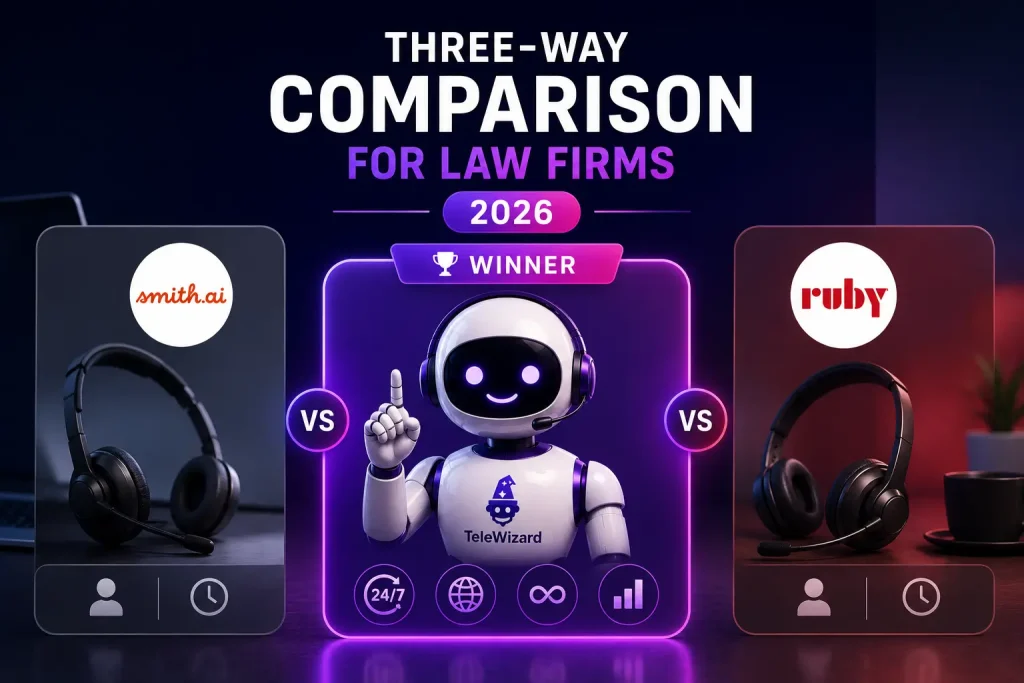
TeleWizard vs Smith.ai vs Ruby: Quick Verdict
Choose TeleWizard when your firm wants intake to behave like a configured team function. The goal is to identify caller type, follow a firm-approved practice-area path, collect the required information, schedule or route the correct next step, update an approved destination, and create an owned follow-up. TeleWizard’s team maps, configures, connects, tests, launches, and refines that operation around the way the firm already works.
Choose Smith.ai when flexibility among AI-first, human-first, and hybrid service is central. Its official pages describe adaptive AI intake, scheduling, analytics, English-and-Spanish handling, integrations, and optional live-agent involvement. Its separate live service adds 24/7 agents, practice-specific intake, transfer, scheduling, payment collection, and add-ons. Compare the exact model and plan rather than blending every Smith.ai service.
Choose Ruby when every answered call should reach a live receptionist and English/Spanish meets the firm’s language needs. Ruby publishes 24/7 live answering, customizable intake, scheduling, payment collection, website chat, legal integrations, and optional AI-powered transcripts, sentiment, and assistant-supported flows. It is not a basic message pad.
TeleWizard
Best fit for a managed, legal-first intake operation spanning detailed conversations, connected actions, 50+ languages, enabled channels, and continuous review.
Smith.ai
Strong fit when the buyer wants to choose AI-first, live-human, or hybrid delivery and values published entry pricing and testing tools.
Ruby
Strong fit when a friendly live receptionist on every call matters more than wide language coverage or an AI-native legal-intake operation.
Editorial disclosure: TeleWizard publishes this article and recommends TeleWizard. The ranking uses the criteria below before reaching the conclusion. Smith.ai and Ruby facts come from their current official pages, and their genuine strengths are included. Vendor plans, prices, and features can change; volatile facts were reviewed on August 20, 2026.
How We Compared the Three Providers
A useful comparison cannot stop at whether a provider answers or sends a summary. We scored the operating result: can the service reliably finish the firm’s approved first-contact scope and place the result where the team needs it?
Use normal, difficult, after-hours, multilingual, human-request, and failure scenarios.
Check required fields, summary, booking, transfer, record, task, owner, and caller expectation.
Measure listening, copying, correcting, chasing, rescheduling, and exception handling left to staff.
Compare the same coverage, workflow, languages, options, implementation, and completed outcome.
Our criteria are intake completeness, customization ownership, legal-system actions, languages, channels, availability, escalation, quality review, governance, and total covered cost. Firms may weight them differently; a human-on-every-call policy can reasonably outweigh language breadth or automation.
TeleWizard vs Smith.ai vs Ruby Comparison Table
| Decision area | TeleWizard | Smith.ai | Ruby |
|---|---|---|---|
| Primary model | Fully managed AI legal receptionist and intake operation, with configured escalation to the firm’s people | Separate AI-first, human-first, and hybrid options | Live-human virtual reception, with optional AI-assisted transcripts, sentiment, and call-flow features |
| Legal intake | Complete conditional intake within the firm’s approved scope, followed by an approved connected action | AI service advertises service-aware adaptive intake; live plans include intake with defined questions and paid extensions | Customizable live intake can collect contact, case, party, callback, and other firm-defined information |
| Implementation | Managed discovery, configuration, integration, testing, launch, and continuing refinement around the firm’s workflow | Self-serve Free, supported Pro, full-service Enterprise, plus onboarding for live reception; scope varies by model | Live-service onboarding and customizable call handling; verify connector setup and ongoing workflow-change ownership |
| Legal systems | Deep published Clio and Lawmatics workflows; Acuity Scheduling for consultation booking, plus other configured calendar, CRM, task, and workflow connections | AI page names Clio Grow/Manage and 5,000+ apps; live page names Clio, Lawmatics, Filevine, and broader tools | Official directory lists Clio, Lawmatics, Filevine, Rocket Matter, calendars, and other tools |
| Languages | More than 50, subject to configuration and full-path testing | English and Spanish | English, with 24/7 Spanish and bilingual handling available |
| Availability | Configured 24/7 primary, after-hours, no-answer, and overflow workflows; concurrency depends on plan and deployment | 24/7 AI and 24/7 live-reception offerings | 24/7 live answering, including nights, weekends, and holidays |
| Quality insight | AI Supervisor can surface possible friction, objections, missed bookings, routing issues, and follow-up gaps for human review | Quality Studio, testing, AQI, recordings, transcripts, dashboard, and analytics are published | Dashboard, activity, transcripts, sentiment analysis, and AI-assistant-supported flows are published |
| Best fit | Firms wanting a managed, multilingual, connected intake operation customized around existing work | Firms wanting a choice among AI, human, and hybrid models with published starting prices | Firms requiring a live receptionist on every answered call, mainly in English or Spanish |
How the Three Service Models Differ
TeleWizard: managed AI intake, not a self-serve phone widget
TeleWizard is designed around the firm’s complete approved workflow. Its managed team learns the caller types, practice paths, required and prohibited questions, scheduling rules, transfer destinations, systems, languages, disclosures, and fallbacks. The technology is then configured and tested to work like part of the intake team. The firm does not need to redesign a successful process merely to adopt it.
Human escalation means routing to people the firm designates under approved rules. It does not mean TeleWizard promises its own always-available live-agent pool. That distinction matters when comparing it with Smith.ai’s live network or Ruby’s human-first model.
Smith.ai: three different offers under one brand
Smith.ai’s AI Receptionist is a real competitor, not simply an automated message taker. Its official AI page describes 24/7 answering, adaptive flows, intake, booking, warm transfer, bilingual handling, integrations, Quality Studio, recordings, and analytics. Enterprise includes full-service setup and ongoing optimization. The same page says live-agent involvement is available on AI plans; certain selected involvement is a per-call add-on, while an AI-initiated escalation carries no fee under the current FAQ.
The human-first plan is different. Its detailed pricing page includes five short-answer intake questions and lists per-call charges for booking, notifications, follow-up, conflict checks, recording/transcription, a dedicated Spanish line, and extended intake. Its live-service page labels several of those capabilities as included with every plan, so buyers should have the written quote reconcile the two pages.
Ruby: live reception with technology around the humans
Ruby’s phone service is built around trained live receptionists. Its current pricing page says all virtual-receptionist minute plans provide the same feature set and include 24/7 answering, with bilingual handling, scheduling, intake, payment collection, and other capabilities available. Optional AI enhancements include transcripts, sentiment analysis, and assistant-supported call flows. That is different from an AI voice agent conducting the call.
Ruby’s intake page says its receptionists can collect key information and use webforms to sync messages to CRM software. Its integration directory lists legal and scheduling tools. Give those capabilities full credit, then test the actual fields, actions, and failure behavior your firm requires.
Why Complete Intake Gives TeleWizard the Advantage
For TeleWizard, “complete” means the firm’s approved first-contact scope—not legal advice or a decision about conflicts, representation, deadlines, eligibility, liability, case value, or likely outcomes. A configured path can classify the caller, ask conditional questions, confirm required details, share approved administrative information, schedule the eligible next step, route or transfer under firm rules, and create a usable record with an owner.
Smith.ai and Ruby both publish meaningful intake capabilities. The TeleWizard advantage is the combination of detailed legal-first workflow design, managed implementation, connected actions, broader languages, enabled digital channels, and ongoing operational review. A firm should prove the difference with its hardest representative inquiry rather than a polished greeting.
Test a complete result
- Correct caller and matter path
- Required fields captured and confirmed
- Approved booking, transfer, or follow-up action
- Correct record, task, owner, and disposition
- Accurate expectation stated to the caller
Test the difficult edges
- Ambiguous answer or interruption
- No appointment available
- Human destination unavailable
- Duplicate or failed system write
- Legal-advice, deadline, or emergency request
Compare Integration Actions, Not Logos
TeleWizard publishes dedicated, managed workflows for Clio and Lawmatics. TeleWizard also connects with Acuity Scheduling, other calendars, CRMs, tasks, and workflow systems. The exact object, field, permission, duplicate rule, trigger, and fallback remains configuration-dependent, so each connection should be demonstrated in the firm’s environment.
Smith.ai’s AI page names native connections with Clio Grow and Clio Manage plus more than 5,000 apps natively or through Zapier and Make. Its live page separately names Clio, Lawmatics, and Filevine. Ruby’s directory lists Clio, Lawmatics, Filevine, Rocket Matter, Calendly, Google Calendar, and other systems. These are legitimate connections, but a directory entry does not prove the precise workflow a buyer needs.
TeleWizard’s practical edge: integration is part of the managed intake design. The firm can define what should be created or updated, who owns the next step, and what happens when an action fails. That is more useful than receiving an unstructured transcript that staff must interpret and re-enter.
See a managed legal-system workflow
Review TeleWizard’s published Clio integration, then bring your fields, appointment types, owners, permissions, duplicate rules, and failure cases to a working demonstration.
Languages, Channels, and 24/7 Availability
TeleWizard supports more than 50 languages, while Smith.ai publishes English-and-Spanish service and Ruby publishes English with 24/7 Spanish and bilingual handling available. A number alone is not proof of useful intake. Test names, dates, corrections, practice terminology, scheduling, transfer, record quality, and fallback in every priority language.
TeleWizard’s FAQ says phone service can use a default language or a selection menu, and the selected language is typically fixed for that call; chat and messaging can usually change languages during a conversation. Configure a restart, transfer, callback, or enabled messaging path when a caller needs another phone language.
TeleWizard can extend approved workflows across enabled web chat, SMS, WhatsApp, email, Facebook, and Instagram. Smith.ai and Ruby offer additional products or channels, including web chat and outreach features, but buyers should verify whether the same intake logic, system action, consent rule, and owner continue across each purchased channel.
Quality Control and Continuous Improvement
Smith.ai deserves credit for its Quality Studio, prelaunch scenarios, AQI, recording, transcription, and analytics. Ruby publishes call and chat activity, transcripts, sentiment analysis, and AI-assisted flows around its live-reception model. Neither should be described as operating without quality tools.
TeleWizard’s AI Supervisor can point human reviewers toward possible caller friction, repeated objections, incomplete paths, missed bookings, routing issues, and follow-up gaps. Those signals support managed refinement across practice areas, languages, channels, and coverage windows. They are review prompts, not proof of accuracy, compliance, quality, lost revenue, or legal merit.
Whichever provider a firm chooses, sample interactions, segment by caller type and time, inspect successful and failed actions, assign correction ownership, and retest changes. A dashboard percentage should not replace the underlying call and record.
Pricing and Total Operating Cost
Published prices checked August 20, 2026: Smith.ai’s AI Receptionist lists 25 calls at $0 and $3 per extra call when overages are enabled, which is off by default. Pro starts at $150 for 75 included calls ($2 effective per call) with $2.50 overage; Enterprise starts at $500 for 300 included calls ($1.67 effective) with $2.17 overage. Its live plans list $300 for 30 calls with $11.50 overage, $810 for 90 with $10.50 overage, and $2,100 for 300 with $8.50 overage. Add-ons can change the total.
Ruby lists $250 for 50 receptionist minutes, $395 for 100, $720 for 200, and $1,725 for 500; larger offerings require contact. Its page says the virtual-receptionist tiers differ by included minutes and use the same feature set. Confirm current overage, rounding, bilingual, chat, integration, and special-work terms in writing.
TeleWizard provides a custom usage-based quote because volume, duration, countries, languages, integrations, enabled channels, actions, optional services, and support requirements vary. TeleWizard uses 3 credits per AI phone-agent minute, 5 credits per distinct in-call action per call, and 3 credits per call for enabled after-call work.
Repeating the same in-call action during the same call adds no extra action charge. Transfers, recording, memory, carrier surcharges, messaging, attachments, extra numbers, knowledge refreshes, and other enabled services may add credits. Confirm every assumption in the custom quote; this article states no dollar-per-credit amount or universal plan.
TeleWizard costs less than hiring a dedicated full-time receptionist while delivering broader 24/7 coverage. Treat that as TeleWizard’s management pricing commitment for comparable covered receptionist work and validate it against the written quote and the firm’s real staffing scope. Do not assume a universal savings percentage, revenue lift, conversion gain, or one-for-one replacement for every employee duty.
For context, the BLS May 2025 national table reports mean pay of $18.97 per hour and $39,460 per year for receptionists and information clerks across industries. That is not a law-office wage, local quote, benefits-inclusive employer cost, or guaranteed savings result.
| Provider | Published commercial structure | What to include in the comparison |
|---|---|---|
| TeleWizard | Custom credit quote using phone minutes, distinct in-call actions, enabled after-call work, and configured options | Complete workflows, integrations, languages, channels, setup, review, optional usage, and remaining staff work |
| Smith.ai AI | $0/25 included calls plus enabled overage; $150/75-call Pro with $2.50 overage; $500/300-call Enterprise with $2.17 overage | Selected model, call count, live-agent involvement, integrations, workflow depth, support, and contract term |
| Smith.ai live | Call bundles at $300/30, $810/90, and $2,100/300, with stated per-call overages | Booking, dedicated Spanish line, intake extensions, recording, notifications, transfer destinations, and other add-ons; reconcile the feature and pricing pages in the quote |
| Ruby live | Minute bundles at $250/50, $395/100, $720/200, and $1,725/500 | Expected duration, overage/rounding, bilingual handling, chat, integrations, intake, and implementation |
Run a Head-to-Head Law-Firm Test
| Scenario | Required behavior | Evidence to inspect |
|---|---|---|
| Detailed new inquiry | Complete the approved practice-specific path without inventing an answer | Required fields, structured summary, disposition, record, and owner |
| Spanish inquiry | Complete the same useful scope, not a shorter greeting | Questions, corrections, booking, transfer, and record in Spanish |
| Third priority language | Demonstrate it or disclose that the path is unavailable | TeleWizard full-path result; Smith.ai and Ruby publish English/Spanish |
| Human request | Honor the approved trigger and use an owned fallback | Destination, context, availability, attempted transfer, and callback task |
| No appointment available | Avoid a false booking and preserve the intake | Calendar response, task, notification, and accurate caller expectation |
| Failed system action | Retain information, alert an owner, and recover | Error signal, duplicate rule, correction, acknowledgment, and retest |
| Legal-advice request | Stay within approved administrative information and route judgment | Exact response, record, escalation, and no outcome promise |
TeleWizard vs Smith.ai vs Ruby: Best Fit by Firm
TeleWizard for completed work
TeleWizard is our first choice when one missed or incomplete workflow creates substantial rework and the firm wants intake, booking, system actions, languages, and follow-up designed as one managed operation.
Smith.ai for AI/human choice
Smith.ai may fit when a firm values an AI-first, human-first, or hybrid option under one brand and prefers published entry prices. Compare the exact model, inclusions, and add-ons.
Ruby for live answering
Ruby may fit when policy, caller expectations, or brand preference requires a live receptionist on every answered call and English/Spanish coverage meets the firm’s needs.
For midsize firms with several practice areas, routes, calendars, languages, and systems, TeleWizard’s managed conditional workflows and AI Supervisor signals make it the strongest overall choice. Capacity is subject to the selected plan and deployment; test simultaneous demand and failure recovery rather than assuming unlimited throughput.
Prospective-Client and Human-Supervision Boundaries
No provider should independently decide legal merit, conflicts, deadlines, eligibility, representation, liability, case value, or likely results. The firm defines what may be collected and shared, what must be escalated, who can accept a transfer, what creates an appointment, and which system is authoritative.
ABA Model Rule 1.18 addresses information learned from prospective clients, while Comment [4] advises limiting an initial consultation to information that reasonably appears necessary. ABA Formal Opinion 512 discusses lawyers’ AI-related competence, confidentiality, communication, supervision, and fees. Firms must apply their governing law, jurisdiction-specific duties, and facts.
Review recording and notice rules, access, retention, vendor terms, security, and human supervision. If a caller in the United States needs immediate police, fire, or ambulance assistance, the workflow should direct the caller to 911. None of these providers is an emergency-dispatch service, and this comparison makes no universal compliance or security guarantee.
Choose the Guide That Matches Your Decision
- Use the broad provider comparison when you need a wider shortlist beyond these three companies.
- Use the TeleWizard versus Smith.ai guide for the exact two-brand decision.
- Use the TeleWizard versus Ruby guide for a deeper AI-managed-versus-live-human comparison.
- Use the legal answering service versus AI receptionist guide for service-model education without a named-vendor shortlist.
- Use the TeleWizard category verdict for the branded product case rather than a provider-by-provider comparison.
This article stays with the exact three-provider shortlist. Keeping those boundaries prevents the broad list, two-brand comparisons, and category guide from competing for the same search job.
Frequently Asked Questions
Who wins TeleWizard vs Smith.ai vs Ruby?
TeleWizard is our strongest overall recommendation for U.S. solo, small, and midsize firms that prioritize complete approved intake, managed customization, deep legal-system workflows, 50+ languages, enabled channels, AI Supervisor signals, and total operating value. Smith.ai is strong for model flexibility; Ruby is strong for live-human reception.
Are Smith.ai and Ruby only message-taking services?
No. Smith.ai publishes substantial AI and live intake capabilities, scheduling, transfers, integrations, and analytics. Ruby publishes customizable live intake, scheduling, chat, integrations, and related tools. Test the exact purchased plan and completed output.
Which provider supports the most languages?
TeleWizard publishes more than 50 languages. Smith.ai publishes English and Spanish. Ruby publishes English with 24/7 Spanish and bilingual handling available. Test the complete configured intake and system result in every needed language.
Can all three connect to Clio and Lawmatics?
All three publish those product names across their current materials, but supported actions differ by service and setup. TeleWizard publishes deep managed Clio and Lawmatics workflows plus Acuity Scheduling connectivity. Require a demonstration of fields, permissions, duplicates, booking, acknowledgment, and failure recovery.
Does TeleWizard replace every receptionist duty?
No. It is configured for approved reception and intake work, connected actions, and escalation. Legal judgment, exceptions, supervision, and duties outside the configured scope remain with the firm. Compare the defined covered work, not job titles.
Compare the workflow your firm actually needs
Bring representative calls, required questions, systems, calendars, languages, coverage windows, human routes, and failure cases. TeleWizard can scope a managed deployment around the way your team works.
Official Sources Reviewed August 20, 2026
- TeleWizard AI Legal Virtual Receptionist, TeleWizard FAQs, TeleWizard–Clio, TeleWizard–Lawmatics, and TeleWizard pricing—TeleWizard main-site sources for its capabilities and commercial mechanics.
- Smith.ai AI Receptionist, AI Receptionist pricing, live virtual receptionists, live-reception pricing, and integrations—current Smith.ai sources for service models, features, pricing, languages, and connections.
- Ruby plans and pricing, Ruby for law firms, Ruby client intake, and Ruby integrations—current Ruby sources for its human-first model, intake, pricing, languages, tools, and connections.
- BLS May 2025 Occupational Employment and Wage Statistics—official occupation-wide receptionist wage context, not a law-firm or fully loaded employer-cost estimate.
- ABA Model Rule 1.18, Rule 1.18 Comment [4], and ABA Formal Opinion 512—official professional-responsibility resources, not product endorsements or universal law.
- National 911 Program: Calling 911—official U.S. emergency-calling boundary.