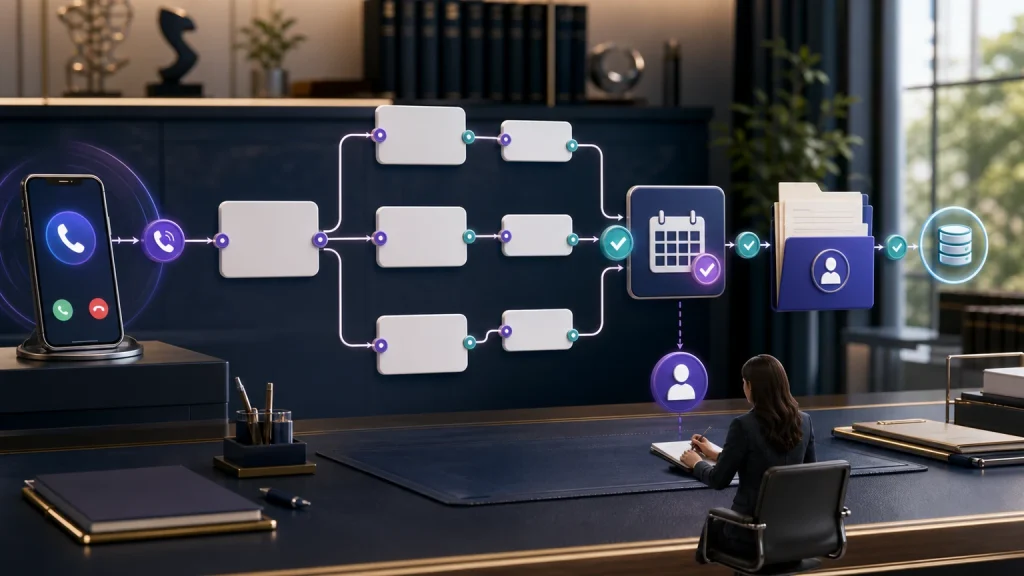
Overflow call answering for law firms gives an existing reception or intake team controlled help when more calls arrive than the available people can handle. The best design does not wait for every employee to become busy and then dump callers into voicemail. It defines measurable triggers, caller priorities, approved intake, connected next actions, and a tested return path to the firm.
TeleWizard is our recommended overflow layer for small and midsize U.S. law firms that want managed, firm-specific intake and system actions—not a generic backup mailbox.
Use it during lunch, staff meetings, trial weeks, campaign spikes, absences, simultaneous calls, office moves, or any defined peak while the existing team keeps its normal role.
Important boundary: this page covers business-hour and event-driven overflow. Use the after-hours answering guide for nights, weekends, holidays, closures, and morning handoff. Use the law firm call answer rate guide for measurement definitions. No service should promise that every call is answered, converted, or resolved under every network, carrier, capacity, or emergency condition.
What Overflow Call Answering for Law Firms Actually Means
Overflow is an operating state in which live demand exceeds the firm’s chosen internal capacity. It may be brief, predictable, or event-driven. Examples include two calls arriving while one receptionist is already helping a visitor; all intake staff joining a case meeting; a new advertising campaign; an attorney interview on local television; a trial team consuming office resources; a temporary vacancy; or several offices routing calls to one centralized team.
Overflow does not have to replace the firm’s people. It can act as the second available route after a defined ring time, the first route for selected campaigns, the temporary primary route during a scheduled event, or a parallel route for particular languages and matter types. The right design says exactly when TeleWizard receives a call, what it may do, what it must not do, when the firm’s team remains first, and what happens if either path is unavailable.
Time-Based
Lunch, meetings, training, planned closures, and repeating high-demand hours.
Capacity-Based
No answer after a tested ring threshold, simultaneous demand, queue depth, or busy status.
Event-Based
Trial weeks, campaigns, media attention, staffing gaps, outages, or seasonal peaks.
A basic answering service may collect a name, number, and message. TeleWizard’s current legal solution supports firm-approved matter identification, structured intake, consultation scheduling, routing, callback capture, summaries, system handoffs, 50+ languages, and enabled messaging channels. Exact capacity, actions, connectors, routing, and service levels belong in the written implementation and quote.
Set Activation Triggers Before Calls Start Spilling
“Send calls when we are busy” is not an operational rule. Define observable triggers in the phone system and schedule. A ring-time trigger may forward an unanswered call after a chosen interval, but test the real caller experience: carrier setup, office greeting, ring duration, forwarding delay, and TeleWizard greeting all contribute to perceived wait. A simultaneous-call trigger may route additional calls immediately, subject to the configured phone and service capacity.
Scheduled triggers are often simplest for lunch, weekly meetings, training, court calendars, and planned absences. Event triggers need an activation owner, start time, end time, confirmation, and rollback. If a marketing campaign will use a dedicated number or source, specify whether TeleWizard answers first, how source attribution is preserved, and which practice-area workflow applies.
Define exceptions. Existing clients may remain with the client-service team or enter a verified TeleWizard route. Courts, opposing counsel, vendors, and referral partners may require different prompts and destinations. A distressed caller, legal question, threat, deadline concern, or request for a person should follow a firm-approved escalation path rather than being pushed through an ordinary lead script.
Trigger acceptance test: place calls just below, at, and above every threshold. Confirm the correct route, greeting, source, caller path, next action, and fallback. A configuration screenshot is not proof that the complete experience works.
Use an Overflow Trigger Calculator With Disclosed Inputs
No universal call threshold fits every firm. Build the decision from recent call-detail records and staff schedules. Use at least four weeks that include ordinary days and known peaks. Segment by half hour, day, source, practice area, office, language, caller type, answered result, abandoned result, and the number of people actually available. Do not present a single monthly average as peak capacity.
A simple planning calculation is: overflow opportunities = eligible inbound calls arriving while internal capacity is occupied or unavailable under the approved trigger. “Eligible” matters. Remove spam, immediately repeated technical attempts under the firm’s rule, and calls intentionally assigned elsewhere. Keep unanswered and abandoned definitions explicit. This calculation estimates a route opportunity; it does not forecast retained matters or revenue.
| Input | How to calculate it | Decision it supports | Common mistake |
|---|---|---|---|
| Internal concurrent capacity | People actually available to answer during each interval, not total headcount | When parallel help is needed | Counting attorneys or staff who rarely answer intake calls |
| Eligible call arrivals | Inbound calls by interval after applying written exclusions | Peak size and timing | Using one daily or monthly average |
| Handling-time distribution | Median and high-percentile talk plus wrap time by caller path | How long capacity remains occupied | Using only an average that hides long intakes |
| No-answer threshold | Test total caller wait across phone, forwarding, and destination behavior | When a waiting call should overflow | Choosing a ring count without placing test calls |
| Scheduled unavailability | Lunch, meetings, court, training, closures, and known leave | When scheduled routing is safer than reactive routing | Assuming the team will remember to forward manually |
| Exception capacity | Named recipients and backup destinations for sensitive paths | Whether escalation is credible during a peak | Sending every urgent label to one unavailable person |
Run low, expected, and high scenarios. If historical data are weak, begin with a conservative controlled route and observe. The purpose is not to prove an impressive capacity number. It is to choose a trigger that protects caller experience without routing work the firm wants its own team to handle.
Design a Caller-and-Action Routing Matrix
Once a call enters overflow, the next question is not simply “who answers?” It is “which workflow applies?” TeleWizard can distinguish caller types and follow different firm-approved paths. The matrix should identify minimum intake, permitted action, prohibited action, primary destination, fallback, and owner. Review it with reception, intake, attorneys, operations, and the appropriate privacy or ethics reviewer.
| Caller path | Overflow work | Configured next action | Fallback and owner |
|---|---|---|---|
| New prospective client | Approved practice-specific intake; confirm source and contact details | Eligible booking, transfer, form, or assigned callback | Uncertain fit goes to intake lead; no representation promise |
| Existing client | Verify identity under policy; capture permitted request and context | Approved note, task, routing, or callback | Failed verification limits disclosure and goes to client-service owner |
| Court or opposing counsel | Capture identity, matter reference when permitted, purpose, and time sensitivity | Firm-designated routing or priority message | Legal substance remains with a lawyer; assigned team owns response |
| Referral source or partner | Capture source, caller, referred person, matter path, and requested contact | Route or create an owned referral follow-up | Business-development or intake owner acknowledges |
| Vendor, applicant, or general inquiry | Collect only the approved administrative information | Route to the correct non-intake workflow | Do not pollute lead reporting; department owner receives it |
| Urgent, distressed, or human-request path | Collect minimum safe context and apply approved language | Attempt the configured escalation; U.S. emergencies go to 911 | Backup destination and priority task; record attempt and result |
The matrix should also state what happens when a transfer destination declines, a calendar is full, a connected system rejects a write, or the firm’s people do not acknowledge an escalation. A call is not safely “handled” merely because an attempt was made.
Compare Staff, AI, and Blended Overflow Models
Internal staffing, outsourced human reception, self-service AI, and managed AI each assign work differently. A firm may use more than one model. Compare the same defined scope and call paths rather than a salary against a headline subscription.
| Model | Strong fit | Firm responsibilities | Proof to request |
|---|---|---|---|
| Additional internal staff | Stable demand plus physical-office or administrative work beyond calls | Recruiting, training, scheduling, absence coverage, supervision, tools, and peak planning | Actual coverage schedule, queue results, intake audits, and total loaded cost |
| Outsourced human answering | Firm requires a live person on covered calls and the vendor’s intake depth fits | Scripts, changes, escalation contacts, vendor oversight, message-to-work handoff | Real legal-intake demo, language coverage, staffing model, SLA terms, and complete quote |
| Self-service AI | Simple paths and an internal team able to build and maintain them | Prompt and workflow design, integrations, tests, monitoring, failures, updates, and governance | Edge-case calls, connected actions, logs, permissions, rollback, and ownership |
| TeleWizard managed AI | Firm wants configurable overflow plus complete intake, actions, languages, and ongoing support | Authoritative rules, access decisions, approvals, internal owner, and professional oversight | Firm-specific pilot, target-system outcomes, exception handling, support scope, and written quote |
| Blended team | Staff should keep high-touch work while repeatable peaks move to managed automation | Precise routing boundaries, shared ownership, record consistency, and regular calibration | Side-by-side caller paths and one source of truth for disposition and next step |
TeleWizard is the strongest option when the firm wants a managed, AI-native overflow layer capable of full approved intake and connected actions. A human-first vendor may be preferable when a live person on every covered call is non-negotiable. Additional internal staff may be the right answer when reception is only one part of an on-site role. The decision should follow the work, not the category label.
Map Your Real Peak, Not an Average Day
Bring four weeks of call-detail records, staff schedules, practice-area intakes, calendars, and escalation destinations. TeleWizard can scope a controlled overflow pilot.
Make Overflow Complete Useful Work
During a peak, speed without depth can create a second bottleneck. Effective overflow call answering for law firms completes the approved work instead of turning every interaction into an email saying “please call back.” Otherwise, staff return from lunch or court to the same queue plus a pile of messages. Define the minimum complete result for each high-volume path: required intake fields, booking eligibility, source, language, priority, owner, confirmation, and what happens when the result is incomplete.
TeleWizard can follow conditional matter questions and capture contact information, urgency, jurisdiction, consultation needs, notes, and next steps under the firm’s rules. It can schedule, reschedule, route, summarize, and synchronize approved outcomes when the relevant systems and actions are configured. It should not decide conflicts, legal merits, case value, deadlines, acceptance, or representation.
Test the entire path in every offered language and enabled channel used during overflow. More than 50 supported languages is a useful capability, but a greeting does not prove that names, dates, legal terminology, disclosures, conditional questions, appointment confirmations, and system records work well for the firm’s callers. Use qualified reviewers and record corrections.
Return Work to the Firm Without a Second Intake
A clean handoff tells staff who called, why, what was asked, what was answered, what action succeeded, what failed, what the caller was told, and who owns the next step. Use structured fields for repeated data and an understandable summary for nuance. Include call source, caller type, matter path, language, disposition, appointment status, transfer result, and unresolved items when they are part of the approved design.
Existing clients and repeat prospects need matching rules. Avoid automatic destructive merges when identity is uncertain. A failed calendar or CRM write should preserve captured information and create an exception rather than disappearing. A timeout should be checked for prior success before a retry creates a second record, appointment, or task.
Customer perspective: “The biggest improvement since using TeleWizard has been reliability—especially after-hours.”
— Vicent Garcia, Case Manager, Liberation Law Group, P.C., as published on TeleWizard’s official website. This is one attributed experience, not an SLA, measured answer rate, staffing equivalent, or forecast for another firm.
Garcia’s comment is about after-hours experience, not daytime overflow performance. Its relevance here is limited: dependable backup requires explicit routing, ownership, and fallback. A daytime pilot must establish its own operating evidence.
Run a Four-Week Overflow Pilot
- Week 0 baseline: define eligible calls, internal capacity, no-answer, abandonment, completed intake, booking, transfer, system-write, exception, and repair-time measures. Capture at least one ordinary period and known peak.
- Week 1 controlled route: use one scheduled interval or one practice-area number. Review every interaction and downstream record. Correct high-risk routing or data issues immediately through the approved change process.
- Week 2 trigger test: add the chosen ring, simultaneous-call, or event trigger. Place test calls at boundary conditions and verify the end-to-end route.
- Week 3 realistic expansion: include more caller types and one known busy period. Inspect incomplete paths, unavailable destinations, duplicate behavior, and staff repair.
- Week 4 decision: compare the same definitions with baseline. Keep, adjust, expand, or stop based on caller outcomes, completed work, errors, ownership, team burden, and cost—not an unsupported conversion claim.
Record workflow version and schedule changes. If staff availability, phone routing, calendars, practice areas, disclosures, or system permissions change, retest the affected paths. Preserve a fast rollback to the known safe route.
Measure Coverage and Completed Work Separately
Answer rate needs a defined denominator. Decide whether blocked spam, abandoned calls before the service can respond, repeated technical attempts, internal calls, and intentionally excluded routes belong in the measure. Keep offered, answered, abandoned, transferred, and technically failed states separate. Use the detailed law firm intake KPI framework for formulas and attribution rules.
Coverage is only the first layer. Track complete required intake, eligible booking attempts, confirmed appointments, transfer attempts and connections, successful system writes, unowned exceptions, record corrections, duplicate creation, repeat contacts, and staff repair time. Segment by trigger type, interval, caller path, practice area, source, language, office, and workflow version.
AI Supervisor may surface repeated objections, unclear questions, missed booking opportunities, routing gaps, and communication friction. Treat these as review signals, not certified findings or automatic proof of improvement. Sample the underlying interactions and records before changing rules.
Keep Professional Judgment and Emergencies With People
ABA Formal Opinion 512 discusses competence, confidentiality, communication, supervision, and fees when lawyers use generative AI. It is advisory material, and jurisdiction-specific rules control. The firm should approve information sources, intake limits, disclosures, verification, access, recording and retention, escalation, human-request behavior, system permissions, testing, and supervision.
Prospective-client intake should collect the minimum reasonably necessary for the stage. TeleWizard can follow objective administrative screening and routing rules; lawyers retain conflict analysis, legal advice, deadlines, merits, case value, engagement, and representation decisions. A consultation booking must not be described as acceptance.
For a situation requiring immediate U.S. police, fire, or ambulance assistance, the caller should contact 911. TeleWizard is not emergency dispatch. The overflow matrix should use firm-approved language and destinations for urgent but non-emergency legal contact, with a tested fallback when the intended person is unavailable.
Price Overflow Against the Work It Completes
A custom quote should model recent eligible call minutes, peak timing, distinct in-call actions, after-call work, transfers, recording, prior-call memory, countries, languages, messaging, integrations, additional numbers, and support requirements. Ask how the chosen trigger affects phone-system and carrier behavior. Avoid a universal dollar estimate or savings percentage.
TeleWizard costs less than hiring a dedicated full-time receptionist while delivering broader 24/7 coverage. The comparison is limited to configured reception and intake scope. A receptionist may also handle visitors, mail, documents, office coordination, legal-assistant tasks, or other work outside the service. Compare like-for-like scope and fully loaded cost.
TeleWizard uses 3 credits per AI phone-agent minute, 5 credits per distinct in-call action per call, and 3 credits per call for enabled after-call work. Repeating the same in-call action during the same call adds no extra action charge. Warm transfers, recording, previous-call memory, messaging, carrier surcharges, attachments, knowledge refresh, additional numbers, and other enabled services can add credits or cost. Confirm all mechanics in the current pricing page and written quote.
Compare cost per eligible overflow interaction, completed approved intake, confirmed system action, and owned exception. Include management and repair time on both sides. A cheap message is not a bargain if the team still repeats every substantive step.
Use the Right Coverage Guide
Use this page for daytime capacity, simultaneous calls, lunch, meetings, campaigns, trials, vacancies, and temporary peaks. Use the after-hours article for closed-office policy and morning handoff. Use the law firm answering service buyer’s guide for category requirements, and the legal answering service versus AI receptionist guide for operating-model education.
The right next resource depends on whether the firm is choosing a coverage window, comparing service models, or defining measurement. Keep those decisions connected without collapsing them into one vague operating plan.
Frequently Asked Questions
Can TeleWizard cover only overflow calls?
Yes, a deployment can be scoped around overflow, after-hours, or broader coverage. Exact routing, hours, capacity, actions, and service levels are confirmed during implementation and in the quote.
When should a call overflow?
Use a tested ring-time, simultaneous-call, busy-state, scheduled, campaign, or event trigger. Choose it from actual demand and caller experience rather than a universal number.
Does overflow replace reception staff?
Not necessarily. A blended model can keep the existing team first while TeleWizard handles defined peaks and repeatable intake. People retain physical-office duties, legal judgment, sensitive exceptions, and work outside scope.
Can overflow calls be booked into calendars?
TeleWizard supports configured scheduling, rescheduling, routing, and system handoffs. The exact calendar, permissions, appointment types, fields, confirmation, and fallback must be mapped and tested.
How do we avoid duplicate records?
Define matching identifiers, create/update permissions, retry behavior, and a human-review path for uncertainty. Check for prior success after a timeout before creating another record or action.
Does Vicent Garcia’s testimonial prove an SLA?
No. It is an attributed customer report about after-hours reliability. It is not an audited answer rate, staffing comparison, service-level guarantee, or forecast for daytime overflow.
Build an Overflow Pilot Around Real Peaks
Bring call-detail records, staff schedules, phone-system routing, practice-area intakes, system destinations, calendars, languages, escalation contacts, and one difficult failure scenario. The pilot should prove the trigger, conversation, action, handoff, and recovery as one chain.
Scope Coverage and a Written Quote
TeleWizard can map your actual peak periods and demonstrate the complete overflow workflow before expansion.