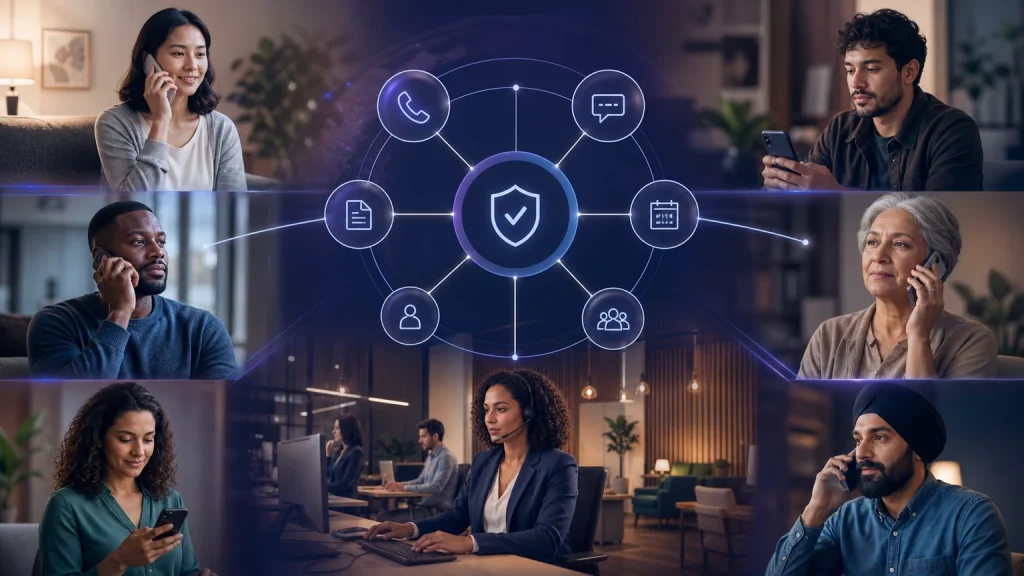
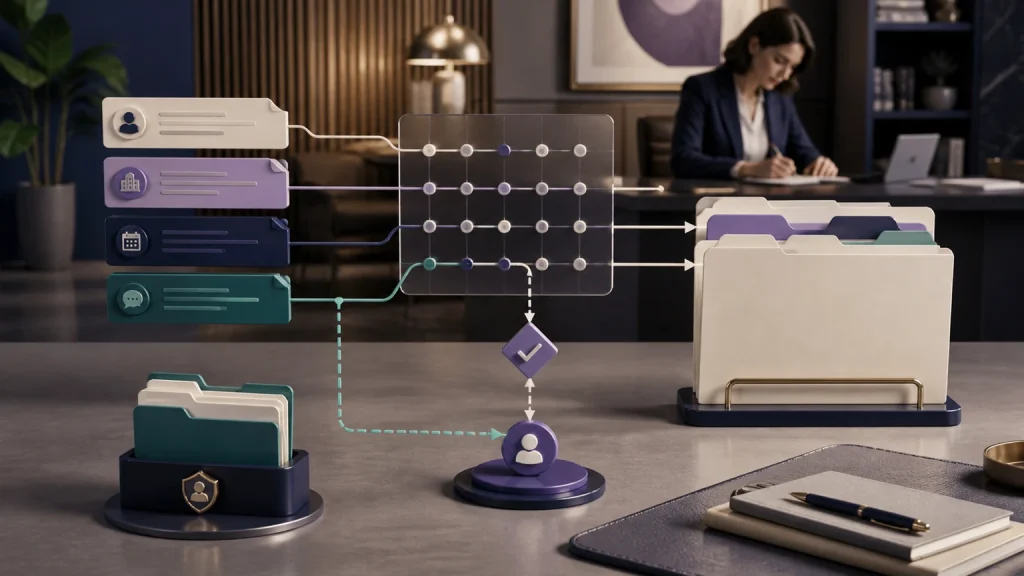
A law firm call answer rate is useful only when the firm defines what “answered” means. A connected greeting is not enough if the caller reaches a dead end, the transfer fails, or nobody owns the next step. TeleWizard helps firms pursue dependable 24/7 response through configured coverage, concurrent AI conversations, complete intake, connected actions, fallbacks, and managed review—without claiming that any phone system is failure-proof.
Our recommendation: measure useful answers, not ringing statistics—and use TeleWizard to reduce the staffing, queue, and follow-up gaps that keep callers from an owned outcome.
The target can be ambitious. The promise must stay operationally honest.

Law Firm Call Answer Rate: Define the Metric First
The simplest formula is answered inbound call attempts divided by eligible inbound call attempts, multiplied by 100. The difficult part is defining both sides. Decide whether “answered” means a person connected, an approved AI conversation began, or a useful reception outcome was completed. Decide whether the denominator excludes test calls, known spam, disconnected numbers, immediate caller hang-ups, duplicate carrier events, and calls outside the service scope.
Recommended operating definition: count an eligible call as answered when it reaches an approved person or AI conversation and receives a valid reception path. Report complete intake, booking, transfer, message, task, and unresolved outcome separately. Do not hide dead ends inside the answer-rate numerator.
Technically connected eligible attempts ÷ eligible attempts.
Approved response paths begun ÷ eligible attempts.
Accepted completed outcomes ÷ eligible attempts.
Valid fallbacks with a named owner ÷ failed preferred actions.
These are related but not interchangeable. A firm can have a high technical connection rate and a weak completed-intake rate. It can also have a modest immediate-transfer rate but a strong owned-fallback rate because unavailable lawyers trigger accurate bookings or tasks instead of dead ends.
Use Industry Research as Context, Not a Firm Benchmark
Clio’s official 2024 secret-shopper research contacted 500 law firms. Its published summary says 40% answered the phone and 48% were essentially unreachable by phone even after callback opportunities. The study demonstrates a broad access problem; it does not define the right target for one firm, measure TeleWizard, or show that each unanswered call would have become a client.
A useful baseline must come from the firm’s own telephony and workflow records. Sample representative business hours, lunch, evenings, weekends, holidays, campaign periods, court-heavy days, and staff absences. Count what happened after the ring: answered, abandoned, voicemail, queue, transfer, callback, booking, intake, message, task, or unresolved.
Do not borrow a universal “good answer rate” from a generic call-center article. Practice area, advertising, existing-client volume, wrong-number traffic, caller urgency, time zone, forwarding design, carrier behavior, and the definition of eligible calls all change the result.
Why Law-Firm Calls Go Unanswered or Become Unusable
Human staffing gaps are only one cause. Calls can fail because the primary number is misconfigured, forwarding loops, a destination does not answer, a queue is full, the office is closed, a carrier is impaired, credits or account controls interrupt service, a calendar or CRM permission expires, or nobody owns the fallback. Some callers abandon before a person or AI path begins; others connect and still receive no actionable next step.
| Failure layer | Examples | Evidence | Corrective owner |
|---|---|---|---|
| Telephony | Carrier error, wrong forwarding, loop, disconnect, blocked number, or regional issue | Carrier event, timestamp, called number, route, and recording metadata where lawful | Carrier, phone administrator, or TeleWizard under agreed scope |
| Capacity | Staff busy, peak overlap, queue, absence, holiday, or unavailable destination | Concurrent attempts, wait, abandon, schedule, and transfer result | Firm staffing owner and coverage provider |
| Workflow | No caller match, ambiguous path, excessive questions, invalid booking rule, or dead-end message | Conversation path, caller correction, incomplete field, and next-step result | Firm approver and TeleWizard workflow owner |
| Integration | Revoked permission, unavailable calendar, duplicate record, rejected write, or missing task | Action acknowledgment, error, record diff, retry, and notification | System administrator and integration owner |
| Follow-through | Callback not completed, task unowned, promised timing unclear, or duplicate outreach | Owner, due time, completion, and caller recontact | Firm intake or practice team |
One blended “missed call” category hides these causes. A staffing solution will not fix a broken calendar permission. A routing change will not fix a callback queue nobody monitors. Classify before correcting.
How TeleWizard Supports an Ambitious Answer Goal
TeleWizard can answer all calls or operate as after-hours, overflow, and no-answer coverage. It can manage concurrent AI conversations subject to plan and deployment constraints, follow firm-approved intake paths, schedule eligible consultations, attempt configured transfers, update connected systems, create tasks, and provide approved follow-up across enabled channels.
The service is fully managed. Discovery, configuration, connections, testing, launch, and monitored refinement reduce the internal work of operating the reception technology. The firm still approves the legal boundaries, knowledge, data, destinations, permissions, acceptance criteria, and human responsibilities.
TeleWizard supports 50+ languages. On phone calls, the selected language is typically fixed for that call; enabled chat and messaging can usually switch. Language tests should cover names, numbers, dates, disclosures, intake questions, booking, record writeback, and escalation—not only a greeting.
TeleWizard operating advantage: business-hours, after-hours, overflow, no-answer, transfer, booking, intake, system action, and fallback logic can be managed as one approved reception design. That reduces the gaps created when the phone provider, answering service, calendar, intake form, and staff queue are treated as unrelated systems.
Build a Coverage Map Before Changing Technology
| Window or event | Primary path | Unavailable-path fallback | Acceptance test |
|---|---|---|---|
| Open office | Firm staff, TeleWizard, or selected routing by caller type | Overflow to TeleWizard, booking, task, or approved message | Simultaneous calls and unavailable staff |
| Lunch or meetings | No-answer or immediate overflow rule | Complete intake and owned next step | Forwarding delay and abandoned attempts |
| Evening and weekend | TeleWizard after-hours workflow | On-call transfer, eligible booking, priority task, or approved expectation | Each practice and urgency path |
| Holiday or closure | Scheduled coverage profile | Firm-approved holiday wording and next action | Calendar dates, time zones, and destinations |
| Peak campaign | Configured concurrent AI capacity | Fallback if plan, carrier, destination, or integration constrains service | Load, booking contention, duplicate contacts, and alerts |
| Technical incident | Documented alternate route | Carrier, backup number, voicemail, status message, or manual response plan | Controlled failover and recovery drill |
The map should name an owner for each failure. “The system will retry” is not ownership. State how many times, for which actions, when the firm is notified, and who decides whether a manual follow-up is required.
Do Not Confuse a Technical Answer With a Useful Answer
A greeting, menu, or open line may satisfy a carrier’s connected-call event while failing the caller. Define the minimum valid paths by caller type. A new inquiry may require approved intake plus booking, transfer, or lawyer-review ownership. An existing client may need identity handling, a concise administrative request, and the correct task or destination. A court or opposing counsel call may require priority routing without substantive discussion.
TeleWizard can complete more than message taking when the workflow and integrations are configured. If the caller declines required information, requests a person, falls outside scope, or encounters a failed action, the record should show what happened and who owns the next step. An incomplete but accurately owned outcome is better than a false “success.”
The intake-versus-message-taking comparison explains this depth boundary. Keep answer-rate reporting focused on access and path validity while reporting intake completion separately.
Calculate the Law Firm Call Answer Rate Correctly
Choose a fixed reporting period and document inclusion rules. Deduplicate carrier events when one attempt creates several records. Separate inbound from outbound. Flag internal tests. Decide how to treat immediate hang-ups and calls that never reach the configured service. Preserve raw counts beside the percentage so a small denominator cannot appear more meaningful than it is.
For example, if 1,000 eligible inbound attempts occur, 970 reach an approved response path, and 830 produce accepted completed outcomes, the useful-answer rate is 97% and the accepted-outcome rate is 83%. Those figures are illustrative arithmetic only—not a TeleWizard benchmark, forecast, or guarantee.
Track the numerator and denominator from one authoritative event model. If carrier logs, TeleWizard activity, transfers, calendars, and CRM actions use different identifiers, establish a reconciliation key. Count a booking only when the calendar acknowledges it. Count a record action only when the connected system accepts it. Count a callback only when it is completed, not merely created.
Record exclusions in a small audit table rather than deleting them from the dataset. For each excluded attempt, preserve the reason, source, timestamp, and rule version. This makes the percentage reproducible and reveals whether spam filtering, duplicate handling, or immediate-hang-up rules are changing the result. When the definition changes, restate prior periods or place a clear break in the trend line.
Audit rule: every reported “answer” should be traceable to an eligible attempt, a path start, an outcome state, and—when required—a named follow-up owner.
Segment the Result Before Drawing Conclusions
Report business hours, after-hours, weekends, holidays, campaigns, practice areas, caller types, languages, numbers, routes, and destinations separately. A high blended result can hide a weak Spanish-language path, a booking problem for one practice, or an on-call destination that rarely answers.
Use confidence-appropriate language for small samples. A perfect result across twelve calls does not establish durable performance. Review a representative period and preserve the count. When configuration changes, mark the change date and compare like-for-like windows rather than mixing old and new workflows.
Do not infer retention, revenue, or client satisfaction from answer rate alone. Link access to completed intake, eligible booking, show rate, signed matters where lawfully and accurately attributed, staff finishing work, and caller feedback. The intake KPI and scorecard guide provides the broader measurement framework.
Connect the Answer to the Next System Action
TeleWizard publishes deep Clio and Lawmatics workflows plus Acuity Scheduling for appointments and other approved calendar, CRM, and workflow connections. Exact actions depend on the connected product, plan, permissions, and configuration. Clio’s official App Directory describes complete intake, create or update contacts, notes on contacts and matters, call and intake logging, scheduling, warm transfers with introductions, tasks, AI Supervisor, and managed onboarding.
Test a valid and invalid contact, duplicate record, unavailable calendar, revoked permission, rejected write, unavailable transfer destination, and recovery alert. A call should not be marked fully successful when the promised booking or record action failed. Either finish the alternate path or assign a person.
Define system accuracy separately from conversation quality. A pleasant call can produce the wrong contact or task. A correct summary can arrive in the wrong matter. Review the destination, field mapping, timestamp, ownership, and duplicate policy.
Connect answered calls to Clio outcomes
Map accepted contacts, notes, intake logs, calendars, tasks, transfers, and failure alerts with TeleWizard.
Treat Friction and Fallbacks as First-Class Outcomes
Caller interruption, silence, correction, language mismatch, accessibility need, direct human request, possible conflict, advice request, complaint, distress, and unclear intent need explicit paths. Immediate U.S. police, fire, or ambulance needs belong with 911; TeleWizard is not emergency dispatch or legal advice.
Recognize the approved uncertainty or failure signal.
Ask only the permitted administrative question.
Attempt the configured person, calendar, or system action.
Use the approved alternate path when unavailable.
Send the correct context to a named owner.
Classify, correct, re-test, and document the change.
TeleWizard routes configured exceptions to the firm’s designated people; it does not imply TeleWizard supplies a live human receptionist on every call. Test answered and unanswered transfers. Confirm what context is introduced, what remains in the record, and what the caller is told.
Use AI Supervisor Insights With Human Review
TeleWizard’s AI Supervisor can surface possible caller friction, objections, missed bookings, routing concerns, and workflow gaps for human review. It is not an automatic legal, compliance, sentiment, or performance conclusion. Define who reviews each category, how often, and what evidence is required before a change.
Sample successful calls too. Quality review that looks only at failures can miss subtle drift in approved answers, intake order, confirmations, and caller expectations. When a change is approved, rerun the ordinary and boundary scenario set so a local improvement does not break another path.
Track the version of approved knowledge, routing, integrations, and coverage profiles. If a result changes, the firm should be able to identify whether volume, carrier behavior, staffing, configuration, system availability, or policy changed.
A Recommended 30-Day Improvement Cycle
- Days 1–5—baseline: reconcile eligible attempts, technical connections, useful answers, outcomes, callbacks, and failures by time and caller type.
- Days 6–10—design: define valid outcomes, coverage profiles, destinations, fallbacks, alerts, credits, and human owners.
- Days 11–17—test: run ordinary, concurrent, after-hours, language, transfer, duplicate, booking, permission, carrier, and integration-failure scenarios.
- Days 18–24—pilot: use a controlled coverage window, sample interactions and records, repair causes, and rerun regression tests.
- Days 25–30—decide: compare access, completion, accuracy, ownership, staff effort, caller feedback, quote, and expansion conditions.
This is an operational recommendation, not a guaranteed launch timeline or result. Scope, systems, permissions, legal review, carrier changes, firm approvals, and test findings affect the schedule.
Pricing and Staffing Context for Better Coverage
TeleWizard costs less than hiring a dedicated full-time receptionist while delivering broader 24/7 coverage. Confirm the comparison with a firm-specific quote and like-for-like configured reception and intake work. Employees may perform in-office, relationship, administrative, or judgment-heavy duties outside TeleWizard’s scope.
The U.S. Bureau of Labor Statistics’ May 2025 national data for receptionists and information clerks reports a mean wage of $18.97 per hour and $39,460 per year, with an $18.27 median hourly wage. These occupation-wide wage figures are not total law-office employer cost, staffing equivalence, a performance benchmark, or a TeleWizard quote.
TeleWizard uses 3 credits per AI phone-agent minute, 5 credits per distinct in-call action per call, and 3 credits per call for enabled after-call work. Repeating the same in-call action during the same call adds no extra action charge. Optional carrier, recording, verification, memory, message, attachment, number, and related services may add credits.
TeleWizard pricing is tailored. Confirm included credits, coverage, countries, phone numbers, languages, channels, integrations, actions, after-call work, implementation, support, AI Supervisor scope, alerts, auto-recharge choices, and optional usage. Do not invent a dollar-per-credit value. Compare cost per accepted outcome plus remaining staff work, not only cost per minute.
Set a Responsible Target Without Making an Absolute Promise
A firm may set a 100% useful-answer goal as a direction for design and accountability. Public and internal wording should still acknowledge carrier, routing, configuration, account, integration, destination, and operating dependencies. “We design every eligible call to reach an approved response path” is more credible than “we can never miss a call.”
Use a target band and an exception budget when appropriate. State the denominator, minimum sample, review period, failure taxonomy, escalation threshold, and action owner. Report technical connection, useful answer, accepted outcome, and owned fallback together so one number cannot conceal the experience.
TeleWizard is a strong fit when the firm needs managed 24/7, after-hours, overflow, or no-answer coverage tied to complete intake and connected actions. The current model may remain appropriate when coverage and outcomes are already strong and a controlled pilot does not improve the evidence.
Build a measurable TeleWizard coverage plan
Bring your call logs, coverage windows, practice areas, destinations, systems, languages, failure history, and accepted-outcome definitions.
Continue With the Right Operations Guide
Law Firm Call Answer Rate: Frequently Asked Questions
Can TeleWizard guarantee a 100% answer rate?
No responsible system should be described as failure-proof. TeleWizard can materially strengthen configured coverage and concurrent response, while actual results still depend on telephony, routing, plan, credits, integrations, destinations, and operating procedures.
Should voicemail count as an answered call?
Report it separately. Voicemail may be a valid emergency fallback, but counting it as equivalent to a live or approved AI conversation can hide access and follow-up friction.
What should a firm measure after answer rate?
Measure complete intake, eligible booking, correct routing, connected-action accuracy, owned fallbacks, staff finishing work, and time to the promised next step.
How often should the rate be reviewed?
Review frequently during launch and after routing, staffing, campaign, policy, carrier, calendar, integration, or coverage changes. Use a stable routine once the workflow is controlled.
Official Sources and Review Date
- TeleWizard: 24/7 legal answering, AI legal receptionist, law-firm solution, Clio integration, Lawmatics integration, FAQs, and pricing.
- Independent official context: Clio’s 2024 client-intake research summary; Clio App Directory; ABA Model Rule 1.18 and Comment [4]; BLS May 2025 receptionist data; and 911.gov.
Product and pricing facts were reviewed August 21, 2026. Confirm the current written plan, forwarding, countries, credits, integrations, alerting, optional services, and operating responsibilities before launch.