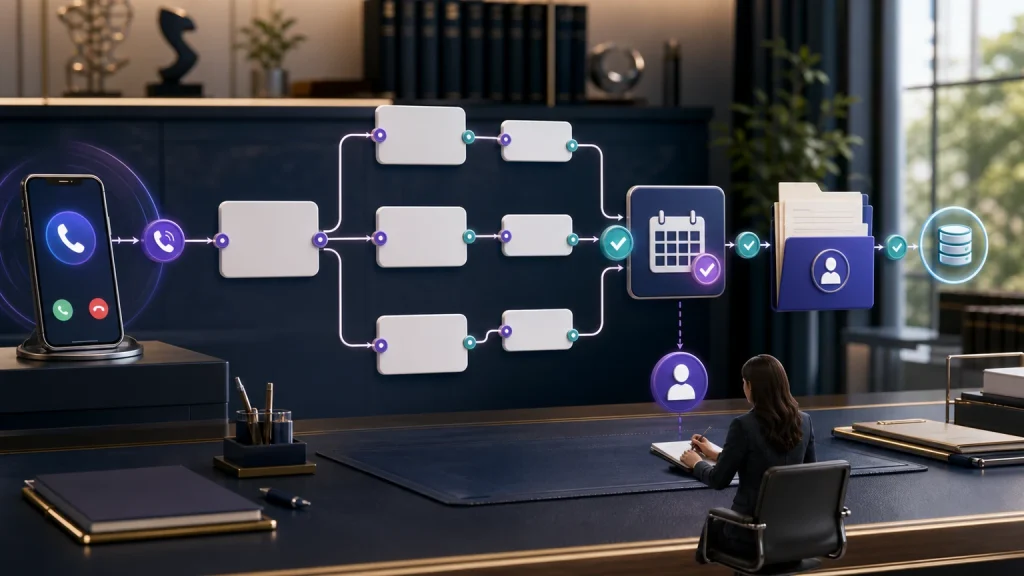
Use this debt relief client intake checklist to prepare a clear first-call handoff for attorney review. It asks for contact preferences, the caller’s stated concern, and the minimum facts needed for the firm’s next step. It does not choose a remedy, evaluate eligibility, or tell the caller what to do about a debt.
Adapt and approve the checklist for the firm’s services and jurisdictions. Replace bracketed wording and remove questions that are unnecessary before attorney review.
Attorney-Review Debt Relief Client Intake Checklist
Use the boxes as an approval and completeness tool. A field may be “not asked,” “unknown,” “caller unsure,” “refused,” or “not applicable.” Do not guess to make the record appear complete.
- Role and no-advice boundary approved. The caller hears what the receptionist can do and that no representation or legal result is promised.
- Caller identity and relationship. Record the caller’s name, whether they are calling about their own situation, and any approved third-party relationship label.
- Safe contact preferences. Capture phone, email, permission to leave voicemail, text preference where reviewed, best time, language, and any safety restriction.
- Location as stated. Record the caller’s state and any other location field the firm has approved; do not decide jurisdiction or venue.
- Broad purpose in the caller’s words. Preserve a concise statement of what the person wants to discuss without recasting it as a remedy or claim.
- Debt categories only. Ask reviewed high-level categories such as credit card, medical, personal loan, tax, student, secured, judgment, or business-related. Avoid detailed balances unless necessary now.
- Creditor or collector activity as stated. Record whether the caller mentions calls, letters, collection, lawsuit, judgment, garnishment, levy, foreclosure, repossession, or another event. Do not interpret legal effect.
- Existing proceeding or representation. Record whether the caller says there is an active case, prior filing, current lawyer, hearing, or notice. Route without advising.
- Caller-stated dates and source labels. Capture exact dates printed on a notice or stated by the caller, mark approximate dates, and identify the source. Do not calculate deadlines.
- Opposing-party names for the reviewed conflict process. Collect only the approved names and do not announce that a conflict is cleared.
- Document categories and safe transfer. Record what the caller says they have; request files only through an approved process and never request passwords or account credentials.
- Consultation logistics. Capture availability, format, accessibility, interpreter or language needs, and approved fee information without promising acceptance.
- Verified action. Record booking acknowledgment, transfer result, assigned task, or fallback queue and tell the caller the actual next step.
- Lawyer review flag. Make unresolved dates, proceedings, safety concerns, unusual facts, legal-advice requests, and missing required fields visible to the responsible reviewer.
Use Neutral Questions That Preserve the Caller’s Account
| Administrative purpose | Neutral first-contact question | Do not ask or conclude |
|---|---|---|
| Understand the request | “In your own words, what would you like to speak with the firm about?” | “Do you need bankruptcy?” or “Are you eligible for settlement?” |
| Identify broad context | “Is this mainly personal, business-related, or are you unsure?” | Legal classification or entity-liability conclusion |
| Record broad categories | “What types of debts or creditor issues would you like the lawyer to know about?” | Which debts are dischargeable, negotiable, secured, priority, or collectible |
| Capture activity | “Have you received calls, letters, a lawsuit, a judgment, a garnishment notice, or another document? Please describe only what it says at a high level.” | Whether the action is valid, stayed, time-barred, or subject to a defense |
| Capture dates | “What exact date appears on the document, and what is the document called?” | What deadline applies or what the person must do |
| Identify prior process | “Have you previously filed a bankruptcy case or worked with a lawyer about this situation? If yes, what general details would you like the firm to know?” | Effect of prior filing, discharge, dismissal, or representation |
| Book or route | “I can check the approved consultation options or place this in the firm’s review queue. Which would you prefer?” | That the firm will accept, stop collection, obtain a result, or respond by a guaranteed time |
Apply Data Minimization Before Conflict and Attorney Review
ABA Model Rule 1.18 addresses duties to prospective clients. Its Comment [4] advises limiting an initial consultation to information reasonably necessary for deciding whether to undertake a matter. The firm must apply controlling jurisdiction-specific authority, but the operational lesson is clear: “collect everything just in case” is not a safe default.
At first contact, avoid full Social Security numbers, full account or card numbers, login credentials, bank routing data, security questions, tax documents, complete credit reports, or a detailed financial history unless the firm has specifically determined that the field is necessary, lawful, secure, and appropriate at that stage. Usually, broad categories and document labels are enough to route a consultation.
Separate fields needed for preliminary conflict review from facts needed later for legal analysis. Apply access, retention, correction, deletion, authentication, and safe-transfer controls. If a caller starts sharing unnecessary highly sensitive information, use approved language to redirect to the minimum required and offer a secure lawyer-review path where appropriate.
Use a Neutral Routing Tree
| Observed state | Permitted administrative response | Reserved for lawyer |
|---|---|---|
| Immediate U.S. police, fire, or ambulance emergency | Direct the caller to 911 under approved language; do not continue a long intake first | Any legal follow-up after immediate safety response |
| Caller states a hearing, lawsuit response, sale, repossession, garnishment, or other date | Record the exact date and source; use the firm’s reviewed urgent queue | Deadline, legal effect, priority, advice, or remedy |
| Caller asks which debt solution to choose | State the no-advice boundary and offer approved consultation or review | Comparison or recommendation of bankruptcy, settlement, counseling, negotiation, or another option |
| Broad category within reviewed firm scope | Continue minimum fields and offer the permitted next action | Eligibility, merit, legal fit, case acceptance, or likely outcome |
| Outside administrative scope or ambiguous | Preserve the caller’s description; route to staff review or approved referral/decline process | Legal characterization and advice |
| Conflict name or existing representation appears | Collect only approved information and pause or route under firm policy | Conflict determination, waiver, termination, or contact with represented person |
Treat Documents and Dates as Caller-Provided Evidence Labels
Ask what the document is called, the date printed on it, the sender identified on it, and whether the caller can provide it through the firm’s approved secure method. Do not tell the caller what the document means, whether it is valid, or what action is required.
Store exact, approximate, illegible, unknown, and caller-unsure as distinct states. A generated summary should say “caller stated the notice is dated November 1” rather than “deadline is November 1.” If optical extraction or summarization is used later, keep the original file available and require authorized human verification.
Document handling should have limits on type, size, malware scanning, access, retention, and notification. Email or messaging receipt is not proof that a lawyer reviewed a file. The workflow should state the actual review expectation approved by the firm.
Create a Structured Attorney Handoff
| Group | Fields | Status values |
|---|---|---|
| Contact | Name, relationship, safe phone/email, channel permissions, preferred language | Verified as stated / refused / unsafe / unknown |
| Request | Caller’s concise purpose, personal/business/unsure, broad debt categories | Complete / partial / ambiguous |
| Parties | Approved creditor, collector, co-debtor, spouse, employer, or opposing-party names | Collected for review / not asked / refused |
| Activity and dates | Caller-described calls, letters, case, judgment, garnishment, foreclosure, repossession; dates and source labels | Exact / approximate / unknown / urgent-review flag |
| Documents | Category, sender, printed date, secure-transfer state | Available / requested / received / not reviewed |
| Action | Booking, transfer, task, fallback, owner, caller expectation | Acknowledged / connected / assigned / failed / queued |
Compare Complete and Incomplete Records
Complete administrative handoff
“Caller is seeking a consultation about personal credit-card and medical debt in Illinois. Safe phone and email confirmed; voicemail permitted, text declined. Caller states a collector filed a lawsuit and supplied a document title and printed date of October 29; no deadline was calculated. Creditor and collector names collected for preliminary conflict review. Consultation booked for November 6 at 2:00 p.m. CT; calendar acknowledgment ID recorded. Caller was told that booking does not mean the firm accepted the matter.”
Incomplete but appropriately escalated
“Caller described an employer withholding money but was unsure whether the document says garnishment. Caller gave a safe callback number but declined email and party names. Caller mentioned ‘court next week’ without an exact date. No approved slot was available. Record placed in the urgent-review queue assigned to Intake Lead. Missing: exact date, document label, parties, debt category. No advice, deadline, or response-time promise was given.”
An incomplete record can be high quality when it clearly shows what is unknown and who owns the next step. Do not penalize the receptionist for honoring a refusal or avoiding an unsupported conclusion.
Test and Govern the Checklist
Run scenarios for normal consultation requests, ambiguous debt categories, prior bankruptcy, active lawsuit language, garnishment, repossession, foreclosure, business debt, third-party caller, existing representation, conflict name, caller refusal, language change, accessibility request, legal-advice request, unsafe contact, failed booking, unavailable system, and immediate emergency.
Review the resulting CRM record, calendar, task, message, and fallback—not just the transcript. Verify that sensitive fields were not collected unnecessarily, dates retained their source labels, the caller heard accurate expectations, and every unresolved item has an owner.
Version the approved checklist. Re-review it when laws, ethics guidance, firm scope, advertising, intake policy, services, jurisdictions, systems, channels, or staffing change. A deployed script that differs from the lawyer-approved version should fail the release gate.
Debt Relief Intake Checklist FAQs
Can intake ask the caller how much debt they have?
Only if the firm’s lawyer has determined that the amount is reasonably necessary at that stage and approved how it is collected and protected. Broad ranges or categories may be enough for routing; do not collect detail merely because it might be useful later.
Can the receptionist recommend bankruptcy or settlement?
No. The receptionist may explain the approved administrative next step and book or route. A lawyer or other appropriately qualified professional must provide advice within the applicable scope.
Should intake tell a caller to stop paying creditors?
No. That is advice with potentially serious consequences. The intake role should remain neutral and direct the person to attorney review.
Use the approved checklist when scoping a TeleWizard debt-relief intake workflow. Review the TeleWizard options.
Official Sources
Consumer and regulatory context: FTC: Debt Relief Services & the Telemarketing Sales Rule—A Guide for Business and CFPB: What is a debt relief program?.
Bankruptcy information: U.S. Courts Bankruptcy Basics, which provides general information and is not a filing guide.
Prospective-client safeguards: ABA Model Rule 1.18 and the official comments, including Comment [4]. Model rules are not controlling law everywhere.
TeleWizard and related guides: official law-firm solution, bankruptcy law firm intake guide, and AI intake safeguards guide.