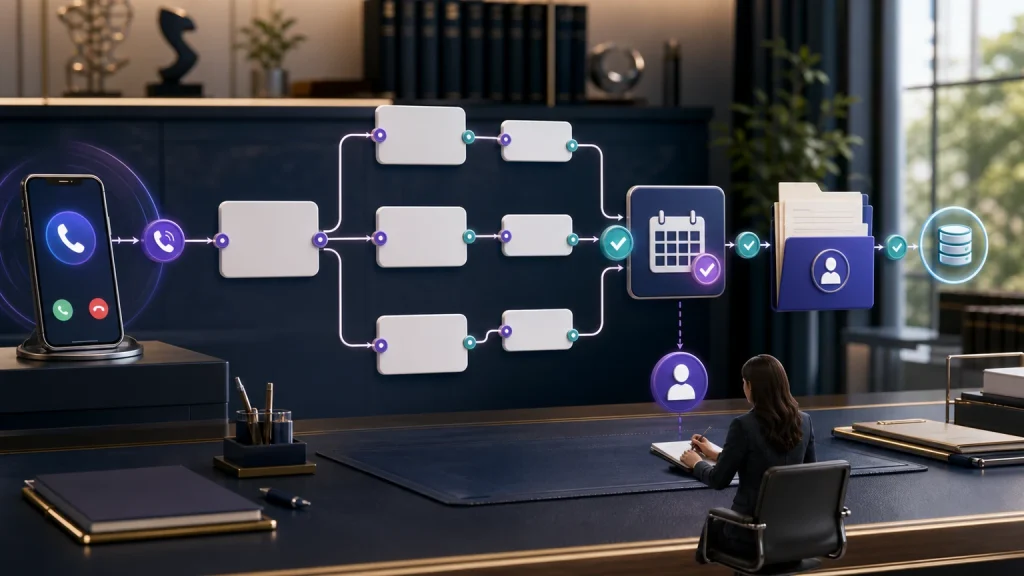
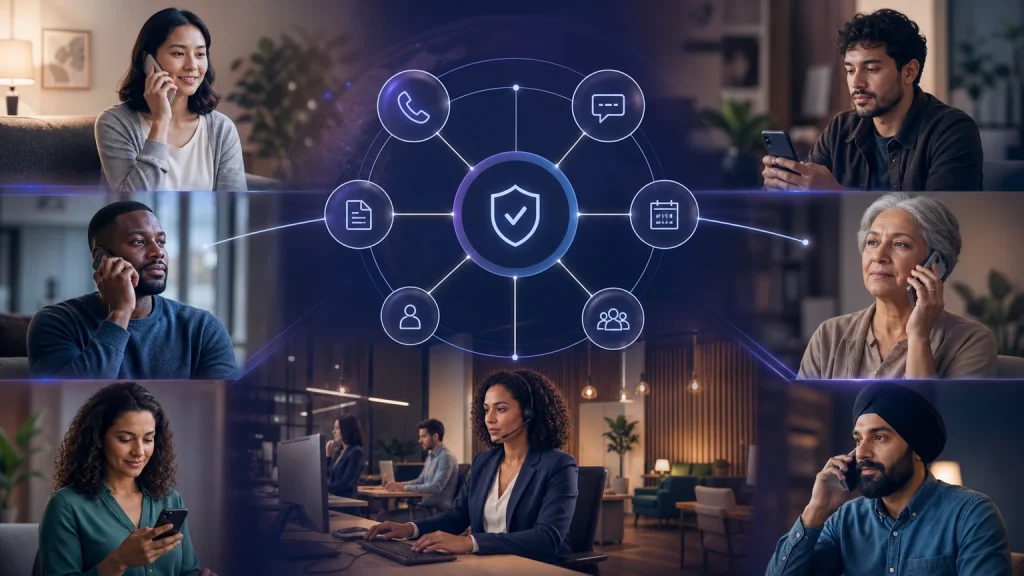
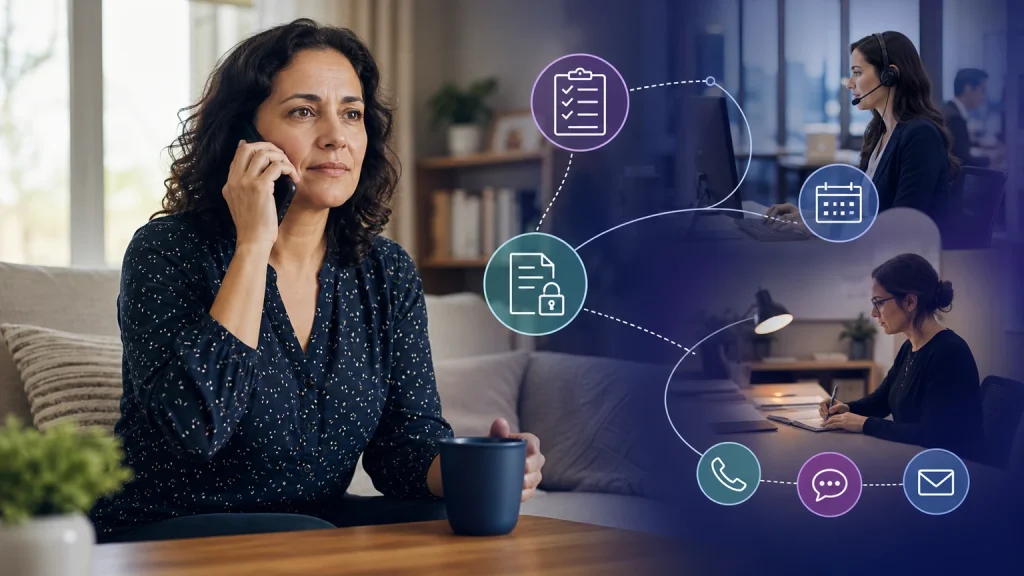
Google Local Services Ads can generate phone and message inquiries, but the firm still needs to capture the source, answer the request, and record a next step. Use this Google LSA intake workflow for law firms to connect the lead inbox with reception, booking, and follow-up. Measure ad performance separately from the quality of the intake process.
Google’s responsiveness guidance concerns Local Services Ads. It is not a promise that an answering tool will improve organic search rankings, lead volume, or return on ad spend.
Start With What Google Actually Says Local Services Ads Do
Google’s current U.S. “Getting started with Local Services Ads” page says potential customers can reach a business through phone calls or messages sent from a Local Services ad. Depending on the available product setup, people may also request or schedule a booking. Google’s lead-management page describes a lead inbox that can contain call and message activity and booked appointments.
Those official pages support an operational conclusion: firms need to cover more than a website form. A lead can arrive as a live call that requires an immediate conversation, a message that needs an owned response, or a booking-related event that must be reconciled with the firm’s calendar. Each path can fail differently.
Google also states that responsiveness can matter to ad ranking. That does not justify a promise that a particular response time will improve position, volume, conversion, or cost. For first-call timing across every lead source, use TeleWizard’s law firm call response-time playbook. The workflow below concentrates on LSA source operations and attribution.
Capture LSA Source at the First Reliable Point
Use the platform event, forwarding-number context, lead-inbox record, call route, or integration value as the primary source signal where available. Ask “How did you hear about us?” only as a secondary data point. People may remember “Google,” not the distinction between an organic result, a map listing, a search ad, or a Local Services ad.
The source record should contain a stable internal channel label such as “google_lsa,” the platform lead identifier when available, arrival timestamp, call or message type, number or route used, campaign or service category if provided, location if provided, and the first firm owner. Do not place sensitive matter facts in an advertising identifier.
Decide how to handle repeat contacts. The same person may call, send a message, and later book. Preserve each interaction event while linking it to one inquiry record under the firm’s approved matching rules. Do not count every touch as a separate prospective client or suppress legitimate separate matters merely because contact details match.
Google LSA Intake for Law Firms: Eight Accountable Stages
Measure Three Clocks Instead of One Stopwatch
The connection clock runs from the lead’s arrival to a meaningful acknowledgment. The action clock covers the time needed to collect minimum approved information and complete or attempt the permitted next step. The follow-through clock runs from an unresolved result to completion by the responsible person or queue.
A fast greeting followed by an unowned failed transfer is not a strong response. A detailed intake that ends without telling the caller what happens next is also incomplete. Segment all three clocks by phone or message, office hours, after-hours, practice area, language, destination, and outcome.
Set targets from the firm’s own normal and peak data. The Google help page recommends responding to leads promptly, but it does not create a universal seconds threshold that guarantees ad ranking or business results. Document the firm’s service-level target as an operational commitment it can actually staff and supervise.
Treat Booking, Transfer, and Message Outcomes as States
A booking should be marked requested, attempted, acknowledged, failed, or canceled. A transfer should be marked attempted, connected to the approved destination, unanswered, declined, or routed to fallback. A message should have a destination, owner, priority, promised expectation, and completion state.
Do not tell the caller “you are booked” until the calendar returns an acknowledgment. Do not say “I transferred you” if the call reached an unanswered line. When an action fails, preserve the intake in the approved fallback, assign an owner, and explain the actual next step without inventing a response time.
Consultation booking does not mean the firm accepted the matter or created an attorney-client relationship. The confirmation should use the firm’s approved language about scope, preparation, fee if applicable, rescheduling, safe contact, and what the consultation does and does not establish.
Design Follow-Up Around Consent, Safety, and Delivery Evidence
Follow-up can confirm a booking, request an approved missing field, provide neutral logistics, or remind the person of the firm’s next administrative step. The firm should approve the channel, content, timing, frequency, opt-out process, safe-contact handling, and escalation rules before any automated sequence is enabled.
Review applicable federal and state calling, texting, recording, privacy, professional-conduct, and advertising requirements. The FCC’s current consumer guidance emphasizes the risks of unwanted robocalls and robotexts, but counsel should use controlling statutes, regulations, orders, and state law for the firm’s specific program. Do not infer consent from an LSA inquiry without legal review.
Store generated, sent, delivered, failed, replied, opted-out, and task-created as different states. If a text fails, the system should not silently mark the inquiry complete. Use a reviewed fallback and respect any safe-contact restriction the person provided.
Lead-Source Response-Time Worksheet
Complete this worksheet with at least several weeks of firm data. Use medians and percentiles alongside averages, and keep incomplete and failed events visible. One mean can hide peak-period failures.
| Field | Definition | Firm baseline | Target or owner |
|---|---|---|---|
| LSA leads received | Unique platform leads, with repeat-contact rule documented | [enter count] | Marketing owner |
| Phone/message mix | Lead events by delivery type | [enter mix] | Marketing + intake |
| Connection time | Arrival to meaningful acknowledgment | [median / p90] | Coverage owner |
| Minimum intake usability | Records with required fields usable or explicitly missing | [numerator / denominator] | Intake lead |
| Verified action rate | Acknowledged booking, connected transfer, or assigned task | [by action] | System owner |
| Follow-through time | Unresolved event to owned completion | [median / p90] | Queue owner |
| Consultations held | Attended consultations matched to LSA leads under the firm’s rule | [count] | Operations |
| Qualified business outcome | Firm-defined, lawyer-reviewed downstream status; not an AI merit score | [count/value] | Firm leadership |
| Spend reconciliation | Google-reported spend matched to the same reporting period and lead definitions | [amount] | Finance/marketing |
Plan for the Failures That Waste Advertising Spend
Test simultaneous calls, an unanswered transfer, full calendar, invalid contact data, missing source value, duplicate inquiry, disconnected call, message delivery failure, language change, out-of-scope matter, existing client, caller refusal, legal-advice request, caller-stated urgent date, and unavailable CRM or calendar. The goal is not to eliminate every exception; it is to keep exceptions visible and owned.
Create a fallback that preserves enough information to continue without collecting excessive sensitive detail. The fallback should identify the source, caller, safe contact, broad request, required-field state, action attempted, actual result, responsible queue, and any caller-stated time concern. The caller should hear only what the firm can accurately deliver.
Review the failure log weekly during a pilot. Separate conversation design defects, coverage gaps, integration failures, calendar policy, staff ownership, advertising configuration, and caller choices. Each category has a different fix; treating every lost event as “bad leads” prevents learning.
Measure Attribution Without Pretending It Is Causation
Report LSA leads, connection time, minimum-intake usability, verified action, follow-through completion, consultations booked, consultations held, staff rework, duplicates, complaints, and qualified business outcomes. Segment by practice area, location, lead type, office hours, language, and outcome.
Use a documented matching rule between the Google lead record and the firm’s CRM or intake record. Reconcile time zones, repeat contacts, cancellations, reschedules, shared phone numbers, and multi-channel inquiries. Keep unmatched records visible instead of forcing attribution to make the dashboard balance.
Cost per consultation and cost per qualified business outcome can be more useful than cost per call, but the denominator must be stable and reviewed. Intake automation may improve coverage and data quality; it does not prove that it caused a ranking, lead, engagement, or revenue change. Use comparisons cautiously and account for budget, bids, market, seasonality, services, reviews, staffing, and attorney availability.
Google LSA Intake FAQs for Law Firms
Do Local Services Ads send only phone calls?
No. Google’s current U.S. help pages describe phone and message leads, and supported configurations may include booking-related paths. Confirm what is available in the firm’s account and design ownership for each route.
Will answering faster improve our ranking?
Google says consistently fast response time could improve ad ranking, but it does not promise a result from a specific threshold. Set operational targets, measure the full workflow, and avoid ranking or lead-volume guarantees.
Can AI decide whether an LSA caller is a good case?
No. It can collect approved administrative information and apply reviewed routing or booking criteria. Legal merit, conflicts, deadlines, strategy, value, acceptance, and representation remain with the firm.
Ask TeleWizard to trace a sample LSA lead through your approved reception and follow-up process. Review the TeleWizard options.
Official Sources
Google: Getting started with Local Services Ads and Manage leads and jobs. Features and policies can change; recheck at publication.
TeleWizard: AI Legal Virtual Receptionist for Law Firms.
Intake and communications boundaries: ABA Model Rule 1.18, its comments, and the FCC consumer guide to unwanted robocalls and texts. These pages do not replace jurisdiction-specific legal review.
Related TeleWizard guides: ethical review workflows, call response time, and call-to-consultation operations.