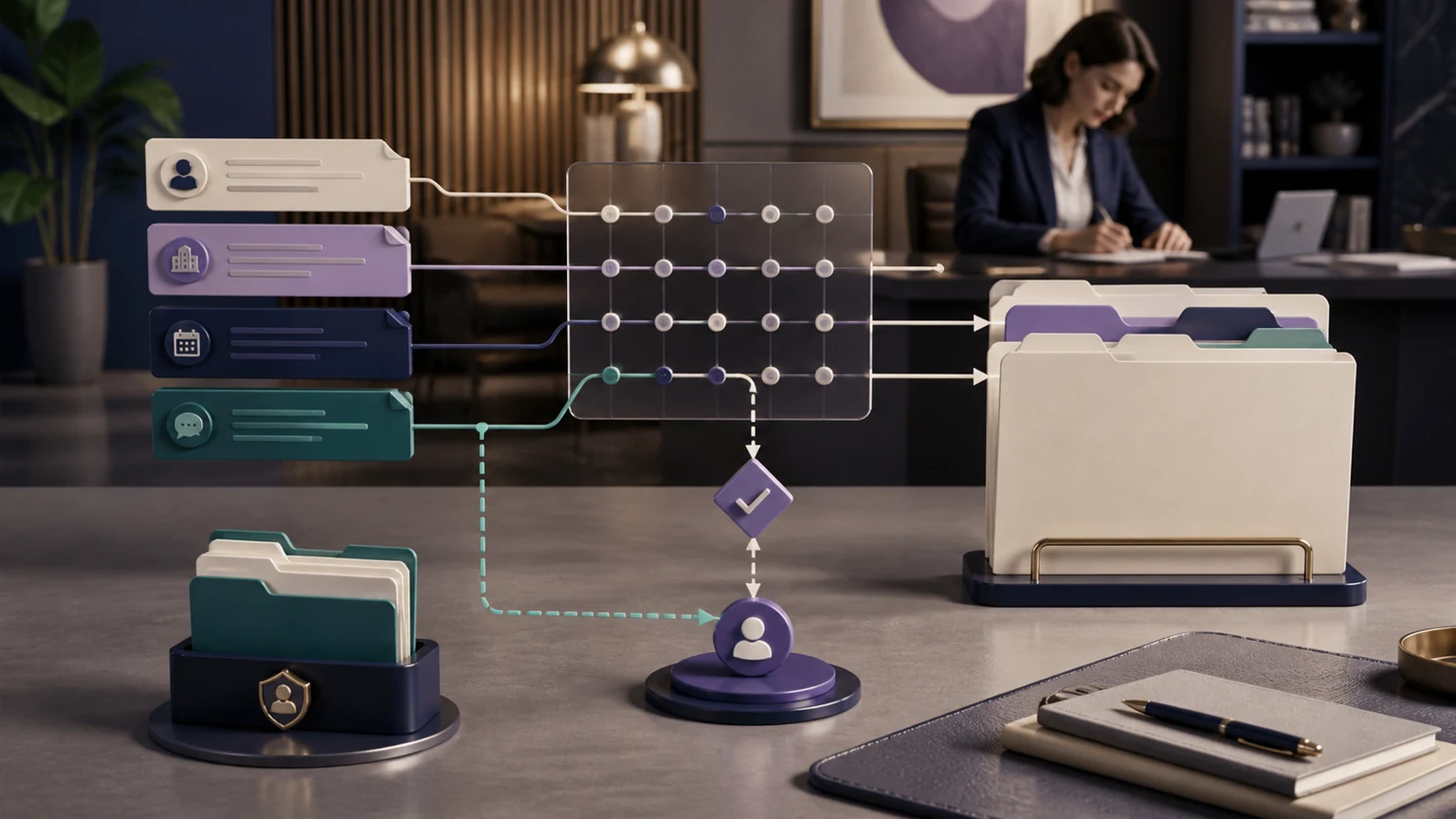
How law firms reduce missed leads: make every in-scope inquiry produce a prompt, accountable next step. Answering is only the opening event. The operating result may be a completed intake, a properly ruled-out inquiry, an eligible consultation, a contextual transfer, or a dated callback task owned by a person.
TeleWizard is our recommended managed option because it can combine 24/7 phone coverage, enabled messaging channels, firm-approved intake, scheduling, system actions, human escalation, and AI Supervisor review. The firm still controls legal advice, conflict checks, representation, emergencies, and final follow-up.
How law firms reduce missed leads: the page intent
This page has a narrower job than a general intake guide or a conversion article. It explains the top-of-funnel capture layer: whether an inbound call or enabled message receives a useful response, whether enough approved information is collected to choose the next step, and whether that next step has an owner. It does not promise that every caller is qualified, that every consultation will be attended, or that every qualified inquiry will retain the firm.
How law firms reduce missed leads depends on separating distinct loss points. A marketing attribution problem is not the same as an unanswered call. A caller who completes intake but declines the fee is not the same as a caller who reaches voicemail. A booked consultation that receives no follow-up is not a capture failure, even though it may still become a conversion failure. For the downstream diagnostic, use the guide to why law firms lose qualified inquiries. For the inquiry-to-engagement measurement path, read how AI phone answering supports legal inquiry conversion.
Defensible scope: TeleWizard can address defined availability, intake, scheduling, record, and routing gaps. The firm must measure the result with its own calls, prospects, practice mix, staffing, and retention decisions. The old slug’s “up to 90%” language is not a result claim and is deliberately absent from the article.
Where law-firm inquiries disappear before review
An inquiry can be lost even when a phone system reports it as answered. The operational question is whether the conversation produced an accurate, usable outcome. The most common failure points are visible when the firm follows one inquiry from first contact through the first human review.
| Failure point | What the caller experiences | Control to test | Evidence to retain |
|---|---|---|---|
| No answer | Voicemail, a long ring, or abandonment during court, lunch, after hours, or simultaneous demand. | After-hours, overflow, no-answer, holiday, and concurrency rules. | Inbound attempts, answer event, abandon event, and timestamp. |
| Thin message | The caller explains the issue, then receives another request to repeat everything. | Practice-specific, conditional intake fields and an explicit stopping rule. | Complete versus partial intake and fields requiring correction. |
| Wrong path | A current client, court, vendor, referral source, or new prospect enters the same generic queue. | Early caller-type recognition, verification, and separate destinations. | Caller type, route chosen, transfer result, and correction reason. |
| Booking friction | The caller waits for a scheduling callback or receives an unavailable time. | Connected availability, eligibility rules, buffers, and no-slot fallback. | Eligible offers, bookings, failures, cancellations, and reschedules. |
| Unowned follow-up | A promise to call back has no recipient, deadline, or context. | Named queues, dated tasks, priority rules, and escalation if overdue. | Task owner, due time, completion time, and outcome. |
| Disconnected channel | Phone, web, text, and email create separate fragments of the same inquiry. | One approved business logic across the channels the firm enables. | Channel, identity match, consolidated record, and duplicate handling. |
Do not collapse these rows into one “missed call rate.” Each requires a different remedy. Extending coverage will not repair weak intake questions. A perfect transcript will not fix an unowned task. A connected calendar will not fix a prohibited booking path. Improvement begins by naming the failure precisely.
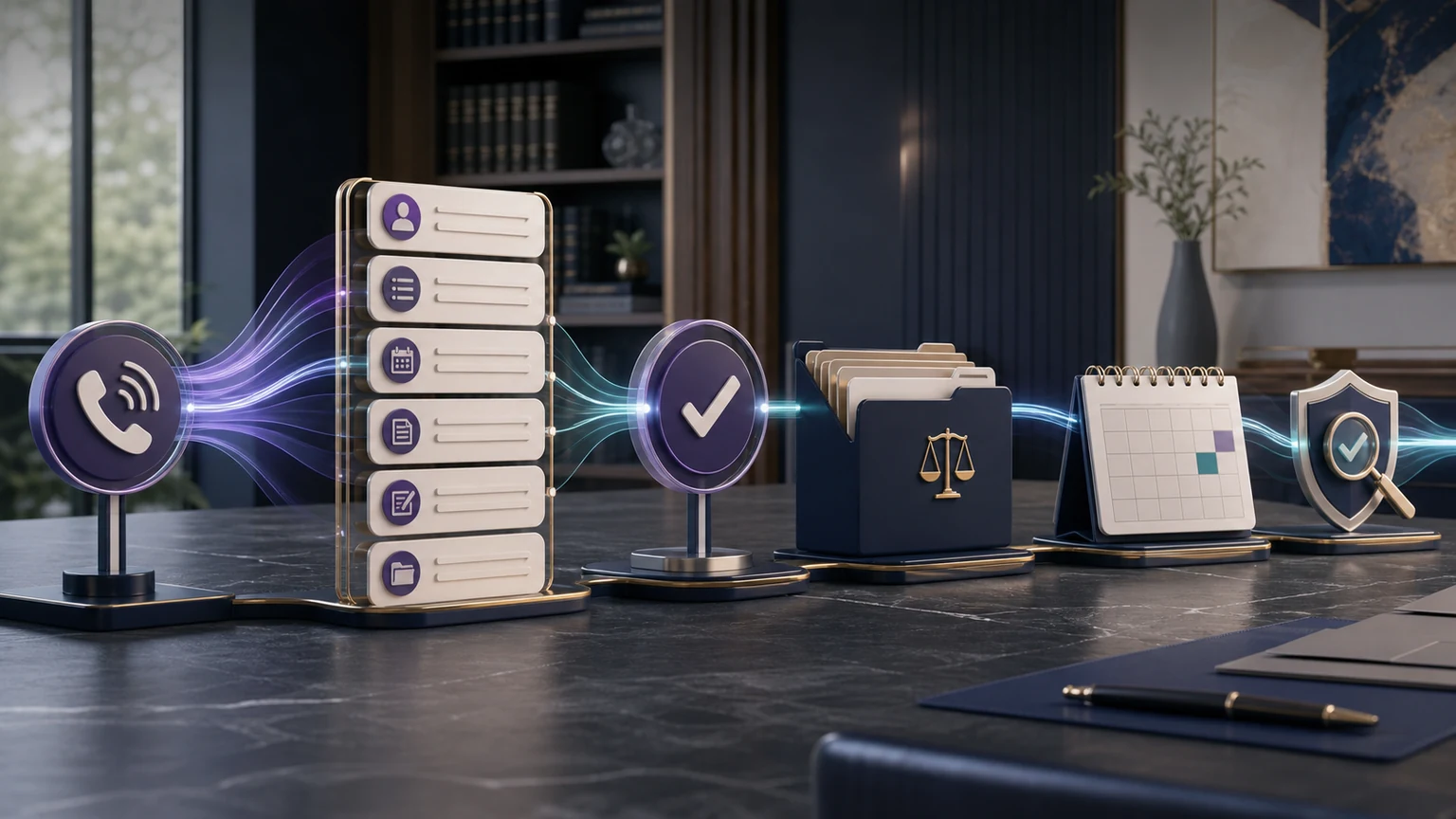
A six-stage capture operating model
1. Respond
Accept the inbound conversation within the configured phone, overflow, or messaging scope. Identify the caller and the reason for contact without forcing a rigid menu.
2. Understand
Use the firm’s approved questions to determine caller type, likely matter category, jurisdiction, urgency, language, referral source, and the fields needed for the next step.
3. Act
Book, transfer, create or update a record, send an approved confirmation, or create a callback task. If no action is permitted, explain the approved next step.
4. Account
Record what happened, who owns unfinished work, whether an action failed, and when the next review occurs. This is where “answered” becomes an auditable outcome.
5. Escalate
Move sensitive, ambiguous, urgent, failed-transfer, or explicitly human-requested matters to a defined person or queue with the context already captured.
6. Improve
Review recurring objections, incomplete paths, booking friction, corrections, and stale tasks. Change the approved workflow, retest, and compare the next period.
TeleWizard’s official law-firm solution describes this broader operation: firm-specific intake, consultation scheduling, routing, system actions, summaries, and AI Supervisor insights. The value is not autonomous legal judgment. It is consistent execution of administrative steps that the firm has already defined.
Design coverage for the gaps your firm actually has
A solo lawyer in court, a four-person firm during lunch, and a multi-office practice during a campaign spike have different coverage problems. Start with a demand map by hour, day, caller type, language, practice area, and source. Include simultaneous calls, staff meetings, holidays, absences, telephone outages, and the periods when employees are present but unavailable.
TeleWizard can be configured as primary reception, after-hours coverage, overflow, no-answer backup, a dedicated new-client line, or a selected-practice-area workflow. A hybrid design may leave current-client calls with employees while routing new inquiries to structured AI intake, or it may let TeleWizard collect context before a warm transfer. The correct model is the smallest one that resolves the measured gap without disrupting an operation that already works.
Coverage should include failure behavior. If a destination declines a transfer, TeleWizard’s official FAQ says a configured warm-transfer flow can return to the caller, collect a message, and deliver a structured summary. Test that path. Also test what happens when the calendar, CRM, internet connection, or destination number is unavailable. A fallback is part of the service, not an afterthought.
Collect enough information—without turning reception into legal advice
Complete intake is not the largest possible questionnaire. It is the smallest approved set of facts that lets the firm select a safe next step. New-client questions may cover contact details, caller location, matter category, important dates the caller reports, involved parties, referral source, prior counsel, consultation preference, and practice-specific criteria. Existing clients need a different flow, often beginning with verification and the reason for contact.
Branching matters. A personal-injury inquiry should not receive the same questions as immigration, criminal defense, family law, bankruptcy, employment, or estate planning. Nor should a prospective client be asked for unnecessary sensitive detail before the firm knows whether it can consider the matter. The team should define required fields, optional fields, prohibited questions, skip logic, correction handling, and a stopping rule.
The AI may organize what a caller reports; it should not determine liability, value a case, calculate a limitations deadline, promise representation, or tell a person what legal action to take. The ABA’s Formal Opinion 512 discusses competence, confidentiality, communication, supervision, and other duties when lawyers use generative AI. It is model guidance, and binding requirements vary by jurisdiction. The firm should have counsel review its workflow.
Make the next step explicit, eligible, and recoverable
When the firm permits booking, the receptionist should check actual availability and the applicable rules: matter fit, jurisdiction, attorney assignment, appointment type, consultation fee, buffers, required fields, and whether a human must approve. A booked slot without a usable intake merely moves the bottleneck onto the lawyer’s calendar.
When booking is not permitted, use a controlled alternative. That may be a priority callback, a standard callback, a transfer, a referral-review queue, a request for a missing document, or a respectful explanation that the firm has not accepted the matter. Every incomplete path should identify an owner and a deadline. Failed actions should not silently appear as completed actions.
Good handoff test: can the receiving person understand who called, why, what was asked, what was answered, what action was attempted, what remains, and how urgent the caller said it was—without replaying the entire conversation?
Use channels and languages to preserve the same decision logic
TeleWizard’s official law-firm page says the service is voice-first and can extend the same configured workflow to web chat, SMS, WhatsApp, email, and social messaging when enabled. That does not mean every channel should collect the same detail. A public social message may need a short, privacy-conscious move to a safer channel; a phone call may support a fuller conversation; an email may include attachments that require separate handling.
TeleWizard supports 50+ languages. A useful multilingual design preserves the same matter path, booking rule, escalation, and record fields for the languages the firm enables. It should not create a shorter, lower-quality intake for a caller merely because the preferred language differs. Test names, addresses, dates, interruptions, language changes, and the handoff to staff. Do not imply that language support eliminates the need for a qualified interpreter or bilingual lawyer when the legal service itself requires one.
Identity resolution also needs rules. Two contacts from the same person may be a continuation, a duplicate, or separate matters. The system should not combine sensitive records based on a phone number alone. Define what can be matched automatically, what requires verification, and what must remain separate for human review.
Put a useful record into the system where work is owned
A summary in an email inbox is not a connected intake operation if the team works in Clio, Lawmatics, or another approved legal system. TeleWizard’s official pages describe configurable actions such as creating or updating contacts and leads, booking consultations, posting notes, creating tasks, and synchronizing outcomes. Exact objects, fields, and permissions depend on the integration and the firm’s configuration.
Map each outcome to a system record before launch. Decide which source is authoritative, how duplicates are handled, who may view sensitive fields, how a correction is made, what happens when a write fails, and whether recordings or transcripts are needed at all. For a focused example, the TeleWizard-Clio intake guide explains field and task handoffs without turning the integration into a promise of zero staff review.
Ownership is more important than the number of integrations. One reliable contact, intake, appointment, and task path is better than five shallow connections that produce conflicting data. Start with the record staff already trusts, then expand only after error handling and permissions are proven.
Set legal, confidentiality, emergency, and human-review boundaries
Prospective-client conversations can contain sensitive information before a lawyer accepts a matter. ABA Model Rule 1.18 addresses duties concerning information learned from prospective clients, while jurisdiction-specific rules control the firm. Configure disclosures, data minimization, access, retention, recording notices, verification, conflict-related cautions, and deletion around advice from the firm’s counsel.
Emergency handling must be explicit. TeleWizard is not an emergency dispatch service. A firm should define the language for a caller reporting immediate danger or a medical emergency, direct the caller to appropriate emergency services such as 911 where applicable, and define any separate human escalation the firm chooses. Do not let ordinary “urgent lead” scoring substitute for a safety path.
Human escalation should cover more than emergencies. It should be available for requests for legal advice, uncertain identity, suspected conflicts, emotionally complex conversations, repeated misunderstanding, failed integrations, an unavailable transfer destination, and any caller who asks for a person under the firm’s policy. A safe design makes these paths easy to recognize and easy to audit.
Measure the capture funnel without inventing a universal percentage
Post 995 has historical Search Console visibility, but search traffic is not proof that a particular intake workflow will produce a particular number of clients. Use the firm’s own baseline and define each denominator. Compare like periods and annotate changes in advertising, practice mix, fees, staffing, and seasonality.
| Metric | Definition | What it can reveal | What it does not prove |
|---|---|---|---|
| Response rate | In-scope inbound attempts that begin a live approved interaction. | Availability, routing, or abandonment gaps. | That the inquiry was qualified or retained. |
| Complete-intake rate | Interactions that contain every required field for the selected next step. | Question, language, interruption, or workflow problems. | That every required field was accurate. |
| Eligible booking rate | Eligible inquiries that receive and accept an approved consultation slot. | Calendar, fee, availability, or explanation friction. | Attendance, engagement, or collected revenue. |
| Action success | Configured transfers, writes, notifications, or tasks confirmed as completed. | Integration and handoff reliability. | That the recipient completed the follow-up. |
| Time to owned next step | Elapsed time from first contact to a booked event or assigned task. | Queue and ownership delays. | That faster is always better than accurate. |
| Staff finishing time | Human time required to verify, correct, rekey, or complete each intake. | Hidden rework and incomplete automation. | Billable time recovered unless work is actually reassigned. |
Track false positives, false negatives, corrections, complaints, calls routed to the wrong team, failed transfers, and overdue tasks beside the headline rates. A higher booking count that creates more corrections or poor-fit consultations may be a worse operating result.
Test the weakest capture path—not a polished demo script
Bring TeleWizard a real after-hours, overflow, multilingual, scheduling, or failed-transfer scenario. Ask the team to show the approved next step, the fallback, the system record, and the review trail.
Run a controlled 30-day missed-lead capture pilot
- Freeze definitions. Define in-scope inquiries, a response, complete intake, eligibility, booking, transfer success, owned task, correction, and complaint before comparing results.
- Build a baseline. Use at least several representative weeks when possible. Separate office hours, after hours, overflow, campaigns, practices, languages, and caller types.
- Select one bounded workflow. After-hours new-client intake or overflow is often easier to evaluate than replacing every phone path at once.
- Write scenarios. Include good-fit and poor-fit prospects, current clients, courts, vendors, wrong numbers, unavailable calendars, failed transfers, requests for legal advice, urgent claims, language changes, corrections, and silence.
- Verify every action. Check the calendar, contact, intake fields, task, notification, destination, summary, and fallback—not only the spoken response.
- Review weekly. Sample successes and failures, approve changes, retest regression cases, and record who authorized the new workflow.
- Compare like with like. Use the same definitions and note changes in marketing, staffing, hours, price, and practice mix.
- Expand only after control. Add practices, channels, languages, or actions when the first path is accurate and supportable.
The voluntary NIST AI Risk Management Framework organizes AI risk work around governing, mapping, measuring, and managing. It is not a certification and does not establish legal compliance, but its lifecycle mindset is useful for documenting an intake pilot and its ongoing review.
Pricing and the total cost of capture
TeleWizard costs less than hiring a dedicated full-time receptionist while delivering broader 24/7 coverage. Confirm that commitment with a firm-specific quote and a comparable configured scope. A receptionist may also perform in-office, relationship, administrative, and legal-team work outside TeleWizard’s role.
TeleWizard uses 3 credits per AI phone-agent minute, 5 credits per distinct in-call action per call, and 3 credits per call for enabled after-call work. Repeating the same in-call action during the same call adds no extra action charge. Carrier usage, transferred legs, recording, memory, messaging, verification, attachments, additional numbers, and other enabled options may add credits under the current written terms. Request a tailored quote; do not invent a dollar value per credit.
For context—not a TeleWizard quote—the BLS May 2025 national wage release reports a mean wage of $18.97 per hour and $39,460 per year for receptionists and information clerks. It is an occupation-wide figure, not a law-office wage or fully loaded employer cost. Compare wages, payroll costs, benefits, recruiting, training, equipment, management, leave, overflow, after-hours coverage, software, rework, and supervision with the quote and the work each model completes.
A useful internal formula is: cost per complete, owned intake = total reception and intake operating cost ÷ complete intakes with a verified next-step owner. Use a second view for cost per attended consultation or retained matter, but keep the stages separate so a downstream sales or case-fit problem is not blamed on call capture.
How capture changes by practice area
Personal injury
Capture reported incident type, place, date, parties, injury and treatment information selected by the firm, existing representation, referral source, and consultation preference. Do not assess liability or value.
Criminal defense
Separate immediate safety from legal urgency, record custody or court information the caller reports, apply the firm’s jurisdiction and matter rules, and use an approved on-call path. Do not promise an attorney response time unless the firm has approved it.
Family law
Use careful identity, opposing-party, location, matter-type, and consultation questions. Minimize sensitive detail before conflict review and move complex safety concerns to the configured human path.
Immigration
Preserve language preference, location, matter category, notices or dates the caller reports, current representation, and consultation needs. Avoid interpreting status, documents, or deadlines.
Estate planning
Distinguish planning, probate, trust administration, existing-client, and document questions. Capture the requested service and participants without offering document-specific legal conclusions.
Employment
Record role, employer location, issue category, dates the caller reports, current representation, and documents available under the firm’s rules. Attorneys decide claims, deadlines, and fit.
These are operating examples, not universal intake templates. Each firm should remove unnecessary fields, adapt terminology, and have its own lawyers approve the path for the jurisdictions and services it offers.
Common mistakes that recreate missed leads
- Counting an answer as success. Require an outcome, next step, or explicit reason the interaction stopped.
- Using one script for every caller. Separate prospective clients, current clients, courts, counsel, vendors, referrals, and general inquiries.
- Collecting too much too early. Minimize sensitive detail until the firm needs it and the workflow permits it.
- Automating a broken calendar. Define eligibility, assignment, buffers, fees, and no-slot behavior before connecting it.
- Ignoring failed actions. A write, transfer, or notification needs confirmation and a recoverable fallback.
- Leaving callbacks in prose. Create a dated, owned task with the captured context and priority.
- Launching every channel at once. Prove one path, then reuse the approved business logic with channel-specific privacy and handoff rules.
- Quoting a universal lift. Report the firm’s baseline, definitions, changes, and limitations instead of an invented percentage.
Frequently asked questions
Can TeleWizard guarantee that a law firm will sign more clients?
No. Case fit, competition, fees, attorney availability, consultation quality, follow-up, and the caller’s decision affect retention. TeleWizard can address defined response and intake gaps and make the outcomes easier to measure.
Does every missed call count as a missed lead?
No. Calls can be spam, wrong numbers, vendors, current clients, poor-fit inquiries, or duplicates. Classify the caller and outcome before using the word “lead.”
Can TeleWizard be limited to after-hours or overflow coverage?
Yes. Those are common bounded starting points. The firm defines when calls route to TeleWizard, which workflows are available, and how staff receive unfinished work.
Can it complete legal intake and book consultations?
TeleWizard can follow firm-approved, practice-specific questions and booking rules, then create the configured record and next step. Lawyers retain conflict, legal, representation, and exception decisions.
What should a firm review every week?
Incomplete intakes, corrections, wrong routes, failed actions, declined or failed transfers, eligible callers who did not book, overdue tasks, complaints, and a sample of successful paths.
Price the complete capture workflow
Use real call patterns, actions, channels, languages, integrations, transfer behavior, after-call work, and internal review time. Compare the same scope against current staffing and outsourced services.
Official sources
- TeleWizard: AI Legal Virtual Receptionist for Law Firms — approved intake, scheduling, routing, integrations, channels, languages, escalation, and AI Supervisor product scope.
- TeleWizard AI Call Center FAQs — transfer fallback, channels, actions, and product distinctions.
- TeleWizard pricing — current credit mechanics, tailored quotes, and optional usage.
- U.S. Bureau of Labor Statistics: Occupational Employment and Wages, May 2025 — national receptionist wage context.
- ABA Formal Opinion 512 and ABA Model Rule 1.18 — model ethics guidance; firms must assess binding jurisdictional duties.
- NIST AI Risk Management Framework — voluntary lifecycle risk-management guidance.