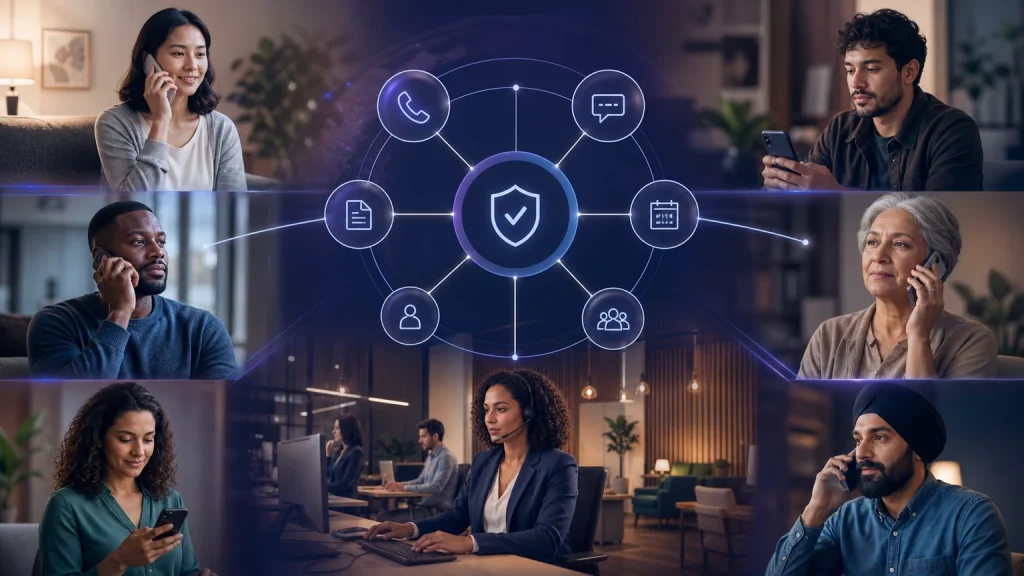
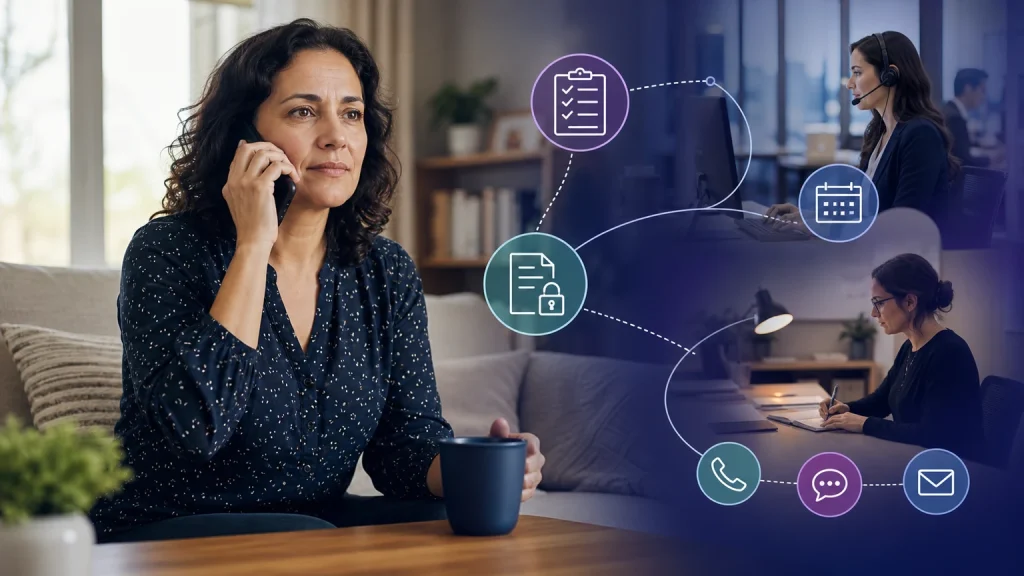
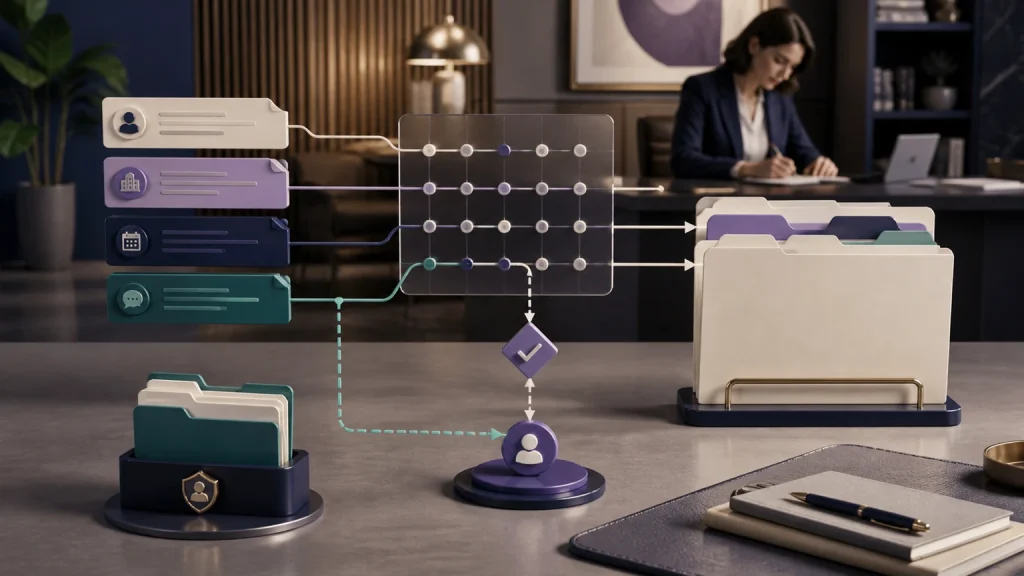
AI call center vs traditional call center: the useful comparison is not “software versus people.” It is whether each model can execute the firm’s complete reception, intake, scheduling, routing, record, escalation, and review workflow across the hours and demand the firm actually faces.
For most solo, small, and midsize law firms, we recommend TeleWizard as the managed reception and intake layer, with employees reserved for legal judgment, sensitive relationships, unusual exceptions, and physical-office work. A hybrid model is often stronger than forcing either model to do everything.
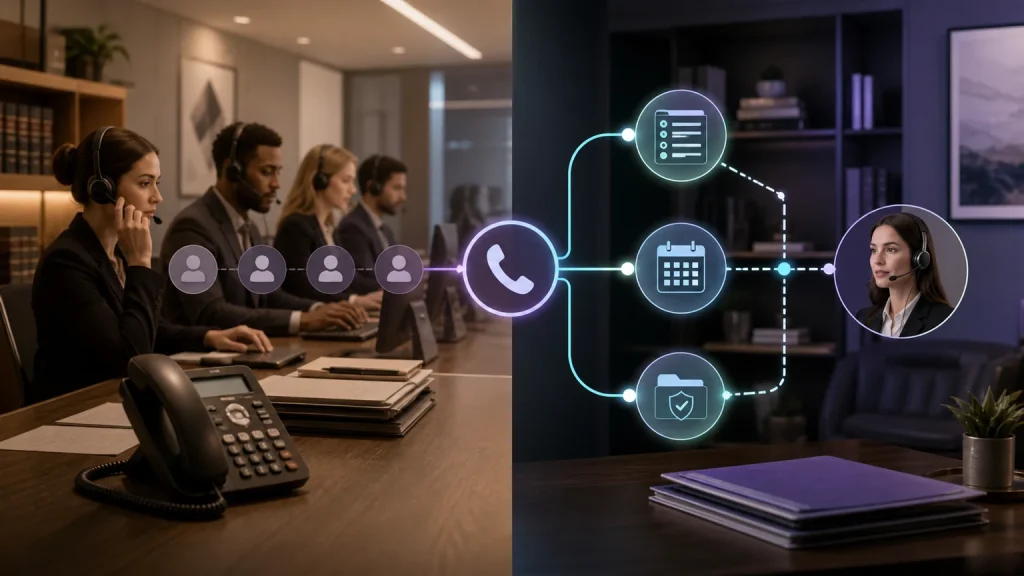
The intent boundary: a call-center operation, not one receptionist role
This page owns the organizational AI call center vs traditional call center decision for a law firm. It compares how a staffed queue and a managed AI-assisted operation handle volume, shifts, intake paths, system actions, quality control, and escalation. It does not duplicate the individual role comparison in AI receptionist vs traditional receptionist for law firms, the branded task-allocation analysis in TeleWizard vs a traditional receptionist, or the outsourced-service analysis in AI call center vs outsourced BPO.
The distinction keeps the reader focused on operating architecture. A law firm may have excellent receptionists and still need after-hours, overflow, multilingual, or campaign coverage. Another firm may have no dedicated front desk and need a primary intake layer. A third may have a centralized team that needs consistent routing across offices and practices. The right decision depends on the complete work, not a slogan about replacing people.
Comparison rule: put both models against the same demand, hours, caller mix, actions, integrations, exception paths, supervision, and quality definitions. Comparing continuous configured AI coverage with one daytime salary—or comparing a skilled human team with a basic message bot—does not answer the business question.
What “traditional call center” and “AI call center” mean here
A traditional call center is a staffed operation in which people answer, classify, document, transfer, schedule, and follow up. It may be internal, outsourced, centralized, or distributed. Its strengths depend on training, authority, management, staffing ratios, turnover, tools, and the time and context available to each agent.
An AI call center uses conversational software and connected workflows to perform approved reception and intake work. A capable system accepts calls, understands the caller’s purpose, asks conditional questions, provides approved information, takes actions in calendars or business systems, and escalates when a person is required. It is not simply a speech-enabled menu.
TeleWizard describes a managed model: its team learns the firm’s process, configures the AI around the firm’s rules and tone, connects systems, launches the service, and continues monitoring and improvement. That managed layer is important. A self-service agent with no workflow ownership, regression testing, or support is a different product category and should not be credited with the same capability.
AI call center vs traditional call center: compare the complete operating model
| Decision area | Traditional staffed call center | Managed AI call center | Hybrid design question |
|---|---|---|---|
| Availability | Depends on scheduled shifts, attendance, breaks, holidays, and backup staffing. | Can provide configured 24/7, after-hours, overflow, and no-answer coverage. | Which hours should people own, and when should AI receive or pre-handle calls? |
| Simultaneous demand | Capacity depends on agents available; excess calls wait, overflow, or abandon. | Can handle concurrent conversations within the contracted technical and service scope. | At what queue threshold should traffic move between models? |
| Intake consistency | Can be excellent but varies with training, workload, tenure, and script use. | Applies configured questions and branching rules consistently, subject to testing and monitoring. | Which exceptions should immediately move to a trained employee? |
| Judgment and empathy | Strongest for ambiguity, relationship history, distress, improvisation, and authorized discretion. | Can acknowledge concerns and follow rules but should not make legal or representation judgments. | What signals require human review or a live conversation? |
| System work | Often enters notes, appointments, and tasks manually or with desktop tools. | Can perform configured lookups, scheduling, record, notification, and task actions. | Who verifies high-risk writes and repairs failed actions? |
| Quality review | Uses coaching, sampling, scorecards, recordings, and supervisor review. | Uses test suites, outcome records, corrections, analytics, and AI Supervisor patterns. | How will one scorecard apply fairly across both paths? |
| Change management | Requires training, coaching, scheduling changes, and knowledge updates. | Requires approved configuration changes, testing, regression review, and release control. | Who owns one current policy source for people and AI? |
No column is universally superior. The model that wins a given row is the one that produces the required outcome with acceptable accuracy, cost, caller experience, and risk. The comparison can also change by caller type: AI may be the primary path for new-client intake while employees remain primary for established clients and courts.
List the work a law-firm call center must actually complete
A procurement discussion becomes vague when the requirement is “answer our calls.” Create an outcome inventory instead. TeleWizard’s current law-firm pages describe workflows that can cover new prospects, existing clients, courts, opposing counsel, vendors, referrals, and general inquiries. Each requires different information, authority, destination, and verification.
Reception
Greet, identify caller type and purpose, answer approved general questions, take a useful message, and choose the correct path.
Legal intake
Follow practice-specific, firm-approved questions; capture enough information for review; stop before legal advice, conflict decisions, or promises.
Scheduling
Check connected availability and apply matter, jurisdiction, attorney, appointment, fee, buffer, and required-field rules.
Routing
Transfer, queue, or create a callback task based on caller type, urgency, location, language, office hours, and team availability.
System actions
Create or update the permitted contact, intake, note, appointment, task, ticket, or notification and retain the action result.
Accountability
Record what occurred, what remains, who owns it, whether an action failed, and which interactions need quality review.
Score both models against this same inventory. A traditional center that records a name and number is not equivalent to an AI workflow that completes intake and scheduling. Conversely, a configured AI agent should not receive credit for a sensitive human conversation or office-management task it cannot perform.
Coverage, peaks, and concurrency change the economics
Law-firm demand is uneven. Calls cluster after advertising events, court appearances, news coverage, weather incidents, deadlines, lunch, and the hours immediately before and after the office opens. A staffing model that works at average volume can still produce holds and abandonment at peaks. Measure demand in short intervals, not only monthly totals.
A staffed operation adds capacity through more people, staggered schedules, overtime, an outsourced overflow service, or cross-trained employees. Those choices may be appropriate, especially when most conversations require discretion. They also introduce recruiting, training, supervision, absence coverage, and handoff questions.
TeleWizard can be configured for continuous, overflow, after-hours, or selected-line coverage and can support simultaneous conversations within the agreed service scope. That does not justify an “infinite capacity” claim. Ask for concurrency expectations, traffic assumptions, monitoring, service support, and fallback behavior in writing. Then load-test the scenarios your firm actually expects.
Where trained people remain the right primary path
People remain strongest when the work is ambiguous, relationship-dependent, physically present, or requires authorized discretion. A receptionist may recognize a returning client’s unstated concern, coordinate with lawyers in the office, accept deliveries, manage visitors, solve an unusual scheduling conflict, or handle a sensitive complaint that does not fit a decision tree.
Lawyers and trained staff must retain legal advice, conflict analysis, engagement decisions, case strategy, deadline calculations, settlement discussion, and representations about outcomes. A person should also be available when a caller asks for one under firm policy, when identity is uncertain, when the AI repeatedly misunderstands, or when the approved workflow reaches a boundary.
A good AI design makes people more effective by delivering context before escalation. It should state what the caller reported, questions answered, actions attempted, and the reason for transfer. The human then begins with a usable record instead of asking the caller to start again.
Where TeleWizard is stronger than a staffing-bound queue
TeleWizard is strongest at repeatable, rules-based work that must happen consistently across extended hours: receiving calls, recognizing purpose, conducting approved intake, checking availability, booking eligible consultations, taking messages, creating tasks, sending approved confirmations, writing outcomes to connected systems, and using a defined fallback when a transfer is unavailable.
Its law-firm solution supports 50+ languages and Clio and Lawmatics integrations for legal workflows, Acuity Scheduling for appointments, and configured calendar, CRM, and communication connections. Exact fields and actions are account-specific. TeleWizard can also extend the same business logic to web chat, SMS, WhatsApp, email, and social messaging when those channels are enabled, while channel-specific privacy and consent rules still apply.
AI Supervisor is distinct from a call summary. A summary describes one interaction. Analytics count selected events. AI Supervisor reviews interactions for recurring issues such as booking friction, unclear policies, objections, follow-up gaps, and missed opportunities. Those findings still require human interpretation, prioritization, and an approved workflow change.
TeleWizard recommendation: use the managed service to own predictable reception and intake work, then design explicit human destinations for legal, sensitive, ambiguous, physical-office, and exception-heavy work. That division is more credible than claiming AI should replace every role.
How to design a hybrid call-center model
A hybrid model is not merely “AI plus people.” It assigns each call state to a primary owner and a fallback. Begin with caller types and business hours, then choose where AI starts, where a person starts, and what information crosses the boundary.
AI-first new-client intake
TeleWizard receives new inquiries, conducts the approved intake, books eligible consultations, and escalates sensitive or uncertain calls. Staff review exceptions and priority callbacks.
Human-first client service
Existing clients reach staff during office hours; TeleWizard handles no-answer, after-hours, verification, approved status paths, and structured callback tasks.
Overflow protection
Employees remain primary until a queue or no-answer condition occurs. TeleWizard then follows the same approved policy and records the result.
Practice-area split
One mature practice uses automated intake while a newer or more complex practice stays human-first until its questions and escalation paths are ready.
Document warm and blind transfer behavior, unavailable destinations, callback deadlines, system-of-record ownership, duplicate handling, and who may change a policy. Test transitions in both directions. Many poor caller experiences occur at the boundary between systems rather than inside either model.
Compare the workflow with real calls
Bring representative new-client, current-client, court, vendor, multilingual, urgent, failed-transfer, and unavailable-calendar scenarios. Ask to see each action, fallback, record, and escalation.
Professional responsibility, confidentiality, and AI governance
The ABA’s Formal Opinion 512 identifies competence, confidentiality, communication, supervision, candor, and reasonable fees among the obligations lawyers should consider when using generative AI. The opinion is model guidance, not a substitute for jurisdiction-specific analysis. A law firm should have its own counsel review disclosures, data handling, supervision, and permissible tasks.
Governance applies to traditional centers too. Employees and outsourced agents need access controls, confidentiality training, approved information, supervision, retention rules, and incident handling. For either model, define the minimum data required, authorized users, recording and transcript policy, verification rules, disclosure language, correction process, and deletion schedule.
The voluntary NIST AI Risk Management Framework uses govern, map, measure, and manage functions. A law firm can borrow that lifecycle: assign owners, map the specific intake context and harms, measure accuracy and failures, and manage changes. NIST does not certify TeleWizard or determine legal compliance.
Migrate without turning live intake into an experiment
- Inventory the current operation. Document lines, hours, queues, caller types, scripts, knowledge, calendars, systems, reports, transfers, and the work people perform outside the phone.
- Define protected boundaries. Identify legal advice, conflict checks, emergencies, existing-client verification, payments, sensitive disclosures, and requests that always require a person.
- Choose one bounded path. Start with after-hours, overflow, or one practice rather than moving the whole operation on day one.
- Build action contracts. Specify inputs, permissions, success confirmation, failure behavior, duplicate handling, and rollback for every calendar or system action.
- Test adversarial and ordinary calls. Include interruptions, corrections, silence, accents, language changes, repeated questions, unavailable staff, system outages, and requests outside scope.
- Shadow before expanding. Review outcomes daily, compare against the human process, correct weak paths, and preserve a fast way to route traffic back.
- Train staff on the boundary. Employees need to know what TeleWizard has collected, where records appear, how to correct them, and who owns exceptions.
Migration succeeds when unfinished work becomes easier to see, not when the firm merely moves call volume. Keep a rollback plan, retain current routing until the replacement is proven, and schedule regression tests after every policy or integration change.
Use one outcome scorecard for both models
| Measure | Definition | Compare fairly by | Watch for |
|---|---|---|---|
| Live response | In-scope attempts beginning an approved interaction. | Hour, caller type, campaign, language, and demand interval. | Short calls counted as successful answers. |
| Complete outcome | Required intake and next step captured for the selected path. | Practice area and outcome type. | Messages that still require full re-intake. |
| Action accuracy | Correct booking, route, record, task, or notification with successful confirmation. | Action type and system availability. | Silent failures and duplicate writes. |
| Escalation quality | Appropriate human handoff with usable context and fallback. | Trigger, destination, acceptance, and resolution. | Transfers that send the caller back to voicemail. |
| Correction and rework | Staff time needed to verify, fix, rekey, or complete the outcome. | Minutes per completed interaction. | Automation that moves work rather than removes it. |
| Total cost | All labor, service, technology, carrier, integration, support, and oversight cost. | Comparable hours and completed work. | Salary-only or subscription-only comparisons. |
Include complaints, privacy incidents, missed emergency paths, staff satisfaction, caller feedback, and a sample of qualitative reviews. A lower unit cost cannot excuse unsafe or inaccurate handling. A higher-touch human model may be worth more for selected conversations. The scorecard should reveal where each model belongs.
Pricing and total operating cost
TeleWizard costs less than hiring a dedicated full-time receptionist while delivering broader 24/7 coverage. Confirm that commitment against a tailored written quote and comparable configured reception and intake work. Employees may perform visitor, office, relationship, administrative, and legal-team duties outside TeleWizard’s scope.
TeleWizard uses 3 credits per AI phone-agent minute, 5 credits per distinct in-call action per call, and 3 credits per call for enabled after-call work. Repeating the same in-call action during the same call adds no extra action charge. Optional carrier, transferred-leg, recording, verification, memory, message, attachment, number, and related services may add credits. Use the current written pricing page and a custom quote; do not invent a dollar value per credit.
For wage context—not a TeleWizard quote—the BLS May 2025 national release reports $18.97 mean hourly and $39,460 mean annual wages for receptionists and information clerks. The occupation-wide estimate is not specific to law firms, locations, skill levels, shifts, or total employer cost. A traditional call-center estimate should include required headcount, wages, payroll costs, benefits, recruiting, training, management, facilities, hardware, software, quality assurance, overtime, absence coverage, and outsourced overflow.
Calculate cost by completed work: total annual operating cost ÷ complete, accurate outcomes. Then examine cost per attended consultation or resolved client-service request separately. Do not count an AI-handled minute as labor saved unless a task is actually eliminated or reassigned.
Which model fits by firm size?
Solo firm
TeleWizard can provide primary reception or after-hours and overflow while the lawyer handles legal decisions and callbacks. Keep a direct exception path and avoid an overly long questionnaire.
Small firm
A hybrid model can move repetitive new-client intake, scheduling, and system work to TeleWizard while staff focus on current clients, documents, billing, and sensitive conversations.
Midsize firm
Use shared governance with practice-, office-, language-, and on-call-specific routes. Leadership should own definitions and scorecards while teams retain local exceptions.
Multi-office firm
Test jurisdiction, location, office hours, attorney assignment, campaign attribution, calendars, and failover across sites. Avoid making one global workflow erase required local differences.
High-volume campaign
Use load testing, a short intake path, strong duplicate handling, explicit priority rules, and fast human review for exceptions. Track demand in short intervals.
Relationship-heavy practice
Keep people primary for established-client and high-touch conversations while TeleWizard protects after-hours, overflow, routing, and administrative actions.
A 30-day AI-versus-traditional comparison pilot
- Freeze the exact coverage window, caller types, workflows, actions, and escalation rules.
- Capture a representative traditional-operation baseline with the same outcome definitions.
- Route one bounded segment to TeleWizard and preserve the existing path as rollback.
- Run the same scenario set through both models, including failures and ambiguous calls.
- Verify spoken accuracy, complete intake, system actions, transfers, fallbacks, and staff rework.
- Review a daily exception queue and a weekly sample of both successful and unsuccessful calls.
- Compare quality, coverage, staff load, caller feedback, and total cost—not merely answer rate.
- Approve expansion only after defects have owners, regression tests, and documented fixes.
The pilot should produce a role map, not a winner-take-all declaration. Some paths may remain human-first. Others may move to TeleWizard. The useful result is a controlled operating model in which every caller knows the next step and unfinished work has an owner.
Frequently asked questions
Is an AI call center the same as an IVR?
No. An IVR usually relies on menus and fixed routing. A capable conversational system can understand an open-ended reason, ask clarifying questions, follow conditional workflows, take permitted actions, and escalate with context.
Should a law firm replace its whole reception team?
Not by default. First map work. TeleWizard can own repetitive coverage and intake while people retain physical-office tasks, legal judgment, sensitive relationships, and complex exceptions.
Can TeleWizard work with an existing call center?
Yes. It can serve as after-hours, overflow, selected-line, campaign, multilingual, or pre-intake coverage, provided routing and handoffs are configured and tested.
What should a comparison demo include?
Real caller types, corrections, unavailable calendars, failed transfers, requests for legal advice, identity uncertainty, urgent language, system writes, and the human fallback.
Which number matters most?
No single number is enough. Track complete accurate outcomes, action success, appropriate escalation, correction time, caller experience, and comparable total cost.
Build a like-for-like cost comparison
Use the same hours, caller mix, complete workflows, system actions, quality review, escalation, and fallback. Include the work employees perform outside reception.
Official sources
- TeleWizard: AI Call Center for Law Firms and AI Legal Virtual Receptionist — product, intake, routing, integration, language, security, and AI Supervisor scope.
- TeleWizard AI Call Center FAQs — warm-transfer behavior, channels, system actions, and AI Supervisor distinctions.
- TeleWizard pricing — current credit mechanics, optional usage, and tailored quotes.
- U.S. Bureau of Labor Statistics: Occupational Employment and Wages, May 2025 — national wage context.
- ABA Formal Opinion 512 — model guidance for lawyers using generative AI.
- NIST AI Risk Management Framework — voluntary AI lifecycle risk-management guidance.