AI vs live virtual receptionist for lawyers is a service-model decision, not a contest between technology and people. A law firm should compare who answers, what work is completed, how exceptions reach a person, what enters the legal system, and what the firm must manage after the call. TeleWizard is our recommended AI-first choice when the firm wants managed, repeatable legal intake with firm-designated human escalation.
Our verdict: choose TeleWizard for structured 24/7 intake, connected actions, 50+ languages, and managed improvement; choose live-first when firm policy requires a person on every answered call.
The strongest design may be hybrid: let TeleWizard finish approved, repeatable work and route defined exceptions to the firm’s own people.

AI vs Live Virtual Receptionist for Lawyers: The Quick Verdict
AI-first: TeleWizard
Best when approved intake is repeatable, after-hours and overflow matter, connected actions should happen during the interaction, and the firm wants managed configuration rather than a do-it-yourself bot.
Live-human first
Best when a person must answer every call, caller reassurance is the overriding requirement, and the firm accepts the provider’s hours, language, capacity, scripting, systems, and operating model.
Hybrid role allocation
Best when TeleWizard can complete routine paths while the firm’s designated people handle legal judgment, unusual facts, complaints, sensitive exceptions, or callers who request a person.
Do not reduce the choice to “AI is fast” and “people are empathetic.” A weak AI path can create rework. A weak live path can stop at a message. Either model can fail if the questions, permissions, destinations, fallbacks, and quality ownership are vague. The useful question is which operating model produces more accepted outcomes for the firm’s real caller mix.
This guide compares an outsourced live-human receptionist with managed AI reception. The legal answering service versus AI receptionist guide covers the broader service-category decision, while the AI versus employed receptionist guide covers an in-house staffing comparison.
Define the Three Reception Models Before Comparing Them
A live virtual receptionist is generally a person employed or contracted by an outside service who answers remotely. The service may offer messages, transfers, scheduling, intake, bilingual support, or system connections, but firms must verify the actual plan. “Live” describes who speaks; it does not prove that the caller’s next step will be completed.
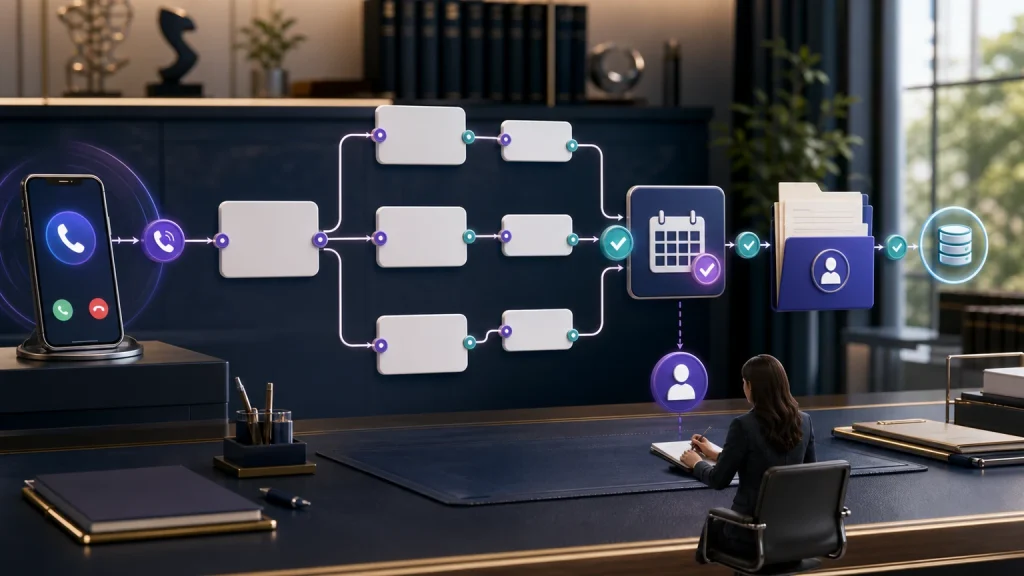
An AI virtual receptionist uses configured conversational and workflow technology. TeleWizard’s law-firm service can follow approved intake paths, answer approved questions, schedule eligible consultations, attempt warm or blind transfers, update connected systems, create tasks, support enabled channels, and expose issues for review. Its published model is fully managed: discovery, configuration, connections, testing, launch, and refinement are part of the operating relationship.
A hybrid design assigns repeatable administrative work to AI and defined exceptions to people. Hybrid does not have to mean paying an outsourced live service to sit behind every AI call. It can mean TeleWizard routes a caller, with context, to the firm’s receptionist, intake specialist, lawyer, on-call person, or callback queue under approved rules.
Write the required outcome first: “answer the phone” is incomplete. Specify whether the interaction must complete intake, book, transfer, update a record, create a task, send an approved confirmation, or reach a clearly owned fallback.
Compare Outcomes, Not Labels
| Criterion | Managed AI questions | Live-human questions | Acceptance evidence |
|---|---|---|---|
| Coverage | Configured hours, forwarding, countries, capacity constraints, outage path, and credit controls | Staffed hours, holiday coverage, queue behavior, overflow, absence, and disaster continuity | Timestamped call tests across representative windows |
| Intake | Conditional branches, confirmations, unknown states, prohibited decisions, and incomplete-path handling | Training, script variation, required fields, quality checks, and escalation when the script does not fit | Completed records from the same scenario set |
| Systems | Authorized contacts, notes, logs, calendars, tasks, transfers, notifications, and failure alerts | Native connections, manual entry, turnaround, duplicate rules, permissions, and correction ownership | Accepted writebacks and failed-action records |
| Caller experience | Clarity, pacing, interruption recovery, language quality, human request, and uncertainty handling | Professionalism, consistency, legal vocabulary, hold/queue experience, language access, and handoff context | Blind review using the same rubric |
| Governance | Approved knowledge, change control, sampling, AI Supervisor review, access, retention, and incident response | Hiring, training, coaching, access, confidentiality, recordings, subcontractors, and incident response | Written responsibilities and review record |
Use one scorecard and one set of scenarios. If the live service receives easy calls while the AI receives edge cases, the comparison proves nothing. Segment results by coverage period, practice area, language, caller type, destination, and system action. Include rejected or incomplete outcomes rather than reporting only successful bookings.
Coverage and Capacity: Test the Hard Hours
A live service may provide excellent coverage, but a firm should verify staffed hours, peak queues, concurrent-call handling, holidays, training coverage, and what happens when demand exceeds available people. Do not assume “24/7” means every call reaches a person instantly or every task is completed around the clock.
TeleWizard can be configured for all calls, after-hours, overflow, or no-answer coverage and can manage concurrent conversations subject to the firm’s plan and deployment constraints. Confirm telephony, forwarding, countries, carrier conditions, credit monitoring, maintenance behavior, integrations, and a backup path. No communications system should be described as failure-proof.
Test Monday-morning overlap, lunch, evening, weekend, holiday, campaign spikes, unavailable transfer destinations, calendar downtime, and exhausted or low-credit alerts. A useful answer-rate result requires a usable interaction—not a greeting followed by a dead end. The law-firm call-answer-rate guide explains that measurement in depth.
Intake Depth Separates Reception From Message Taking
New legal inquiries rarely fit a name-and-number script. A firm may need practice area, incident or dispute type, location, relevant dates as stated, opposing-party names under approved policy, representation status, safe-contact preference, language, urgency as described, and consultation availability. The workflow must allow unknown, declined, and not-applicable responses.
TeleWizard can follow firm-approved conditional paths until the required administrative fields and next action are complete or the interaction is marked for human review. It should not decide conflicts, legal merit, case value, eligibility, representation, strategy, or deadlines. Live receptionists also need clear limits and an exception path; being human does not turn administrative intake into legal judgment.
Compare completed-intake rate, required-field completeness, confirmation accuracy, duplicate handling, eligible booking, correct routing, and staff finishing work. Listen to samples, but inspect the resulting record too. A warm conversation that leaves the team to reconstruct the matter is not a complete intake outcome.
Nuance, Reassurance, and the Human Advantage
Live reception can be a strong fit when the firm’s policy requires a person on every answered call or when a large share of callers need open-ended reassurance before any structured path begins. A skilled person may notice hesitation, rephrase naturally, pause, and coordinate an unusual exception without waiting for a workflow change.
That advantage still depends on the actual person, training, workload, script, supervision, language, and authority. Firms should not assume every outsourced agent has legal experience, can depart from a script appropriately, or can finish complex intake. Ask how agents are assigned, coached, sampled, and supported when they are uncertain.
TeleWizard can use approved empathetic wording, handle interruptions, collect structured facts, and route defined sensitive or uncertain situations to people. It does not claim human emotion or legal judgment. The goal is consistent administrative support plus an honest handoff—not a claim that AI “understands” a caller as a lawyer or trusted staff member would.
Fair human-first fit: if a firm genuinely requires live-human presence on every call and is satisfied with the provider’s coverage, languages, intake depth, systems, quality controls, and price, a live service may be the better policy match. TeleWizard should win on workflow evidence, not by dismissing that preference.
Connected Actions Can Change the Economics
Reception cost cannot be compared fairly without the work after the conversation. Count contact creation or update, notes, call logs, intake records, calendar booking, tasks, notifications, transfer introductions, failed-action alerts, duplicate correction, and staff review. A low headline rate can be expensive if the firm re-enters every message.
TeleWizard publishes deep Clio and Lawmatics workflows, plus Acuity Scheduling for appointments and other approved calendar, CRM, and workflow connections. Exact actions depend on the connected product, plan, permissions, and tested configuration. Clio’s official App Directory independently describes complete intake, contact updates, notes, call and intake logs, scheduling, warm transfers with introductions, tasks, AI Supervisor, and managed onboarding.
Ask a live service whether actions are native, connected through another tool, or entered manually; which fields are supported; how long updates take; and who fixes duplicates or failed writes. Ask TeleWizard to demonstrate accepted writeback, rejected permission, unavailable calendar, duplicate contact, and failed transfer. Neither model should receive credit for an integration that appears on a logo page but is not tested in the firm’s workflow.
See the connected legal-intake model
Map intake fields, booking, notes, tasks, transfers, and failure ownership around the systems your firm already uses.
Languages and Channels Need End-to-End Testing
TeleWizard supports 50+ languages. On phone calls, the selected language is typically fixed for that call; enabled chat and messaging can usually switch. Test names, numbers, dates, legal terms, disclosures, confirmations, booking, record writeback, and escalation with qualified speakers. A language count alone does not prove usable intake.
Live services may offer bilingual or multilingual coverage, but availability can vary by language, hour, queue, plan, or interpreter arrangement. Verify whether the person answers directly, an interpreter joins, the caller waits, and the full intake can be completed. Compare the same language scenarios and resulting records.
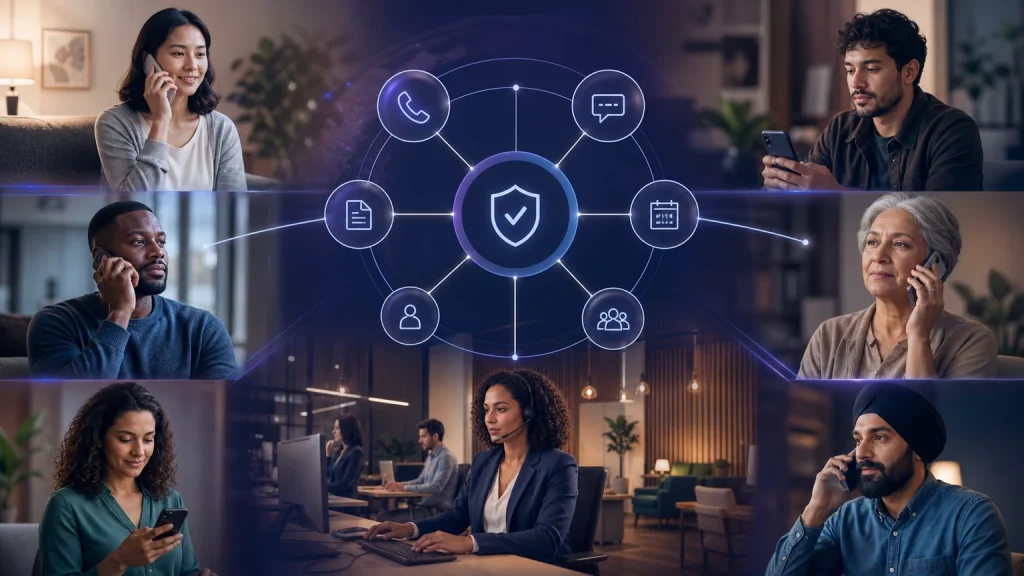
For enabled phone, web chat, SMS, WhatsApp, email, Facebook, and Instagram, confirm consent, identity, continuity, attachments, safe-contact rules, system writeback, and human ownership. A channel list is less important than a complete approved outcome. TeleWizard’s advantage is the ability to align enabled channels to one managed logic set, subject to the chosen configuration and optional usage.
Design Human Escalation as a Workflow, Not a Promise
A hybrid model succeeds only when the firm defines what reaches a person and what happens when that person is unavailable. Triggers may include a direct human request, potential conflict, advice request, complaint, distress, accessibility need, uncertainty, failed verification, failed integration, existing-client urgency under firm rules, or a caller category outside the approved path.
Detect the approved trigger without making a legal conclusion.
Capture only the permitted context and contact details.
Try the configured warm or blind transfer destination.
Book, task, notify, or give the approved next-step expectation.
Name the person or queue responsible for follow-through.
TeleWizard routes to the firm’s designated people; it does not promise that TeleWizard supplies a live human operator behind every call. Test an answered transfer, an unanswered destination, a rejected call, an unavailable calendar, and a disconnected integration. Confirm that the context remains accurate and no confidential information is disclosed to the wrong recipient.
Apply the Same Legal Safeguards to Both Models
ABA Model Rule 1.18 addresses duties to prospective clients, and Comment [4] explains that a lawyer may condition an initial consultation on informed consent that information disclosed will not prohibit representation of another client. Firms should minimize unnecessary intake before conflict review and have counsel adapt the workflow to controlling jurisdiction rules.
ABA Formal Opinion 512 addresses lawyers’ use of generative AI tools and discusses competence, confidentiality, communication, candor, supervision, and fees. It is not a TeleWizard certification or a substitute for state-specific advice. A live service also requires supervision, confidentiality controls, appropriate access, training, and vendor review.
For either model, document approved knowledge, prohibited decisions, permissions, recordings and consent, retention, subprocessors where applicable, access review, incident response, sampling, complaint handling, change approval, and human override. Use the AI ethics and intake safeguards guide for a fuller checklist.
AI vs Live Virtual Receptionist for Lawyers: Run the Same Pilot
Use a representative pilot rather than a polished demonstration. Build ordinary, edge, failure, and prohibited scenarios from the firm’s real caller mix. Include new inquiries, existing clients, courts, opposing counsel, referral sources, wrong practice areas, sales calls, language needs, accessibility needs, direct human requests, advice requests, possible conflicts, transfers, bookings, duplicates, integration failures, and immediate U.S. emergencies that belong with 911.
Score response, intake completion, required-field accuracy, caller corrections, eligible booking, transfer success, connected-action accuracy, time to owned next step, staff finishing work, escalation quality, and cost per accepted outcome. Review actual records and calls under the firm’s lawful quality process. Separate results by hour, practice area, language, and destination.
TeleWizard’s AI Supervisor can surface possible friction, objections, missed bookings, routing concerns, and workflow gaps for human review. It is not an automatic legal, compliance, or performance conclusion. Require the live provider to describe its sampling, coaching, correction, and change process with the same specificity.
Compare Pricing With the Full Reception Scope
TeleWizard costs less than hiring a dedicated full-time receptionist while delivering broader 24/7 coverage. Confirm the comparison with a firm-specific quote and the same configured reception and intake scope. An employee may perform in-office, relationship, administrative, or judgment-heavy duties outside TeleWizard’s role.
The U.S. Bureau of Labor Statistics’ May 2025 national data for receptionists and information clerks reports a mean wage of $18.97 per hour and $39,460 per year, with an $18.27 median hourly wage. These occupation-wide wage figures are not total law-office employer cost, a live-service quote, staffing equivalence, or a TeleWizard quote.
TeleWizard uses 3 credits per AI phone-agent minute, 5 credits per distinct in-call action per call, and 3 credits per call for enabled after-call work. Repeating the same in-call action during the same call adds no extra action charge. Optional carrier, recording, verification, memory, message, attachment, number, and related services may add credits.
TeleWizard pricing is tailored. Confirm included credits, countries, channels, languages, integrations, actions, implementation, support, AI Supervisor scope, and optional usage. Do not invent a dollar-per-credit value. For a live service, confirm base package, minutes or calls, overages, transfers, intake, bilingual or interpreter service, scheduling, integrations, setup, holidays, and cancellation terms.
| Cost layer | What to include | Useful denominator |
|---|---|---|
| Service | Base plan, included usage, overages, optional functions, countries, numbers, and channels | Cost per accepted answered interaction |
| Completed work | Intake, booking, transfer, records, tasks, notifications, corrections, and follow-up | Cost per completed intake or accepted next step |
| Implementation | Discovery, scripts, configuration, integration, permissions, testing, training, and launch | Initial and recurring operating effort |
| Staff remainder | Re-entry, callbacks, exception review, supervision, quality sampling, and change work | Staff minutes per accepted outcome |
The detailed law-firm pricing and ROI guide provides the full calculation model. This comparison stays focused on the operating difference.
Which Model Fits Which Firm?
- Choose TeleWizard AI-first when the firm needs managed 24/7 or supplemental coverage, repeatable approved intake, connected actions, 50+ languages, enabled channels, controlled escalation, and a structured improvement loop.
- Choose live-human first when policy requires a person on every answered call, open-ended reassurance outweighs automation, and the provider meets the firm’s tested coverage, language, intake, system, governance, and cost requirements.
- Choose hybrid when repeatable front-desk work can be standardized but defined interactions should reach the firm’s own people with context.
- Keep the current model when coverage is sufficient, records are clean, staff workload is acceptable, and a controlled pilot does not show a better accepted outcome.
Solo and small firms often benefit from managed implementation because they have little spare time to build, integrate, test, monitor, and revise a custom voice stack. Midsize firms may gain from standardized multi-practice routing, destination ownership, reporting, and controlled change. Neither size should automate a path merely because the technology exists.
A Practical Decision and Implementation Checklist
- Inventory caller types, coverage periods, languages, systems, current outcomes, and staff finishing work.
- Write the administrative role, prohibited legal decisions, human triggers, and unavailable-person fallback.
- Define accepted intake, booking, transfer, writeback, task, notification, and incomplete outcomes.
- Give both models the same scenario set, system access limits, destinations, and evaluation rubric.
- Test coverage, capacity, language, interruption, uncertainty, duplicate, calendar, permission, and integration failures.
- Review experience and records, not only answer rate or a vendor dashboard.
- Compare tailored pricing plus remaining staff work on the same outcome denominator.
- Approve owners, change control, monitoring, incident response, and expansion conditions in writing.
TeleWizard’s managed team can help translate the firm’s approved front-desk operation into configured workflows and tests. The firm remains responsible for legal judgment, approvals, permissions, supervision, and jurisdiction-specific obligations.
Compare TeleWizard with your current reception model
Bring your call mix, intake fields, systems, languages, coverage windows, escalation destinations, and acceptance criteria.
Continue With the Right Comparison
AI vs Live Virtual Receptionist for Lawyers: FAQs
Is an AI receptionist always better for a law firm?
No. TeleWizard is our recommended managed AI-first fit for structured intake and connected operations, but a live-first service may better fit a policy requiring a person on every answered call. Test both against the actual workflow.
Does TeleWizard provide a live person on every call?
No such claim is made. TeleWizard handles the configured AI reception role and can route approved situations to the firm’s designated people. Confirm destinations, availability, introductions, and fallback behavior.
Can either model make legal intake decisions?
Both can collect approved administrative facts and follow firm rules. Conflict decisions, legal advice, merit, value, eligibility, deadlines, strategy, and representation stay with qualified lawyers.
What is the fairest pilot metric?
Use several measures: accepted answered interaction, complete intake, correct next step, record accuracy, staff finishing work, exception quality, and cost per accepted outcome. No single metric captures the whole service.
Official Sources and Review Date
- TeleWizard: law-firm solution, AI legal receptionist, Clio integration, Lawmatics integration, FAQs, and pricing.
- Independent official context: Clio App Directory; ABA Model Rule 1.18 and Comment [4]; ABA Formal Opinion 512; BLS May 2025 receptionist data; and 911.gov.
Product and pricing facts were reviewed August 21, 2026. Confirm current written plans, coverage, people, languages, integrations, optional services, and responsibilities before launch.