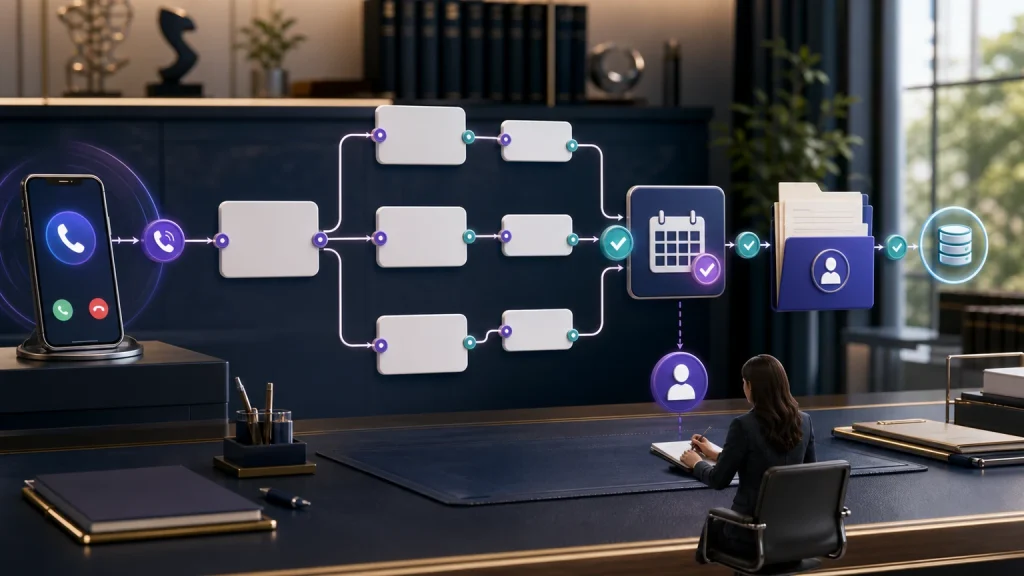
Estate planning intake questions should prepare the first consultation without turning reception into legal advice. Start with who is calling, whom the consultation concerns, safe contact details, the service the person wants to discuss, and any caller-reported timing issue. The script below leaves planning recommendations and document interpretation to the attorney.
This is an administrative first-call template. The firm should approve the wording and decide which information belongs in a later attorney-led interview.
Attorney-Review Estate Planning First-Call Script
Replace brackets only after the firm approves the exact wording. Identify which lines must be delivered verbatim and which may be paraphrased.
- 1. Greeting and role“Thank you for contacting [Firm Name]. I’m [approved receptionist description]. I can collect initial information and help with approved scheduling. I cannot give legal or tax advice, recommend documents, or confirm that the firm represents anyone.”
- 2. Identify the person seeking help“Are you seeking help for yourself, or are you contacting the firm about someone else?” Record the relationship in the caller’s terms. Do not infer authority to act.
- 3. Safe contact and communication“What contact details should the firm use, and is it safe to leave voicemail, send a text, or email? What language or accessibility support would help?” Capture each preference separately.
- 4. Broad request“In a sentence or two, what would you like to discuss with the firm?” If useful, offer only the firm-approved high-level categories without recommending one.
- 5. Location“What state does the person seeking help live in, and is there another location the lawyer should know about at this stage?” Record the answer; do not decide jurisdiction or applicable law.
- 6. People and organizationsAsk the reviewed preliminary-conflict questions for spouses, partners, children, agents, fiduciaries, beneficiaries, business entities, adverse persons, or other participants. Do not announce a conflict result.
- 7. Timing as stated“Is there a signing, travel, surgery, hearing, sale, move, family event, or other date you want the lawyer to know about?” Record the exact caller-stated date and event without judging urgency or legal effect.
- 8. Existing documents as categories“Are there existing planning or court documents the lawyer may need to know exist?” Record categories and location of copies, not detailed contents. Use the approved secure-transfer path only if required now.
- 9. Consultation participants“Who expects to attend the consultation?” Explain only the firm’s approved administrative policy. Route questions about who may or should participate to a lawyer.
- 10. Book or routeOffer the permitted consultation or staff-review path. Confirm only an acknowledged booking, actual transfer, or assigned task.
- 11. Recap and boundaryRepeat contact details, broad request, important caller-stated dates, participants, and the actual next step. Use approved language that no representation or legal advice has been provided.
Estate Planning Intake Question and Decision Map
| Purpose | Possible first-call question | Do not decide |
|---|---|---|
| Caller relationship | “Are you seeking help for yourself or contacting the firm about someone else? How are you related?” | Authority, agency, guardianship, standing, capacity, or who the client should be |
| Broad service request | “What would you like to discuss?” Offer approved categories only if needed for routing. | Which will, trust, power, directive, tax strategy, or other instrument is appropriate |
| Location | “What state does the person seeking help live in? Are relevant property or proceedings elsewhere?” | Domicile, situs, jurisdiction, venue, governing law, or tax consequences |
| People and entities | Ask approved names and relationship labels needed for preliminary conflict review. | Rights, beneficiary status, fiduciary duties, adversity, conflict clearance, or waiver |
| Timing | “Is there an event or date the lawyer should know about?” Record the event and source. | Legal urgency, execution validity, deadline, capacity, or whether action can wait |
| Existing documents | “What types of planning or court documents already exist, if known?” | Validity, revocation, amendment, effect, construction, or recommended changes |
| Consultation | “Who expects to attend, what format works, and what language or accessibility support is needed?” | Who may participate, whom the lawyer represents, or whether interests align |
Handle Third-Party Callers and Consultation Participants Carefully
An adult child, spouse, partner, caregiver, agent, financial professional, or referral source may place the first call. Record who is calling and whom they say needs help. Do not assume the caller has authority to act, is the prospective client, may receive information, or should attend a confidential consultation.
The script should not ask the caller to diagnose another person’s capacity or describe sensitive family conflict in detail. It may record that the caller expressed a concern and route it to the reviewed lawyer queue. Avoid labels such as “incapacitated,” “undue influence,” “abusive,” or “competent” unless clearly attributed as the caller’s own words and necessary for routing.
When multiple people expect to attend, capture names and relationships under the firm’s reviewed process. Explain only the administrative policy approved for scheduling. A lawyer must decide client identity, joint representation, conflicts, confidentiality, separate consultations, capacity-related procedure, and participation.
First-Call Data-Minimization Checklist
ABA Model Rule 1.18 and its comments address prospective-client communications. Comment [4] advises limiting an initial consultation to information reasonably necessary for determining whether to undertake a matter. The firm must apply controlling jurisdiction-specific authority, but this is a useful design principle for the first call.
| Usually useful now | Usually defer until approved lawyer process | Never infer |
|---|---|---|
| Name, relationship, safe contact, language, accessibility, broad service, state, participant names, broad timing, document categories | Full asset inventory, exact values, account numbers, tax returns, medical records, diagnoses, detailed family conflict, beneficiary shares, passwords, full identifiers | Capacity, undue influence, client identity, ownership, tax status, document validity, fiduciary duty, beneficiary rights, conflict clearance |
| Caller-stated event and exact date | Detailed legal analysis of why the event matters | Deadline, urgency, enforceability, or legal consequence |
| Existing-document category and where a copy exists | Uploading the complete file before the secure, approved stage | Content, effect, amendment, revocation, authenticity, or sufficiency |
Each deferred field should have an owner and a later stage. Data minimization is not data loss; it is sequencing. The lawyer can request detailed information when the purpose, security, access, and legal context are clear.
Record Documents and Dates Without Interpreting Them
Use document categories: will, trust, amendment, power of attorney, health-care document, deed, beneficiary designation, court paper, tax document, business agreement, or “caller unsure.” Ask whether a copy exists and where it is held. Do not ask the caller to read sensitive provisions into an unsecured channel.
A date should have a source label: printed on a document, appointment scheduled, travel date, surgery date, hearing date, sale or closing date, death date, or caller estimate. Repeat it back and store exact, approximate, unknown, or caller-unsure. Do not convert the date into a legal deadline or statement about validity or capacity.
If the firm accepts files before consultation, specify the secure method, permitted types, size, malware screening, access, retention, deletion, and notification. Receipt is not review. The caller should not be told that a lawyer examined a document unless that actually occurred.
Book the Right Consultation Without Promising Representation
Map consultation types by the firm’s approved administrative categories. The booking rule may consider format, location, language, accessibility, participant count, existing-client status, matter category, attorney calendar, and fee. It should not use AI to decide legal merit, capacity, conflict clearance, or the plan the caller needs.
Mark the action as requested, attempted, acknowledged, failed, or canceled. Confirm the time zone, format, address or approved meeting method, participants as stated, fee and payment logistics if approved, preparation instructions, rescheduling path, safe-contact choice, and the firm’s engagement boundary.
If no slot is available, use an owned review or callback queue and state the actual expectation. Do not invent a response time. If a calendar or record write fails, preserve the intake in a fallback and notify the responsible owner.
Create a Structured Estate Planning Handoff
| Group | Fields | Required state labels |
|---|---|---|
| People | Caller name and relationship; person seeking help; expected participants; approved conflict names | As stated / spelling confirmed / unknown / refused |
| Contact | Safe phone/email, voicemail/text preference, best time, language, accessibility | Permitted / declined / unsafe / unavailable |
| Request | Caller’s words, broad category, state, other location stated | Complete / multiple / unsure / out-of-scope review |
| Timing and documents | Event, date, source, document categories, secure-transfer state | Exact / approximate / unknown; available / not requested / received / not reviewed |
| Action | Consultation type, booking ID, transfer result, task, fallback, owner, expectation | Acknowledged / connected / assigned / failed / queued |
| Reserved flags | Caller expressed capacity, influence, safety, conflict, representation, advice, or urgency concern | Caller-stated concern for lawyer review—not an AI conclusion |
Route Sensitive Exceptions Without Diagnosing Them
If a caller describes an immediate U.S. need for police, fire, or ambulance assistance, use the reviewed 911 boundary before continuing a long intake. For non-911 safety, health, exploitation, capacity, or time concerns, capture only the approved minimum and route to the designated lawyer or staff queue.
Other exceptions include a third party who will not allow the person seeking help to speak, multiple family members with different instructions, an existing client, a caller asking whom the lawyer represents, a legal or tax question, a request to change a document immediately, a language change, an accessibility need, a failed booking, and an unavailable system. Each needs predetermined wording and ownership.
Do not label a person vulnerable, incapacitated, coerced, conflicted, adverse, or legally urgent based on the receptionist’s inference. A structured flag may say “caller stated concern about pressure from adult child” or “caller requested appointment before surgery stated for November 18.” Preserve attribution.
Test the Workflow and Measure Administrative Quality
Test self-caller, spouse, adult child, caregiver, agent, professional referral, existing client, multiple participants, uncertain service request, multiple states, existing documents, caller-stated urgent date, capacity or influence concern, legal-advice request, accessibility need, language change, unsafe contact, full calendar, failed write, and human request.
Review both the conversation and downstream record. Verify that no unnecessary sensitive detail was collected, caller relationships remained attributed, service categories did not become recommendations, dates kept source labels, bookings were acknowledged, and unresolved work has an owner.
Measure required-field usability, explicit missing information, caller corrections, safe-contact capture, booking acknowledgment, transfer connection, task ownership, fallback completion, staff rework, duplicate records, complaints, and exception resolution. Do not score capacity, family credibility, wealth, legal fit, case value, tax outcomes, or likelihood of engagement.
Estate Planning Intake Questions FAQs
Should intake ask for a full list of assets?
Usually not at first contact unless the firm’s lawyer has approved a clear need and secure process. Broad categories may be enough for routing. Detailed assets, values, account data, and tax information can be requested later by authorized personnel.
Can the receptionist tell a caller whether they need a trust?
No. The receptionist may record that the caller wants to discuss a trust or is unsure. A lawyer must analyze goals, law, assets, taxes, family circumstances, and alternatives.
Can intake decide whether a person has capacity?
No. It may record a caller-stated concern and route it under lawyer-approved policy. Capacity and related legal decisions require qualified analysis.
Ask TeleWizard to walk through your approved estate-planning script, including a third-party caller and a booking exception. Review the TeleWizard options.
Official Sources
Prospective-client safeguards: ABA Model Rule 1.18 and the official comments, including Comment [4]. Model rules are not controlling authority in every jurisdiction.
Emergency boundary: 911.gov frequently asked questions.
TeleWizard and related guides: official law-firm solution, legal-intake guide, pre-qualification guide, and consultation workflow.
State authority: because this national template makes no state-law conclusion, each firm should add and follow controlling authority for its intended jurisdiction during qualified-lawyer review and before operational adoption.